Good habits are the small things children do every day without being reminded: washing hands, saying thank you, putting shoes back in the rack. They do not appear overnight, but with a little repetition, a lot of praise and a simple good habits worksheet for kids, even a five-year-old can start to own them.
Print-ready worksheets for this topic
EVS & GK Worksheets PDF for UKG & Class 1 – My Body, Plants, Animals, India & GK Quiz, Ages 5–7 (42 Pages) – A4 PDF, instant download. ₹99 ₹199
This page is for parents and for UKG and Class 1 teachers. You will find a list of 20 good habits, each with a one-line reason a child can understand, a good habits and bad habits sorting table, magic words in English and Hindi, a weekly habit chart you can copy, and a tick or cross worksheet with answers. Use it at home, in a circle-time lesson or as part of your EVS unit.
🧰 Make practice more fun at home
As an Amazon Associate, Homework Hiccups earns from qualifying purchases, at no extra cost to you.
Quick answer: To build good habits in kids aged 4 to 7:
- Pick 3 habits at a time, such as washing hands, brushing twice and saying thank you.
- Explain why in one simple line: “We wash hands to wash away germs.”
- Track them on a weekly habit chart with ticks or stickers.
- Model them yourself; children copy what they see.
- Practise with a worksheet: sort good and bad habits, then tick or cross.
List of good habits for Class 1: 20 habits with simple reasons
Read these aloud and talk about each one. The reason matters: children follow a habit more willingly when they understand it.
| # | Good habit | Why (in a child’s words) |
|---|---|---|
| 1 | Wake up on time | So I am not rushing and can eat breakfast. |
| 2 | Brush my teeth twice a day | To keep my teeth strong and my breath fresh. |
| 3 | Take a bath every day | To stay clean and feel fresh. |
| 4 | Wash my hands before eating and after the toilet | To wash away germs that can make me ill. |
| 5 | Eat fruits and vegetables | They help my body grow strong. |
| 6 | Drink enough water | My body needs water to work well. |
| 7 | Cut my nails every week | Dirt and germs hide under long nails. |
| 8 | Cover my mouth when I cough or sneeze | So I do not spread germs to others. |
| 9 | Say please, thank you and sorry | It shows I respect people. |
| 10 | Greet elders | Saying namaste or good morning makes people feel happy. |
| 11 | Share and take turns | Playing is more fun when everyone gets a chance. |
| 12 | Put my things back in their place | Then I can find them next time. |
| 13 | Pack my school bag the night before | So I do not forget my books in the morning. |
| 14 | Throw rubbish in the dustbin | To keep my home, school and city clean. |
| 15 | Turn off the tap and lights when not needed | To save water and electricity. |
| 16 | Read a little every day | Reading makes me a better learner. |
| 17 | Play outdoors | Running and jumping keep me fit and happy. |
| 18 | Limit screen time | Too much screen is bad for my eyes and sleep. |
| 19 | Help at home | Families work together, and I am part of my family. |
| 20 | Sleep on time | My body and brain grow while I sleep. |
10 good habits in daily life (the short list)
If 20 feels like a lot, start with these ten everyday habits. Many UKG and Class 1 teachers use a list very like this one:
- Brush twice a day.
- Bathe every day.
- Wash hands before and after meals.
- Eat healthy food.
- Drink clean water.
- Say please and thank you.
- Respect elders.
- Keep my things tidy.
- Throw rubbish in the dustbin.
- Go to bed on time.
Good habits and bad habits activity
Children understand good habits faster when they see the opposite. Read each pair aloud, or write the habits on slips of paper and let children sort them into two boxes marked with a smiley and a sad face.
| Good habit 😊 | Bad habit ☹ |
|---|---|
| Washing hands before eating | Eating with dirty hands |
| Brushing teeth at night | Going to bed without brushing |
| Throwing wrappers in the dustbin | Throwing wrappers on the road |
| Covering your mouth while sneezing | Sneezing on others |
| Eating fruits and dal | Eating chips every day |
| Saying sorry after a mistake | Blaming someone else |
| Waiting for your turn | Pushing in the line |
| Closing the tap after use | Leaving the tap running |
| Sleeping on time | Watching TV late at night |
| Keeping nails short and clean | Biting nails |
A fun classroom version: call out a habit. Children stand up and clap for a good habit, and sit down and fold their arms for a bad one.
Good manners worksheet for Class 1: magic words in English and Hindi
Manners are habits too. Teach these “magic words” in both languages, and practise them in role play: at the shop, at a friend’s house, in class.
| English | Hindi | Say it | When to use it |
|---|---|---|---|
| Please | कृपया | kripya | When asking for something |
| Thank you | धन्यवाद / शुक्रिया | dhanyavaad / shukriya | When someone helps or gives you something |
| Sorry | माफ़ कीजिए / क्षमा कीजिए | maaf keejiye / kshama keejiye | When you make a mistake or hurt someone |
| Excuse me | ज़रा सुनिए | zara suniye | To get someone’s attention politely |
| Good morning | सुप्रभात | suprabhaat | When you meet someone in the morning |
| Hello | नमस्ते | namaste | When you greet anyone, especially elders |
| No problem | कोई बात नहीं | koi baat nahin | When someone says sorry or thank you to you |
Quick manners worksheet: ask your child which magic word they would use.
- Your friend lends you a crayon. (Thank you)
- You want some more water at dinner. (Please)
- You bump into someone by mistake. (Sorry)
- You meet your teacher at 8 in the morning. (Good morning)
- You need to ask a shopkeeper something while he is busy. (Excuse me)
Good habits worksheet for kids: tick or cross (with answers)
Copy these sentences onto paper. Your child puts a tick (✓) next to a good habit and a cross (✗) next to a bad habit. This works as an EVS good habits worksheet for Class 1 and, read aloud, for UKG too.
- Riya washes her hands before lunch.
- Aman leaves his toys all over the floor.
- Kabir brushes his teeth every morning and night.
- Zoya throws a banana peel on the road.
- Arjun says thank you when his grandmother gives him a laddoo.
- Meera watches cartoons until midnight.
- Sahil covers his mouth when he sneezes.
- Tara pushes others to get on the swing first.
- Dev drinks water from his own bottle.
- Anya turns off the fan when she leaves the room.
- Rohan bites his nails when he is bored.
- Ishaan packs his school bag at night.
Answers
| Sentence | Answer | Sentence | Answer |
|---|---|---|---|
| 1. Riya | ✓ | 7. Sahil | ✓ |
| 2. Aman | ✗ | 8. Tara | ✗ |
| 3. Kabir | ✓ | 9. Dev | ✓ |
| 4. Zoya | ✗ | 10. Anya | ✓ |
| 5. Arjun | ✓ | 11. Rohan | ✗ |
| 6. Meera | ✗ | 12. Ishaan | ✓ |
For the crosses, ask: “What should they do instead?” Turning each bad habit into a good one is the real learning. Aman can put his toys back in the box; Zoya can find a dustbin; Meera can switch off the TV and sleep on time.
Prefer ready-to-print pages?
EVS & GK Worksheets PDF for UKG & Class 1 – My Body, Plants, Animals, India & GK Quiz, Ages 5–7 (42 Pages) – A4 PDF, instant download. ₹99 ₹199
A printable weekly habit chart
Draw this on an A4 sheet in landscape and stick it on the fridge or the classroom wall. Each evening, your child ticks or adds a sticker for every habit done that day. Choose 4 or 5 habits to begin with; you can swap them after a few weeks.
| Habit | Mon | Tue | Wed | Thu | Fri | Sat | Sun |
|---|---|---|---|---|---|---|---|
| Brushed teeth morning and night | |||||||
| Washed hands before meals | |||||||
| Ate a fruit or vegetable | |||||||
| Said please and thank you | |||||||
| Put toys and books away | |||||||
| In bed on time |
Tips that make habits stick
- Praise the action, not the child. “You washed your hands without being told!” works better than “Good girl.”
- Attach habits to routines. Brushing comes after dinner; washing hands comes before every meal. The routine becomes the reminder.
- Be the example. If adults say thank you to the delivery person and put their phones away at meals, children notice.
- Celebrate a full week. A small reward, like choosing the Sunday breakfast, keeps the chart exciting.
- Do not punish a missed day. Just start again tomorrow.
Good habits in the classroom
For UKG and Class 1 teachers, good habits fit naturally into EVS, GK and morning assembly. A simple one-week plan:
- Monday: discuss cleanliness habits; practise handwashing for 20 seconds while singing a short rhyme.
- Tuesday: healthy food sort with picture cards.
- Wednesday: magic words role play in pairs.
- Thursday: the good and bad habits stand-up, sit-down game.
- Friday: tick or cross worksheet and a “habit star” badge for every child who tried.
Quick GK questions on the body and health appear in our LKG GK questions and Class 1 GK questions. Good habits also sit inside most EVS books, so see UKG EVS worksheets and EVS worksheets for Class 1 for related questions. For screen-time swaps, try our activities for kids without screens.
Printable good habits worksheets
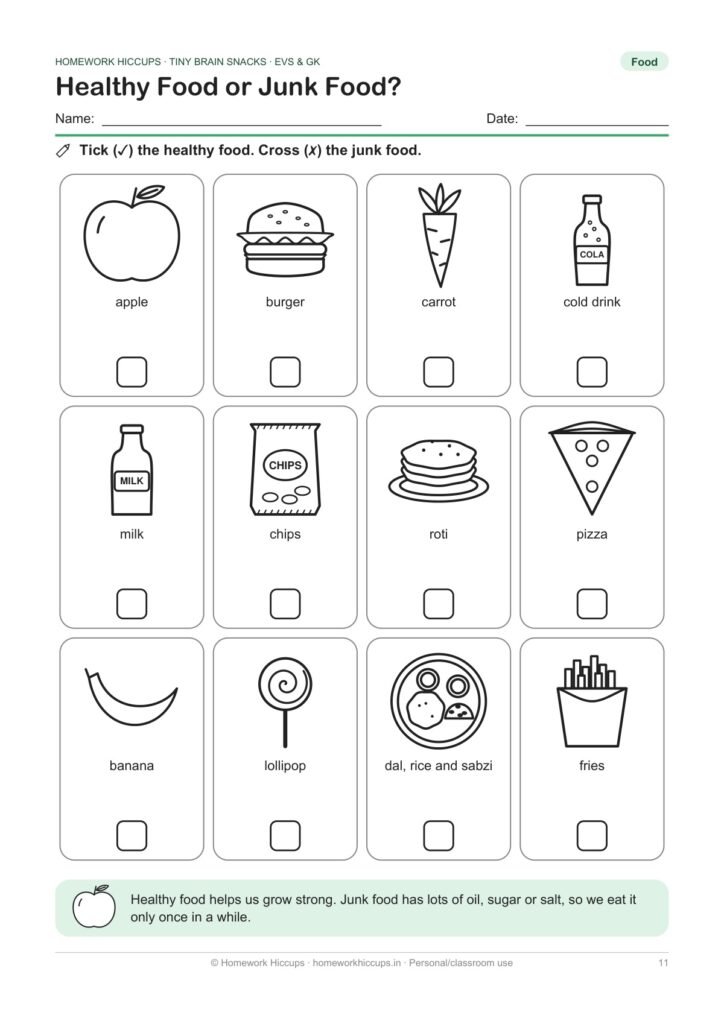
Our EVS & GK Worksheets PDF for UKG and Class 1 (42 A4 pages, ages 5 to 7) includes a good habits vs bad habits tick/cross page and “My body” pages on body parts, counting and the five senses, alongside healthy food vs junk food, saving water, road safety, community helpers, plants, animals, seasons and India’s national symbols. It ends with a picture GK quiz, answer keys and a “GK Star” certificate. Pages are picture-based, so UKG children can work with little reading and Class 1 children can do most pages alone.
Get the EVS & GK Worksheets – ₹99
If you would like EVS together with English, maths and Hindi practice, the Complete Worksheet Library Bundle includes all 20 packs, 790+ pages in total. Browse more EVS and GK worksheets. All packs are for personal or single-classroom use.
See the Complete Worksheet Library – ₹699
🧸 Learning toys kids love
As an Amazon Associate, Homework Hiccups earns from qualifying purchases, at no extra cost to you.
Frequently asked questions
What are 10 good habits for kids?
Ten good habits for kids are brushing twice a day, bathing daily, washing hands before and after meals, eating healthy food, drinking clean water, saying please and thank you, respecting elders, keeping things tidy, using the dustbin and going to bed on time.
How do I teach good habits to a 5-year-old?
Choose three habits, explain each in one simple sentence, attach them to daily routines and track them on a weekly chart. Praise every effort, model the habits yourself and add new ones slowly.
What are good manners for Class 1 students?
Good manners for Class 1 include saying please, thank you and sorry, greeting teachers and elders, waiting for your turn, listening when others speak, sharing and keeping the classroom clean.
What is the difference between good habits and bad habits?
Good habits are things we do often that keep us healthy, safe, kind and organised, like washing hands. Bad habits are things we do often that harm us or others, like biting nails or littering.
At what age should children start a habit chart?
Most children can use a simple picture or sticker habit chart from about age 4. Keep it to three to five habits, use pictures for non-readers and review it together each evening.