It is 7 pm, dinner is not ready, and your six-year-old is lying under the table instead of writing four sentences. If that sounds familiar, you are not alone. Knowing how to help child with homework without shouting, bribing or quietly finishing it yourself is one of the most common worries of parents of Class 1 and Class 2 children in India.
Print-ready worksheets for this topic
Class 1 Maths Worksheets PDF – Numbers to 100, Addition, Subtraction, Money & Time (49 Pages) – A4 PDF, instant download. ₹149 ₹299
The good news is that small children do not need long study hours. They need a predictable routine, a calm grown-up nearby and tasks broken into pieces they can finish. This guide covers homework tips for parents that actually work at this age: when and where to sit, how long a child can focus, what helping looks like (and what doing it for them looks like), how to handle tears, what to say instead of “good job”, and when to talk to the teacher.
🧰 Make practice more fun at home
As an Amazon Associate, Homework Hiccups earns from qualifying purchases, at no extra cost to you.
Quick answer: To help a Class 1 or 2 child with homework:
- Same time, same place: a fixed slot after a snack and some play, at a clear table.
- Short chunks: 10 minutes of work, a 2–3 minute break, then the next chunk.
- Help, don’t do: read the question aloud, ask a hint question, let the child write.
- Praise effort: name what they did (“you checked every answer”).
- Talk to the teacher if homework regularly takes more than 30 minutes or ends in tears.
How much homework for Class 1 is normal?
Less than many parents expect. India’s School Bag Policy 2020 from the Ministry of Education suggests no homework up to Class 2, and many schools now keep it very light at this stage. In practice, though, schools differ a lot. Some send a page of writing every day, some send weekend projects, and some send nothing. Check your school’s homework policy, which is often in the diary or on the school website.
A useful rule: if a Class 1 child is spending more than 20 to 30 minutes a day on set homework, something needs adjusting. Either the work is too hard, the child is distracted, or the routine needs work. None of these mean your child is lazy.
How to help child with homework: set a fixed time and spot
Children this age fight less when the routine decides, not the parent. Pick a time and stick to it most days.
- Not straight after school. Children come home hungry and tired. Give them a snack, water and 30 to 60 minutes of free play first.
- Not right before bed. A sleepy child cannot think, and bedtime battles grow.
- Same spot. A dining table or a small desk, cleared of toys and phones. The TV off.
- A homework kit. Two sharpened pencils, an eraser, a sharpener, crayons and a ruler in one box, so there is no 10-minute hunt for a pencil.
If both parents work, the routine can happen later, say 6.30 pm after an evening snack. What matters is that it is the same each day.
How long can a Class 1–2 child focus?
Every child is different, but most six- and seven-year-olds can concentrate on a desk task for about 10 to 15 minutes before their attention drifts. That is normal brain development, not bad behaviour. So plan homework in chunks.
| Step | Time | What happens |
|---|---|---|
| Look at the list | 1 minute | Together, check the diary and decide the order: easy task first. |
| Chunk 1 | 10 minutes | One task, for example 5 maths sums. |
| Wiggle break | 2–3 minutes | Jump 10 times, drink water, stretch. No screens. |
| Chunk 2 | 10 minutes | Next task, for example 4 sentences. |
| Pack up | 2 minutes | Child puts books in the bag and ticks the diary. |
A visible timer (a kitchen timer or a sand timer) helps a lot. Children relax when they can see the end.
Helping vs doing it for them
This is where most homework fights begin. When a child is stuck, it is tempting to just write the answer. But homework is meant to show the teacher what your child can do on their own, and to give the child practice. Here is what helping looks like.
| Instead of this | Try this |
|---|---|
| Writing the answer yourself | Read the question aloud and ask, “What is it asking you to do?” |
| Saying “No, that’s wrong” | Saying “Check this one again” and pointing to the line |
| Doing the sum on your fingers | Giving objects to count: 8 spoons plus 5 spoons |
| Spelling every word | Asking, “What sound does it start with?” |
| Rubbing out messy writing | Asking the child to choose their best word and circle it |
| Finishing the project at midnight | Letting the child do a simple version they can explain |
Sit nearby, but not on top of them. Doing your own quiet task, like reading or folding clothes, shows that this is work time for everyone.
Child not interested in studies? Handling tears and tantrums
When a child melts down at homework time, there is usually a reason underneath: tiredness, hunger, a task that feels too big, or worry about getting it wrong. A few things help.
- Name the feeling. “You’re tired and this feels like a lot.” Children calm down faster when they feel understood.
- Make the task smaller. Fold the page so only two sums show. Finish those, then unfold.
- Offer a choice. “Maths first or English first?” “Pencil or crayon for the drawing?” Choices give back a feeling of control.
- Take a real break. If tears start, stop for five minutes. Cuddle, water, a walk to the balcony. Then try one small task.
- Stop if needed. On a very bad day, write a short note in the diary to the teacher. One missed page is better than a habit of fear around learning.
If your child seems uninterested in studies most days, look at the wider picture: sleep, screen time, friendships at school, eyesight and hearing. A quick eye test is worth doing if a child avoids reading or writing.
How to make homework fun (without turning it into a show)
- Be the student. Let your child “teach” you the sum, then make a deliberate mistake for them to catch.
- Use real things. Count rotis, measure the table with spoons, find words starting with “b” in the kitchen.
- Race the timer, not a sibling. “Can you beat yesterday’s time and still keep it neat?”
- Sticker tracker. One sticker per day the routine happens, not per perfect page.
- Read aloud together. Reading is the best homework of all at this age. Our guide on how to teach reading to kids has simple steps.
Prefer ready-to-print pages?
Class 1 Maths Worksheets PDF – Numbers to 100, Addition, Subtraction, Money & Time (49 Pages) – A4 PDF, instant download. ₹149 ₹299
Praise that works
“Good boy” and “very good” are kind, but they do not tell a child what to repeat. Specific praise builds effort.
- “You kept trying that sum even when it was hard.”
- “Your letters are sitting on the line today.”
- “You checked every answer before you closed the book.”
- “You finished without being reminded. That’s responsible.”
Avoid comparing with siblings or classmates. It rarely motivates small children and often makes them stop trying.
A study routine for a Class 1 child: weekly plan
On days with no school homework, a short practice session keeps the habit going. Here is a simple study routine for a Class 1 child that takes about 20 minutes a day.
| Day | 10 minutes | 10 minutes |
|---|---|---|
| Monday | School homework | Reading a short story aloud |
| Tuesday | School homework | One maths worksheet page |
| Wednesday | School homework | Writing 3 sentences about the day |
| Thursday | School homework | One maths worksheet page |
| Friday | Reading together | Free drawing or a puzzle |
| Saturday | Kitchen or market maths (counting, money) | Library book or story time |
| Sunday | Rest | Pack the bag, check the diary |
Balance matters just as much. Children need outdoor play, chores and unstructured time. For ideas, see our list of activities for kids without screens and our guide to good habits for kids.
When to talk to the teacher
Teachers usually want to know if homework is not working. Send a short, polite note or ask for a few minutes at a parent-teacher meeting if:
- Homework regularly takes more than 30 minutes.
- Your child cannot understand the instructions, even after you read them aloud.
- There are tears most evenings.
- Your child says they are scared of getting it wrong in class.
Ask what your child can do on their own in class, and what the teacher expects at home. Often a small change, like fewer sums or permission to answer orally, makes a big difference.
Short daily worksheets as a calm routine
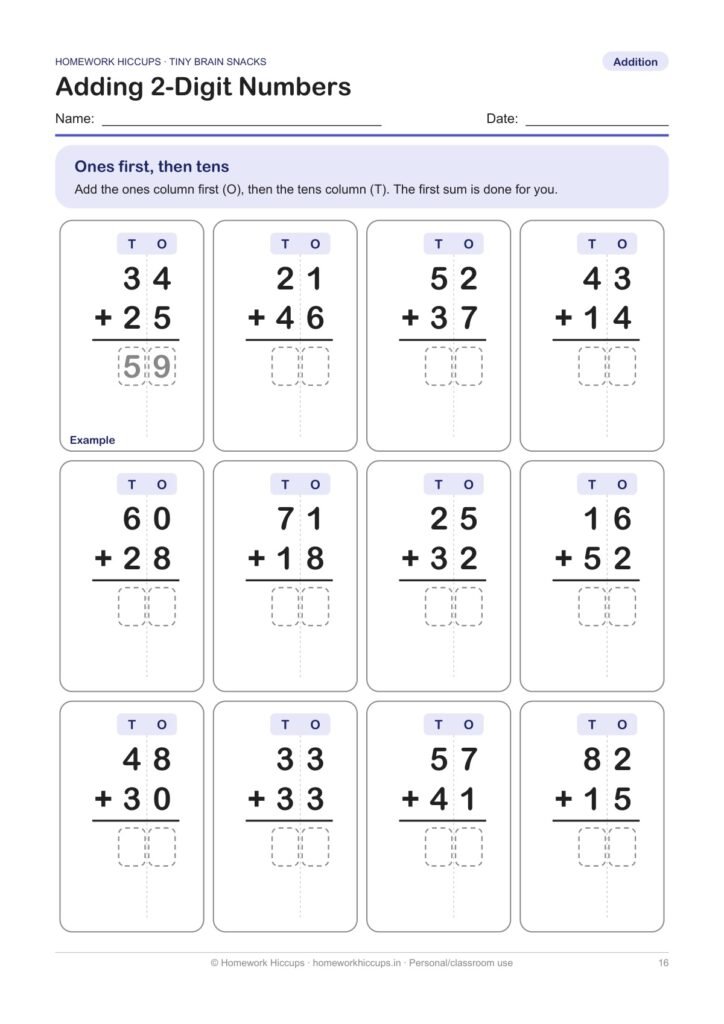
Many parents find that one short worksheet page a day works better than a long session at the weekend. It is predictable, it ends quickly, and progress is easy to see. You can find many free ideas in our free printable worksheets for kids guide.
If you want a ready-made set for maths, our Class 1 Maths Worksheets PDF (₹149, 49 pages, ages 6 to 7) is built around 5-minute pages: numbers to 100, tens and ones, addition and subtraction, Indian money, shapes, measurement, time and simple data, plus 3 mental maths speed sheets. It has 5 pages of answer keys so checking takes seconds, and a 4-week progress tracker that fits this kind of routine.
Get the Class 1 Maths Worksheets PDF – ₹149
Want to see the style first? Try a free sample first: 5 pages with the cover, 3 real pages from the pack and a contents page. Just enter your name and email at checkout, no payment needed.
You can also explore our maths worksheets and Class 2 worksheets.
🧸 Learning toys kids love
As an Amazon Associate, Homework Hiccups earns from qualifying purchases, at no extra cost to you.
Frequently asked questions
How long should a Class 1 child spend on homework?
For most Class 1 children, 10 to 20 minutes is plenty, broken into short chunks. If homework regularly takes more than 30 minutes or ends in tears, speak to the teacher.
Should I correct my child’s homework mistakes?
Point gently to where a mistake is and ask your child to check it again, rather than writing the answer yourself. A few mistakes help the teacher see what your child needs.
How do I make my child study at home without fighting?
Use a fixed time and place, give a snack and play first, break work into 10-minute chunks with short breaks, offer small choices and praise effort with specific words.
What should I do if my child is not interested in studies?
Check sleep, screen time, eyesight and how things are going at school. Make tasks smaller, use real objects and stories, and keep sessions short. If the problem continues, talk to the class teacher.
Is homework necessary for Class 1 and 2?
Guidance in India suggests very little or no homework up to Class 2, but schools differ. Short daily reading and a little practice at home help, as long as the routine stays calm and brief.