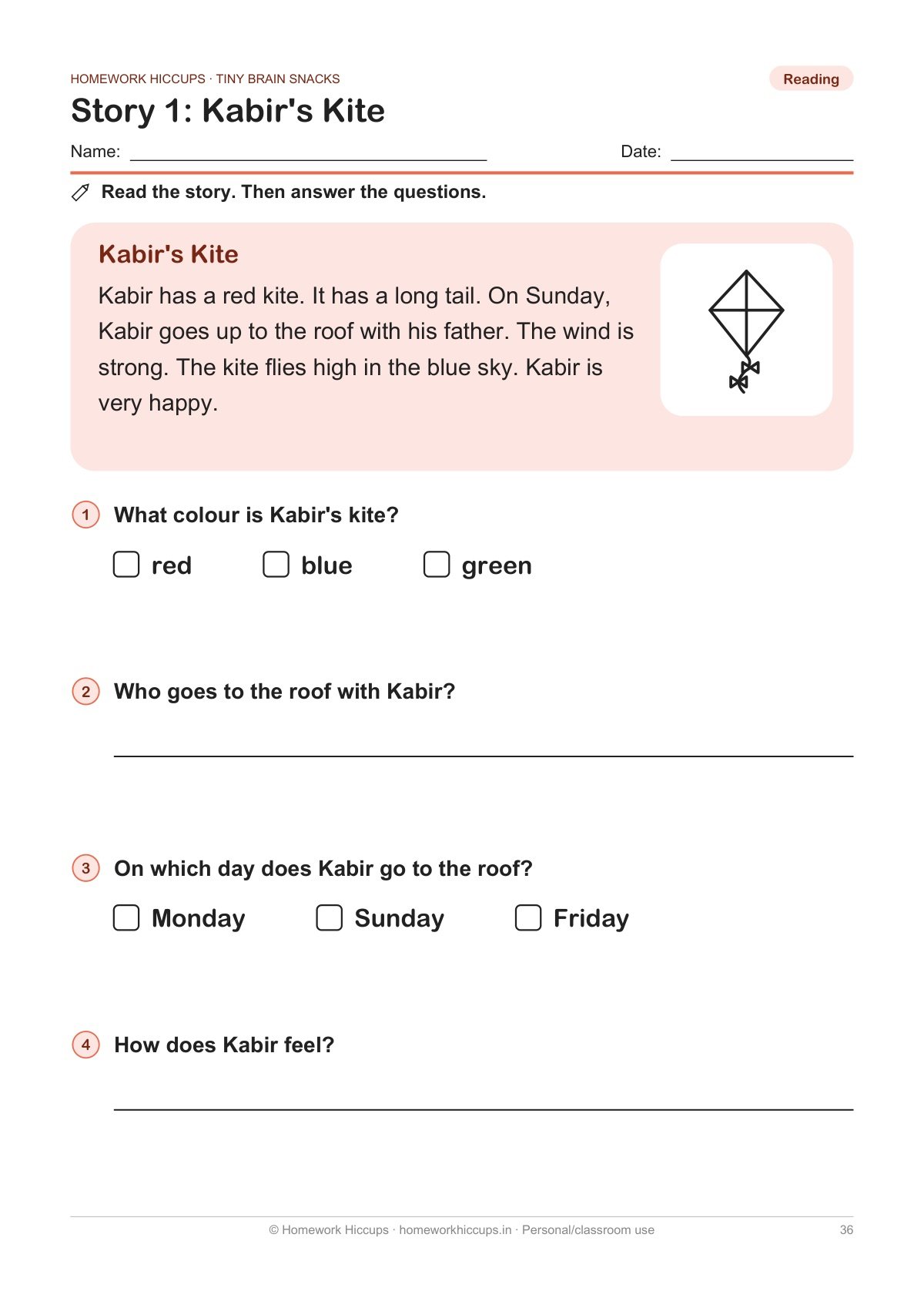
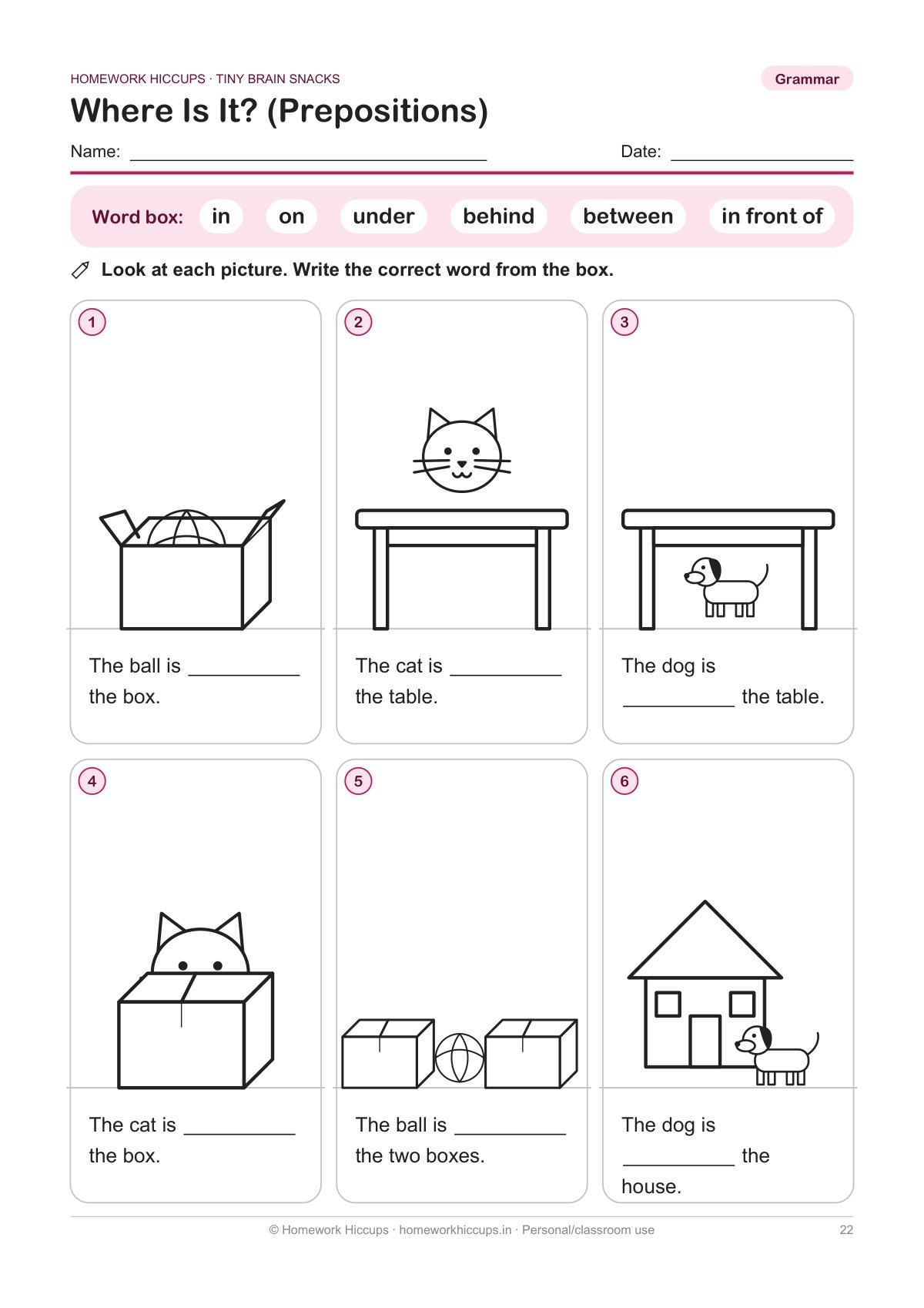
EVS in UKG is not about memorising facts. It is about helping five-year-olds notice the world around them: their own body, the food on their plate, the animals in the street, the bus they ride and the rain outside the window. Good ukg evs worksheets turn that curiosity into short, picture-based tasks that children can answer by circling, matching and ticking.
Print-ready worksheets for this topic
EVS & GK Worksheets PDF for UKG & Class 1 – My Body, Plants, Animals, India & GK Quiz, Ages 5–7 (42 Pages) – A4 PDF, instant download. ₹99 ₹199
On this page you will find the EVS topics most UKG classes cover, split into Term 1 and Term 2, followed by free sample exercises with answers on the five senses, animal homes, food from plants and animals, means of transport and seasons in India. Everything is in simple English, so it works for English-medium schools and for parents helping at home.
Quick answer: Common UKG EVS topics are:
- Term 1: my body, sense organs, good habits, my family, my home, food we eat.
- Term 2: plants, animals and their homes, young ones, transport, community helpers, seasons, water, our country.
- Worksheet types: match, circle, tick or cross, colour, sort into groups, one-word answers.
- Tip: topics vary by school, so check your child’s school book and pick matching pages.
EVS topics for kindergarten: Term 1 and Term 2
There is no single national UKG EVS syllabus, so every school orders topics a little differently. The table below shows a split that many schools follow. Use it as a guide, and see our UKG syllabus page for the full picture across English, maths, Hindi and EVS.
| Term | Topic | What children learn |
|---|---|---|
| Term 1 | My body | Name body parts; count eyes, ears, hands and fingers |
| Term 1 | Sense organs | Eyes see, ears hear, nose smells, tongue tastes, skin feels |
| Term 1 | Good habits | Brushing, bathing, washing hands, eating healthy food |
| Term 1 | My family and my home | Family members; types of houses; rooms of a house |
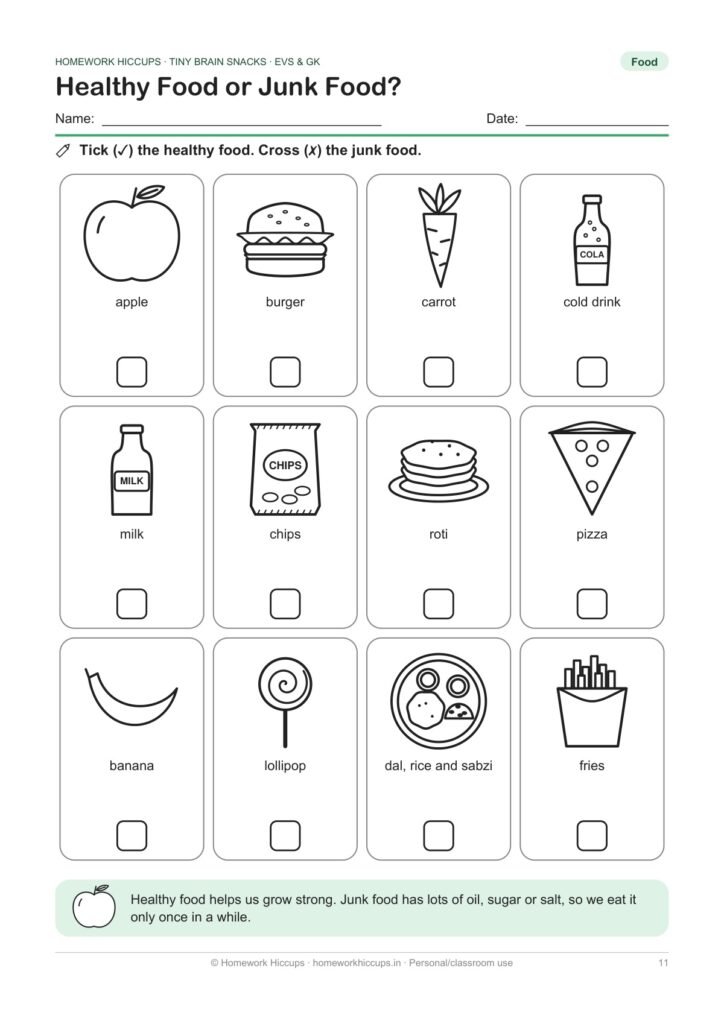
| Term 1 | Food we eat | Fruits and vegetables; healthy food and junk food |
| Term 2 | Plants | Parts of a plant; what a plant needs; food from plants |
| Term 2 | Animals | Pet, farm, wild and water animals; homes; young ones; sounds |
| Term 2 | Transport | Land, water and air transport; traffic lights |
| Term 2 | Community helpers | Doctor, farmer, postman, police officer and their tools |
| Term 2 | Seasons and water | Summer, rainy season, winter; uses of water; saving water |
| Term 2 | Our country | National flag and symbols; festivals of India |
Many of these topics overlap with GK. If your child enjoys quick questions, our LKG GK questions are a gentle warm-up, even for UKG.
UKG EVS worksheet with answers: Term 1 samples
Copy these onto paper, draw small pictures if you like, or simply ask the questions aloud. Answers follow each exercise.
Exercise 1: UKG worksheet on sense organs
Match the sense organ to what it does.
| Sense organ | What it does |
|---|---|
| 1. Eyes | a. smell |
| 2. Ears | b. feel (touch) |
| 3. Nose | c. see |
| 4. Tongue | d. hear |
| 5. Skin | e. taste |
Answers: 1–c (eyes see), 2–d (ears hear), 3–a (nose smells), 4–e (tongue tastes), 5–b (skin feels).
Which sense organ helps you…?
- …enjoy the smell of a rose? Nose
- …hear the school bell? Ears
- …know that ice is cold? Skin
- …know that a lemon is sour? Tongue
- …see a rainbow? Eyes
Exercise 2: How many do I have?
- How many eyes do you have? 2
- How many noses do you have? 1
- How many ears do you have? 2
- How many fingers are on one hand? 5
- How many fingers are on both hands together? 10
Exercise 3: Good habits, tick or cross
Put a tick (✓) for a good habit and a cross (✗) for a bad habit.
- Washing hands before eating. ✓
- Brushing teeth twice a day. ✓
- Throwing wrappers on the road. ✗
- Biting nails. ✗
- Sleeping on time. ✓
For a much longer list, with a printable habit chart, read our page on good habits for kids.
Exercise 4: Food from plants or animals
Write P if the food comes from a plant and A if it comes from an animal.
| Food | Answer | Food | Answer |
|---|---|---|---|
| Rice | P | Milk | A |
| Apple | P | Egg | A |
| Dal | P | Honey | A (from bees) |
| Spinach | P | Paneer | A (made from milk) |
| Roti (wheat) | P | Curd | A (made from milk) |
Talk about why paneer and curd count as animal food even though they come from the kitchen: both are made from milk, and milk comes from cows and buffaloes.
UKG EVS worksheet with answers: Term 2 samples
Exercise 5: Animal homes
Match the animal to its home.
| Animal | Home |
|---|---|
| 1. Bird | a. kennel |
| 2. Dog | b. web |
| 3. Lion | c. nest |
| 4. Bee | d. stable |
| 5. Horse | e. den |
| 6. Spider | f. hive |
Answers: 1–c (nest), 2–a (kennel), 3–e (den), 4–f (hive), 5–d (stable), 6–b (web).
Exercise 6: Young ones
- The young one of a cow is a calf.
- The young one of a dog is a puppy.
- The young one of a cat is a kitten.
- The young one of a hen is a chick.
- The young one of a goat is a kid.
Exercise 7: Means of transport
Sort each one into land, water or air.
| Land | Water | Air |
|---|---|---|
| bus | ship | aeroplane |
| auto-rickshaw | boat | helicopter |
| train | houseboat | hot-air balloon |
| bicycle |
To use this as a worksheet, read out the 10 words in a jumbled order and ask your child to point to land, water or air. The table above is the answer.
Exercise 8: Seasons in India
Many UKG books teach three main seasons: summer, the rainy season (monsoon) and winter. Some also add spring and autumn.
- We wear woollen sweaters in winter.
- We carry an umbrella and wear a raincoat in the rainy season.
- We wear light cotton clothes and eat mangoes in summer.
- Which season do children make paper boats in? Rainy season
- In which season do we use a fan or cooler the most? Summer
Exercise 9: True or false (quick revision)
- A fish lives in water. True
- We should leave the tap running while brushing. False (turn it off to save water)
- A doctor helps us when we are ill. True
- Green traffic light means stop. False (red means stop; green means go)
- Plants need water and sunlight to grow. True
Exercise 10: Community helpers and their tools
Who uses this? Say the tool and let your child name the helper.
| Tool or thing | Helper |
|---|---|
| Stethoscope | Doctor |
| Letters and parcels | Postman or postwoman |
| Plough and seeds | Farmer |
| Scissors and comb | Barber |
| Fire hose | Firefighter |
| Bricks and cement | Mason |
Exercise 11: Parts of a plant
Draw a simple plant with roots, a stem, leaves, a flower and a fruit. Ask your child to point and answer:
- Which part holds the plant in the soil? Roots
- Which part holds the plant up and carries water? Stem
- Which part is usually green and flat? Leaf
- Which part is colourful and may smell nice? Flower
- What does a plant need to grow? Water, sunlight, air and soil
Turning these samples into a free PDF
Parents often search for UKG EVS worksheets PDF free download in English medium. You can make your own from this page: copy the exercises you need into a document, add a line for your child’s name and the date, leave space for drawing, and use your printer’s “Save as PDF” option. Two exercises per A4 page is a comfortable amount for a five-year-old. For a Term 1 test practice, combine Exercises 1 to 4; for Term 2, combine Exercises 5 to 9. Keep the answers on a separate sheet for yourself.
Prefer ready-to-print pages?
EVS & GK Worksheets PDF for UKG & Class 1 – My Body, Plants, Animals, India & GK Quiz, Ages 5–7 (42 Pages) – A4 PDF, instant download. ₹99 ₹199
How to teach UKG EVS at home
- Go outside first. A ten-minute walk teaches more about plants, animals and transport than any page. Count buses, spot birds, touch leaves.
- Use the kitchen. Sort vegetables and fruits; ask which foods come from animals.
- Talk in full sentences. Ask “What does a cow give us?” and encourage “A cow gives us milk.”
- Keep worksheets short. One page a day, about 5 minutes, is enough for most five-year-olds.
- Read aloud. Most UKG children cannot read the questions yet. Read them out and let your child answer by pointing, circling or saying.
Looking ahead to next year? Our EVS worksheets for Class 1 continue these topics with chapter-wise questions, and the UKG worksheets PDF guide covers the other UKG subjects.
Printable UKG EVS worksheets
If you would like print-ready pages instead of drawing your own, our EVS & GK Worksheets PDF for UKG and Class 1 (42 A4 pages, ages 5 to 7) covers every topic above. It includes labelling body parts, “How many do I have?” counting, the five senses match, a good habits vs bad habits tick/cross page, types of houses and rooms, food from plants or animals, healthy and junk food, parts of a plant, pet, farm, wild and water animals, animal homes (nest, kennel, den, hive, stable, web), young ones, means of transport, traffic lights, road safety, community helpers, seasons in India with a clothes match, saving water, India’s national flag and symbols, and festivals of India. There is a picture GK quiz, answer keys for every page with a fixed answer and a “GK Star” certificate. Pages are picture-based, so UKG children can answer with very little reading.
Get the EVS & GK Worksheets – ₹99
Want EVS plus English, maths and Hindi in one go? The Complete Worksheet Library Bundle includes all 20 packs, 790+ pages in total.
See the Complete Worksheet Library – ₹699
Browse more EVS and GK worksheets and UKG worksheets. All packs are for personal or single-classroom use and print well in black and white.
Frequently asked questions
What topics are covered in UKG EVS?
Common UKG EVS topics are my body, sense organs, good habits, my family, my home, food, plants, animals and their homes, transport, community helpers, seasons, water and our country. The exact list and order vary from school to school.
What is the difference between Term 1 and Term 2 UKG EVS?
Many schools teach topics about the child, such as body, senses, habits, family and food, in Term 1. Term 2 usually moves outward to plants, animals, transport, helpers, seasons and India. Check your school calendar for the exact split.
How do I teach sense organs to a UKG child?
Use real objects. Let your child smell a flower, taste a little lemon, listen to a bell, touch ice and look at a picture book. After each one, ask which body part helped. Then try a simple matching worksheet.
Is EVS taught as a separate subject in UKG?
In many schools, EVS is taught as a short subject or as part of general awareness or GK periods in UKG. Some schools use a combined EVS and GK book. Either way, the topics are similar.
How long should a UKG child spend on EVS worksheets?
About 5 minutes a day, or one page, is enough. Young children learn EVS best through talking, walks and hands-on activities, with a short worksheet to check understanding.