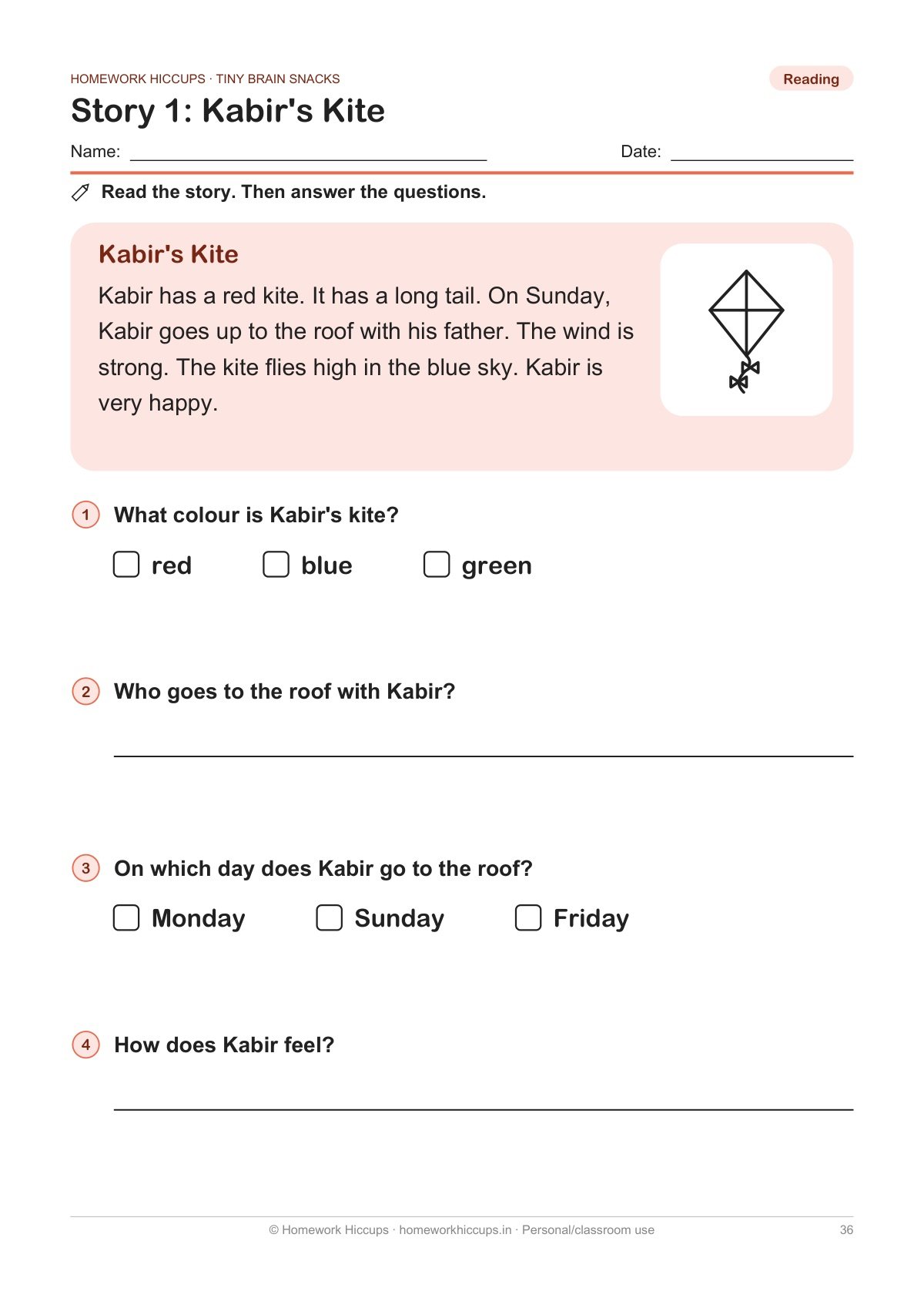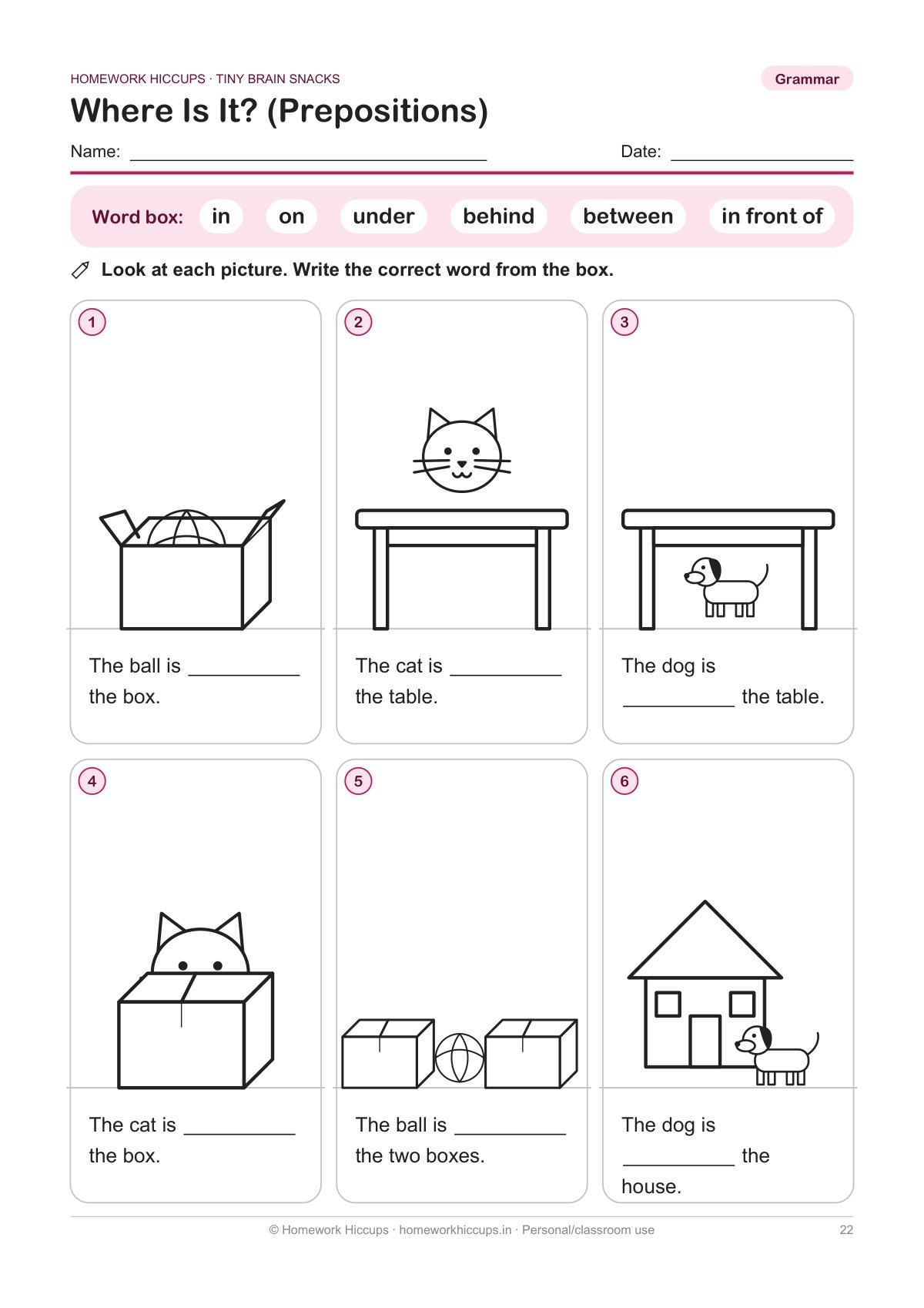
UKG (Upper Kindergarten) is the last year before “big school”. For many Indian families it comes with a mix of excitement and worry — Class 1 admissions, interviews at some schools, thicker notebooks and the question every parent quietly asks: “Is my child ready?”
Print-ready worksheets for this topic
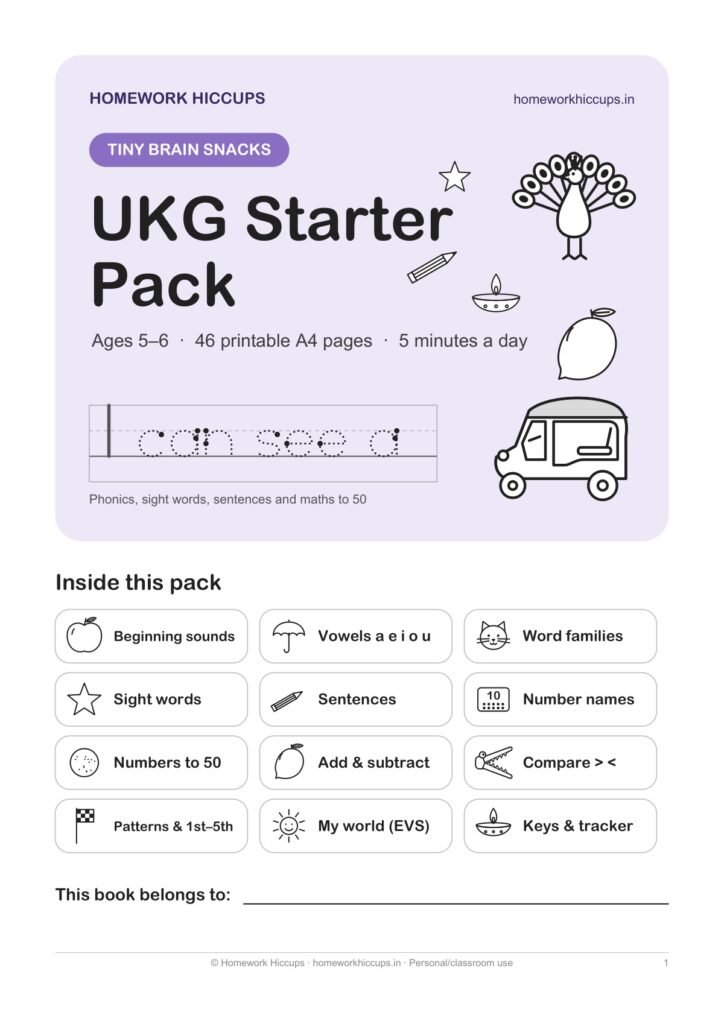
UKG Worksheets PDF – Tiny Brain Snacks Starter Pack (46 Pages) – A4 PDF, instant download. ₹149 ₹299
This guide breaks down the skills most children work on in UKG, gives you a practical Class 1 readiness checklist, and shows how to use UKG worksheets PDF printables for short, screen-free practice at home. As always, UKG programmes vary from school to school, so treat this as a picture of typical skills rather than an official syllabus.
Quick answer: Before Class 1, most UKG children work towards:
- English: writing capital and small letters confidently, reading and writing simple CVC words, and beginning to read short phrases and sentences.
- Maths: numbers to 50 or 100, counting and comparing quantities, before/after/between, simple addition and subtraction with objects, shapes and patterns.
- Life skills: sitting for 10–15 minutes, following instructions, managing a tiffin and belongings.
Use short UKG worksheets (5 minutes a day) to practise. Our 46-page UKG Starter Pack (₹149) covers all of this, or try our free 6-page sample first.
What changes from LKG to UKG?
If LKG is about learning letters and numbers, UKG is about using them. Children move from tracing single letters to writing words, from counting objects to comparing and adding them, and from listening to stories to reading a few words on their own.
| Area | Typical LKG focus | Typical UKG focus |
|---|---|---|
| Letters | Recognising and tracing A–Z, a–z | Writing independently on a four-line notebook; capital–small matching |
| Reading | Letter sounds, first sounds, a few CVC words | Blending CVC words, common sight words, short sentences |
| Numbers | 1–20, count & write 1–10 | 1–50 or 1–100, number names, tens and ones in some schools |
| Operations | More/less, before/after | Simple addition and subtraction with pictures or objects |
| EVS | Myself, family, animals, fruits | Plants, water, safety, seasons, our neighbourhood |
If your child is still consolidating LKG skills, that is common — see our guide to the LKG syllabus for the foundations.
UKG English: skills to practise
Writing
- Writing all capital and small letters from memory with correct stroke order.
- Correct placement on the four-line notebook — tall letters, tail letters and body letters in the right spaces.
- Copying simple words and, later, short sentences with finger spaces between words.
- Writing their own name (first and sometimes surname) neatly.
If letter formation is still shaky, our step-by-step guide on how to teach alphabet writing to kids covers grip, stroke order and reversals.
Phonics and reading
- Knowing the sound of each letter.
- Blending three-letter CVC words: cat, pen, big, hot, sun.
- Word families: -at (cat, bat, mat), -en (hen, pen, ten), -ig (big, pig, wig).
- Recognising some common sight words such as the, is, a, I, see, my.
- Reading short sentences like “I see a cat.”
Language and grammar basics
- Opposites (big/small, hot/cold), “a” and “an”, this/that.
- Naming words (nouns) and simple action words — introduced informally in many schools.
- Speaking in full sentences and telling a short story from pictures.
UKG Maths: skills to practise
Numbers
- Counting, reading and writing numbers to 50 (many schools go to 100).
- Number names (one, two, three…) for smaller numbers, often up to 10 or 20.
- Before, after and between numbers.
- Comparing numbers: greater than, less than, equal to (often using “more” and “less” first).
- Ascending and descending order.
- Skip counting by 2s, 5s or 10s in some schools.
Early operations
- Addition as “putting together” — using pictures, fingers or objects, typically within 10.
- Subtraction as “taking away” — also within 10.
- Simple word problems told aloud: “You have 3 laddoos and Dadi gives you 2 more. How many now?”
Shapes, patterns and measurement
- 2D shapes and some 3D shapes (ball/sphere, box/cube).
- Completing and creating patterns.
- Comparing length, height and weight; early ideas of time (morning, afternoon, night; days of the week).
Class 1 readiness checklist
Use this checklist as a friendly guide, not a test. It is normal for a child to be strong in some areas and still developing in others. Tick what your child can do most of the time.
| Area | Can my child… | ✓ |
|---|---|---|
| Writing | Write all capital and small letters without tracing? | ☐ |
| Writing | Write their own name? | ☐ |
| Writing | Copy a short word or sentence from the board or a book? | ☐ |
| Reading | Say the sound of most letters? | ☐ |
| Reading | Blend and read simple three-letter words? | ☐ |
| Maths | Count objects accurately to 20? | ☐ |
| Maths | Read and write numbers to 50 (or what the school expects)? | ☐ |
| Maths | Say which number comes before and after? | ☐ |
| Maths | Add and take away small numbers using objects? | ☐ |
| Focus | Sit and work on one task for 10–15 minutes? | ☐ |
| Listening | Follow a two- or three-step instruction? | ☐ |
| Independence | Open their tiffin, use the toilet, pack their bag with little help? | ☐ |
| Social | Take turns, share and ask the teacher for help? | ☐ |
Lots of unticked boxes in the first half of UKG is normal — much of this develops over the year. If you are concerned about something specific, such as speech, hearing, vision or attention, talk to the class teacher and, if needed, your paediatrician.
How to use UKG worksheets PDF printables at home
Printable worksheets are a simple, low-cost way to give your child regular practice without screens. Here is how to make them work:
Keep sessions short and regular
Five to ten minutes a day is plenty for most UKG children. A short daily session builds the habit of “sitting down to work”, which is a big part of Class 1 readiness, without turning homework into a fight.
Match what’s happening in class
Look at the school diary or ask the teacher which letters, words or numbers are being covered this month. Pick worksheets on the same topics so home practice supports classwork.
Mix the subjects
Alternate days: English writing one day, Maths the next, a colouring or maze page as a “fun day”. Variety keeps children interested.
Talk while they work
Ask questions: “How did you know that was 7?” “What sound does that word start with?” Explaining their thinking helps children understand, not just complete.
Use worksheets for holiday homework too
Summer and Diwali breaks can mean either a mountain of school holiday homework or nothing at all. A few printed pages a week keeps skills fresh without overwhelming anyone.
Prefer ready-to-print pages?
UKG Worksheets PDF – Tiny Brain Snacks Starter Pack (46 Pages) – A4 PDF, instant download. ₹149 ₹299
A sample weekly UKG practice plan
| Day | Worksheet focus (5–10 min) | Everyday extension |
|---|---|---|
| Monday | Small letter writing on four lines | Write the shopping list together |
| Tuesday | Numbers: before/after/between | Read lift or house numbers |
| Wednesday | CVC words and word families | Rhyming game in the car or auto |
| Thursday | Addition with pictures | Add fruits in the basket |
| Friday | Sentence copying or sight words | Read a picture book together |
| Weekend | Fun page: maze, pattern or colouring | Outdoor play — it matters too |
Homework Hiccups UKG Starter Pack: everything above in one PDF
If you’d rather not hunt for worksheets every evening, our Tiny Brain Snacks: UKG Starter Pack follows exactly the skills in this guide, in a calm 5-minutes-a-day format.
| UKG skill | What’s in the pack |
|---|---|
| Phonics | Beginning sounds, vowels a e i o u, middle sounds |
| Reading | Word families -at, -an, -en, -ig, -op, -ug; read & match CVC words |
| Sight words | the, is, a, I, can, see, my, go, we, it – trace, find and fill in |
| Writing | Copying words and short sentences on four-line guides |
| Numbers | Number names one–twenty, numbers 1–50, counting to 20, bigger/smaller with > and < |
| Operations | Addition and subtraction with pictures (to 10), before/after/between |
| EVS | My body, fruits & vegetables, day & night, seasons in India, my day |
| Routine | Answer keys, 4-week tracker and a “UKG Super Star” certificate |
It is 46 A4 pages for ₹149, and you can print pages as often as you like for your own child.
Get the UKG Starter Pack – ₹149
Not sure yet? Try our free 6-page sample as a warm-up — read how to use the free worksheets at home. And if your child still needs to firm up letter formation or numbers to 20, the LKG Starter Pack is a good foundation-filler.
See all packs in our shop, and browse our posts on printable homework worksheets for kids and printable kids learning templates for more ideas.
A few gentle reminders for UKG parents
- Don’t compare. The child next door reading full sentences doesn’t mean yours is behind. Children develop at different speeds, and many skills “click” suddenly.
- Reading aloud is gold. Ten minutes of reading a story together — in English, Hindi or your home language — builds vocabulary and listening skills that worksheets alone can’t.
- Protect play. Building blocks, drawing, outdoor games and pretend play all build the focus, coordination and problem-solving that Class 1 needs.
- Sleep and routine matter. A rested child learns more easily than a tired one.
FAQs: UKG worksheets PDF and Class 1 readiness
What should a UKG child know before Class 1?
Typically, children are working towards writing capital and small letters independently, reading simple three-letter words, counting and writing numbers to 50 or 100, simple addition and subtraction with objects, and managing basic classroom routines. Exact expectations vary by school, so check your school’s guidelines.
Are UKG worksheets enough to prepare my child for Class 1?
Worksheets are a useful part of preparation, especially for writing and number practice. They work best alongside reading aloud together, conversation, play and building independence — Class 1 readiness is about more than written work.
How many worksheets should a UKG child do a day?
One or two short worksheets, taking about 5–10 minutes in total, is plenty for most UKG children. Regular short practice is usually more effective and more pleasant than long sessions.
Does Homework Hiccups have a UKG worksheets PDF?
Yes. The Tiny Brain Snacks UKG Starter Pack is a 46-page printable A4 PDF covering phonics, CVC word families, sight words, sentence writing, numbers to 50, simple addition and subtraction and EVS, for ₹149. A free 6-page sample is also available.
Can I use LKG worksheets for a UKG child?
Yes, for revision. If your UKG child still finds letter formation, stroke order or number writing tricky, LKG-level worksheets help fill those gaps and build confidence before moving on to UKG-level work.