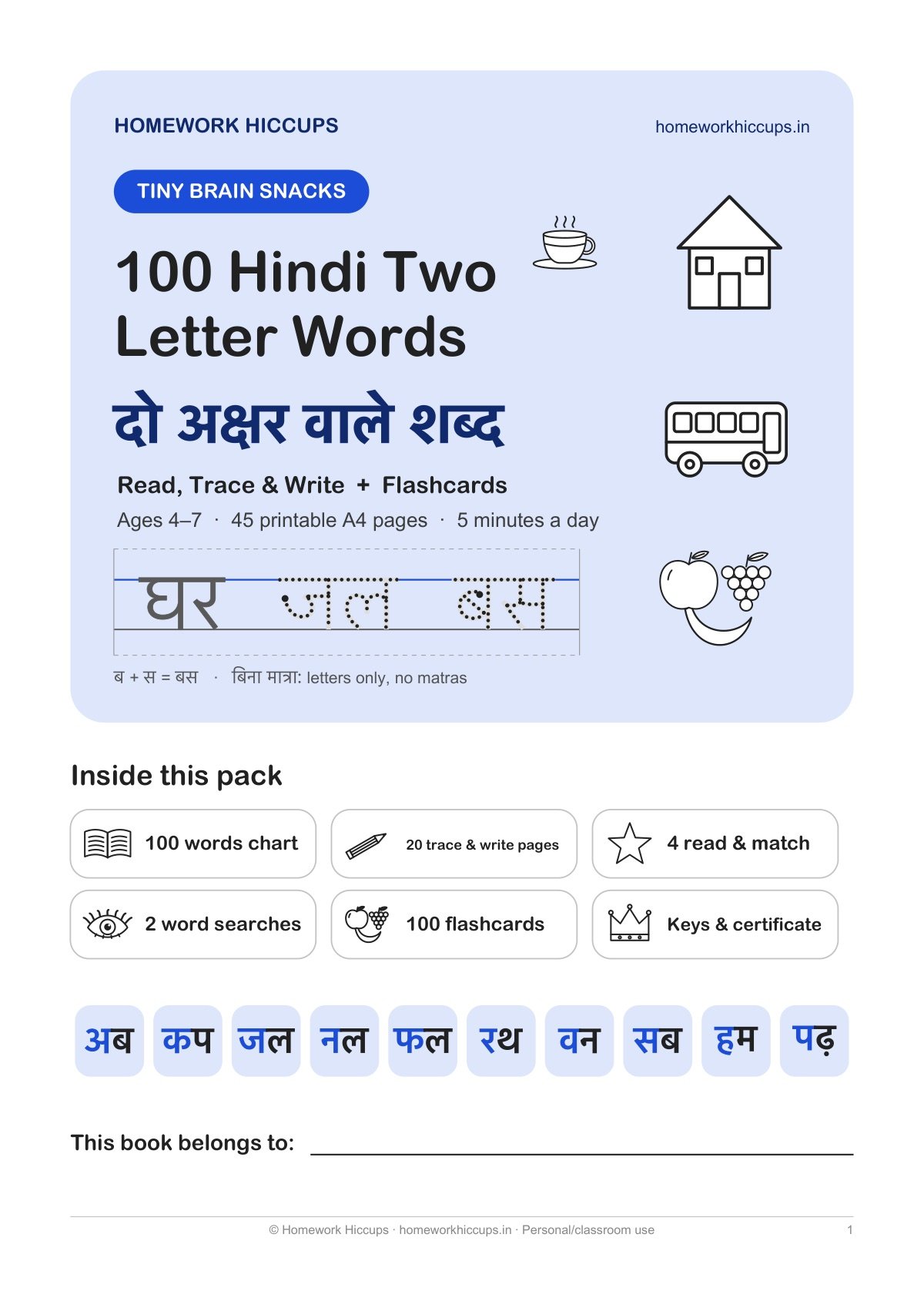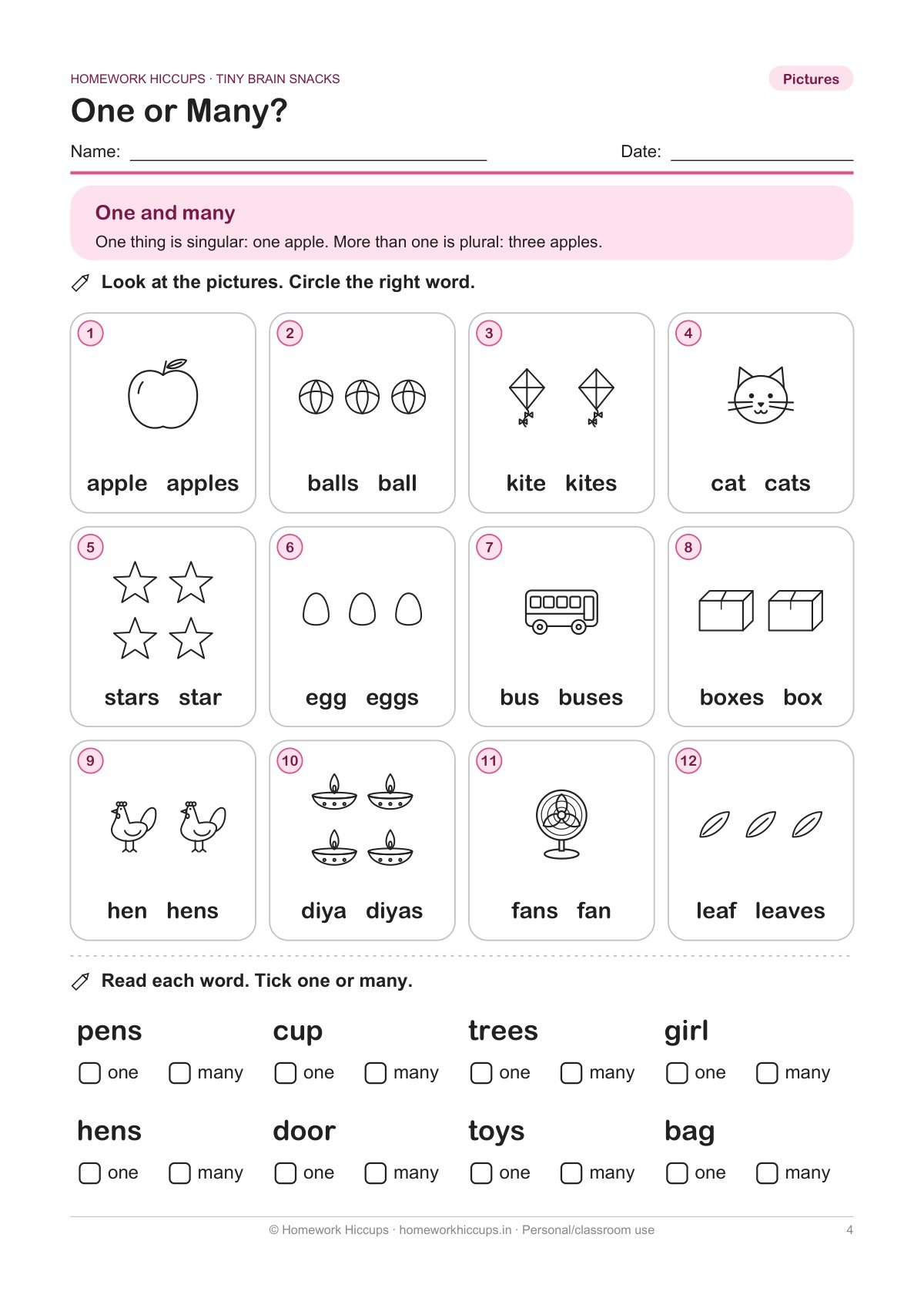
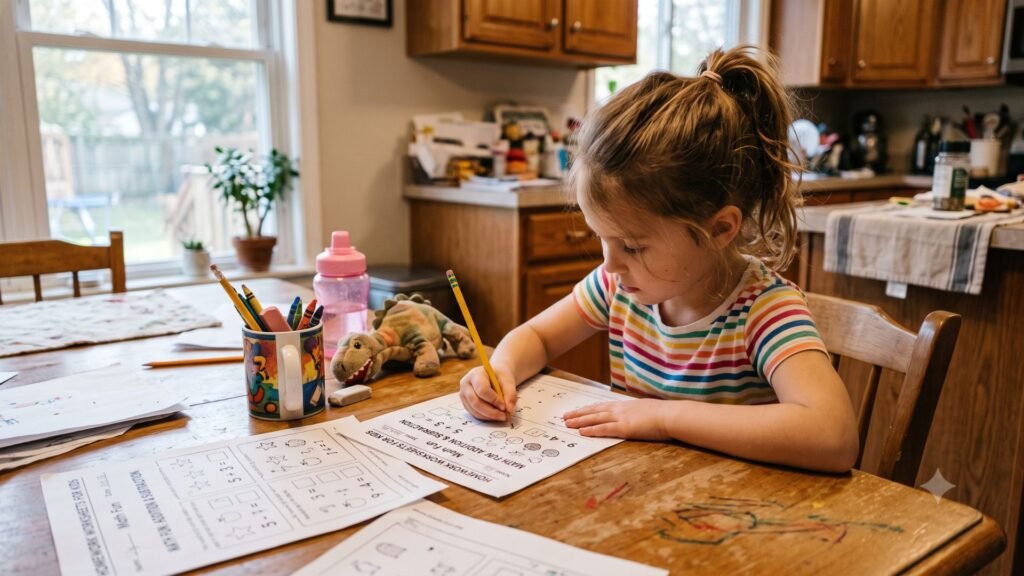
Many parents want to help their children learn at home, but homework can quickly become stressful. Children may avoid starting, lose focus halfway through, or rush through work without understanding it. Teachers and homeschoolers face a different challenge: finding practice material that is useful, age-appropriate, and easy to prepare. This is where printable homework worksheets for kids can help.
Print-ready worksheets for this topic
Complete Worksheet Library – All 20 Packs for Ages 3–8 (790+ Pages) – A4 PDF, instant download. ₹699 ₹2130
Printable worksheets give children a clear task to complete, while giving adults a simple way to support learning without creating a new lesson plan. In this guide, you will learn how to choose effective worksheets, build a calm homework routine, use worksheets for reading, maths, and study skills, and avoid common mistakes. You will also see how a structured resource such as Printable Homework Worksheets for Kids can support regular practice at home or in the classroom.
🧰 Make practice more fun at home
As an Amazon Associate, Homework Hiccups earns from qualifying purchases, at no extra cost to you.
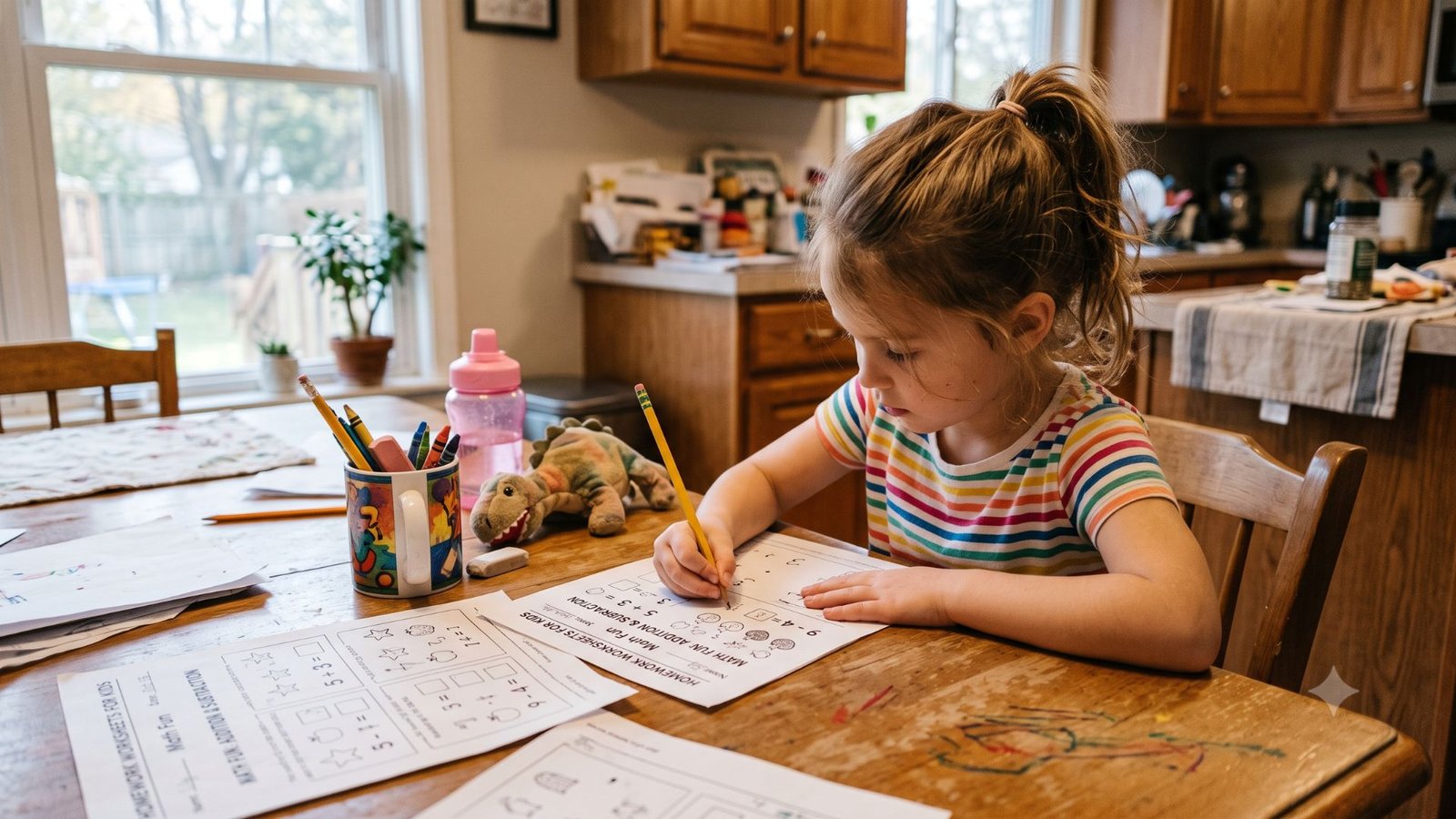
What Are Printable Homework Worksheets and Why Do They Matter?
Printable homework worksheets are ready-to-use learning pages that children can complete after school, during revision, or as part of a homeschool routine. They may include reading comprehension questions, maths problems, spelling activities, writing prompts, matching tasks, puzzles, or study-skills templates.
Their value is not simply “more work.” A good worksheet gives a child a focused task with a clear beginning and end. For example, a Class 3 student may complete one page of multiplication practice, while an older student may use a revision sheet to organise key points before a test.
For parents, worksheets reduce the need to invent activities every evening. For teachers, they can support classroom learning, revision, or differentiated homework. For homeschoolers, they provide structure and a record of what has been practised. The National Curriculum Framework developed by NCERT emphasises connecting learning expectations with suitable pedagogical processes, which is a useful reminder that practice should support understanding—not replace teaching.
Why Do Children or Students Struggle With Homework?
Homework struggles rarely mean a child is lazy or unable to learn. Often, the problem is that the task feels unclear, too long, too difficult, or disconnected from what the child already knows. A child may also be tired after school, unsure how to begin, or distracted by noise, screens, or siblings.
Consider a common situation: a parent asks a child to “finish your homework,” but the child has three subjects, several pages, and no idea where to start. The child delays, the parent becomes frustrated, and homework time turns into an argument. Breaking the work into smaller steps can make the same task feel manageable.
Common Learning or Homework Challenges
Children may face different obstacles depending on their age, subject, and learning style. Younger children may find it hard to sit for long periods or may need help reading instructions. Older students may understand the topic in class but forget the steps when working alone.
Some frequent challenges include:
-
Not knowing how to start a task.
-
Losing focus after a few minutes.
-
Finding instructions confusing.
-
Struggling with a specific skill, such as reading comprehension or fractions.
-
Rushing to finish without checking answers.
-
Feeling anxious when work seems too difficult.
A practical response is to make expectations visible. Instead of saying, “Do your homework,” a parent can say, “First complete questions 1 to 5, then we will check them together.” This gives the child a manageable next step.
How Parents and Teachers Can Offer Support
Support works best when adults guide the process rather than take over the task. A parent can sit nearby, read instructions aloud, ask questions, and encourage the child to explain their thinking. A teacher can model one example, provide a worked sample, or assign a shorter task for a child who needs extra practice.
The American Psychological Association suggests that families can support learning by giving children some choice, using calm routines, and involving them in solving problems when work becomes difficult. For example, a child might choose whether to complete reading or maths first, as long as both are finished by a set time.apa
Teachers can also make homework more effective by keeping instructions simple, connecting tasks to classroom learning, and giving feedback that focuses on improvement. The National Association of School Psychologists recommends a consistent workspace, required materials, a planned start time, and supervision without micromanaging.nasponline
Practical Ways to Improve Homework Time
Improving homework does not always require more hours. Often, it requires better structure, clearer tasks, and regular short practice. The following strategies can help children build independence while still receiving the support they need.
Strategy 1: Use Short, Focused Practice Sessions
Short sessions are often more effective than long, tiring study blocks. A child in primary school may work well with 10–15 minutes of focused practice, while older students may manage 20–30 minutes before needing a short break.
Try this approach:
-
Choose one worksheet or one section of homework.
-
Set a timer for a manageable period.
-
Remove unnecessary distractions.
-
Work until the timer ends.
-
Take a 3–5 minute break.
-
Review the work together.
For example, a parent helping a Class 4 child with maths might assign ten addition and subtraction questions rather than an entire chapter. The goal is steady practice, not exhaustion. Avoid turning every session into a test; allow mistakes, questions, and discussion.
Strategy 2: Match Worksheets to the Child’s Current Level
A worksheet should feel challenging enough to encourage thinking, but not so difficult that the child gives up. If a child answers every question correctly in seconds, the task may be too easy. If they cannot begin after reading the instructions, it may be too advanced.
Use a simple three-level approach:
-
Review level: Practice a skill the child already knows.
-
Practice level: Work on the current school topic.
-
Stretch level: Try one or two slightly harder questions.
A teacher might give most students a standard comprehension worksheet, while providing a shorter passage or additional vocabulary support to students who need it. A homeschooler can use the same idea by rotating between revision pages and new-skill activities.
Strategy 3: Build a Predictable Homework Routine
Children often respond well to routine because it removes the daily question of when and where homework will happen. Choose a regular time, prepare materials in advance, and keep the workspace simple.
A routine could look like this:
-
Snack and short rest after school.
-
10–15 minutes of homework or worksheet practice.
-
Short break.
-
Complete the remaining task.
-
Quick review with a parent, teacher, or tutor.
The routine does not need to be strict. If Tuesday is busy because of an activity, move homework earlier or shorten the session. The important part is consistency over time. Edutopia notes that thoughtful routines and clear expectations can help students stay on task.
How Educational Products and Printable Resources Can Help
Structured educational resources can save preparation time and make practice more consistent. Instead of searching for separate activities every evening, parents and teachers can use organised worksheets that focus on specific skills.
Printable resources are especially useful because they can be used in different ways. A parent may print one page for homework practice. A teacher may use several pages for revision or early-finisher activities. A homeschooler may include them in a weekly learning plan. A student may keep completed pages in a folder to track progress.
Good resources should be clear, age-appropriate, and easy to use. They should also encourage thinking rather than only copying. For example, a reading worksheet may ask a child to find evidence in a passage, while a maths worksheet may include a word problem that requires more than one step.
How Printable Homework Worksheets for Kids Can Support Parents, Teachers, and Homeschoolers
Printable Homework Worksheets for Kids is designed to make structured homework practice easier for parents, teachers, students, and homeschoolers. It provides printable learning material that can be used during homework time, revision, classroom practice, or independent learning sessions.
Because it is printable, families and educators can use only the pages they need. A parent might select one worksheet after school, while a teacher may use selected pages for revision or extra practice. A homeschooler can include the resource in a weekly plan and revisit pages when a child needs more practice.
Printable Homework Worksheets for Kids can help reduce the daily preparation burden that often makes homework time stressful. Instead of creating activities from scratch, adults can offer a clear task and spend more time supporting the child’s thinking. The resource is suitable for children who benefit from structured practice in reading, maths, study skills, or general homework support.
Learn more about Printable Homework Worksheets for Kids and use it in the way that best fits your child, classroom, or homeschool routine.
A Simple Example or Weekly Routine
Here is a realistic weekly routine for a parent supporting a primary-school child:
-
Monday: Choose one reading comprehension worksheet. Read the passage together, then let the child answer independently.
-
Tuesday: Complete a short maths worksheet. Focus on accuracy and ask the child to explain one answer.
-
Wednesday: Use a writing or vocabulary activity. Encourage complete sentences rather than one-word answers.
-
Thursday: Review a previous worksheet and correct mistakes together.
-
Friday: Let the child choose a favourite activity page as a reward for a consistent week.
A teacher could adapt this into a classroom routine by assigning one page for homework and using another page for revision. A homeschooler could place the worksheets in a weekly folder and use completed pages to see which skills need more attention.
The aim is not to complete every page perfectly. It is to create a repeatable habit that makes learning feel manageable.
Prefer ready-to-print pages?
Complete Worksheet Library – All 20 Packs for Ages 3–8 (790+ Pages) – A4 PDF, instant download. ₹699 ₹2130
Mistakes to Avoid
Even helpful resources can become unhelpful if they are used in the wrong way. Avoid these common mistakes:
-
Giving too much at once. One or two focused pages are usually better than a large stack of worksheets.
-
Using worksheets without explanation. Read instructions together, especially for younger children.
-
Focusing only on correct answers. Ask the child how they solved a problem or why they chose an answer.
-
Turning homework into a punishment. Keep the tone calm and encouraging.
-
Ignoring the child’s level. Adjust the difficulty if a child is consistently frustrated or bored.
-
Comparing children. Focus on individual progress rather than speed or marks.
If a child struggles with a worksheet, pause and identify the exact difficulty. Is it reading the question, understanding the concept, or managing time? Then offer targeted support rather than simply repeating the same task.
🧸 Learning toys kids love
As an Amazon Associate, Homework Hiccups earns from qualifying purchases, at no extra cost to you.
Want everything for Nursery to Class 2?
Complete Worksheet Library – All 20 Packs for Ages 3–8 (790+ Pages): all 20 printable packs, 790+ A4 pages of English, maths, Hindi, EVS and festival activities. ₹699 ₹2130
Frequently Asked Questions
How long should a child spend on homework worksheets each day?
It depends on the child’s age, school workload, and attention span. Many families find that 10–20 minutes of focused worksheet practice works well for younger children, while older students may need 20–40 minutes for homework and revision. It is better to have a short, consistent session than a long, stressful one. If a child becomes tired or frustrated, pause, break the task into smaller parts, and return to it later.
Are printable worksheets useful for homeschooling?
Yes. Printable worksheets can give homeschool families a clear structure and make it easier to track what has been practised. They can be used for reading, maths, writing, vocabulary, revision, and independent activities. However, worksheets should not be the only learning method. Combine them with discussion, hands-on activities, reading aloud, projects, and real-life examples to keep learning varied and meaningful.
How can I help my child without doing the homework for them?
Start by reading the instructions together and asking the child to explain the task in their own words. Then let them attempt the first question independently. If they get stuck, ask guiding questions such as, “What is the question asking?” or “What do you already know?” Avoid giving direct answers too quickly. The National Association of School Psychologists advises parents to supervise and support without taking control of the work.
What should I do if my child refuses to complete homework?
First, try to understand the reason. The work may be too difficult, too long, confusing, or the child may be tired. Break the task into one small step, such as completing only the first three questions. Offer a short break after that step. Use calm language and avoid turning homework into a power struggle. If the difficulty continues, speak with the teacher to understand whether the child needs extra support or a different approach.
Prefer ready-to-print pages?
Complete Worksheet Library – All 20 Packs for Ages 3–8 (790+ Pages) – A4 PDF, instant download. ₹699 ₹2130
Can teachers use printable worksheets for homework?
Yes. Teachers can use printable worksheets for revision, practice, early-finisher activities, substitute lessons, or differentiated homework. It helps to choose worksheets that match the current topic and provide clear instructions. Teachers can also adapt the task by assigning selected questions, adding an example, or asking students to explain their reasoning. This keeps the activity purposeful rather than simply adding more pages.
How do I know if a worksheet is too difficult?
Watch for signs such as long pauses, repeated requests for help, frustration, guessing, or avoidance. If a child cannot start after reading the instructions, the language or concept may be too advanced. Try working through one example together, reducing the number of questions, or choosing a review-level worksheet first. The goal is to build confidence through achievable practice before moving to more challenging material.
Should children check their own answers?
Yes, when appropriate. Self-checking helps children notice mistakes and understand their thinking. For younger children, a parent can check answers with them and discuss errors calmly. Older students can use an answer key after attempting the work, then revisit the questions they got wrong. This turns mistakes into learning opportunities instead of reasons for discouragement.
Final Thoughts
Printable homework worksheets for kids can make homework time more structured, predictable, and less stressful. The most effective approach is not to assign more work, but to choose clear, age-appropriate activities and use them consistently. Short practice sessions, a simple routine, and supportive guidance can help children develop stronger reading, maths, and study skills over time.
Whether you are a parent, teacher, or homeschooler, focus on progress rather than perfection. Use worksheets to support understanding, encourage independence, and make learning feel manageable. A resource such as Printable Homework Worksheets for Kids can provide ready-to-use practice material, helping you spend less time preparing and more time supporting your child’s learning.
Call to Action
If you are looking for a practical way to support homework practice, revision, and independent learning, explore Printable Homework Worksheets for Kids. It is designed for parents, teachers, students, and homeschoolers who want clear, printable learning activities without spending hours preparing materials. You can use it during homework time, classroom practice, revision, or family learning sessions.
Printable Homework Worksheets for Kids can help reduce homework stress by giving children focused tasks and giving adults a simple way to guide practice. Explore the resource, choose the pages that suit your learner, and start building a calmer homework routine today.