UKG (Upper Kindergarten) is the last year before Class 1, and it is often the year parents start paying close attention to the syllabus. Will my child be reading? How far should they count? What will the half-yearly assessment look like? This guide explains what the UKG syllabus usually covers in English, Maths, EVS and Hindi, gives you a month-wise plan from April to March, and ends with a simple Class 1 readiness checklist.
Print-ready worksheets for this topic
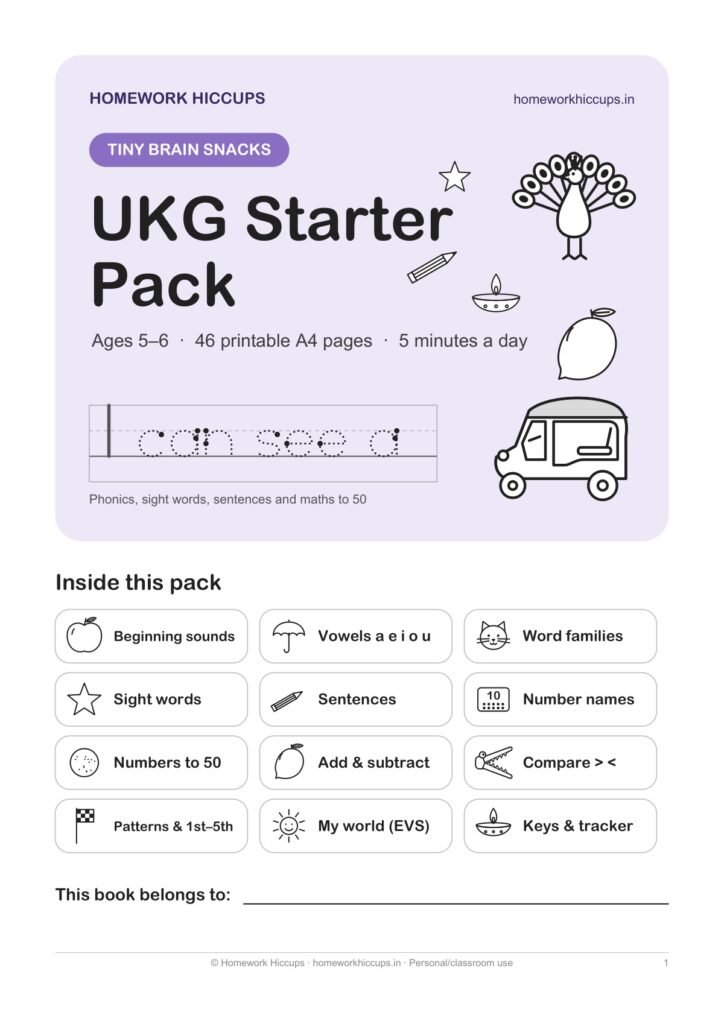
UKG Worksheets PDF – Tiny Brain Snacks Starter Pack (46 Pages) – A4 PDF, instant download. ₹149 ₹299
First, the honest bit: there is no single official CBSE UKG syllabus. CBSE, ICSE and state boards set curricula for school classes, but pre-primary years are planned by each school or preschool chain. What is described below is a typical picture drawn from common practice in Indian schools. Your school’s plan may move faster or slower, so always check the term plan in your child’s diary.
🧰 Make practice more fun at home
As an Amazon Associate, Homework Hiccups earns from qualifying purchases, at no extra cost to you.
Quick answer: A typical UKG syllabus in Indian schools covers:
- English: capital and small letters written independently, phonics, CVC word families (cat, hat, mat), common sight words and reading short sentences.
- Maths: numbers to 50 or 100, number names (often 1–20), before/after/between, comparing numbers, simple addition and subtraction, shapes, patterns, time and money basics in some schools.
- EVS / GK: myself, family, plants, animals, food, water, seasons, transport, community helpers, safety and good habits.
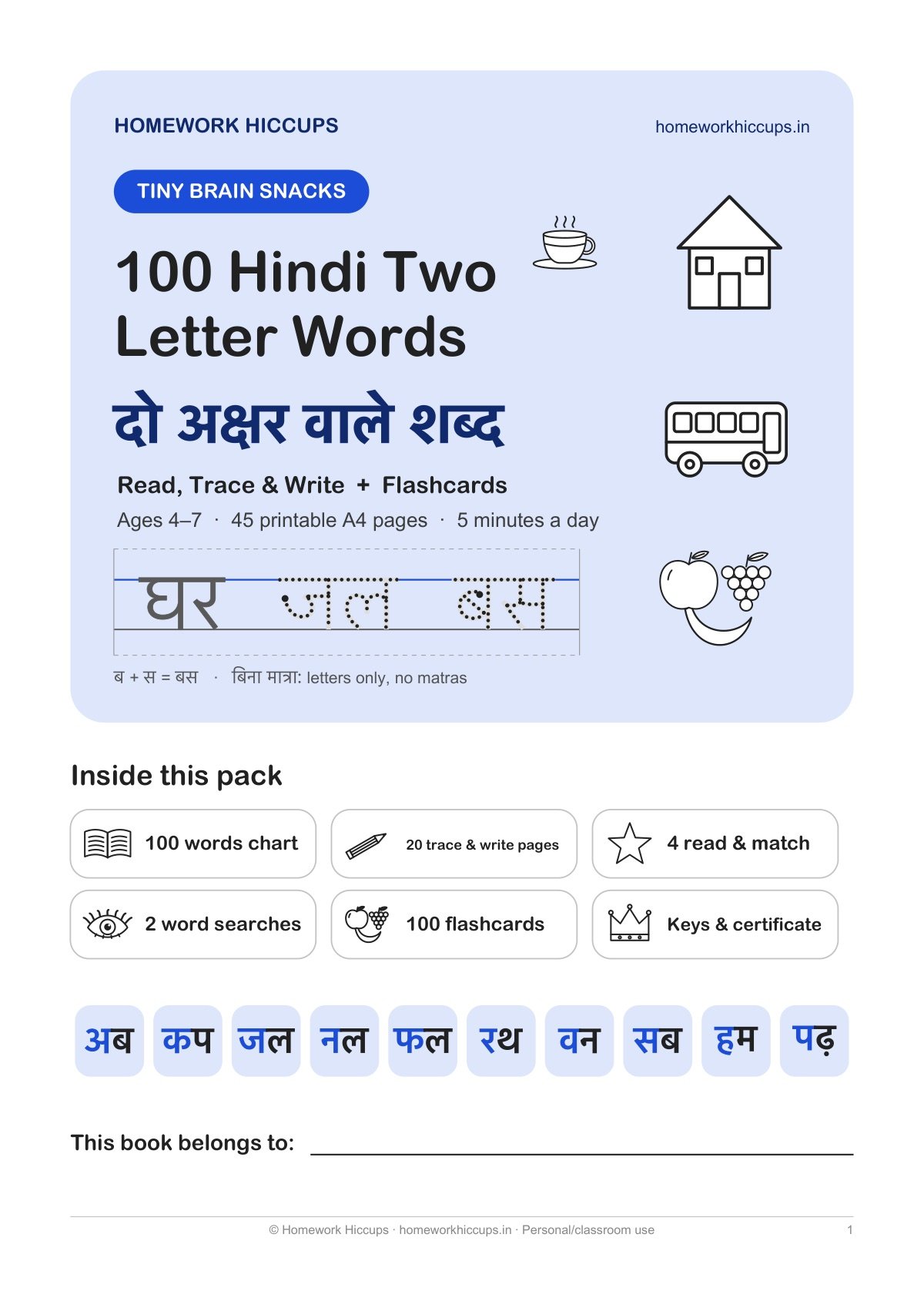
- Hindi: स्वर and व्यंजन, two letter words without matra, and in many schools the first few matras.
The year is usually split into two terms, with an informal half-yearly check around September–October and a final one around February–March.
Is there an official CBSE UKG syllabus?
No. CBSE affiliates schools and prescribes curricula for school classes, but it does not publish a fixed UKG syllabus that every school must follow. Instead, early-years teaching in India is guided by two national documents:
- National Education Policy (NEP) 2020, which describes ages three to eight as the “foundational stage” — three years of preschool plus Classes 1 and 2.
- National Curriculum Framework for Foundational Stage (NCF-FS) 2022, which sets out learning goals for this stage and recommends play-based, activity-based learning, with children assessed mainly through observation of their work and play rather than formal tests.
Schools use these frameworks as a guide and then design their own UKG syllabus, choose their own books and decide the pace. Under NEP terminology you may also see UKG called Balvatika, the preparatory year before Class 1. That is why two CBSE-affiliated schools in the same city can have quite different UKG plans — and why “UKG syllabus PDF” downloads from random websites rarely match your child’s school.
UKG English syllabus: phonics, CVC words and sentences
If LKG was about recognising letters, UKG is about using them to read and write words.
Writing
- Writing capital (A–Z) and small (a–z) letters independently on a four-line notebook.
- Matching capital and small letters, and filling in missing letters (a _ c).
- Copying and then writing simple words, and later short phrases.
Phonics and reading
- Letter sounds for all 26 letters, including the short vowel sounds a, e, i, o, u.
- Blending three-letter CVC (consonant–vowel–consonant) words and reading word families such as -at, -en, -ig, -op, -ug. Our CVC words list groups them by vowel.
- Common sight words — the, is, a, I, it, in, on, my, see, we — that cannot always be sounded out.
- Reading short sentences such as “The cat is on the mat.”
Speaking and grammar basics
- Rhymes, show-and-tell and answering questions about a picture or story.
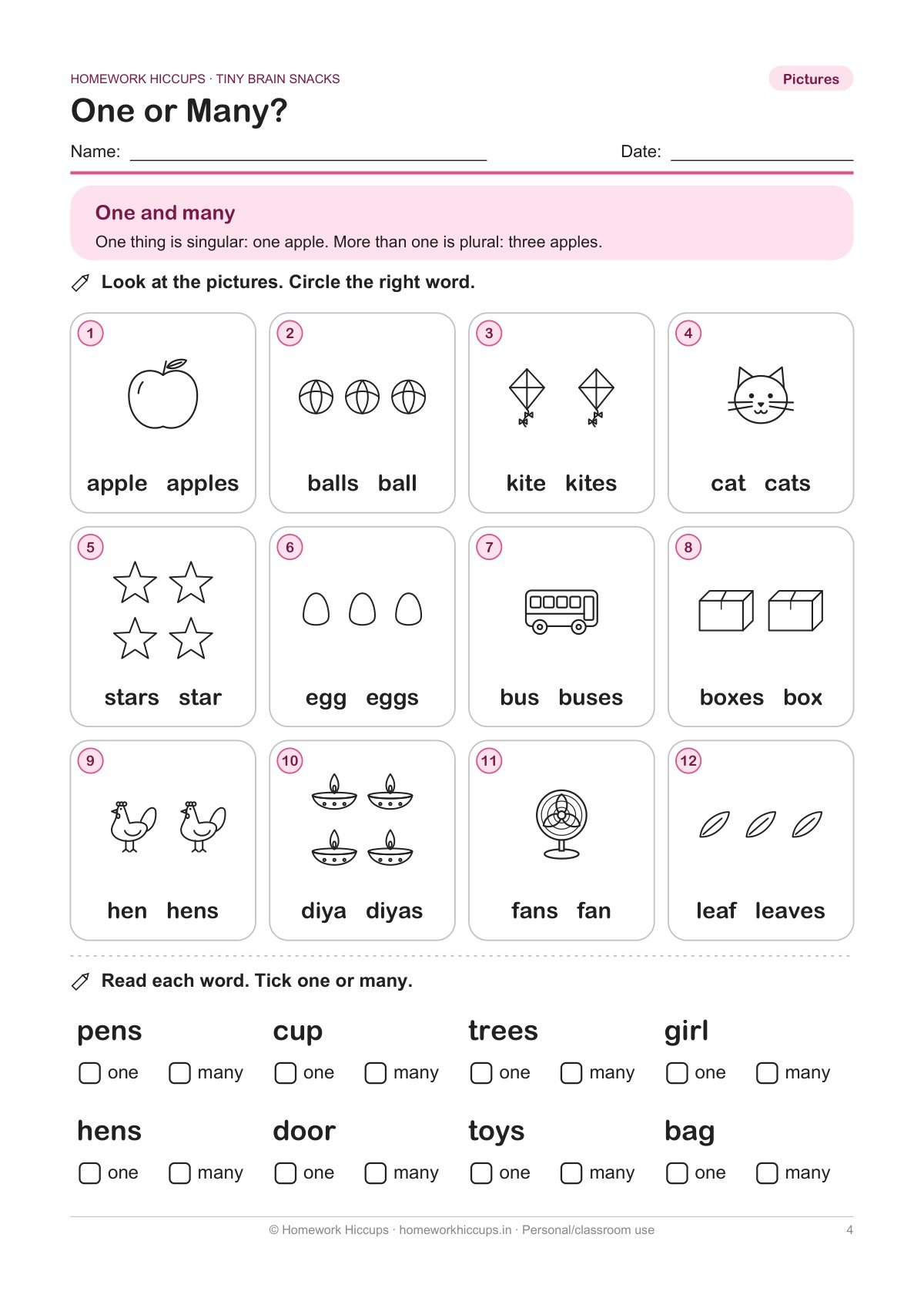
- In many schools, simple concepts like this/that, a/an, one/many and opposite words.
UKG Maths syllabus: numbers, addition and shapes
Numbers
- Counting, reading and writing numbers to 50 in most schools, and to 100 in many.
- Number names — usually one to ten or one to twenty in UKG, with more in Class 1. See our guide to number names 1 to 100 for a full chart.
- Before, after and between numbers, and comparing numbers (bigger/smaller, more/less, sometimes the > and < signs).
- Skip counting in 2s, 5s or 10s in some schools, and an early idea of tens and ones.
Operations
- Simple addition within 10 or 20, using pictures, objects and number lines.
- Simple subtraction within 10, often introduced in the second term.
Shapes, patterns and measurement
- 2D shapes (circle, square, triangle, rectangle, oval) and often a first look at 3D shapes like cube and sphere.
- Completing and creating patterns.
- Comparisons: long/short, heavy/light, full/empty.
- In some schools, days of the week, reading o’clock times and recognising Indian coins.
UKG EVS and GK syllabus
EVS in UKG is still taught mostly through talk, pictures, stories and activities, with a little more writing than in LKG. Common themes are:
- Myself: body parts, sense organs, healthy habits, my address and phone number in some schools.
- My family and home: types of houses, rooms and their uses.
- Plants: parts of a plant, what plants need, fruits and vegetables.
- Animals: domestic and wild animals, their homes, young ones and sounds.
- Food and water: healthy food, sources of water, saving water.
- Transport and safety: land, water and air transport, road safety and traffic lights.
- Community helpers, seasons, festivals and national symbols.
UKG Hindi syllabus: varnamala, two letter words and matras
Many English-medium schools teach Hindi (or the regional language) in UKG. A typical sequence:
- Revision of स्वर (अ to अः) and व्यंजन (क to ज्ञ), with writing on the शिरोरेखा.
- Reading and writing words without matra, starting with two letter words in Hindi such as घर, जल and फल, then three letter words like कमल.
- The first matras — often आ की मात्रा (ा) and sometimes इ and ई — in the second term.
- Hindi numbers (गिनती) १ to १० or १ to २०, depending on the school.
Hindi plans vary even more than English ones. Some schools finish the whole बारहखड़ी in UKG; others leave matras entirely for Class 1.
Term-wise UKG syllabus at a glance
| Subject | Term 1 (approx. April–September) | Term 2 (approx. October–March) |
|---|---|---|
| English | Revision of letters, letter sounds, vowels, CVC words with a and e | CVC words with i, o, u, sight words, reading and writing short sentences |
| Maths | Numbers 1–50, number names 1–10, before/after, shapes, patterns | Numbers 51–100, number names to 20, comparing, addition and subtraction, time or money basics |
| EVS / GK | Myself, family, home, food, plants | Animals, transport, water, safety, seasons, community helpers |
| Hindi | स्वर and व्यंजन revision, Hindi numbers | Words without matra, first matras |
Prefer ready-to-print pages?
UKG Worksheets PDF – Tiny Brain Snacks Starter Pack (46 Pages) – A4 PDF, instant download. ₹149 ₹299
Month-wise UKG plan (April to March)
Here is one possible way a school year might be paced. Schools that start in June, or follow a different calendar, simply shift it along. Treat it as a guide, not a timetable.
| Month | English | Maths | EVS / Hindi |
|---|---|---|---|
| April–May | Letter revision, capital–small matching | Numbers 1–20 revision, counting objects | Myself; स्वर revision |
| June–July | Letter sounds, vowels, CVC words with a | Numbers to 30, before/after | My family, my home; व्यंजन revision |
| August | CVC words with e and i | Numbers to 50, number names 1–10 | Food, plants; Hindi numbers |
| September | Revision, first sight words | Shapes, patterns, revision | Half-yearly revision |
| October–November | CVC words with o and u, more sight words | Numbers to 75, comparing numbers, addition with pictures | Animals, transport; two letter words |
| December–January | Short phrases and sentences | Numbers to 100, number names to 20, subtraction with pictures | Water, safety, seasons; three letter words |
| February–March | Reading short passages, revision | Time or money basics, revision | Community helpers; first matras; final revision |
Half-yearly and final assessment: what schools check
In line with NCF-FS, many schools now assess UKG children through observation, portfolios and short activities rather than written exams. Others still hold a half-yearly and an annual assessment, usually mixing oral and written parts. Typical tasks include:
- Reading letters, CVC words and a few sight words aloud.
- Writing dictated letters or simple words.
- Writing numbers, filling in before/after numbers and solving a few picture sums.
- Naming shapes, colours, animals or body parts from pictures.
- Reciting a rhyme or answering simple oral questions.
The best preparation is the same short daily practice you would do anyway. Avoid turning the weeks before an assessment into long revision sessions — at this age, that tends to create stress rather than confidence.
Class 1 readiness checklist
By the end of UKG, many children can:
- Write capital and small letters without tracing.
- Read simple CVC words and a handful of sight words.
- Count objects to 20 accurately and recognise numbers to 50 or more.
- Add and take away small numbers using fingers or objects.
- Sit for a 10–15 minute task, follow two-step instructions and manage their own tiffin and bag.
If your child is not ticking every box, that is very common. Children develop at different speeds, and the first months of Class 1 revisit much of this. If you have specific concerns about speech, hearing, vision or motor skills, talk to the class teacher first. For a side-by-side view of the two kindergarten years, read our guide to the difference between LKG and UKG, and for the year before, see the LKG syllabus.
UKG worksheets to practise each topic
Five focused minutes on paper each day usually helps more than long weekend sessions. Our guide to UKG worksheets and the skills needed before Class 1 explains how to set up a routine that sticks.
If you want everything in one place, the UKG Starter Pack follows the core of the syllabus above:
| UKG topic | Covered in the pack |
|---|---|
| Phonics and CVC words | Phonics practice and CVC word families |
| Sight words and sentences | Sight word pages and simple sentences |
| Numbers | Numbers to 50 |
| Operations | Addition and subtraction |
| EVS | EVS-lite pages |
It is 46 A4 pages for ₹149, paid by UPI, and you can print pages again for your own child whenever a topic needs another round.
Get the UKG Starter Pack – ₹149
For Hindi, our Hindi Matras worksheets (44 pages, ₹99) start with words without matra and build up to the full बारहखड़ी — useful whether your school teaches matras in UKG or Class 1.
🧸 Learning toys kids love
As an Amazon Associate, Homework Hiccups earns from qualifying purchases, at no extra cost to you.
Frequently asked questions about the UKG syllabus
Is there an official CBSE syllabus for UKG?
No. CBSE does not publish a fixed UKG syllabus. Schools design their own pre-primary plans, guided by NEP 2020 and the National Curriculum Framework for Foundational Stage (NCF-FS) 2022, so UKG syllabi differ from school to school.
What is taught in UKG maths?
Most schools cover numbers to 50 or 100, number names (often to 20), before/after/between, comparing numbers, simple addition and subtraction with pictures or objects, shapes and patterns. Some also introduce time and money basics.
Should a UKG child be able to read?
Many UKG children begin reading simple CVC words, a few sight words and short sentences by the end of the year. Some read fluently and others are just starting to blend sounds — both are within the normal range at this age.
Are matras taught in UKG?
It depends on the school. Many schools teach words without matra and the first one or two matras in UKG, while others leave matras for Class 1. Check your school’s Hindi plan.
How should I prepare my child for the UKG half-yearly assessment?
Keep to short daily practice of reading, writing and counting, and ask the teacher what will be checked. Many schools assess through oral tasks and observation, so a calm, familiar routine helps more than intense last-minute revision.