Nursery, LKG, UKG, Pre-KG, Balvatika — if you are applying for admission or just trying to understand your child’s school, the names alone can be confusing. The most common question parents ask is simple: what is the actual difference between LKG and UKG? Is it only age, or does the syllabus really change?
Print-ready worksheets for this topic
UKG Worksheets PDF – Tiny Brain Snacks Starter Pack (46 Pages) – A4 PDF, instant download. ₹149 ₹299
This guide explains the full forms, typical ages, a side-by-side syllabus comparison, what changes from one year to the next, how to tell whether your child is ready for UKG, and how to support each stage at home.
Quick answer: The difference between LKG and UKG is mainly age and depth of learning:
- LKG (Lower Kindergarten): usually for children around 4–5 years old. Focus on recognising and tracing letters and numbers, letter sounds, counting to about 20, shapes and fine-motor skills.
- UKG (Upper Kindergarten): usually for children around 5–6 years old, the year before Class 1. Focus on writing independently, reading CVC words and short sentences, numbers to 50 or 100, and simple addition and subtraction.
- In short: LKG is about learning letters and numbers; UKG is about using them.
Exact age cut-offs vary by state and school, so always check the admission rules where you are applying.
LKG and UKG full form and age (with Nursery)
Most Indian schools follow three pre-primary years before Class 1:
| Class | Full form | Typical age | Also called |
|---|---|---|---|
| Nursery | Nursery | About 3–4 years | Pre-KG, Pre-Nursery in some schools, Balvatika 1 |
| LKG | Lower Kindergarten | About 4–5 years | KG 1, Junior KG, PP1, Balvatika 2 |
| UKG | Upper Kindergarten | About 5–6 years | KG 2, Senior KG, PP2, Balvatika 3 |
“Kindergarten” comes from German and means “children’s garden”. The names KG 1/KG 2, Junior/Senior KG and PP1/PP2 (pre-primary) all describe the same two years; Balvatika is the term used under the National Education Policy (NEP) 2020.
A note on age: the ages above are typical, not rules. Age cut-off dates differ between states, boards and individual schools. In line with NEP 2020, many states are moving towards a minimum age of six for Class 1, which in turn shifts the ages for Nursery, LKG and UKG. Before you apply, check your state’s current notification and the school’s own admission criteria.
Difference between LKG and UKG syllabus: side by side
There is no single official syllabus for either year — schools design their own, guided by the National Curriculum Framework for Foundational Stage (NCF-FS) 2022. But the general pattern is similar across most Indian schools:
| Area | LKG (typical) | UKG (typical) |
|---|---|---|
| Age | About 4–5 years | About 5–6 years |
| English letters | Recognising and tracing capital A–Z, then small a–z | Writing capital and small letters independently; capital–small matching |
| Reading | Letter sounds, first sounds of words, a few CVC words late in the year | Blending CVC word families, sight words, short sentences |
| Numbers | Counting and writing 1–20 (some schools to 50) | Numbers to 50 or 100, number names to 10 or 20 |
| Maths concepts | Count and write, before/after, shapes, patterns, big/small | Comparing numbers, simple addition and subtraction, 2D and some 3D shapes, sometimes time and money |
| Hindi | स्वर such as अ, आ, इ and pre-writing patterns | स्वर and व्यंजन, words without matra, often the first matras |
| EVS | Myself, family, body parts, fruits, animals, colours | Plants, water, transport, safety, seasons, community helpers |
| Skills | Pencil grip, colouring, sitting for short tasks | Writing in a four-line notebook, 10–15 minute focus, managing belongings |
For full detail on each year, see our guides to the LKG syllabus and the UKG syllabus, including term-wise and month-wise plans.
What changes from LKG to UKG?
The jump from LKG to UKG is less about new topics and more about independence and depth. Four changes stand out:
1. From tracing to writing
In LKG, most writing is tracing — following dotted lines to form letters and numbers. In UKG, children are expected to write letters, numbers and simple words without dots, usually in a four-line notebook. If handwriting still feels hard, our guide on how to teach alphabet writing covers pencil grip and stroke order.
2. From letters to words
LKG children learn that “b” says /b/. UKG children put sounds together to read words like bat, sun and pen, then short sentences. Hindi follows the same path: from single letters to words like घर, जल and फल — see our list of two letter words in Hindi.
3. From counting to calculating
LKG Maths builds number sense — knowing that “5” means five things. UKG uses that understanding to compare numbers and to add and take away small quantities.
4. From short activities to longer focus
A typical LKG task lasts a few minutes. By the end of UKG, many children can stay with a task for 10–15 minutes, follow two-step instructions and manage their tiffin and bag — skills that matter a great deal in Class 1.
How to know your child is ready for UKG
Promotion from LKG to UKG is usually automatic, but it helps to know what a confident start looks like. Many children starting UKG can:
- Recognise most capital letters and many small letters, and say their sounds.
- Count objects to 10 accurately and recognise numbers to 20.
- Hold a pencil with reasonable control and trace letters on a guide.
- Name basic shapes and colours.
- Sit for a short task, take turns and follow a simple instruction.
If some of these are still developing, do not worry. UKG revisits most LKG skills in the first term, and children often make big leaps in a few months. If you have specific concerns about speech, hearing, vision or very weak hand strength, speak to the class teacher, and to your paediatrician if needed.
Prefer ready-to-print pages?
UKG Worksheets PDF – Tiny Brain Snacks Starter Pack (46 Pages) – A4 PDF, instant download. ₹149 ₹299
How to support each stage at home
The approach is the same for both years — short, regular, screen-free practice — but the focus shifts.
Supporting an LKG child
- Five minutes of tracing, colouring or mazes a day to build pencil control.
- Letter-sound games: “I spy something that starts with /m/.”
- Counting everyday things — rotis, stairs, buttons.
- Plenty of hands-on play: playdough, threading, tearing and pasting paper.
Supporting a UKG child
- Reading a few CVC words or sight words aloud each day.
- Writing one short word or number without tracing.
- Simple sums with objects: “You have 3 grapes; I give you 2 more.”
- Reading together every day, letting your child point to words they know.
For both, follow the school’s order of topics, stop while your child is still enjoying it, and praise effort rather than perfect handwriting.
Worksheets for LKG vs UKG
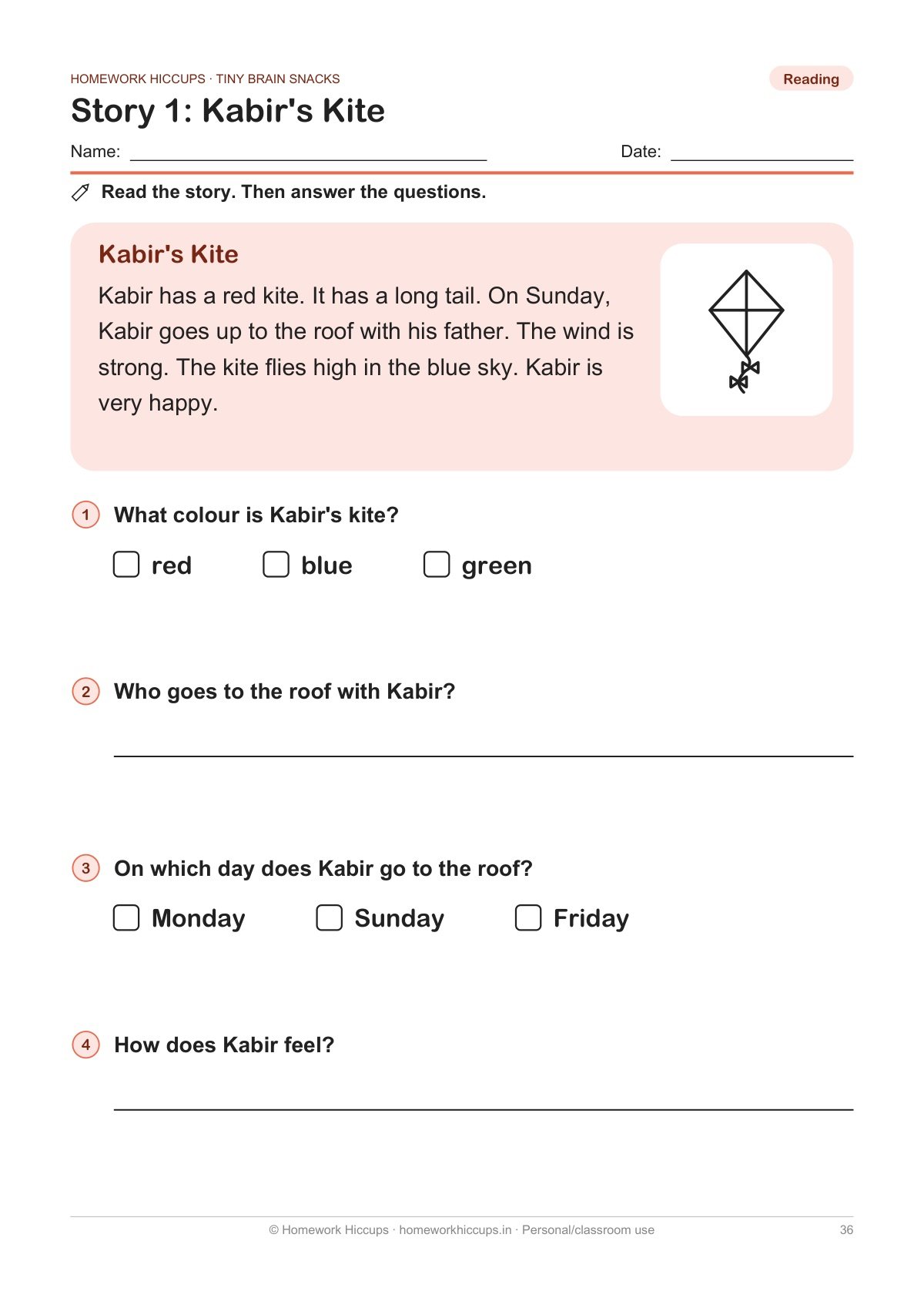
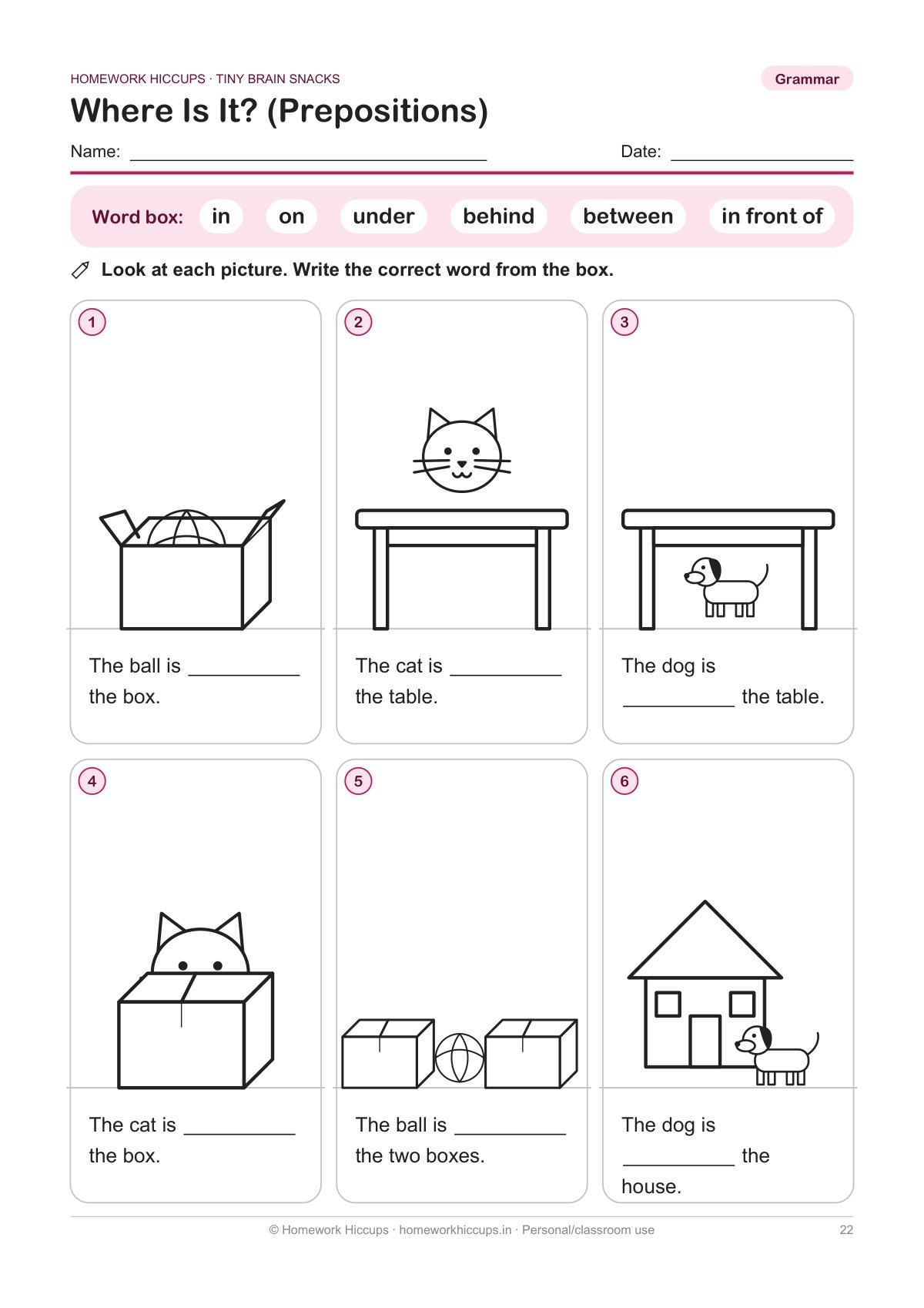
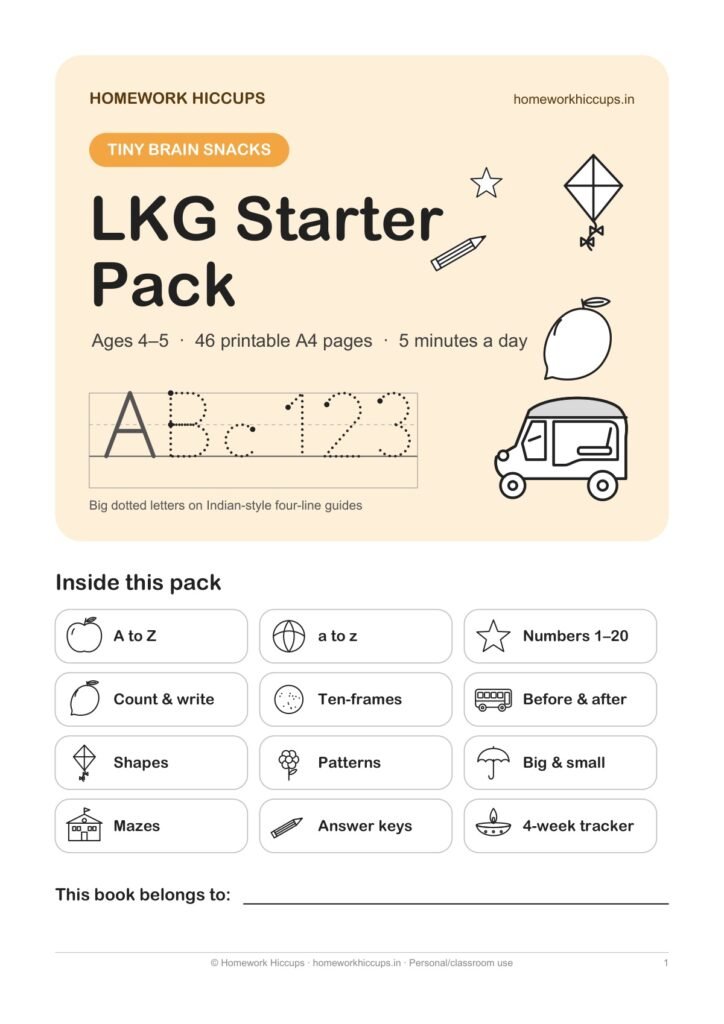
Good worksheets match the stage. An LKG page should have large tracing guides and lots of pictures; a UKG page can ask children to write independently, read words and solve simple sums. Here is how our two starter packs compare:
| LKG Starter Pack | UKG Starter Pack | |
|---|---|---|
| Pages and price | 46 A4 pages, ₹149 | 46 A4 pages, ₹149 |
| English | A–Z and a–z tracing on four-line guides | Phonics, CVC word families, sight words, sentences |
| Maths | Numbers 1–20 tracing, count and write, before/after, shapes, patterns | Numbers to 50, addition and subtraction |
| Extras | Mazes, 4-week tracker, certificate, answer keys | EVS-lite pages |
Not sure where to start? Try our free 6-page LKG sample first — it is a quick way to see how your child responds to printable practice.
Download the Free LKG Worksheets PDF
For a full four-week routine in LKG, see the LKG Starter Pack or browse all LKG worksheets. If your child is already in UKG, the UKG pack covers the core of that year, and you can see more in our UKG worksheets collection. All packs are paid by UPI and can be reprinted for your own child as often as you need.
Get the UKG Starter Pack – ₹149
Frequently asked questions about LKG and UKG
What is the full form of LKG and UKG?
LKG stands for Lower Kindergarten and UKG stands for Upper Kindergarten. They are the second and third years of pre-primary school in most Indian schools, after Nursery and before Class 1.
What is the age for LKG and UKG?
Children in LKG are usually around 4–5 years old, and children in UKG around 5–6 years old. Age cut-offs vary by state, board and school, so check the current admission rules where you are applying.
Which is higher, LKG or UKG?
UKG is higher. Children usually move from Nursery to LKG, then to UKG, and then to Class 1.
Is the UKG syllabus much harder than LKG?
It builds on LKG rather than starting afresh. The main changes are writing without tracing, reading simple words and sentences, larger numbers and simple addition and subtraction. Most children manage the step well with short, regular practice.
Can my child skip LKG and join UKG directly?
Some schools allow it if the child meets the UKG age criteria, but policies differ. Ask the school about its rules, and consider spending a few weeks on LKG skills such as letter recognition and counting before UKG begins.