GK (general knowledge) at LKG level is not about memorising facts for a test. It is about a four- or five-year-old talking confidently about their own world: who is in their family, which animal says “moo”, what colour a banana is and who helps us when we are sick. Schools often ask these questions orally in class, in term-end assessments and sometimes in an informal chat at admission time.
Print-ready worksheets for this topic
LKG Worksheets PDF – Tiny Brain Snacks Starter Pack (46 Pages) – A4 PDF, instant download. ₹149 ₹299
Below you will find 50 LKG GK questions and answers in simple English, grouped by theme, plus tips on practising them through play rather than drilling. Every answer here is short enough for a young child to say in their own words.
🧰 Make practice more fun at home
As an Amazon Associate, Homework Hiccups earns from qualifying purchases, at no extra cost to you.
Quick answer: LKG GK questions usually cover five themes:
- Myself and my family: name, age, family members, body parts.
- Animals and birds: names, sounds, homes and babies.
- Fruits, vegetables and colours: naming and describing everyday foods.
- Helpers and transport: doctor, farmer, postman; bus, train, aeroplane.
- Our country: very simple facts such as the national bird (peacock) and the national flower (lotus).
Practise a few questions a day through conversation, picture books and games — not by rote.
Why GK matters in LKG (and what schools actually ask)
In LKG, GK is closely tied to EVS (Environmental Studies) and to speaking skills. Teachers want to see that a child can understand a question, think for a moment and answer in a word or a short sentence. The facts themselves are simple; the real skill is listening and speaking.
Most LKG GK is taught orally with pictures, flashcards and rhymes. Some schools send home GK worksheets where children colour, match or circle the right picture. If you would like to see how GK fits into the full year, our guide to the LKG syllabus explains English, Maths and EVS term by term.
🧸 Learning toys kids love
As an Amazon Associate, Homework Hiccups earns from qualifying purchases, at no extra cost to you.
Myself, my family and my body: 10 questions
These answers will be different for every child, so help your child find their own words.
| # | Question | Answer |
|---|---|---|
| 1 | What is your name? | My name is ____. |
| 2 | How old are you? | I am ____ years old. |
| 3 | What is your father’s name? | My father’s name is ____. |
| 4 | What is your mother’s name? | My mother’s name is ____. |
| 5 | In which class do you study? | I study in LKG. |
| 6 | How many eyes do you have? | Two. |
| 7 | How many fingers are there on one hand? | Five. |
| 8 | With what do we see? | Eyes. |
| 9 | With what do we hear? | Ears. |
| 10 | With what do we smell? | Nose. |
Animals and birds: 10 questions
| # | Question | Answer |
|---|---|---|
| 11 | Which animal gives us milk? | Cow (buffaloes and goats also give milk). |
| 12 | Which animal barks? | Dog. |
| 13 | Which animal says “meow”? | Cat. |
| 14 | Which animal is called the King of the Jungle? | Lion. |
| 15 | Which animal has a long trunk? | Elephant. |
| 16 | Which animal has a very long neck? | Giraffe. |
| 17 | Where does a bird live? | In a nest. |
| 18 | Which bird can talk by copying our words? | Parrot. |
| 19 | Which animal hops and has long ears? | Rabbit. |
| 20 | What is a baby dog called? | Puppy. |
Fruits, vegetables and colours: 10 questions
| # | Question | Answer |
|---|---|---|
| 21 | What colour is a banana when it is ripe? | Yellow. |
| 22 | What colour is grass? | Green. |
| 23 | What colour is the sky on a clear day? | Blue. |
| 24 | Which fruit is called the King of Fruits? | Mango. |
| 25 | Which fruit is red and keeps the doctor away, as the saying goes? | Apple. |
| 26 | Which vegetable makes us cry when we cut it? | Onion. |
| 27 | Which orange vegetable do rabbits love? | Carrot. |
| 28 | Which vegetable grows under the ground and is used in aloo paratha? | Potato. |
| 29 | Which fruit is green outside and red inside? | Watermelon. |
| 30 | Name a sour fruit. | Lemon (or raw mango, tamarind). |
Helpers, transport and our country: 10 questions
| # | Question | Answer |
|---|---|---|
| 31 | Who treats us when we are sick? | Doctor. |
| 32 | Who grows food for us? | Farmer. |
| 33 | Who brings letters and parcels? | Postman. |
| 34 | Who teaches us in school? | Teacher. |
| 35 | Who puts out fires? | Firefighter. |
| 36 | Which vehicle flies in the sky? | Aeroplane. |
| 37 | Which vehicle runs on railway tracks? | Train. |
| 38 | Which vehicle moves on water? | Boat or ship. |
| 39 | What is the national bird of India? | Peacock. |
| 40 | What is the national flower of India? | Lotus. |
Other simple India facts some LKG classes cover: the national animal is the tiger, the national fruit is the mango, and our flag has three colours — saffron, white and green — with a blue wheel (the Ashoka Chakra) in the middle.
Prefer ready-to-print pages?
LKG Worksheets PDF – Tiny Brain Snacks Starter Pack (46 Pages) – A4 PDF, instant download. ₹149 ₹299
Everyday thinking questions: 10 more
These are the kind of questions teachers ask to check understanding, not memory.
| # | Question | Sample answer |
|---|---|---|
| 41 | What do we wear when it rains? | A raincoat, or we carry an umbrella. |
| 42 | What do we drink when we are thirsty? | Water. |
| 43 | When do we see the moon and stars? | At night. |
| 44 | What gives us light in the day? | The Sun. |
| 45 | What should we do before eating? | Wash our hands. |
| 46 | How many times should we brush our teeth? | Twice a day. |
| 47 | What do we say when someone helps us? | Thank you. |
| 48 | What is the shape of a roti? | Circle (round). |
| 49 | Which day comes after Sunday? | Monday. |
| 50 | What colour does the traffic light show when we must stop? | Red. |
Admission-style questions: how to practise without pressure
Rules about admission interactions vary by state and school. Under the Right to Education Act, schools are not meant to subject children or parents to screening procedures at admission, and some places use points or lotteries for entry-level seats. Still, many parents find that a teacher chats informally with the child on the first day or during a school visit. Typical questions are gentle and open-ended:
- What is your name? How old are you?
- What is your favourite colour / food / toy?
- Can you tell me about this picture?
- Can you count these blocks?
- Can you sing a rhyme for me?
The best preparation is everyday conversation, not rehearsed scripts. A few ideas:
Turn GK into a game
Play “I spy” at home (“I spy something yellow that we eat”), or a quick animal-sound guessing game in the car. Children remember far more when they are laughing.
Use real life
Name vegetables at the sabzi market, point out the postman, count buses at the stop. These small moments are better than flashcards.
Accept short answers
“Cow” is a perfect answer at four. You can model a full sentence (“Yes! The cow gives us milk”) without correcting your child.
Do not over-practise
Three to five questions a day is plenty. If your child seems tired or anxious, stop and come back tomorrow.
LKG GK worksheets: what to look for
GK worksheets for LKG should be mostly pictures: colour the red fruit, match the animal to its home, circle the vehicle that flies. Writing should be minimal at this age. Look for pages that also build pencil control, since that is one of the biggest LKG goals.
Not sure if worksheets suit your child yet? Start with our free 6-page LKG sample and see how your child responds.
Download the Free LKG Worksheets PDF
Our post on free LKG worksheets and how to use them at home explains how to make printed pages part of a calm daily routine.
For a structured four-week plan covering core LKG English and Maths skills, the LKG Starter Pack has 46 A4 pages for ₹149, paid by UPI and printable as many times as you need for your own child.
Get the LKG Starter Pack – ₹149
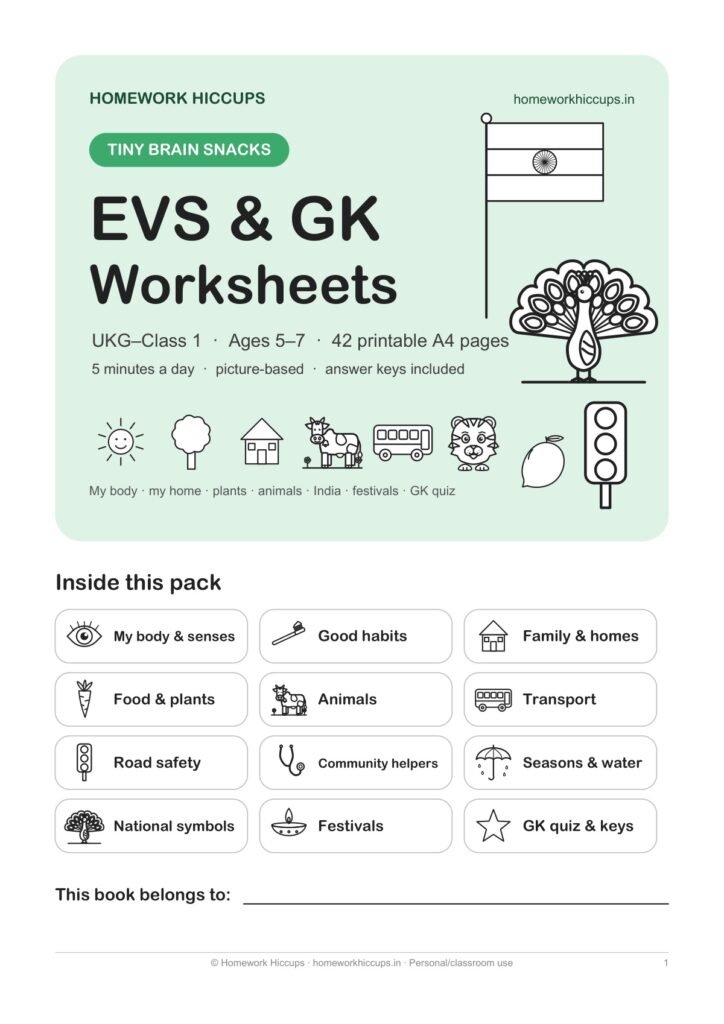
If your child is a little older or you want more EVS and GK practice, our EVS and GK Worksheets PDF (₹99) is designed for UKG to Class 1 and includes topics like animals and their homes, community helpers, national symbols of India and a GK quiz with answer keys. You can browse everything for this age in the LKG worksheets category, and when your child moves up, see our Class 1 GK questions for the next level.
Frequently asked questions about LKG GK
What GK questions are asked in LKG?
Mostly simple questions about the child’s own world: name, age and family, body parts, animals and their sounds, fruits and vegetables, colours, community helpers, transport and a few easy facts about India such as the national bird and flower.
How many GK questions should an LKG child learn?
There is no fixed number. Understanding matters more than quantity. A few questions a day through conversation and play is enough, and children often pick up many more naturally from stories and daily life.
Is GK a separate subject in LKG?
In many schools it is part of EVS or general awareness rather than a separate subject. Some schools list GK on the report card, usually assessed orally or through simple picture-based activities.
What is the national bird of India for LKG kids?
The national bird of India is the peacock. A simple way to remember it is that the peacock dances when it rains and has beautiful blue and green feathers.
Should I make my child memorise GK answers for admission?
It is better not to. Rehearsed answers can make children anxious and sound unnatural. Talk with your child every day, read picture books together and let them answer in their own words.