Telling the time is one of those skills that looks simple to adults and feels like magic to a six-year-old. Two hands, twelve numbers, and somehow the long hand pointing at 6 means “thirty”. If you are looking for a class 1 worksheet on time, or you are a teacher planning a clock unit for Class 1 or Class 2, the good news is that children learn this best in small, ordered steps with plenty of hands-on practice.
Print-ready worksheets for this topic
Times Tables, Time & Money Worksheets PDF – Tables 2–10, Clock, Calendar & Indian Rupees (41 Pages) – A4 PDF, instant download. ₹99 ₹199
This guide gives you a clear step-by-step order for teaching the clock, a paper-plate clock you can make in ten minutes, an Indian daily-routine timeline activity, instructions for drawing your own blank clock faces, and a ready-to-use clock worksheet for Class 1 with answers that you can copy onto paper today.
🧰 Make practice more fun at home
As an Amazon Associate, Homework Hiccups earns from qualifying purchases, at no extra cost to you.
Quick answer: To teach time to Class 1 and Class 2 children:
- Start with the parts: the short hand shows the hour, the long hand shows the minutes.
- Then o’clock: long hand on 12, short hand on the hour (UKG to Class 1).
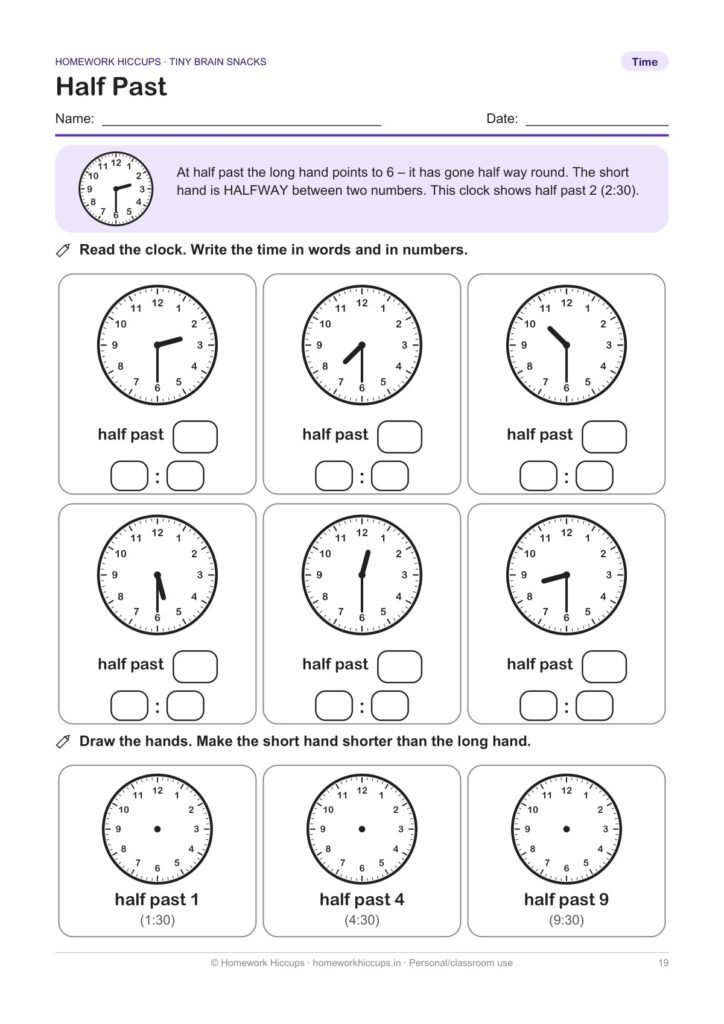
- Then half past: long hand on 6, short hand halfway between two numbers (Class 1).
- Then quarter past, quarter to and 5-minute times (commonly Class 2).
- Practise daily: use a real clock, a paper-plate clock and short worksheets with answer keys.
What order should you teach the clock in?
Many schools follow a similar progression, though the exact order varies between CBSE, ICSE and state board books. Use this table as a guide and check your child’s school book for what is being taught this term.
| Stage | Commonly taught | What the child can do |
|---|---|---|
| Nursery and LKG | Day and night, morning and evening, before and after | Says what we do in the morning and at night |
| UKG | Parts of a clock, o’clock times (in many schools) | Names the hour hand and minute hand; reads 3 o’clock |
| Class 1 | O’clock and half past, days of the week, months | Reads and draws 7 o’clock and half past 7 |
| Class 2 | Quarter past, quarter to, 5-minute times, calendar | Reads 6:15, 7:45 and 10:20; draws hands correctly |
Do not rush to the next row. A child who is shaky on o’clock times will find half past confusing, and a child who cannot count in 5s will struggle with 5-minute times. Counting skills matter here, so if your child still mixes up number names, spend some time with our number names 1 to 100 guide first.
How to teach clock to kids: worksheets and hands-on steps
Step 1: Meet the clock
Sit with a real wall clock or a toy clock. Point out the 12 numbers and the two hands. Say: “The short hand is the hour hand. It is short because hours are slow. The long hand is the minute hand. It is long because it has to travel all the way round every hour.”
Step 2: O’clock times
Move only the short hand at first, keeping the long hand on 12. Ask, “The short hand is on 4. What time is it?” Then say together, “4 o’clock.” Link times to real events, like 9 o’clock bedtime. An o clock worksheet for class 1 usually asks children to read the time and then draw the short hand themselves.
Step 3: Half past
Show that when the long hand goes from 12 to 6, it has gone halfway round the clock. That is why we say half past. The tricky part: the short hand also moves. At half past 3 it sits halfway between 3 and 4, not on 3. Many printed clocks get this wrong, so look for worksheets with accurately drawn hands.
Step 4: Quarter past and quarter to (Class 2)
Fold a paper circle into four to show quarters. Long hand on 3 is quarter past. Long hand on 9 is quarter to. At quarter to 8, the short hand is nearly on 8 but not quite, because 8 o’clock has not arrived yet. This is the time children get wrong most often, so practise it often in a class 2 clock worksheet.
Step 5: 5-minute times (Class 2)
Write 5, 10, 15 and so on up to 55 in small numbers around the outside of a clock face. Children count in 5s as the long hand moves: the long hand on 4 means 20 minutes, on 7 means 35 minutes, on 11 means 55 minutes. If skip counting in 5s is new, the 5 times table is a natural partner; see our guide on how to learn multiplication tables.
| Long hand points to | Minutes past the hour | We also say |
|---|---|---|
| 12 | 0 | o’clock |
| 1 | 5 | 5 past |
| 2 | 10 | 10 past |
| 3 | 15 | quarter past |
| 4 | 20 | 20 past |
| 5 | 25 | 25 past |
| 6 | 30 | half past |
| 7 | 35 | 25 to |
| 8 | 40 | 20 to |
| 9 | 45 | quarter to |
| 10 | 50 | 10 to |
| 11 | 55 | 5 to |
Make a paper-plate clock (10 minutes)
A paper-plate clock is the best clock activity worksheet for kindergarten and Class 1 that is not actually a worksheet. Children can move the hands themselves, which a printed page cannot do.
You need: one paper plate, a black sketch pen, a piece of coloured card or an old greeting card, scissors and one paper fastener (split pin) from any stationery shop. A pencil pushed through and a small ball of clay behind the plate works too.
- Find the centre of the plate by folding it in half twice and pressing lightly. Mark the point.
- Write 12 at the top, 6 at the bottom, 3 on the right and 9 on the left. Doing these four first keeps the spacing even.
- Fill in 1 and 2 between 12 and 3, then 4 and 5, 7 and 8, and 10 and 11.
- Cut two hands from card: a short, wide one for the hour and a long, thin one for the minutes. Use two colours if you can.
- Push the paper fastener through both hands and the centre of the plate, and open the legs at the back.
- For Class 2, write 5, 10, 15 and so on outside each number in a small, light colour.
Now play “Show me”: call out a time and your child sets the clock. Then swap roles. Make a deliberate mistake now and then; children love catching grown-ups out.
Blank clock worksheets: how to draw your own
Blank clock worksheets printable from a pack are quicker, but you can make a good set at home with a pencil and a steel bangle or small bowl.
- Trace around the bangle to make six circles on one A4 sheet (two across, three down).
- In each circle, mark 12, 3, 6 and 9 first, then the other numbers.
- Put a dot in the centre of each circle.
- Write a time under each clock, such as “half past 2”, and ask your child to draw both hands.
- For extra challenge, leave the numbers off the last two clocks and ask your child to add them.
Check that the minute hand is drawn longer, and that at half past the hour hand sits between two numbers.
Activity: an Indian daily-routine timeline
Time makes sense to children when it is connected to their own day. Draw a long line across a sheet of paper and mark these times, or adjust them to match your family:
| Time | What happens | Question to ask |
|---|---|---|
| 6:30 | Wake up and brush teeth | Is it morning or evening? |
| 7:00 | Breakfast: poha or paratha | Where is the long hand at 7 o’clock? |
| 7:30 | School bus comes | How do we say 7:30 in words? |
| 8:00 | School assembly | Is this before or after the bus? |
| 1:30 | School gets over | Where is the short hand at half past 1? |
| 5:00 | Play in the park | What do you do at 5 o’clock? |
| 6:00 | Homework time | How many hours after 5 o’clock? |
| 8:00 | Dinner with family | Is it day or night? |
| 9:00 | Bedtime story and sleep | What is the last thing you do? |
Ask your child to draw a small clock face next to each activity and set the hands. Morning, afternoon and night also come up in GK; our Class 1 GK questions include a few on days, months and seasons.
🧸 Learning toys kids love
As an Amazon Associate, Homework Hiccups earns from qualifying purchases, at no extra cost to you.
Prefer ready-to-print pages?
Times Tables, Time & Money Worksheets PDF – Tables 2–10, Clock, Calendar & Indian Rupees (41 Pages) – A4 PDF, instant download. ₹99 ₹199
Class 1 worksheet on time: clock questions with answers
This clock worksheet for Class 1 with answers is ready to copy. Draw each clock described below on paper, or read the descriptions aloud and let your child set the paper-plate clock. Questions 1 to 6 suit Class 1; questions 7 to 12 suit Class 2.
Part A: O’clock and half past (Class 1)
- The short hand is on 7 and the long hand is on 12. What time is it?
- The short hand is on 2 and the long hand is on 12. What time is it?
- The short hand is halfway between 4 and 5, and the long hand is on 6. What time is it?
- The short hand is on 11 and the long hand is on 12. What time is it?
- The short hand is halfway between 9 and 10, and the long hand is on 6. What time is it?
- The short hand is halfway between 12 and 1, and the long hand is on 6. What time is it?
Part B: Quarters, 5-minute times and 1 hour later (Class 2)
- The long hand is on 3 and the short hand is just past 6. What time is it?
- The long hand is on 9 and the short hand is nearly on 8. What time is it?
- The long hand is on 4 and the short hand is a little past 10. What time is it?
- The long hand is on 11 and the short hand is nearly on 3. What time is it?
- Riya’s dance class starts at 5 o’clock and lasts 1 hour. When does it end?
- Lunch is at half past 12. What time will it be 1 hour later?
Answers
| Question | Answer in words | Digital time |
|---|---|---|
| 1 | 7 o’clock | 7:00 |
| 2 | 2 o’clock | 2:00 |
| 3 | half past 4 | 4:30 |
| 4 | 11 o’clock | 11:00 |
| 5 | half past 9 | 9:30 |
| 6 | half past 12 | 12:30 |
| 7 | quarter past 6 | 6:15 |
| 8 | quarter to 8 | 7:45 |
| 9 | 20 past 10 | 10:20 |
| 10 | 5 to 3 | 2:55 |
| 11 | 6 o’clock | 6:00 |
| 12 | half past 1 | 1:30 |
Watch question 8 and question 10 closely. Children often write 8:45 instead of 7:45, or 3:55 instead of 2:55, because the short hand looks as if it is on the next number. Ask: “Has 8 o’clock come yet?” That one question fixes most mistakes.
Common mistakes and quick fixes
- Mixing up the hands. Colour the hour hand red and the minute hand blue on every clock you draw for a week.
- Reading the long hand as the hour. Always read the short hand first: “Short hand first, long hand next.”
- Hour hand on the number at half past. Show a real clock at 3:30 and let your child see the hour hand between 3 and 4.
- Saying 6 minutes when the long hand is on 6. Practise counting in 5s around the clock until it is quick.
Ready-to-print clock and time worksheets
If you would like accurate, printable pages without drawing clocks by hand, our Times Tables, Time & Money Worksheets PDF (41 A4 pages, ages 6 to 9) includes parts of a clock and counting minutes in 5s, o’clock, half past, quarter past and quarter to pages where children read the clock and draw the hands, 5-minute times such as 7:20 and 4:55, matching clock faces to digital times, “Aarav’s day” daily routine timeline with questions, a calendar page and simple 1-hour-later story sums. The clock faces are drawn so the hour hand sits in the right place, and answer keys cover every clock page. The same pack also has times tables 2 to 10 and Indian money.
Get the Tables, Time & Money Pack – ₹99
For a full year of Class 1 maths, the Class 1 Maths Worksheets PDF (49 pages) covers numbers to 100, addition, subtraction, money, shapes, measurement and a time section with morning to night, days and months, and reading and drawing o’clock times.
See the Class 1 Maths Worksheets – ₹149
You can also browse all maths worksheets and Class 1 worksheets. Both packs are for personal or single-classroom use.
Frequently asked questions
At what age can a child tell the time?
Most children can read o’clock times by about age 5 or 6 and half past by age 6 or 7. Quarter past, quarter to and 5-minute times usually come around age 7 or 8. Every child is different, so follow your child’s pace.
What time topics are in a Class 1 worksheet on time?
A typical Class 1 time worksheet covers parts of a clock, reading and drawing o’clock and half past times, morning, afternoon, evening and night, and the days of the week and months of the year. Some schools also introduce quarter past.
Why is the hour hand between two numbers at half past?
The hour hand moves slowly all the time, not in jumps. By half past, it has travelled halfway from one number to the next. At half past 3, it sits halfway between 3 and 4.
How do I explain quarter to?
Fold a paper circle into four. When the long hand reaches 9, three quarters of the hour have gone and one quarter is left before the next hour. So 7:45 is quarter to 8, because 8 o’clock is a quarter of an hour away.
Are digital clocks or analogue clocks better for learning?
Start with an analogue clock with hands, because it shows how time moves round in a circle. Once your child can read it, match analogue times to digital times like 4:30 so they understand both.