Skip counting means counting forward by the same jump each time: 2, 4, 6, 8 or 5, 10, 15, 20. It is the bridge between counting one by one and learning times tables, which is why skip counting worksheets for Class 1 appear in almost every school’s maths plan. Children who can count in 2s, 5s and 10s add faster, count money more easily and find tables far less scary later.
Print-ready worksheets for this topic
Class 1 Maths Worksheets PDF – Numbers to 100, Addition, Subtraction, Money & Time (49 Pages) – A4 PDF, instant download. ₹149 ₹299
This guide gives you every sequence written out and checked, the patterns to spot on a 1 to 100 chart, 15 fill-in-the-missing questions with answers, real-life examples with chappals, coins and fingers, a few games, and a clear path from skip counting to multiplication. Copy any of it into a notebook or onto the board.
Quick answer:
- By 2s: 2, 4, 6, 8, 10, 12, 14, 16, 18, 20.
- By 5s: 5, 10, 15, 20, 25, 30, 35, 40, 45, 50.
- By 10s: 10, 20, 30, 40, 50, 60, 70, 80, 90, 100.
- Order to teach: 10s first, then 5s, then 2s; 3s and 4s in Class 2.
- Use real things: pairs of chappals, ₹5 coins, fingers on hands.
Skip counting for kids: what it is and why it matters
When children count a pile of 30 marbles one at a time, they often lose their place. Skip counting lets them group things and count the groups. It also builds three skills Class 1 and Class 2 maths depend on:
- Number sense: seeing that 35 comes after 30 and before 40.
- Faster adding: 20 + 5 is easy once a child knows the 5s.
- Times tables: the 2s sequence is the table of 2, the 5s sequence is the table of 5.
Before you start, make sure your child can count and write numbers to 100 and say what comes before and after a number. Our posts on number names 1 to 100 and before and after numbers help with that groundwork.
Counting in 2s, 5s and 10s: the full sequences
| Count by | Sequence | Pattern to notice |
|---|---|---|
| 10s | 10, 20, 30, 40, 50, 60, 70, 80, 90, 100 | Every number ends in 0; the tens digit goes up by 1 |
| 5s | 5, 10, 15, 20, 25, 30, 35, 40, 45, 50, 55, 60, 65, 70, 75, 80, 85, 90, 95, 100 | Numbers end in 5, 0, 5, 0 |
| 2s | 2, 4, 6, 8, 10, 12, 14, 16, 18, 20, 22, 24, 26, 28, 30, 32, 34, 36, 38, 40, 42, 44, 46, 48, 50 | Numbers end in 2, 4, 6, 8, 0 again and again |
| 3s (Class 2) | 3, 6, 9, 12, 15, 18, 21, 24, 27, 30, 33, 36 | The jumps of 3 make a slanting line on a 100 chart |
| 4s (Class 2) | 4, 8, 12, 16, 20, 24, 28, 32, 36, 40 | Every second number in the 2s sequence |
Teach 10s first because the pattern is the clearest. 5s come next, because children can see 5 fingers on each hand. 2s take a little longer because the list is long, so practise up to 20 first, then 50, then 100.
Patterns on a 1 to 100 chart
Draw or print a 1 to 100 chart with ten numbers in each row. Then ask your child to colour:
- Counting by 10: the whole last column (10, 20, 30 … 100).
- Counting by 5: two full columns, the one ending in 5 and the one ending in 0.
- Counting by 2: every second column, the ones ending in 2, 4, 6, 8 and 0. These are the even numbers.
- Counting by 3: 3, 6, 9, 12 and so on. The coloured squares form slanting lines.
Seeing the stripes appear is a lovely “aha” moment and helps the sequences stick.
Skip counting on a number line
Draw a line from 0 to 20 on the floor with chalk. Your child stands on 0 and jumps two numbers at a time, saying each landing number aloud: 2, 4, 6, 8. Then try jumps of 5 on a line from 0 to 50 marked in 5s. Jumping with the whole body works far better for six-year-olds than writing alone.
Skip counting by 3 (and 4) for Class 2
Many schools add skip counting by 3 and 4 in Class 2, just before the tables of 3 and 4. The 3s are the hardest because the last digit does not repeat neatly. Two tips help:
- Use real groups of 3: wheels on an auto-rickshaw, sides of a triangle, three ladoos on each plate.
- Say the 3s in a rhythm with claps on every third number: one, two, three, four, five, six, seven, eight, nine.
For 4s, point out that every second number in the 2s list is a 4s number: 2, 4, 6, 8, 10, 12.
Skip counting worksheets for Class 1: fill in the missing numbers
Copy these into a notebook, leaving a blank for each missing number. Questions 1 to 10 suit Class 1; 11 to 15 stretch into counting back and Class 2.
- 2, 4, __, 8, __, 12
- 10, 20, __, 40, __
- 5, 10, 15, __, 25, __
- 14, 16, __, 20, __
- 35, 40, __, 50, __
- 60, 70, __, __, 100
- 22, 24, 26, __, __
- 75, 80, 85, __, __
- 3, 6, 9, __, 15, __
- 4, 8, 12, __, 20, __
- 90, 80, __, 60, __ (counting back by 10)
- 20, 18, __, 14, __ (counting back by 2)
- 50, 45, __, 35, __ (counting back by 5)
- 3, 13, 23, __, __ (jumps of 10 from 3)
- 21, 24, 27, __, __
Answers
| Q | Answer | Q | Answer | Q | Answer |
|---|---|---|---|---|---|
| 1 | 6, 10 | 6 | 80, 90 | 11 | 70, 50 |
| 2 | 30, 50 | 7 | 28, 30 | 12 | 16, 12 |
| 3 | 20, 30 | 8 | 90, 95 | 13 | 40, 30 |
| 4 | 18, 22 | 9 | 12, 18 | 14 | 33, 43 |
| 5 | 45, 55 | 10 | 16, 24 | 15 | 30, 33 |
Skip counting by 2, 5, 10 in real life
Children understand skip counting best when it counts something they can touch. Try these word problems at home or in class; the answers are in brackets.
- Chappals: 6 pairs of chappals are at the door. How many chappals? Count 2, 4, 6, 8, 10, 12. (12)
- ₹5 coins: Aarav has 7 coins of ₹5. How much money? Count 5, 10, 15, 20, 25, 30, 35. (₹35)
- Fingers: 4 children hold up one hand each. How many fingers? Count 5, 10, 15, 20. (20)
- Bundles of sticks: 5 bundles with 10 sticks each. How many sticks? Count 10, 20, 30, 40, 50. (50)
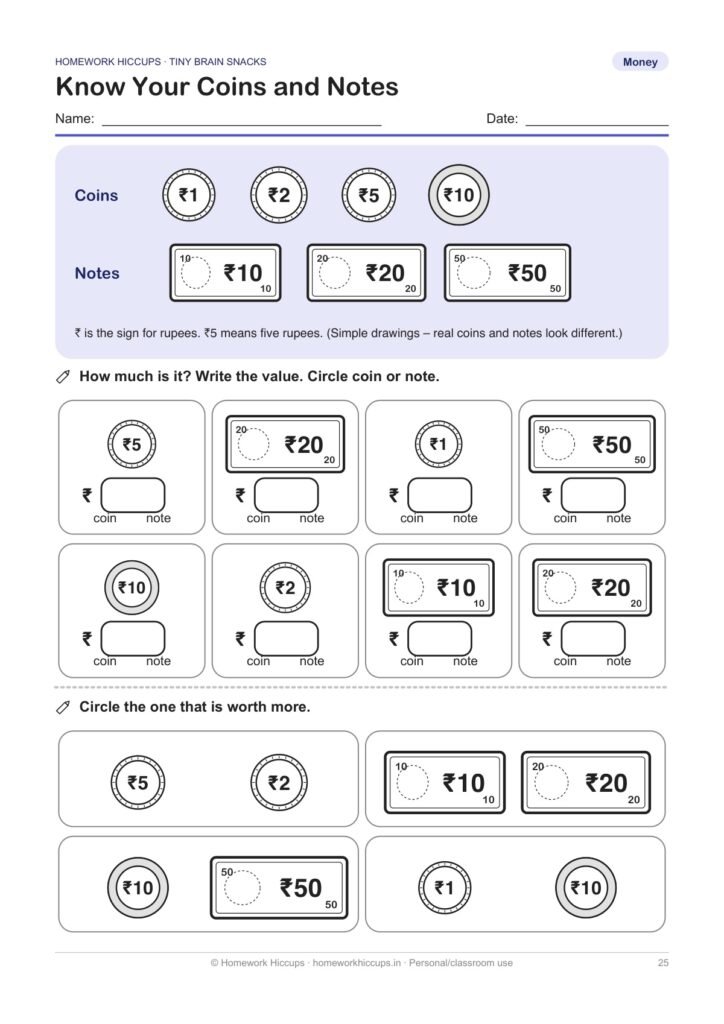
- ₹10 notes: 8 notes of ₹10. How much? Count 10, 20 … 80. (₹80)
- Socks: 9 pairs of socks on the line. How many socks? (18)
- Auto-rickshaw wheels (Class 2): 5 autos, 3 wheels each. Count 3, 6, 9, 12, 15. (15)
- Cow legs (Class 2): 6 cows, 4 legs each. Count 4, 8, 12, 16, 20, 24. (24)
Prefer ready-to-print pages?
Class 1 Maths Worksheets PDF – Numbers to 100, Addition, Subtraction, Money & Time (49 Pages) – A4 PDF, instant download. ₹149 ₹299
Games that make skip counting fun
- Clap and whisper: count from 1 to 20. Whisper the odd numbers and clap loudly on the even ones. The loud numbers are the 2s.
- Coin shop: give your child ₹5 coins (real or paper) and price toys at ₹15, ₹25 and ₹40. They pay by counting in 5s.
- Hopscotch jumps: chalk numbers 0 to 50 in a path. Call “jumps of 5” or “jumps of 10” and let them hop.
- Ball toss: throw a ball back and forth. Each catch adds the next number in the sequence. A drop means start again.
- Missing number cards: lay out cards 10, 20, 30 … 100, turn two face down and ask which numbers are hiding.
- Odd numbers challenge: start at 1 and count by 2s: 1, 3, 5, 7, 9. Children discover the odd numbers on their own.
From skip counting to multiplication
Once a child counts in 2s smoothly, show them that the same list answers a question: “How many in 3 groups of 2?” Count 2, 4, 6. That is 3 × 2 = 6. Then write the sequence as a table:
| Groups | Count by 2 | Count by 5 | Count by 10 |
|---|---|---|---|
| 1 | 2 | 5 | 10 |
| 2 | 4 | 10 | 20 |
| 3 | 6 | 15 | 30 |
| 4 | 8 | 20 | 40 |
| 5 | 10 | 25 | 50 |
This is exactly how the tables of 2, 5 and 10 are built. Children who learned skip counting first usually find these tables easy. Our guide on how to learn multiplication tables picks up from here. Skip counting also speeds up mental sums, which links nicely with our addition worksheets for Class 1.
Common mistakes to watch for
- Losing the pattern after 20 or 50. Practise the bridge numbers: 18, 20, 22 and 48, 50, 52.
- Adding 1 instead of the jump: 5, 10, 11. Go back to the number line and jump physically.
- Counting back is harder than counting on. Practise counting back by 10 from 100 before counting back by 2 or 5.
- Reciting without understanding. Always ask, “How many groups did we count?”
Printable skip counting worksheets for Class 1 PDF
Our Class 1 Maths Worksheets PDF (49 A4 pages) has a numbers to 100 section with a 100 grid to fill, count on and count back, before, after and between, and skip counting in 2s, 5s and 10s. It also has tens and ones pages with bundles of sticks, addition and subtraction, Indian money, time, three mental maths speed sheets and answer keys. It is for personal and single-classroom use.
Get the Class 1 Maths Worksheets PDF – ₹149
Try a free sample first: the free Class 1 maths sample has 5 pages (cover, 3 real pages from the pack and a contents page). Enter your name and email at checkout; no payment is needed.
For Class 2, the Class 2 Maths Worksheets PDF (₹149, 50 pages) includes skip counting in 2s, 3s, 5s, 10s and 100s, along with tables of 2, 3, 4 and 5. Browse all maths worksheets.
Want everything for Nursery to Class 2?
Complete Worksheet Library – All 20 Packs for Ages 3–8 (790+ Pages): all 20 printable packs, 790+ A4 pages of English, maths, Hindi, EVS and festival activities. ₹699 ₹2130
Frequently asked questions
What is skip counting in simple words?
Skip counting means counting forward by the same number each time instead of by 1. For example, counting by 2s goes 2, 4, 6, 8, 10.
Which skip counting should Class 1 children learn?
Many Class 1 children learn to count in 10s, 5s and 2s up to 100. Counting in 3s and 4s is usually added in Class 2.
What comes after 45 when counting by 5?
50 comes after 45 when counting by 5s. The sequence goes 40, 45, 50, 55, 60.
How does skip counting help with multiplication?
Each skip counting sequence is a times table. Counting 2, 4, 6 shows that 3 groups of 2 make 6, which is 3 × 2 = 6.
How can I teach skip counting by 2 at home?
Count pairs of chappals, socks or shoes, jump on a chalk number line two steps at a time, and colour every second square on a 1 to 100 chart.