Class 1 maths data handling sounds grand, but it is simply this: sorting things, counting them, writing the count down neatly and then answering questions about it. Children already do it when they count how many red and blue crayons are in the box or how many friends like mango ice cream. A good data handling worksheet just turns that everyday counting into a tidy table they can read.

Print-ready worksheets for this topic
Class 1 Maths Worksheets PDF – Numbers to 100, Addition, Subtraction, Money & Time (49 Pages) – A4 PDF, instant download. ₹149 ₹299
This guide explains sorting, tally marks and pictographs in plain words, gives you six ready-to-copy data tables with questions and checked answers, a class survey activity for teachers, and shows how Class 2 builds on the same ideas with a pictograph key. Everything here can be copied into a notebook or onto a whiteboard for free.
Quick answer: Data handling for Class 1 and 2 usually covers:
- Sorting: grouping objects by colour, shape, size or type.
- Tally marks: one line for each item, with every fifth line drawn across the first four to make a bundle of 5.
- Pictographs: a picture for each item (Class 1) or a picture for a fixed number of items, shown in a key (Class 2).
- Reading data: most, fewest, how many more, how many in all.
Class 1 maths data handling: what it means
Data is just information we collect, such as how many children walk to school or which fruit the family likes best. Handling data means three simple steps:
- Collect: ask, look or count.
- Organise: sort the things into groups and record them as tally marks, a table or a pictograph.
- Read: answer questions such as which group is biggest and how many there are altogether.
Many schools introduce it near the end of Class 1, after children are comfortable counting to 20 and adding small numbers. If your child is still building those skills, our addition worksheets for Class 1 post is a good place to warm up first.
Start with sorting at home
Before any worksheet, tip a small bowl of mixed objects onto the table: buttons, blocks, dried rajma and chana, or fridge magnets. Ask your child to sort them. Then ask, “How did you sort them?” There is no single right answer. One child sorts by colour, another by size. That conversation is the heart of data handling. Next, count each group and write the numbers on a slip of paper. You have just made your first data table.
Tally marks: the easy way to count as you go
A tally mark is a small standing line drawn for each item. When you reach the fifth item, you draw a line across the first four. This bundle of 5 makes counting quick, because children can count bundles in fives and then add the loose lines. For example, 7 is one bundle of 5 and 2 more lines. 12 is two bundles and 2 more lines.
Practise by standing at the window for two minutes and drawing a tally line every time a vehicle passes. Children love it, and it shows why tally marks were invented: you can record while things are still happening.
A common mistake is drawing the fifth line as a separate standing line, so the bundle looks like 6. Another is forgetting to cross the bundle at all. Ask your child to say “one, two, three, four, cross!” out loud while drawing.
Six class 1 data handling worksheet tables (with answers)
Copy any of these into a notebook. Ask your child to draw the tally marks in the middle column first, then answer the questions. Answers are given straight after each table so you can check in seconds.
Table 1: Fruits in a basket
| Fruit | Tally | Number |
|---|---|---|
| Apple | 1 bundle | 5 |
| Banana | 1 bundle + 2 | 7 |
| Mango | 4 lines | 4 |
| Orange | 3 lines | 3 |
Questions: Which fruit is the most? Which is the fewest? How many more bananas than mangoes? How many apples and mangoes together? How many fruits in all?
Answers: banana; orange; 3 more; 9; 19 fruits.
Table 2: Favourite colours in our class
| Colour | Children |
|---|---|
| Red | 8 |
| Blue | 6 |
| Green | 5 |
| Yellow | 3 |
Questions: Which colour is liked most? How many more children like red than yellow? How many like blue or green? How many children were asked?
Answers: red; 5 more; 11; 22 children.
Table 3: Pets in our lane
| Pet | Number |
|---|---|
| Dog | 6 |
| Cat | 4 |
| Fish | 2 |
| Parrot | 3 |
Questions: How many more dogs than cats? How many more fish are needed to equal the parrots? How many pets in all?
Answers: 2 more; 1 more fish; 15 pets.
Table 4: Vehicles at the school gate in 10 minutes
| Vehicle | Number |
|---|---|
| Car | 9 |
| Auto-rickshaw | 7 |
| Bike or scooter | 12 |
| Bus | 2 |
Questions: Which vehicle came most often? How many more bikes than buses? How many autos and buses together? How many vehicles in all?
Answers: bike or scooter; 10 more; 9; 30 vehicles.
Table 5: Kites flown on Makar Sankranti (pictograph)
Key: ★ = 2 kites
| Child | Kites |
|---|---|
| Aarav | ★★★ |
| Meera | ★★★★★ |
| Kabir | ★★ |
| Zoya | ★★★★ |
Questions: How many kites did each child fly? Who flew the most? How many more kites did Meera fly than Kabir? How many kites in all?
Answers: Aarav 6, Meera 10, Kabir 4, Zoya 8; Meera; 6 more; 28 kites.
Table 6: Library books read in a month (pictograph)
Key: ★ = 5 books
| Section | Books |
|---|---|
| Class 2A | ★★★★ |
| Class 2B | ★★★★★★ |
| Class 2C | ★★★ |
Questions: How many books did each section read? Which read the fewest? How many more did 2B read than 2C? How many books altogether?
Answers: 2A 20, 2B 30, 2C 15; 2C; 15 more; 65 books.
Tables 1 to 4 suit Class 1. Tables 5 and 6 use a key, which is usually a Class 2 idea, so save them for later or use them as a challenge.
Pictographs: from one picture each to a key
In Class 1, a pictograph normally uses one picture for one thing. If four children like mango, you draw four mangoes. Children can count the pictures directly, which keeps it friendly.
In Class 2, many schools introduce a key, where one picture stands for more than one thing, such as 2, 5 or 10. This makes big numbers fit on the page, but it adds a step: children must multiply or skip count. Kabir’s two stars in Table 5 mean 2 + 2 = 4 kites, not 2. This is the most common Class 2 mistake, so always ask, “What does one picture mean?” before any question. Skip counting in 2s, 5s and 10s is the best preparation; our maths worksheets for Class 2 guide covers where this fits in the year.
| Skill | Class 1 | Class 2 |
|---|---|---|
| Sorting | By colour, shape, type | By two features (red and round) |
| Tally marks | Up to about 20 | Larger counts, surveys |
| Pictograph | 1 picture = 1 thing | Key such as 1 picture = 2, 5 or 10 |
| Questions | Most, fewest, how many | How many more, total, comparing |
| Making data | Copy a given table | Run a small survey and draw it |
Class survey activity for teachers
This takes one period and works for 20 to 40 children.
- Pick a question with four answers, such as “Which is your favourite fruit: mango, banana, apple or grapes?”
- Draw a big table on the board with four rows and a tally column.
- Collect: each child walks up and draws one tally line next to their choice. The class counts aloud together for every fifth line and the child draws the cross.
- Count: children count bundles in fives and add the loose lines. Write the number column.
- Draw: in notebooks, children turn the table into a pictograph with one fruit drawing per child (Class 1) or with a key of 2 (Class 2).
- Talk: ask three questions: which is most, which is fewest, and how many more chose the first than the last.
Other good survey questions: how do you come to school, how many brothers and sisters do you have, which is your favourite season, which pet would you like.
Prefer ready-to-print pages?
Class 1 Maths Worksheets PDF – Numbers to 100, Addition, Subtraction, Money & Time (49 Pages) – A4 PDF, instant download. ₹149 ₹299
Data handling for kids at home: five quick ideas
- Fridge tally: stick a sheet on the fridge and tally how many glasses of water each family member drinks in a day.
- Weather week: draw a sun, cloud or rain picture every day for a week, then count each.
- Shoe sort: sort the family’s shoes into sandals, school shoes and slippers and make a table.
- Vegetable basket: after shopping, count tomatoes, onions and potatoes and ask who has the most.
- Toy census: count soft toys, cars and blocks, then draw a pictograph.
These connect nicely with shapes too: sort blocks into cubes, cylinders and spheres. See our shapes worksheets for Class 1 for shape-sorting ideas.
Common mistakes and how to fix them
| Mistake | Fix |
|---|---|
| Counting an item twice | Tick or cross off each picture as it is counted |
| Fifth tally line drawn standing | Say “one, two, three, four, cross” aloud |
| Counting pictures, ignoring the key | Circle the key and read it first |
| Mixing up most and fewest | Point to the longest and shortest row first |
| Wrong answer to how many more | Line up the two rows and count the extra ones |
Data questions also appear in many maths olympiad papers for young children. If your child enjoys these puzzles, try the practice set in our Class 1 maths olympiad questions post.
Print-ready Class 1 maths pages
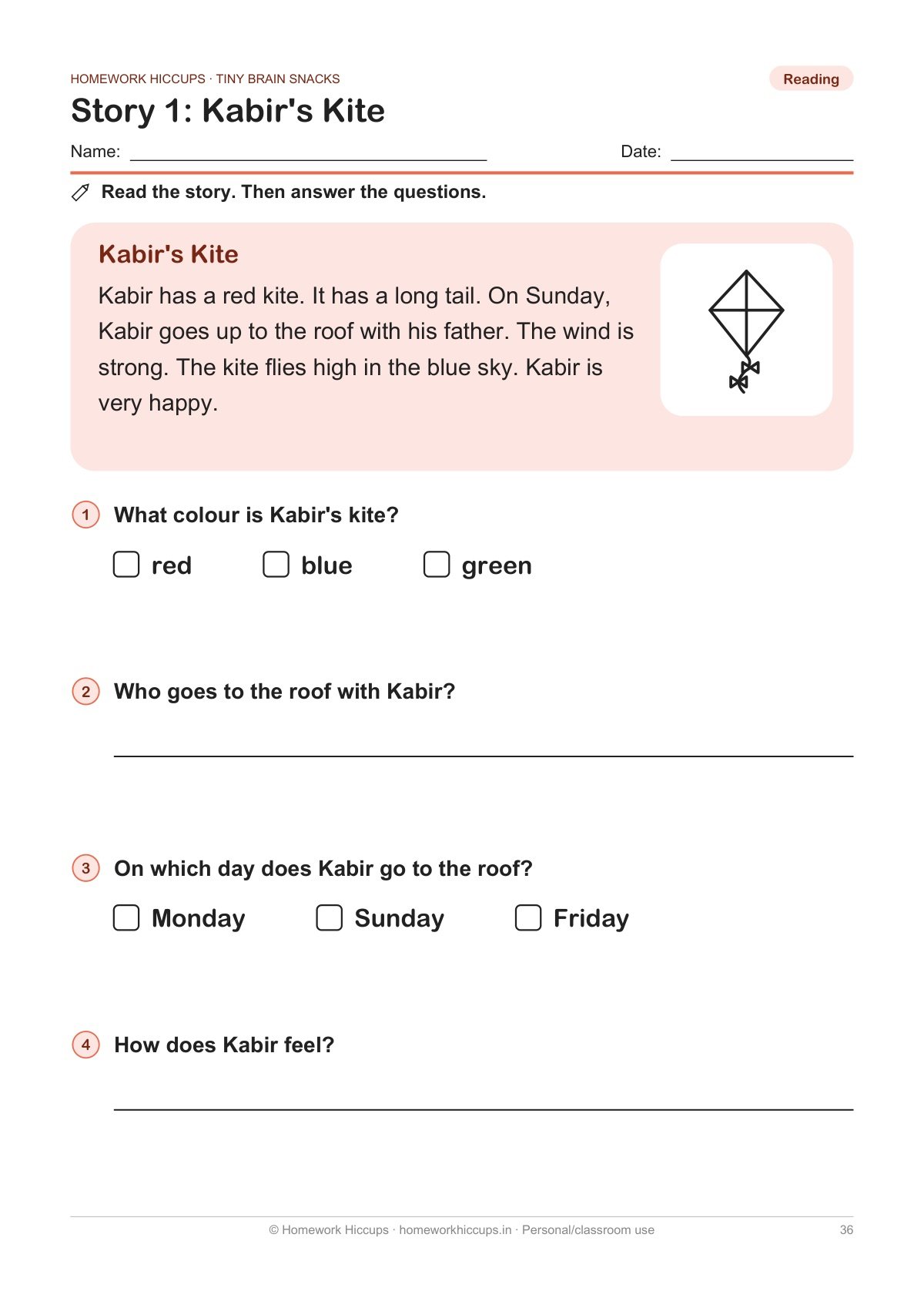
If you would rather print than copy by hand, the Class 1 Maths Worksheets PDF (49 A4 pages, ₹149) includes data handling pages with tally marks of favourite fruits and a Makar Sankranti kites pictograph. It also covers numbers to 100, tens and ones, addition and subtraction, Indian money, shapes, measurement and time, with three mental maths speed sheets and five pages of answer keys. It follows common Class 1 themes and is not an official board workbook.
Get the Class 1 Maths Worksheets PDF – ₹149
Not sure yet? Try a free sample first: a 5-page PDF with the cover, 3 real pages from the pack and the contents page, free with just your name and email. You can also browse all our maths worksheets and Class 1 worksheets.
Want everything for Nursery to Class 2?
Complete Worksheet Library – All 20 Packs for Ages 3–8 (790+ Pages): all 20 printable packs, 790+ A4 pages of English, maths, Hindi, EVS and festival activities. ₹699 ₹2130
Frequently asked questions
What is data handling in Class 1?
It means collecting information, sorting it into groups, recording it with tally marks, a table or a simple pictograph, and then answering questions such as which group has the most.
How do you teach tally marks to kids?
Draw one line for each item. On the fifth item, draw a line across the first four to make a bundle of 5. Then count the bundles in fives and add the loose lines.
What is a pictograph for Class 2?
A pictograph shows data with pictures. In Class 2 a key often says how many things one picture stands for, such as one star for 2 kites, so children skip count to read it.
When is data handling taught in Class 1?
Many schools teach it near the end of Class 1, after counting to 20 and simple addition, but the order varies by school and book.
How many tally bundles make 20?
Four bundles of 5 make 20, because 5 + 5 + 5 + 5 = 20.