Addition is usually the first “real” maths a child writes in a notebook, and it sets the tone for everything that follows. When it is taught step by step, with objects first and symbols later, children enjoy it and feel clever. If you are searching for addition worksheets for Class 1, this guide shows you the full progression from single-digit sums to 2-digit addition without carrying, with a worked example for each strategy.
Print-ready worksheets for this topic
Class 1 Maths Worksheets PDF – Numbers to 100, Addition, Subtraction, Money & Time (49 Pages) – A4 PDF, instant download. ₹149 ₹299
It is for parents helping at home and for teachers planning UKG and Class 1 maths lessons. You will get a strategy table, 40 practice sums, 10 Indian word problems (ladoos, cricket runs, diyas and more), a short list of Hindi maths words for Hindi-medium families, and a complete answer key.
Quick answer: Teach Class 1 addition in this order:
- Count all with objects and pictures (3 + 2).
- Count on from the bigger number (8 + 3: nine, ten, eleven).
- Number line hops forward.
- Doubles and near doubles (6 + 6 = 12, so 6 + 7 = 13).
- Make 10 (9 + 4 = 9 + 1 + 3 = 13).
- 2-digit without carrying: add ones, then tens (34 + 25 = 59).
The addition progression for UKG and Class 1
Children do not learn addition in one jump. They move from counting every object to using clever shortcuts. The table shows the usual order and roughly when each strategy is introduced in many Indian schools.
| Strategy | Example | How the child thinks | Typical class |
|---|---|---|---|
| Count all | 3 + 2 | Counts 3 objects, counts 2 more, then counts all 5 from the start | Nursery – UKG |
| Count on | 8 + 3 | Says “eight” and counts on: nine, ten, eleven | UKG – Class 1 |
| Number line | 6 + 5 | Starts at 6, hops forward 5 times, lands on 11 | Class 1 |
| Doubles | 7 + 7 | Remembers the double: 14 | Class 1 |
| Near doubles | 7 + 8 | 7 + 7 = 14, one more is 15 | Class 1 |
| Make 10 | 9 + 4 | Moves 1 from the 4 to make 10, then 10 + 3 = 13 | Class 1 |
| Adding tens | 40 + 50 | 4 tens + 5 tens = 9 tens = 90 | Class 1 |
| 2-digit without carrying | 34 + 25 | Ones: 4 + 5 = 9. Tens: 3 + 2 = 5. Answer 59 | Class 1 |
Spend most of your time on the middle of the table. Children who know their doubles and their “pairs that make 10” find every later stage easier.
How to teach addition to kids: worked examples
1. Count all (addition with pictures)
This is what an addition worksheet for Class 1 with pictures usually starts with.
Worked example: 3 + 2. Draw 3 balloons and then 2 more balloons. Ask your child to count all of them, touching each one: 1, 2, 3, 4, 5. Write 3 + 2 = 5. Say it aloud: “Three and two more make five.”
Use real things as often as you can: spoons, peas, bangles, toy cars. Pictures come after objects, and numbers come after pictures.
2. Count on from the bigger number
Worked example: 8 + 3. Instead of counting all eleven, hold 8 “in your head”. Say “eight”, then put up a finger for each number you count on: nine, ten, eleven. Three fingers are up, so 8 + 3 = 11.
Teach children to start with the bigger number. 2 + 9 is the same as 9 + 2, and counting on 2 from 9 is much quicker than counting on 9 from 2. This is a good moment to show that you can add in any order.
3. Hops on a number line
Worked example: 6 + 5. Put your finger on 6. Hop forward five times, counting the hops, not the numbers: 7 (one), 8 (two), 9 (three), 10 (four), 11 (five). You land on 11, so 6 + 5 = 11.
Draw a small arc for each hop. It stops children from counting the starting number by mistake, which is the most common number-line error.
4. Doubles and near doubles
Doubles are easy to remember because they have a picture: two hands make 5 + 5 = 10, an egg tray has 6 + 6 = 12, a spider has 4 + 4 = 8 legs.
Worked example: 7 + 8. “I know 7 + 7 = 14. 8 is one more than 7, so the answer is one more than 14.” 7 + 8 = 15.
5. Make 10
Children should know the pairs that make 10 by heart: 1 + 9, 2 + 8, 3 + 7, 4 + 6, 5 + 5.
Worked example: 9 + 4. 9 needs 1 more to make 10. Take 1 from the 4, leaving 3. Now 10 + 3 = 13. So 9 + 4 = 13. A ten-frame (two rows of five boxes) makes this very easy to see.
6. 2-digit addition without carrying
In Class 1, 2-digit addition is usually kept to sums where the ones add up to 9 or less, so nothing needs to be carried. Carrying (regrouping) is commonly taught in Class 2.
Worked example: 34 + 25.
- Write 34 above 25, ones under ones and tens under tens. Label the columns T and O.
- Add the ones first: 4 + 5 = 9. Write 9 in the ones column.
- Add the tens: 3 + 2 = 5. Write 5 in the tens column.
- Read the answer: 59.
Always start from the ones column, even when there is nothing to carry. The habit pays off next year.
Tips to make addition stick
- Five minutes of “quick facts” daily. Call out doubles and make-10 pairs while walking to school or waiting for dinner.
- Use the same words. Add, plus, and, more, altogether, total, sum. Children learn they all point to addition.
- Turn-around facts. If 3 + 5 = 8, then 5 + 3 = 8. This halves the facts to learn.
- Play dice games. Roll two dice and add. First to reach 50 by keeping a running total wins.
- Link to subtraction. Every addition fact gives two subtraction facts. Our guide to subtraction worksheets for Class 1 follows the same steps in reverse.
- Know the numbers first. Addition is much easier when children can count on fluently. Practise before and after numbers and read number names 1 to 100 for word problems.
Addition worksheets for Class 1: 40 free practice sums
Copy a few sums into a notebook each day. Sets A and B work well as a UKG maths worksheet for addition (with counters or pictures). Sets C and D are for Class 1. Answers are at the end.
Set A: addition worksheet for Class 1, single digit
- 3 + 2
- 4 + 5
- 6 + 1
- 2 + 7
- 5 + 5
- 8 + 0
- 1 + 9
- 3 + 6
- 4 + 4
- 7 + 2
Set B: within 20 (count on, doubles, make 10)
- 9 + 4
- 8 + 5
- 7 + 6
- 6 + 6
- 9 + 9
- 8 + 7
- 5 + 8
- 12 + 3
- 14 + 5
- 11 + 7
Set C: adding tens
- 20 + 30
- 40 + 50
- 10 + 60
- 30 + 30
- 70 + 20
Set D: addition worksheet for Class 1 without carry (write in columns)
- 23 + 14
- 45 + 32
- 61 + 27
- 52 + 36
- 34 + 15
- 70 + 19
- 43 + 43
- 26 + 52
- 81 + 16
- 55 + 24
- 13 + 65
- 40 + 38
- 62 + 7
- 71 + 28
- 44 + 51
Class 1 maths addition word problems
Read each problem aloud. Ask your child: “What do we know? What are we finding? Do we add?” Encourage a quick drawing before writing the sum.
- Dadi made 6 ladoos in the morning and 5 ladoos in the evening. How many ladoos did she make altogether?
- Rohit scored 24 runs in the first match and 13 runs in the second match. How many runs did he score in all?
- Aanya lit 8 diyas and her brother lit 7 diyas. How many diyas did they light together?
- There are 12 mangoes in a basket. Papa brings 6 more. How many mangoes are there now?
- On Makar Sankranti, Kabir flew 3 kites and Ishaan flew 4 kites. How many kites did they fly in total?
- Mummy made 10 rotis for lunch and 10 rotis for dinner. How many rotis did she make that day?
- Zoya has 32 marbles. She finds 15 more under the sofa. How many marbles does she have now?
- A school bus has 41 children. At the next stop, 23 more children get on. How many children are on the bus now?
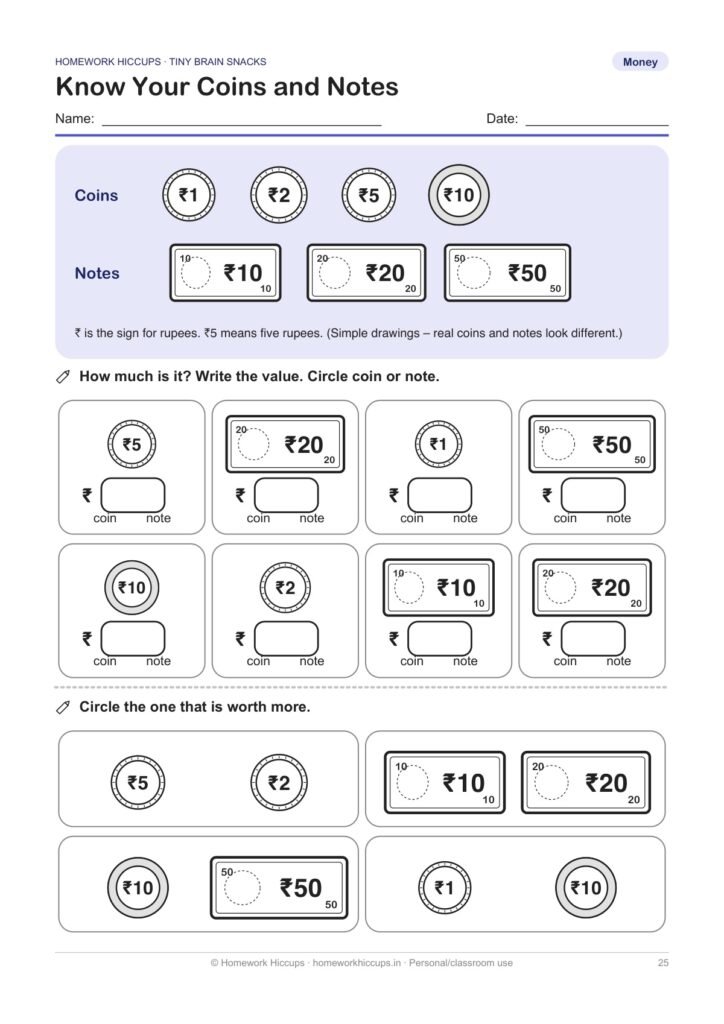
- Meera has a ₹10 coin and a ₹5 coin. How much money does she have?
- For a rangoli, Didi used 50 yellow marigolds and 40 orange marigolds. How many marigolds did she use?
Prefer ready-to-print pages?
Class 1 Maths Worksheets PDF – Numbers to 100, Addition, Subtraction, Money & Time (49 Pages) – A4 PDF, instant download. ₹149 ₹299
Addition worksheet in Hindi: useful maths words
Many children learn maths in Hindi at school or hear Hindi maths words at home. Here are the words that appear most often on a Hindi addition worksheet, with transliteration and meaning.
| Hindi | Transliteration | Meaning |
|---|---|---|
| जोड़ | jod | addition |
| जोड़ना | jodna | to add |
| योगफल | yogphal | sum (the answer of an addition) |
| कुल | kul | total |
| बराबर | barabar | equal to (=) |
| संख्या | sankhya | number |
| इकाई | ikai | ones |
| दहाई | dahai | tens |
| और | aur | and |
| कितने | kitne | how many |
A simple Hindi word problem you can try: राम के पास 4 आम हैं। सीता ने उसे 3 आम और दिए। अब राम के पास कुल कितने आम हैं? (Ram has 4 mangoes. Sita gave him 3 more. How many mangoes does Ram have in total now?) Answer: 4 + 3 = 7 आम.
You can also write sums in words: पाँच और तीन मिलकर आठ होते हैं (five and three together make eight), which is 5 + 3 = 8.
Addition worksheet for Class 1: answer key
Set A: 1. 5 · 2. 9 · 3. 7 · 4. 9 · 5. 10 · 6. 8 · 7. 10 · 8. 9 · 9. 8 · 10. 9
Set B: 11. 13 · 12. 13 · 13. 13 · 14. 12 · 15. 18 · 16. 15 · 17. 13 · 18. 15 · 19. 19 · 20. 18
Set C: 21. 50 · 22. 90 · 23. 70 · 24. 60 · 25. 90
Set D: 26. 37 · 27. 77 · 28. 88 · 29. 88 · 30. 49 · 31. 89 · 32. 86 · 33. 78 · 34. 97 · 35. 79 · 36. 78 · 37. 78 · 38. 69 · 39. 99 · 40. 95
Word problems: 1. 6 + 5 = 11 ladoos · 2. 24 + 13 = 37 runs · 3. 8 + 7 = 15 diyas · 4. 12 + 6 = 18 mangoes · 5. 3 + 4 = 7 kites · 6. 10 + 10 = 20 rotis · 7. 32 + 15 = 47 marbles · 8. 41 + 23 = 64 children · 9. ₹10 + ₹5 = ₹15 · 10. 50 + 40 = 90 marigolds
Print-ready addition worksheets
Our Class 1 Maths Worksheets PDF (49 A4 pages) includes addition within 20 with pictures, on a number line, in a line and going down, 2-digit addition without carrying, adding tens and 10 more, and 10 word problems with Indian context such as marbles, bananas, cricket runs, diyas, ladoos and aam panna. The same pack covers numbers to 100, place value, subtraction, Indian money, shapes, measurement, time and data, with three mental maths speed sheets and five pages of answer keys. Licence: personal or single-classroom use.
Get the Class 1 Maths Worksheets PDF – ₹149
If your child is still in UKG, look at what is commonly covered in the UKG syllabus before starting written sums, and browse our UKG worksheets. For Class 1, see all Class 1 worksheets and maths worksheets.
Want everything for Nursery to Class 2?
Complete Worksheet Library – All 20 Packs for Ages 3–8 (790+ Pages): all 20 printable packs, 790+ A4 pages of English, maths, Hindi, EVS and festival activities. ₹699 ₹2130
Frequently asked questions
What addition should a Class 1 child know?
Many Class 1 books cover addition within 20 using pictures and number lines, adding tens, and 2-digit addition without carrying, along with simple word problems. Most schools introduce carrying in Class 2.
What is addition without carrying?
It is column addition where the digits in each column add up to 9 or less, so nothing moves to the next column. For example, 34 + 25: 4 + 5 = 9 and 3 + 2 = 5, so the answer is 59.
How do I teach addition to a 5-year-old?
Start with real objects and count all of them together. Then show counting on from the bigger number, using fingers. Keep it playful with dice, stories and snacks, and practise for only five to ten minutes at a time.
What is the make 10 strategy?
Make 10 means splitting one number so the other becomes 10. For 9 + 4, take 1 from the 4 to make 9 into 10, leaving 3. Then 10 + 3 = 13. It works best once children know the pairs that make 10.
What is addition called in Hindi?
Addition is called jod (जोड़) in Hindi. To add is jodna (जोड़ना), and the answer of an addition sum is called yogphal (योगफल).