Addition with carrying is the big maths milestone of Class 2. Children who happily add 23 + 14 suddenly get stuck on 47 + 38, because the ones add up to more than nine and something has to move into the tens column. With the right picture in their heads, though, carrying becomes simple. This guide to addition with carrying for Class 2 shows you how to teach it with ₹10 notes and bundles of sticks, step by step.
Print-ready worksheets for this topic
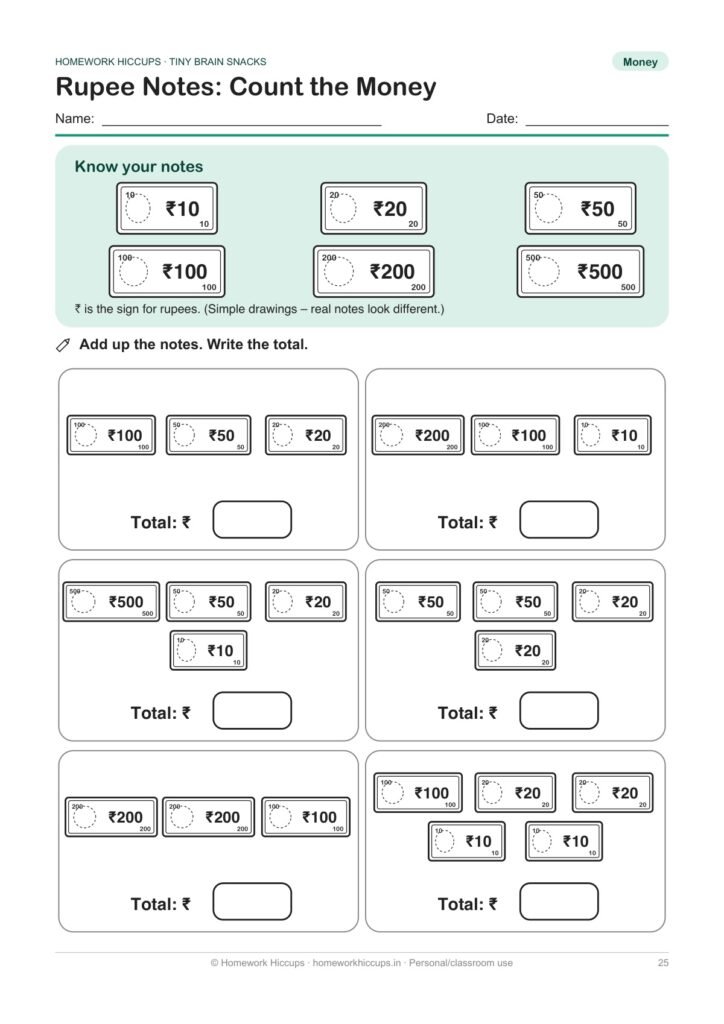
Class 2 Maths Worksheets PDF – Numbers to 1000, Carrying, Borrowing, Tables, Money & Time (50 Pages) – A4 PDF, instant download. ₹149 ₹299
You will also find 20 two-digit and 20 three-digit sums with checked answers, 10 word problems set in everyday Indian situations, the mistakes children make most often and a two-week plan. It is the companion to our post on subtraction with borrowing for Class 2, so you can teach the two side by side.
🧰 Make practice more fun at home
As an Amazon Associate, Homework Hiccups earns from qualifying purchases, at no extra cost to you.
Quick answer: To add with carrying (also called regrouping):
- Line up the numbers in ones, tens and hundreds columns.
- Add the ones first. If the answer is 10 or more, write the ones digit and carry the 1 ten to the top of the tens column.
- Add the tens, including the carried 1. If this is 10 or more, carry 1 hundred.
- Add the hundreds, including any carried 1.
- Check by estimating: 47 + 38 is about 50 + 40 = 90, so 85 makes sense.
How to teach addition with regrouping: start with money
Before any column sums, children need to understand one idea: ten ones make one ten. Indian money makes this easy because every child knows a ₹10 note is worth ten ₹1 coins.
Give your child four ₹10 notes and seven ₹1 coins (47 rupees). Then give three ₹10 notes and eight ₹1 coins (38 rupees). Ask them to put all the coins together: 15 coins. Now ask, “Can we swap ten coins for a note?” They swap, and now have 8 notes and 5 coins: ₹85. That swap is exactly what carrying means.
No real money at home? Use bundles of ice-cream sticks or matchsticks held with a rubber band (one bundle = 10) and loose sticks for ones. For three-digit sums, a ₹100 note or a big bundle of ten bundles stands for a hundred. Our place value worksheets for Class 1 post has more ideas for building this foundation.
Addition with carrying for Class 2: the column method
Two-digit example: 47 + 38
| Step | What to do | Result |
|---|---|---|
| 1 | Write 47 above 38, ones under ones, tens under tens. | T O columns lined up |
| 2 | Add the ones: 7 + 8 = 15. | 15 is 1 ten and 5 ones |
| 3 | Write 5 in the ones column. Write a small 1 above the tens column. | carry 1 |
| 4 | Add the tens: 4 + 3 + the carried 1 = 8. | 8 tens |
| 5 | Read the answer. | 85 |
Three-digit example: 368 + 257
- Ones: 8 + 7 = 15. Write 5, carry 1 to the tens.
- Tens: 6 + 5 + 1 = 12. Write 2, carry 1 to the hundreds.
- Hundreds: 3 + 2 + 1 = 6. Write 6.
- Answer: 625. Estimate: about 370 + 260 = 630, so 625 is sensible.
Teach children to say the steps aloud: “Ones first. Is it ten or more? Then carry.” Saying it helps them remember the order.
2 digit addition with regrouping worksheet: 20 sums
Write each sum in columns on squared paper or in a maths notebook, one digit per box. Sums 1 to 15 have answers under 100. Sums 16 to 20 are a Class 2 challenge with answers over 100.
| A | B | C | D | E |
|---|---|---|---|---|
| 1) 47 + 38 | 2) 26 + 35 | 3) 18 + 27 | 4) 39 + 44 | 5) 56 + 28 |
| 6) 65 + 17 | 7) 29 + 49 | 8) 34 + 58 | 9) 48 + 36 | 10) 15 + 67 |
| 11) 57 + 25 | 12) 68 + 24 | 13) 19 + 19 | 14) 46 + 46 | 15) 73 + 18 |
| 16) 78 + 45 | 17) 66 + 58 | 18) 89 + 23 | 19) 54 + 68 | 20) 95 + 38 |
Answers: 1) 85 2) 61 3) 45 4) 83 5) 84 6) 82 7) 78 8) 92 9) 84 10) 82 11) 82 12) 92 13) 38 14) 92 15) 91 16) 123 17) 124 18) 112 19) 122 20) 133
3 digit addition with carrying: 20 sums
Sums 1 to 4 carry from the ones only. Sums 5 to 8 carry from the tens only. Sums 9 to 20 carry twice. All answers are under 1000.
| A | B | C | D |
|---|---|---|---|
| 1) 245 + 137 | 2) 318 + 256 | 3) 426 + 147 | 4) 509 + 283 |
| 5) 137 + 182 | 6) 264 + 351 | 7) 472 + 163 | 8) 385 + 241 |
| 9) 368 + 257 | 10) 479 + 186 | 11) 156 + 267 | 12) 593 + 248 |
| 13) 275 + 389 | 14) 647 + 158 | 15) 338 + 494 | 16) 196 + 407 |
| 17) 458 + 375 | 18) 599 + 201 | 19) 287 + 536 | 20) 349 + 478 |
Answers: 1) 382 2) 574 3) 573 4) 792 5) 319 6) 615 7) 635 8) 626 9) 625 10) 665 11) 423 12) 841 13) 664 14) 805 15) 832 16) 603 17) 833 18) 800 19) 823 20) 827
Sums 16 and 18 are worth a chat. In 196 + 407 the tens add to 9 + 0 + 1 = 10, so the tens digit is 0 and 1 is carried again. In 599 + 201 there is a carry from both the ones and the tens, giving exactly 800.
Addition with carrying word problems
Word problems show children why addition matters. Ask them to underline the numbers, decide that the question wants a total, and then write the sum in columns.
- A sweet shop sold 46 ladoos in the morning and 37 in the evening. How many ladoos did it sell in all?
- Aman scored 58 runs in the first match and 34 runs in the second. How many runs did he score altogether?
- There are 27 boys and 35 girls in Class 2B. How many children are there in the class?
- Mummy paid ₹65 for apples and ₹48 for bananas. How much did she spend?
- A train had 245 passengers. At the next station, 168 more got on and nobody got off. How many passengers are on the train now?
- The school library has 356 Hindi books and 278 English books. How many books is that?
- On Diwali, Meena lit 129 diyas and her brother lit 95. How many diyas did they light together?
- For a rangoli, Dadi used 186 red flowers and 147 yellow flowers. How many flowers did she use?
- A farmer picked 475 mangoes on Monday and 389 on Tuesday. How many mangoes did he pick in two days?
- A bus travelled 238 km on the first day and 196 km on the second day. How far did it travel in total?
Answers: 1) 83 ladoos 2) 92 runs 3) 62 children 4) ₹113 5) 413 passengers 6) 634 books 7) 224 diyas 8) 333 flowers 9) 864 mangoes 10) 434 km
For problem 7, remind children to write 95 under the tens and ones of 129, not under the hundreds.
Prefer ready-to-print pages?
Class 2 Maths Worksheets PDF – Numbers to 1000, Carrying, Borrowing, Tables, Money & Time (50 Pages) – A4 PDF, instant download. ₹149 ₹299
Common mistakes with addition with carrying
- Writing the whole ones total: 47 + 38 written as “715” because the child wrote 15 in the ones column. Only the ones digit goes there; the ten is carried.
- Forgetting the carried 1: the answer comes out ten less (75 instead of 85). Ask children to write the carry clearly and tick it once used.
- Starting from the left: always add the ones first, then tens, then hundreds.
- Misaligned columns: especially when adding a two-digit number to a three-digit one. Squared paper helps.
- Carrying when not needed: some children carry every time. Ask, “Is it ten or more?” before carrying.
- Not checking: a quick estimate catches most errors. If 47 + 38 comes out as 715, the estimate of about 90 shows it is wrong.
A two-week plan
| Days | Focus | Activity |
|---|---|---|
| 1–2 | Ten ones make one ten | Swap ₹1 coins for ₹10 notes; bundle sticks |
| 3–4 | Two-digit carrying with objects | Do sums 1–5 with money, then on paper |
| 5–6 | Two-digit column method | Sums 6–15, saying the steps aloud |
| 7 | Answers over 100 | Sums 16–20 |
| 8–9 | Three-digit, one carry | Three-digit sums 1–8 |
| 10–11 | Three-digit, two carries | Three-digit sums 9–20 |
| 12–13 | Word problems | Problems 1–10 |
| 14 | Review | Redo any wrong sums; make up two word problems |
Ten minutes a day is plenty. If your child is still unsure about tens and ones, spend longer on days 1 and 2. If adding without carrying is shaky, go back to our addition worksheets for Class 1 first.
Class 2 maths worksheets addition: print-ready practice
Our Class 2 Maths Worksheets PDF (₹149, 50 A4 pages) has separate pages for 2-digit and 3-digit addition with carrying in H/T/O columns. The first sum on each page is fully worked in grey, showing the carried 1s. There is also a mixed add-or-subtract page, 10 word problems with Indian context, subtraction with borrowing, numbers to 1000, tables 2 to 5, money, time, measurement, shapes and data, with five answer-key pages. It follows common Class 2 themes and is not an official board or NCERT workbook.
Get the Class 2 Maths Worksheets – ₹149
Want to see the pages first? Try a free sample first: 3 real pages from the pack, plus the cover and contents page. For the full year’s topics, read our guide to maths worksheets for Class 2.
🧸 Learning toys kids love
As an Amazon Associate, Homework Hiccups earns from qualifying purchases, at no extra cost to you.
Frequently asked questions
What is addition with carrying?
Addition with carrying is adding numbers when a column adds up to 10 or more. We write the ones digit in that column and carry the 1 to the next column on the left. It is also called addition with regrouping.
How do you explain carrying to a child?
Use money. Ten ₹1 coins can be swapped for one ₹10 note. When the ones add up to 10 or more, we swap ten ones for one ten and move it to the tens column. That swap is carrying.
What is 47 + 38 with carrying?
Add the ones: 7 + 8 = 15. Write 5 and carry 1. Add the tens: 4 + 3 + 1 = 8. The answer is 85.
When do children learn 3 digit addition with carrying?
Many schools teach two-digit addition with carrying in late Class 1 or Class 2, and three-digit addition with carrying in Class 2 or Class 3. The order depends on the school and textbook.
How can my child check an addition answer?
Estimate by rounding each number to the nearest ten or hundred and adding. If the answer is far from the estimate, check the carrying again. Older children can also check by subtracting one number from the answer.