Many of us remember chanting tables in a sing-song voice — “do ekam do, do dooni chaar” — until they stuck. Reciting still helps, but children learn multiplication tables much more easily when they also understand why 3 × 4 is 12 and spot the patterns hiding inside each table. Patterns turn a long list into a puzzle they can crack.
Print-ready worksheets for this topic
Times Tables, Time & Money Worksheets PDF – Tables 2–10, Clock, Calendar & Indian Rupees (41 Pages) – A4 PDF, instant download. ₹99 ₹199
This guide covers simple tricks for every table from 2 to 10 and a four-week plan that takes about five minutes a day.
Quick answer: The easiest way for kids to learn multiplication tables from 2 to 10:
- Understand first: show multiplication as equal groups and skip counting (3, 6, 9, 12…).
- Learn the easy tables first: 2s (doubling), 10s (add a zero), 5s (answers end in 0 or 5).
- Use the swap rule: 3 × 8 is the same as 8 × 3, so every fact you learn gives you a second one free — nearly halving the work.
- Use tricks for the harder tables: 4s are double the 2s, 9s have a finger trick and digits that add up to 9, and 6s are the 5s plus one more group.
- Practise little and often: five minutes a day, one table at a time, with a quick weekly speed check.
When do children learn multiplication tables?
It varies by school and board. Many schools introduce multiplication as repeated addition in Class 2, often starting with the 2, 5 and 10 tables, and expect children to know tables up to 10 by Class 3 or 4. Check your child’s school plan for the exact order.
Start with understanding, not memorising
Before any table, make sure your child knows what multiplication means. 4 × 3 simply means “4 groups of 3”. Put three peanuts on each of four plates and count them: 12. Then arrange 12 buttons as 4 rows of 3 to make an array. Turn it sideways and it becomes 3 rows of 4. Same 12 buttons.
A child who understands groups can always work out a forgotten fact instead of guessing.
Skip counting: the bridge to tables
Skip counting is counting in equal jumps: 2, 4, 6, 8… or 5, 10, 15, 20… It is the most natural way into tables. Practise it out loud while climbing stairs or clapping. Once your child can skip count by a number, they already know that table’s answers in order.
Multiplication tricks for tables 2 to 10
The swap rule (commutative property): halve the work
The order of numbers in multiplication does not change the answer: 3 × 7 = 7 × 3 = 21. This is called the commutative property. It is the single most useful idea for learning tables.
Think of the full grid of tables from 2 × 2 up to 10 × 10. That is 81 facts. But because each pair appears twice (3 × 7 and 7 × 3), there are only 45 different facts to learn. By the time your child reaches the 7 and 8 tables, they will already know most of the answers. Show this on a multiplication grid.
Table of 2: doubling
Multiplying by 2 is the same as doubling, or adding a number to itself. 2 × 6 = 6 + 6 = 12. All answers in the 2 table are even numbers.
Table of 10: add a zero
To multiply a whole number by 10, write a zero after it: 10 × 7 = 70. Explain why, not just the trick: 7 tens make 70, so the 7 moves into the tens place and a zero fills the ones place.
Table of 5: half of ten, ending in 0 or 5
Every answer in the 5 table ends in 0 or 5. Odd numbers times 5 end in 5 (5 × 3 = 15); even numbers times 5 end in 0 (5 × 4 = 20). Another trick: 5 is half of 10, so 5 × 8 is half of 10 × 8 = 80, which is 40. Counting in fives on a clock face also helps.
Table of 4: double, then double again
Multiplying by 4 is the same as doubling twice. For 4 × 6: double 6 is 12, double 12 is 24. If your child knows the 2 table, they can work out every fact in the 4 table.
Table of 3: skip counting and patterns
The 3 table is best learnt by skip counting: 3, 6, 9, 12, 15, 18, 21, 24, 27, 30. Point out that the answers go odd, even, odd, even. A child can also think “2 groups plus 1 more group”: 3 × 7 = 2 × 7 + 7 = 14 + 7 = 21.
Table of 6: the 5s plus one more group
6 × a number is 5 × that number plus one more of it. For 6 × 7: 5 × 7 = 35, then add 7 more = 42. There is also a neat pattern: when 6 multiplies an even number, the answer ends in that same number — 6 × 2 = 12, 6 × 4 = 24, 6 × 6 = 36, 6 × 8 = 48.
Table of 8: double three times
Multiplying by 8 is doubling three times. For 8 × 3: double 3 is 6, double 6 is 12, double 12 is 24. The 8 table is also double the 4 table, so 8 × 7 is double 4 × 7 (28), which is 56.
Table of 7: fewer new facts than you think
The 7 table has a reputation for being hard, but by the swap rule your child already knows most of it: 7 × 2, 7 × 3, 7 × 4, 7 × 5, 7 × 6, 7 × 9 and 7 × 10 all come from other tables. That leaves just 7 × 7 = 49 and 7 × 8 = 56. For the second, children love the pattern 5, 6, 7, 8: 56 = 7 × 8.
Table of 9: the finger trick and the digit sum
The 9 table has two lovely tricks:
- Finger trick: hold up all ten fingers. To find 9 × 4, fold down the fourth finger from the left. There are 3 fingers to the left of the folded one (tens) and 6 to the right (ones): 36. It works for 9 × 1 up to 9 × 10.
- Digit sum and the tens digit: for 9 × 2 up to 9 × 10, the digits of the answer add up to 9 (9 × 6 = 54, and 5 + 4 = 9). Also, the tens digit is one less than the number you are multiplying by: for 9 × 6, the tens digit is 5, and 5 + 4 = 9, so the answer is 54.
Another way to think of it: 9 × a number is 10 × that number minus one group. 9 × 7 = 70 − 7 = 63.
A 4-week plan to learn tables 2 to 10
About five minutes a day, five or six days a week. Thanks to the swap rule, the later tables have fewer new facts.
| Week | Tables | Main trick | Daily 5-minute routine |
|---|---|---|---|
| 1 | 2, 10 and 5 | Doubling, add a zero, ends in 0 or 5 | Groups with objects, skip count aloud, one table page |
| 2 | 4 and 3 | Double-double, skip counting by 3 | Skip count, fill the table, revise one Week 1 table |
| 3 | 9 and 6 | Finger trick, digit sum, 5s plus one group | Finger trick practice, mixed questions from Weeks 1–3 |
| 4 | 8 and 7 | Double three times, swap rule, 5-6-7-8 | Fill the multiplication grid, short speed check |
At the end of each week, do a short, friendly speed check: ten mixed questions, with your child trying to beat their own time from last week. Compare only with their own earlier score, never with siblings or classmates.
Prefer ready-to-print pages?
Times Tables, Time & Money Worksheets PDF – Tables 2–10, Clock, Calendar & Indian Rupees (41 Pages) – A4 PDF, instant download. ₹99 ₹199
Tips to make tables practice stick
- Say it, write it, use it. Recite a table aloud, write it once, and then use it in a real question: “There are 4 of us and each wants 3 rotis. How many rotis?”
- Mix the order. Once a table is known in order, ask facts out of order. Aim for 6 × 7 without counting up from 6 × 1.
- Use everyday moments. Count autorickshaw wheels (3s), chair legs (4s) or ₹5 and ₹10 coins.
- Stay calm about mistakes. Ask your child to work out a wrong fact with a trick rather than simply giving the answer.
Printable multiplication tables practice
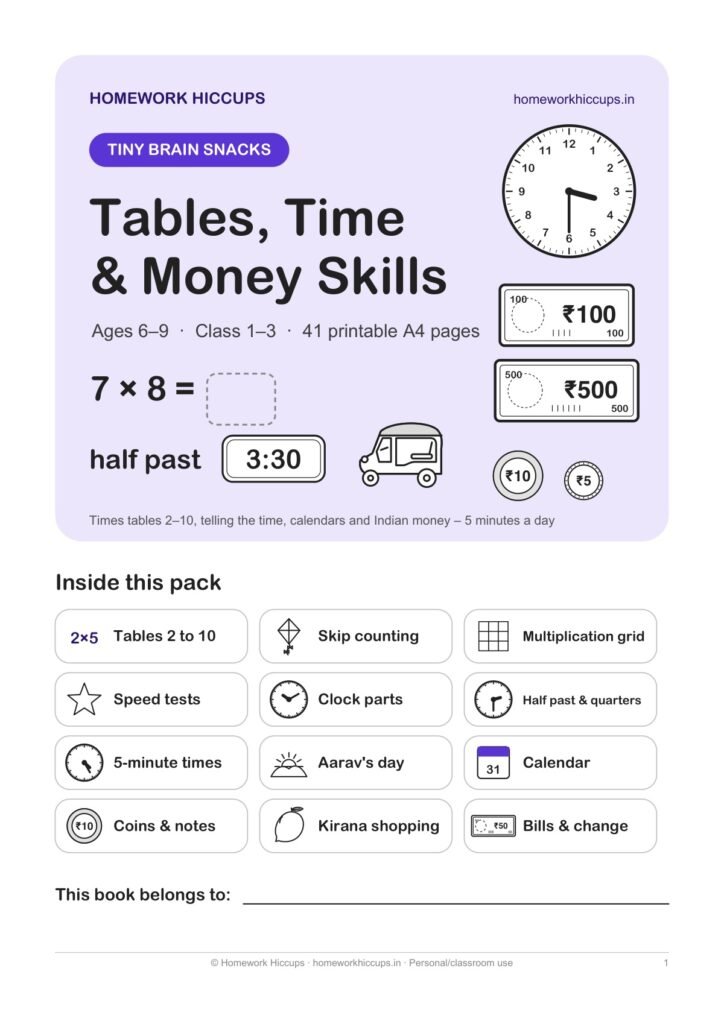
If you would like ready-made, screen-free practice pages, our Tables, Time & Money pack has 41 printable A4 pages that fit neatly with the four-week plan.
| What you need | What’s in the pack |
|---|---|
| One table at a time | Tables 2–10, one page each |
| See the swap rule | A multiplication grid |
| Weekly checks | Speed tests |
| Bonus: time | Clocks to 5 minutes and a calendar page |
| Bonus: money | Indian money practice with a kirana shop activity |
Get the Tables, Time & Money Pack – ₹99
Payment is by UPI through Razorpay, and you can reprint pages whenever needed. For broader Class 2 practice, see the Class 2 Maths worksheets (₹149), or explore the Complete Worksheet Library bundle and everything else in the shop.
Want everything for Nursery to Class 2?
Complete Worksheet Library – All 20 Packs for Ages 3–8 (790+ Pages): all 20 printable packs, 790+ A4 pages of English, maths, Hindi, EVS and festival activities. ₹699 ₹2130
Frequently asked questions about learning multiplication tables
What is the easiest way to learn multiplication tables?
Start with understanding (equal groups and skip counting), learn the easy 2, 5 and 10 tables first, and use the swap rule so each fact counts twice. Then use tricks for the harder tables and practise for about five minutes a day.
Which multiplication table should a child learn first?
Most children find the 2, 10 and 5 tables easiest, because they connect to doubling, place value and counting in fives. After that, 4 and 3 are a natural next step, followed by 9, 6, 8 and 7.
How does the 9 times table finger trick work?
Hold up ten fingers and fold down the finger matching the number you are multiplying by 9. Fingers to the left of the folded one are the tens, and fingers to the right are the ones. For 9 × 4, that gives 3 and 6, so 36.
How long does it take to learn tables from 2 to 10?
It varies from child to child. With about five minutes of regular daily practice, many children can work through tables 2 to 10 in around four weeks, then keep them fresh with short weekly revision.
Should children memorise tables or understand them?
Both. Understanding helps children work out a fact they have forgotten, while regular practice makes facts quick and automatic. Recitation works best when it is combined with groups, arrays and tricks.