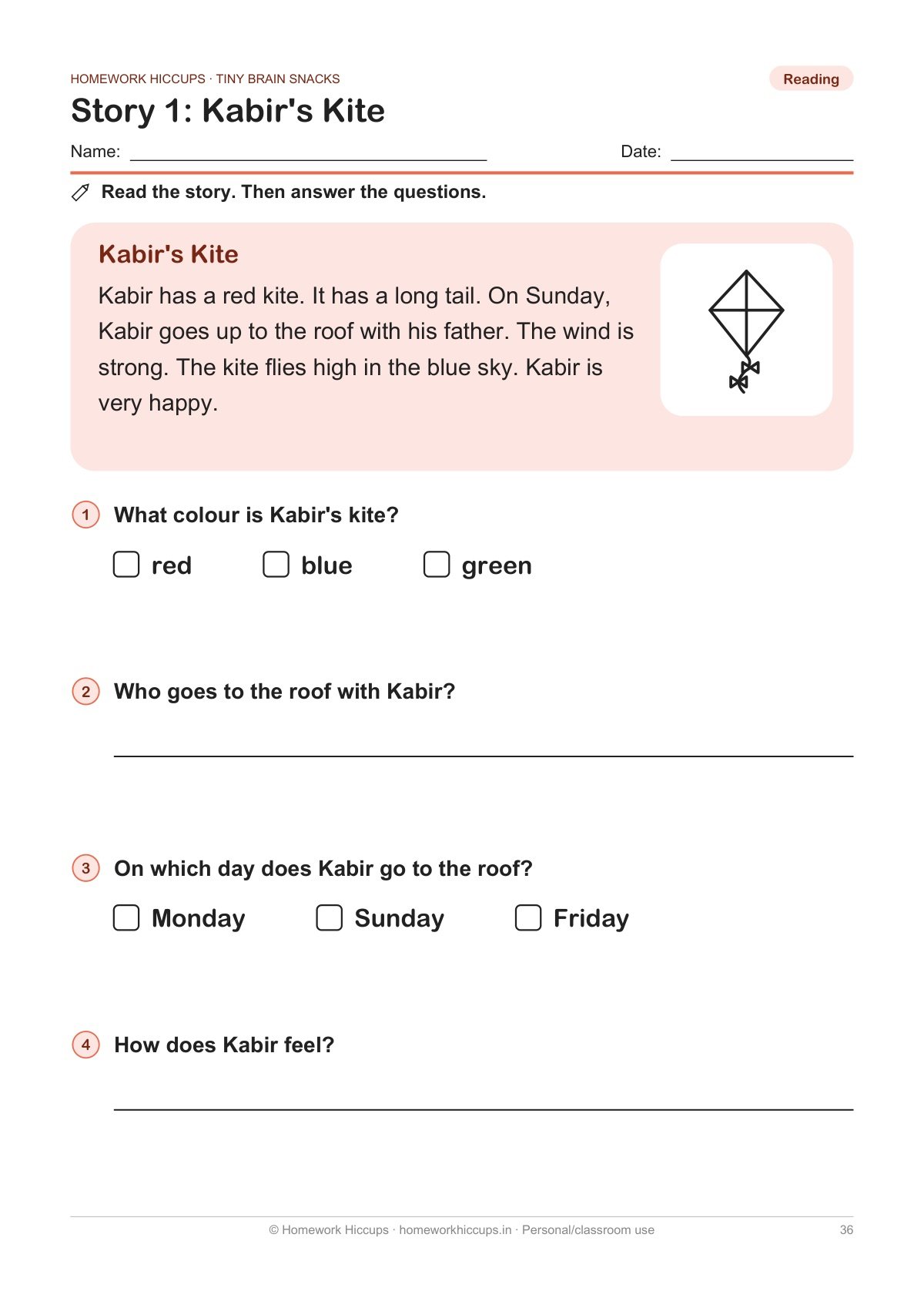
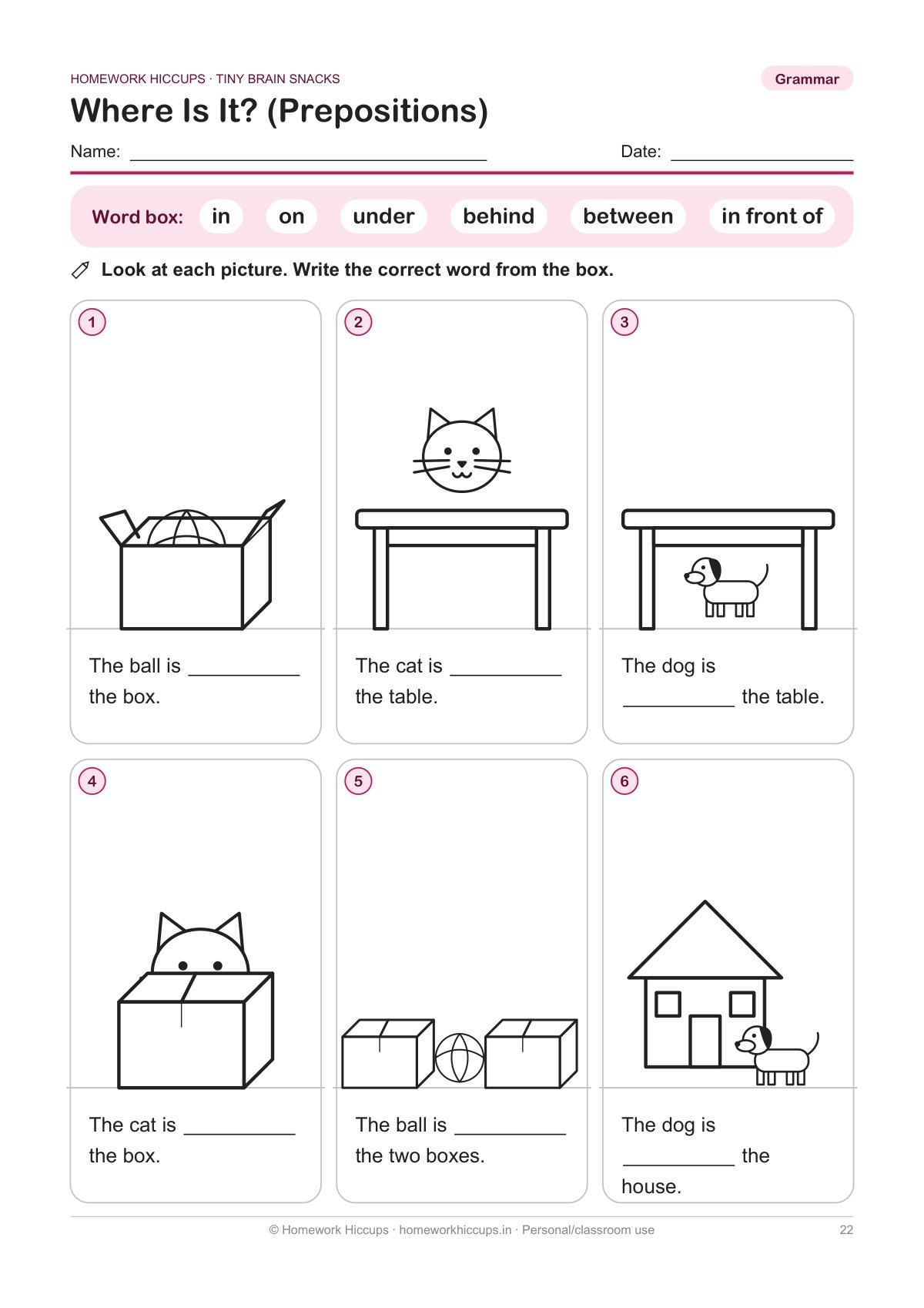
UKG is the year numbers start to mean something. Your child moves from reciting 1 to 20 to understanding that 23 comes just after 22, that 7 is bigger than 4 and that three ladoos plus two ladoos makes five. Good maths worksheets for UKG support that shift with short, clear practice, not pages of copying numbers.

Print-ready worksheets for this topic
UKG Worksheets PDF – Tiny Brain Snacks Starter Pack (46 Pages) – A4 PDF, instant download. ₹149 ₹299
This guide is for parents and pre-primary teachers. It covers what UKG maths commonly includes, a month-by-month plan for the school year, ready-to-copy practice with verified answers you can use for free, and the free UKG sample if you want to try printed pages first. Schools vary, so use it as a guide to what many schools teach rather than an official syllabus.
Quick answer: UKG maths worksheets usually practise:
- Numbers: counting, reading and writing to 50, and in many schools to 100.
- Number names: one to twenty, sometimes to fifty or a hundred.
- Number order: before, after and between; filling missing numbers.
- Comparing: bigger and smaller, more and less, using > and <.
- Adding and taking away: with pictures, within 10.
- Shapes and patterns: circle, square, triangle, rectangle; what comes next.
What maths for UKG class commonly includes
By UKG, most children can count objects to 10 and recognise numbers to 20. The UKG year builds on that in a few clear strands.
| Topic | What children practise | Example |
|---|---|---|
| Counting and writing numbers | Counting objects, writing numbers to 50, then to 100 in many schools | Count 14 stars, write 14 |
| Number names | Reading and spelling number words | 12 = twelve |
| Before, after, between | Number order and missing numbers | __ 29 __ = 28, 30 |
| Comparing numbers | Bigger and smaller, more and less, > and < | 17 > 9 |
| Addition with pictures | Counting two groups together, sums within 10 | 3 + 2 = 5 |
| Taking away | Crossing out and counting what is left, within 10 | 7 − 3 = 4 |
| Shapes | Naming 2D shapes, counting sides and corners | A triangle has 3 sides |
| Patterns | Shape patterns and counting in 2s, 5s and 10s | 10, 20, 30, 40 |
| Ordinal numbers | First to fifth in a line or race | Meera came 1st |
If you are unsure how this differs from the year before, our post on the difference between LKG and UKG explains how expectations step up, and the UKG syllabus guide covers English, EVS and Hindi too.
A month-by-month UKG maths plan
Most Indian schools run from April to March. This plan moves one small step at a time. Ten minutes of maths a day, plus counting in everyday life, is plenty.
| Months | Focus | Everyday practice |
|---|---|---|
| April – May | Revise 1 to 20: count, read, write; number names one to ten | Count stairs, spoons, rotis |
| June – July | Numbers 21 to 50; number names to twenty; shapes | Find circles and squares at home |
| August | Before, after and between to 50; missing numbers | Read house or flat numbers aloud |
| September | Bigger and smaller; more and less; > and < | Who has more grapes? |
| October – November | Addition with pictures within 10 | Add toys or ladoos on a plate |
| December | Taking away within 10; simple story sums | Eat 2 biscuits, how many left? |
| January | Numbers 51 to 100; counting in tens | Count ₹10 notes or coins |
| February | Patterns; counting in 2s and 5s; 1st to 5th | Bead or bangle patterns |
| March | Mixed revision | Play shop with real coins |
Free UKG maths worksheet: ready-to-copy practice with answers
Copy any of these into a notebook or onto a sheet of A4. Every answer has been checked, and the answers sit just below each set, so cover them before your child starts.
1. UKG number worksheets: before, after and between
Write the number that comes just before and just after.
- __ 15 __
- __ 29 __
- __ 40 __
- __ 67 __
- __ 99 __
Write the number that comes in between.
- 18 __ 20
- 45 __ 47
- 59 __ 61
- 79 __ 81
Answers: Before and after: 14, 16 · 28, 30 · 39, 41 · 66, 68 · 98, 100. Between: 19 · 46 · 60 · 80.
For a full explanation and more practice, see our post on before and after numbers.
2. Fill the missing numbers
- 21, 22, __, 24, __
- 36, __, 38, __, 40
- 10, 20, __, 40, __
- 50, 49, __, 47, __
Answers: 23, 25 · 37, 39 · 30, 50 · 48, 46.
3. Number names
Match the number to its name, or write the name on the line.
| Number | Name | Number | Name |
|---|---|---|---|
| 11 | eleven | 16 | sixteen |
| 12 | twelve | 17 | seventeen |
| 13 | thirteen | 18 | eighteen |
| 14 | fourteen | 19 | nineteen |
| 15 | fifteen | 20 | twenty |
Spellings to watch: forty has no “u” even though four does, and fifteen and fifty use “fif”, not “five”. When your child is ready to go further, our list of number names 1 to 100 has every number written out.
4. Bigger or smaller: use >, < or =
Tell your child the crocodile always opens its mouth towards the bigger number.
- 34 __ 43
- 56 __ 52
- 70 __ 17
- 88 __ 89
- 25 __ 25
Answers: 34 < 43 · 56 > 52 · 70 > 17 · 88 < 89 · 25 = 25.
5. Addition worksheets for UKG: adding with pictures
Draw the pictures (dots, apples or stars) for each group, count them all, then write the total.
- 2 apples + 3 apples = __
- 4 stars + 1 star = __
- 3 balls + 3 balls = __
- 5 kites + 2 kites = __
- 4 + 4 = __
- 6 + 3 = __
- 7 + 2 = __
- 1 + 9 = __
Story sums:
- Riya has 3 ladoos. Her nani gives her 2 more. How many ladoos does Riya have now?
- Aarav has 4 kites. Meera gives him 3 kites. How many kites does Aarav have?
Answers: 5 · 5 · 6 · 7 · 8 · 9 · 9 · 10. Story sums: 5 ladoos · 7 kites.
6. Taking away
Draw the pictures, cross out the ones that go away, then count what is left.
- 5 − 1 = __
- 7 − 3 = __
- 9 − 4 = __
- 10 − 6 = __
- 8 − 8 = __
Answers: 4 · 4 · 5 · 4 · 0.
7. Shapes
Ask your child to find each shape at home, then fill in the sides and corners.
| Shape | Sides | Corners | Things at home |
|---|---|---|---|
| Circle | 0 straight sides | 0 | roti, bangle, clock |
| Triangle | 3 | 3 | samosa, a slice of sandwich cut corner to corner |
| Square | 4 (all the same length) | 4 | carrom board, a square tile |
| Rectangle | 4 (two long, two short) | 4 | door, book, phone |
| Oval | 0 straight sides | 0 | egg, a serving platter |
8. Patterns: what comes next?
- 2, 4, 6, __, __
- 5, 10, 15, __, __
- 10, 20, 30, __, __
- 20, 19, 18, __, __
- circle, square, circle, square, __
Answers: 8, 10 · 20, 25 · 40, 50 · 17, 16 · circle.
9. Counting to 100 and first to fifth
Count in tens to 100 together: 10, 20, 30, 40, 50, 60, 70, 80, 90, 100. Then ask your child to fill the gaps: 60, 70, __, 90, __.
Next, line up five toys and race them across the floor. Say the order aloud: first, second, third, fourth, fifth. Then try this: three children run a race. Kabir finishes before Diya. Diya finishes before Sam. Who came first of these three?
Answers: 80, 100 · Kabir came first of the three, then Diya, then Sam.
Prefer ready-to-print pages?
UKG Worksheets PDF – Tiny Brain Snacks Starter Pack (46 Pages) – A4 PDF, instant download. ₹149 ₹299
Tips to make UKG maths stick
- Touch before paper. Let your child count real objects first, then the same sum on paper. Rajma beans, buttons and bottle caps all work.
- Fingers are fine. Counting on fingers is a normal step at this age, not a bad habit.
- Talk maths all day. “Bring me 4 spoons.” “Who has more rotis?” “What comes after 29?” A few questions a day matter more than an extra worksheet.
- Watch for reversals. Writing 3, 7 or 9 backwards is common in UKG. Gently show the correct starting point and keep going.
- Stop while it is fun. Five happy minutes beat twenty tearful ones.
UKG maths worksheets PDF: the UKG Starter Pack
If you would like print-ready pages, our UKG Starter Pack (₹149, ages 5 to 6) has 46 A4 pages covering phonics, sight words, sentences, maths to 50 and a little EVS. The maths section includes:
- Number names one to ten and eleven to twenty (read, trace and write)
- Numbers 1 to 50: a tracing page and a fill-the-gaps grid
- Count to 20: count and write, and count and circle the right number
- Bigger or smaller, and a page of > and < with a crocodile hint
- Two pages of adding with pictures (sums to 10) and two pages of taking away
- Before, after and between (numbers to 50) with a number helper strip
- Patterns (counting in 2s and 5s, and back in 5s) and a 1st to 5th race page
It also has beginning sounds, vowels, six word families, sight words, sentence writing, five My World pages, three pages of answer keys, a 4-week progress tracker and a certificate. It does not include a separate shapes page or numbers beyond 50, so use the shapes table and the 51 to 100 practice on this page alongside it. The pages are mostly black line art and print well in black and white; the licence covers personal or single-classroom use.
Get the UKG Starter Pack – ₹149
Want to check the level first? Try a free sample first: a 5-page PDF with the cover, 3 real pages from the pack and a contents page. Enter your name and email at checkout and download it with no payment.
For a closer look at every page in the pack, read our UKG worksheets PDF guide, or browse all UKG worksheets and maths worksheets.
Want everything for Nursery to Class 2?
Complete Worksheet Library – All 20 Packs for Ages 3–8 (790+ Pages): all 20 printable packs, 790+ A4 pages of English, maths, Hindi, EVS and festival activities. ₹699 ₹2130
Frequently asked questions
What maths is taught in UKG?
Many schools teach counting and writing numbers to 50 or 100, number names, before, after and between, comparing numbers with bigger and smaller, simple addition and taking away within 10 using pictures, basic shapes, patterns and first to fifth.
Up to which number should a UKG child count?
Most UKG children learn to count, read and write numbers to 50 during the year, and many schools go up to 100 by the end of UKG. Number names are usually taught to twenty, and sometimes further.
Should UKG children do addition?
Yes, simple addition within 10 is commonly taught in UKG, usually with pictures or real objects. Children count two groups together and write the total. Written sums without pictures usually come later.
How long should a UKG child do maths worksheets each day?
About 5 to 10 minutes a day is enough for most five-year-olds. One or two pages, done happily, plus counting in everyday life, works better than long sessions.
Is there a free UKG maths worksheet?
Yes. This page has free practice with answers on numbers, number names, comparing, addition, taking away, shapes and patterns. There is also a free 5-page UKG sample, while the full UKG Starter Pack costs 149 rupees.