LKG is the year numbers stop being a song and start being things you can touch. Your four-year-old learns that “five” means five ladoos on a plate, that the elephant is big and the mouse is small, and that a pencil can be longer than a crayon. Good LKG maths worksheets support this with short, playful pages, not long rows of copying.
Print-ready worksheets for this topic
LKG Worksheets PDF – Tiny Brain Snacks Starter Pack (46 Pages) – A4 PDF, instant download. ₹149 ₹299
This guide is for parents and pre-primary teachers. It explains what LKG maths usually covers, gives ready-to-copy worksheet ideas with answers, kitchen maths games, a simple term plan and the mistakes to avoid. Schools differ, so treat it as a guide to what many schools teach, not an official syllabus.
Quick answer: LKG maths worksheets usually practise:
- Numbers: recognising, counting and tracing 1 to 20 (some schools go to 50).
- Counting objects: count and write, count and colour, ten-frames.
- Number order: what comes before and after.
- Comparing: big and small, long and short, tall and short, more and less.
- Shapes and patterns: circle, square, triangle, rectangle; what comes next.
- Early addition: joining two small groups of pictures (totals up to 5, then 10).
What LKG maths worksheets usually cover
At four, most children can say numbers in order but cannot yet match each number to the right amount. The LKG year builds that link step by step. Here is what many schools include. If you want the full picture across subjects, see our LKG syllabus guide.
| Topic | What children practise | When it is usually ready |
|---|---|---|
| Numbers 1 to 10 | say, recognise, trace, count objects | first term |
| Numbers 11 to 20 | recognise and trace, count bigger groups | second term |
| Before and after | the number that comes just before or after | second term |
| Big and small | circle the big one, colour the small one | first term |
| Long and short, tall and short | compare two lengths or heights | first or second term |
| More and less | which group has more | second term |
| Shapes | circle, square, triangle, rectangle | all year |
| Patterns | AB patterns like red, blue, red, blue | second term |
| Picture addition | 2 balls and 1 ball make 3 balls | third term |
Some schools also add numbers to 50, number names one to ten or simple zero. Ask your class teacher which range they use and follow that.
LKG counting worksheets you can make at home
Counting is the heart of LKG maths. The aim is one-to-one counting: touching each object once and saying one number for it. These DIY sheets take five minutes to draw on plain paper.
1. Count and write
Draw groups of simple pictures in boxes, with an empty square next to each. Your child counts and writes the number.
- 3 mangoes. Answer: 3
- 5 stars. Answer: 5
- 2 kites. Answer: 2
- 7 flowers. Answer: 7
- 4 balloons. Answer: 4
2. Count and colour
Draw a row of 8 circles and write a number at the start, such as 6. Your child colours exactly 6 circles. Answer: 6 coloured, 2 left white. This is harder than it looks, because children must stop at the right number.
3. Ten-frame dots
Draw a box with two rows of five squares. Put dots in some squares and ask “How many?” Then ask “How many more to make 10?”
- 8 dots. Answer: 8, and 2 more make 10
- 6 dots. Answer: 6, and 4 more make 10
- 5 dots. Answer: 5, and 5 more make 10
4. Before and after number train
Draw three train coaches. Fill the middle one and leave the others blank.
- __ 4 __ Answer: 3, 5
- __ 9 __ Answer: 8, 10
- __ 12 __ Answer: 11, 13
- __ 17 __ Answer: 16, 18
For many more of these, our guide to before and after numbers has ready lists and number-line tips.
LKG maths worksheets for long and short, big and small
Comparing sizes builds the language children need for measuring later. Use real objects first, then a worksheet.
5. Long and short
Draw two pencils, one clearly longer, side by side and starting from the same line. Ask your child to circle the long one and put a cross on the short one. Repeat with two snakes, two ribbons and two trains. Answer: the one that reaches further from the starting line is long.
Tip: always line up the starting ends. If one pencil starts further left, children get confused, and that is a fair mistake.
6. Tall and short
Draw a giraffe and a goat, a tall building and a hut, or a coconut tree and a tulsi plant. Ask “Which is tall?” Answers: giraffe, building, coconut tree.
7. Big and small
Draw an elephant and a mouse, a big ball and a small ball, a watermelon and a grape. Circle the big one and colour the small one. Answers: elephant, big ball and watermelon are big.
8. More and less
Draw 4 apples in one box and 6 apples in another. Ask “Which box has more?” Answer: the box with 6. Then ask which has less. Answer: the box with 4. Keep the pictures the same size, so children compare the number and not the size.
LKG maths activity worksheets: shapes and patterns
9. Shape hunt
Draw a picture made of shapes, such as a house (square body, triangle roof, rectangle door, circle window). Ask your child to colour circles red, squares blue, triangles yellow and rectangles green, then count each. Answer for the house above: 1 square, 1 triangle, 1 rectangle, 1 circle.
Use Indian examples children know: a roti is round like a circle, a samosa looks like a triangle, a carrom board is a square and a door is a rectangle.
10. What comes next?
- red, blue, red, blue, __ Answer: red
- circle, square, circle, square, __ Answer: circle
- big ball, small ball, big ball, __ Answer: small ball
- clap, stamp, clap, stamp, __ Answer: clap
LKG maths worksheets for addition with pictures
Addition in LKG should be about joining groups, not about the plus sign. Start with real objects: “You have 2 biscuits. I give you 1 more. How many now?” Only after many such moments should you move to a picture sheet.
11. Picture addition
Draw two small groups with a plus sign between them and a box for the total.
| Pictures | Number sentence | Answer |
|---|---|---|
| 2 balls and 1 ball | 2 + 1 | 3 |
| 3 ducks and 2 ducks | 3 + 2 | 5 |
| 1 kite and 3 kites | 1 + 3 | 4 |
| 4 ladoos and 2 ladoos | 4 + 2 | 6 |
| 5 stars and 3 stars | 5 + 3 | 8 |
| 6 fish and 4 fish | 6 + 4 | 10 |
Let your child count all the pictures from one. “Counting on” (starting at 4 and saying 5, 6) usually comes later, in UKG.
Prefer ready-to-print pages?
LKG Worksheets PDF – Tiny Brain Snacks Starter Pack (46 Pages) – A4 PDF, instant download. ₹149 ₹299
Kitchen maths games for LKG
Children learn maths fastest when it is part of real life. These games need nothing but what is already in your kitchen.
- Roti count: “We need one roti for each person. How many people are eating?” Count plates together.
- Spoon sort: Sort big spoons and small spoons into two piles. Which pile has more?
- Vegetable line-up: Put a long bottle gourd (lauki) and a short carrot side by side. Which is longer?
- Peas in cups: Write 1 to 5 on five small cups. Your child drops that many peas or chana into each.
- Pattern plate: Make a pattern with grapes and banana slices: grape, banana, grape, banana. What comes next?
- Snack sums: “You have 2 biscuits and I give you 2 more. How many now?” Answer: 4.
A simple LKG maths term plan
| Term | Focus | Worksheet ideas |
|---|---|---|
| Term 1 (June to September) | numbers 1 to 10, big and small, circle and square | count and write, trace 1 to 10, circle the big one |
| Term 2 (October to December) | numbers 11 to 20, before and after, long and short, triangle and rectangle, patterns | number train, ten-frames, shape hunt, what comes next |
| Term 3 (January to March) | more and less, picture addition to 5 then 10, revision | picture addition, more or less, mixed revision |
Many schools in India start the year in April or June, so shift the months to match your child’s school.
A five-minute daily routine
- One minute: count something real, such as stairs, shoes or spoons.
- Three minutes: one worksheet page or one DIY sheet.
- One minute: praise and a star on a chart.
Stop while your child is still enjoying it. Five happy minutes every day beat thirty tearful minutes once a week.
Mistakes to avoid with LKG maths
- Rote counting only. Saying 1 to 20 is not the same as counting 20 objects. Always count real things.
- Pushing number writing too early. Tracing big numbers is fine. Writing small numbers neatly in a notebook can wait.
- Worrying about reversals. Writing 2, 3, 5, 7 or 9 backwards is very common at four and five. Show the correct start point and move on.
- Too many pages. One or two pages a day is enough.
- Skipping the language. Words like more, less, before, after, long and short are maths words. Use them all day.
- Comparing with other children. Some children count to 20 in June, others in February. Both are normal.
If your child is still unsure of numbers 1 to 5, step back to our nursery maths worksheets ideas. If they are flying through 1 to 20, peek at what comes next in our maths worksheets for UKG guide.
LKG maths worksheets PDF: the LKG Starter Pack
If you would rather print than draw, our LKG Starter Pack (₹149, ages 4 to 5) has 46 A4 pages. Alongside capital and small letters A to Z, the maths pages include:
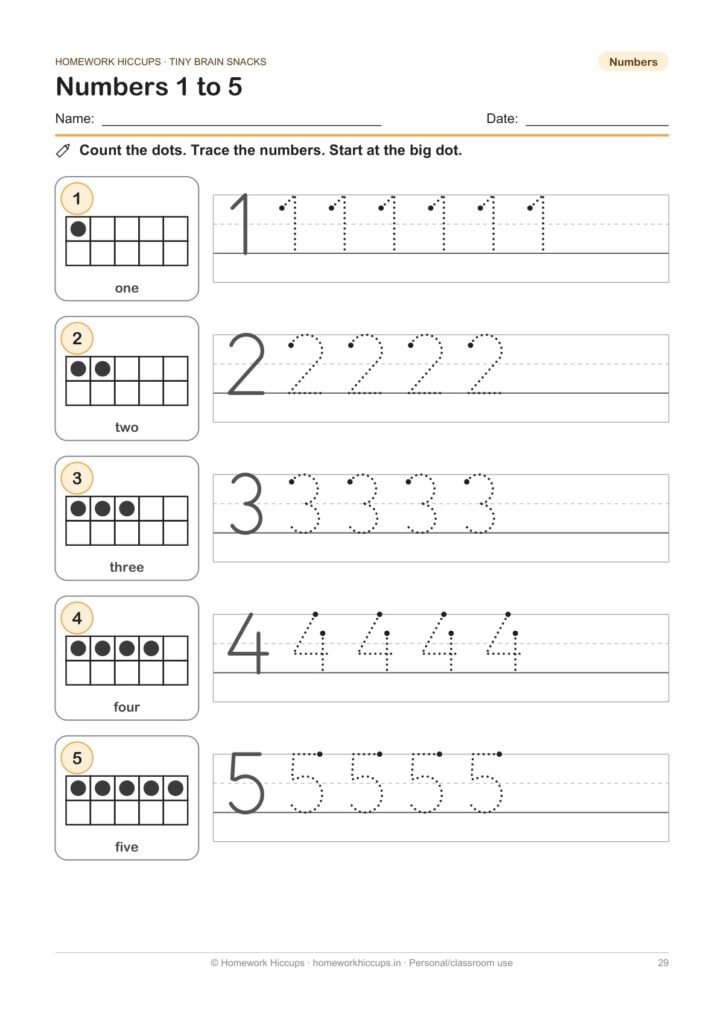
- Numbers 1 to 20 across four pages: count the dots, trace the number and read its name
- Count and write (1 to 5) and count and write (6 to 10)
- A ten-frames page with a “make 10” question
- A number train page for before and after
- Shapes: trace and say (circle, square, triangle, rectangle) and a shape hunt
- A “what comes next” patterns page and a big and small page
- Two mazes, answer keys, a 4-week tracker and a certificate
Long and short, more and less, and picture addition are not separate pages in the pack, so use the DIY ideas above for those. Everything prints in black and white on A4, for personal or single-classroom use.
Get the LKG Starter Pack – ₹149
Not sure yet? Try a free sample first: a free 6-page LKG sample. Enter your name and email at checkout and download it with no payment. You can also read our list of free LKG worksheets ideas.
You can also explore all our maths worksheets.
Frequently asked questions
What maths is taught in LKG?
Many schools teach numbers 1 to 20 (some to 50), counting objects, before and after, big and small, long and short, tall and short, more and less, basic shapes, simple patterns and picture addition with small numbers.
Up to which number should an LKG child count?
Most LKG children work on numbers 1 to 20 during the year, and some schools go to 50. Counting real objects correctly to 10 is more important than reciting to 50.
Are LKG maths worksheets with answers useful for parents?
Yes. Answers let you check a page in seconds and spot patterns, such as a child who always miscounts after 7. The DIY ideas on this page all include answers.
Should LKG children learn addition?
Light picture addition is fine in the last term, such as 2 balls and 1 ball make 3 balls. Keep totals to 5 first, then 10, and always let children count the pictures.
How many LKG maths worksheets should my child do in a day?
One or two pages, about five minutes in total, is plenty for a four-year-old. Short daily practice works much better than long weekend sessions.