Nursery maths worksheets work best when they come after play, not instead of it. A three-year-old who has counted spoons at lunch, sorted buttons into bowls and found every round thing in the kitchen will sit down with a counting sheet and actually understand it. A child who meets numbers only on paper usually ends up copying shapes without meaning.

Print-ready worksheets for this topic
Nursery Worksheets PDF for Ages 3–4 – Pre-Writing, Colours, Shapes, A–Z & 1–10 (46 Pages) – A4 PDF, instant download. ₹149 ₹299
This guide is for parents and pre-primary teachers of children aged 3 to 4. It explains what maths looks like at this age, which hands-on activities to do first, the easiest order for number tracing, how to teach shapes and big and small, a gentle four-week plan of five minutes a day, and simple worksheets you can draw yourself with a pencil and a sheet of paper. At the end you will find a free sample and our print-ready Nursery pack.
Quick answer: Good nursery maths worksheets for ages 3 to 4 focus on:
- Counting 1 to 10: count real objects first, then count and colour pictures on paper.
- Number recognition: big dotted numbers with a start dot and an arrow, one number at a time.
- Shapes: circle, square, triangle and star, traced and then found in a picture.
- Comparing: big and small, more and less, same and different, odd one out.
- Time: 3 to 5 minutes a day is plenty. Stop while your child is still enjoying it.
What maths can a 3 to 4 year old really do?
Every child is different, and every school sets its own pace, but in many Nursery, Pre-KG and playgroup classes children commonly work towards:
- Rote counting to 10, saying the numbers in order, often with a song or rhyme.
- Counting objects to 5, then to 10, touching one object for each number. This is called one-to-one counting and it is harder than it looks.
- Recognising numerals 1 to 10, pointing to a 3 when you ask for 3.
- Early tracing of numbers, usually 1 to 5 first and 6 to 10 later in the year.
- Naming basic shapes: circle, square, triangle, and often star, rectangle or oval.
- Comparing size and quantity: big and small, tall and short, more and less.
- Sorting and matching by colour, shape or type.
Notice what is not on the list: writing numbers neatly, adding on paper or counting to 100. Those come in LKG and UKG. If your child can count five spoons correctly and tell you which plate has more ladoos, they are right on track. For a fuller picture of the year, see our nursery syllabus guide.
Hands-on maths before paper
Think of worksheets as the last step. These activities use things already in any Indian home or classroom.
1. Counting at mealtimes
Count rotis on the plate, spoons on the table or grapes in a bowl. Touch each one as you say the number. When your child is confident, ask, “Can you give me three grapes?” Giving an exact number is a big step beyond just saying numbers.
2. Button and bead sorting
Put a handful of large buttons in a tray with two or three small bowls. Ask your child to sort by colour, then by size. Always sit with them, because small items are a choking risk for this age.
3. Shape hunt
Walk around the house looking for shapes. The clock is a circle, a roti is a circle, a chapati board is a circle, a window is a square or rectangle, a slice of sandwich cut corner to corner makes two triangles. Children remember shapes far better when they find them in real life.
4. Big and small toys
Line up two teddies, two cups or two shoes, one big and one small. Ask, “Which one is big? Which one is small?” Then add a third and introduce “middle”.
5. Number play-dough
Roll dough into snakes and shape them into numbers on top of a big printed or hand-written number. Squeezing and rolling dough also strengthens finger muscles. Our fine motor activities for preschoolers post has many more ideas that prepare little hands for holding a crayon.
Counting worksheets for nursery: what a good page looks like
Once your child counts real objects with confidence, a counting worksheet makes sense. A good counting worksheet for nursery has:
- Big, clear pictures that are easy to tell apart, such as mangoes, balloons or fish.
- Small numbers, usually 1 to 5 at first, never crowded on the page.
- One simple task: count and colour, count and circle the number, or colour the right number of stars.
- Very little text, because the child cannot read yet. You read the instruction aloud.
A useful trick: ask your child to colour or tick each picture as they count it. That stops them counting the same mango twice, which is the most common counting mistake at this age.
Number worksheets for nursery: the easiest tracing order
Children do not have to trace numbers in order from 1 to 10. Some numbers are much easier to form than others. Starting with simple straight-line numbers builds confidence. Here is an order many teachers find gentle:
| Stage | Numbers | Why this order |
|---|---|---|
| 1 | 1, 4, 7 | Straight lines only (standing, sleeping and slanting lines) |
| 2 | 0, 6, 9 | Built on a circle or curve, which children practise in pre-writing |
| 3 | 2, 3, 5 | Curves plus a change of direction |
| 4 | 8, 10 | 8 needs a smooth crossing curve; 10 needs two digits side by side |
Whatever the tracing order, keep counting aloud from 1 to 10 every day.
Before number tracing, children need pencil control. If your child still finds a straight standing line hard, spend a week or two on line practice first. Our guide to nursery lines worksheets explains standing, sleeping, slanting and curved lines in the right order.
Tips for tracing numbers
- Use a fat crayon or a triangular pencil. Thin pencils tire small hands.
- Always start at the green start dot and follow the arrow. Say the movement out loud: “Down, stop. That is 1.”
- Trace the number in the air with a big arm first, then on your child’s back, then on paper.
- Three or four neat tracings are better than a full row of wobbly ones.
Shapes, big and small, and other pre primary maths worksheets
Pre primary maths is much more than numbers. Shapes, size and sorting teach children to notice, compare and think, which matters as much as counting.
Shapes
Start with the circle, then the square, triangle and star. A good sequence for each shape is: find it at home, trace a big dotted outline, then find and colour that shape in a picture made of mixed shapes. Use the names consistently. Say “circle”, not “round thing”, so your child learns the real word.
Big and small
Show two pictures of the same thing in different sizes, like a big elephant and a small elephant. Ask your child to colour the big one or circle the small one. Then move to tall and short, long and short, and full and empty with real cups of water.
More and less
Draw two plates, one with 2 ladoos and one with 5. Ask, “Which plate has more?” Children often pick the plate where ladoos are spread out, so count together to check.
For more page ideas suited to this age across all subjects, see our post on worksheets for 3 year olds.
Prefer ready-to-print pages?
Nursery Worksheets PDF for Ages 3–4 – Pre-Writing, Colours, Shapes, A–Z & 1–10 (46 Pages) – A4 PDF, instant download. ₹149 ₹299
A gentle 4-week nursery maths plan (5 minutes a day)
This plan assumes five short sessions a week. Do the hands-on activity first and the worksheet second. If your child is tired or upset, skip the paper part. You can repeat any week as many times as needed.
| Week | Hands-on (2–3 minutes) | Paper (2–3 minutes) |
|---|---|---|
| Week 1: Numbers 1 to 3 | Count spoons, rotis and claps up to 3; give me 1, 2 or 3 grapes | Count and colour 1 to 3 pictures; trace 1 |
| Week 2: Numbers 4 and 5, circle and square | Count stairs to 5; shape hunt for circles and squares | Count and colour 4 and 5 pictures; trace 4; trace a circle and a square |
| Week 3: Big and small, more and less | Line up shoes by size; two plates of ladoos, which has more? | Colour the big one; circle the plate with more; trace 7 |
| Week 4: Numbers 6 to 10, triangle and star | Count buttons to 10; sort buttons by colour; find triangles | Colour N stars for 6 to 10; trace 0 and 6; trace a triangle and a star |
Give one star per session on a fridge chart. After four weeks, revisit the hardest numbers in a new way.
DIY nursery maths worksheets you can draw yourself
You do not need a printer to start. Here are six worksheets you can draw in two minutes on a plain sheet or in a notebook.
- Count and colour. Draw three rows: 2 balloons, 4 fish and 3 apples. Ask your child to colour each row and say how many. Answers: 2, 4, 3.
- Colour N stars. Draw a row of 6 stars and write a big 4 at the start. Your child colours exactly 4 stars and leaves 2 blank.
- Circle the number. Draw 5 mangoes, then write 3, 5 and 2 underneath. Your child counts and circles 5.
- Dotted number. Write a big number 1 with dots, as tall as your hand, with a dot at the top to start. Make three copies in a row.
- Shape find. Draw a simple house using a square, a triangle roof, a circle sun and a rectangle door. Ask your child to colour all the triangles red and circles yellow.
- Big and small. Draw a big cup and a small cup, a big ball and a small ball. Ask your child to put a tick on each big one.
Slip the sheet into a clear plastic pocket and use a dry-erase marker so you can reuse it.
Nursery maths worksheets PDF: our print-ready option
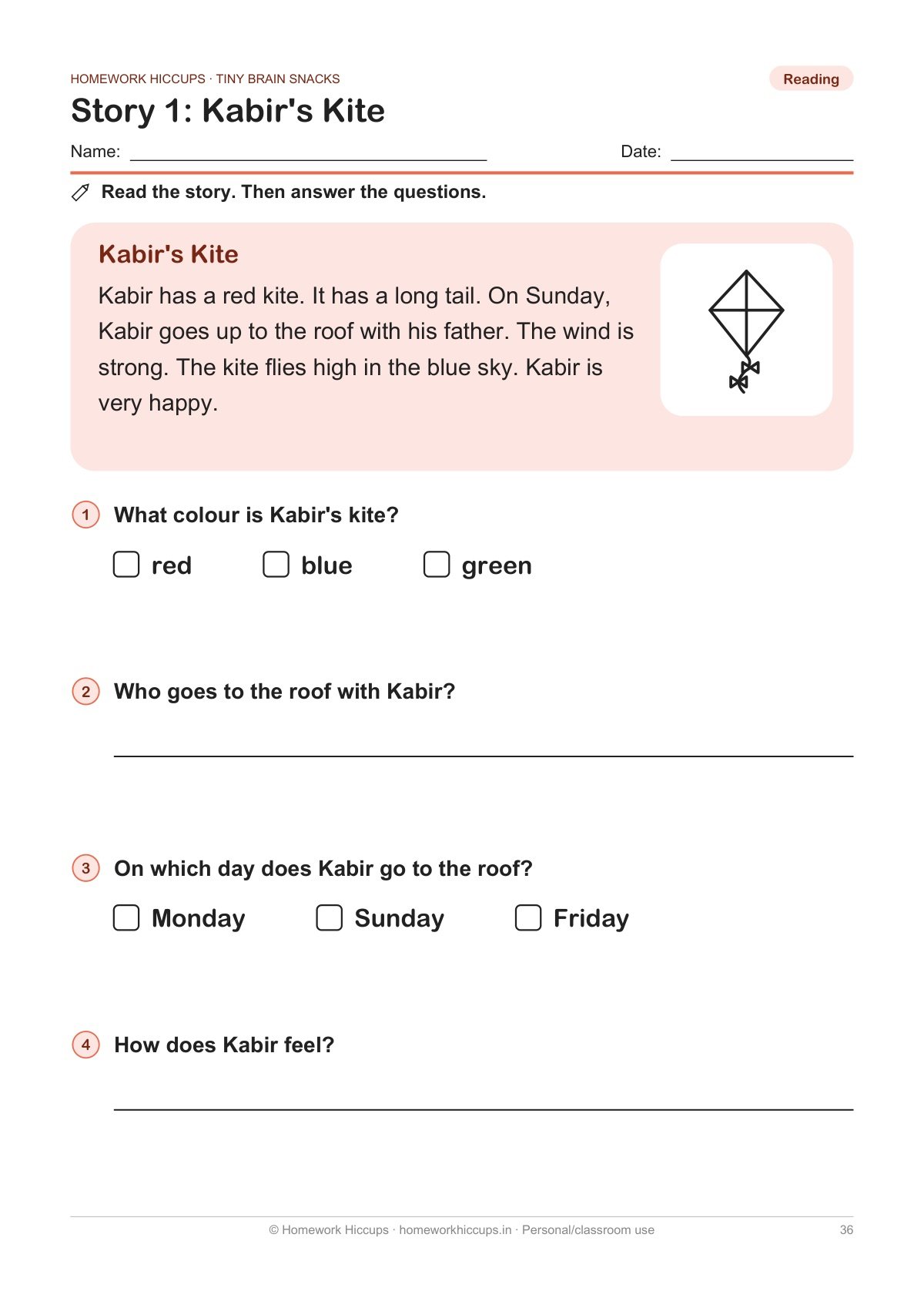
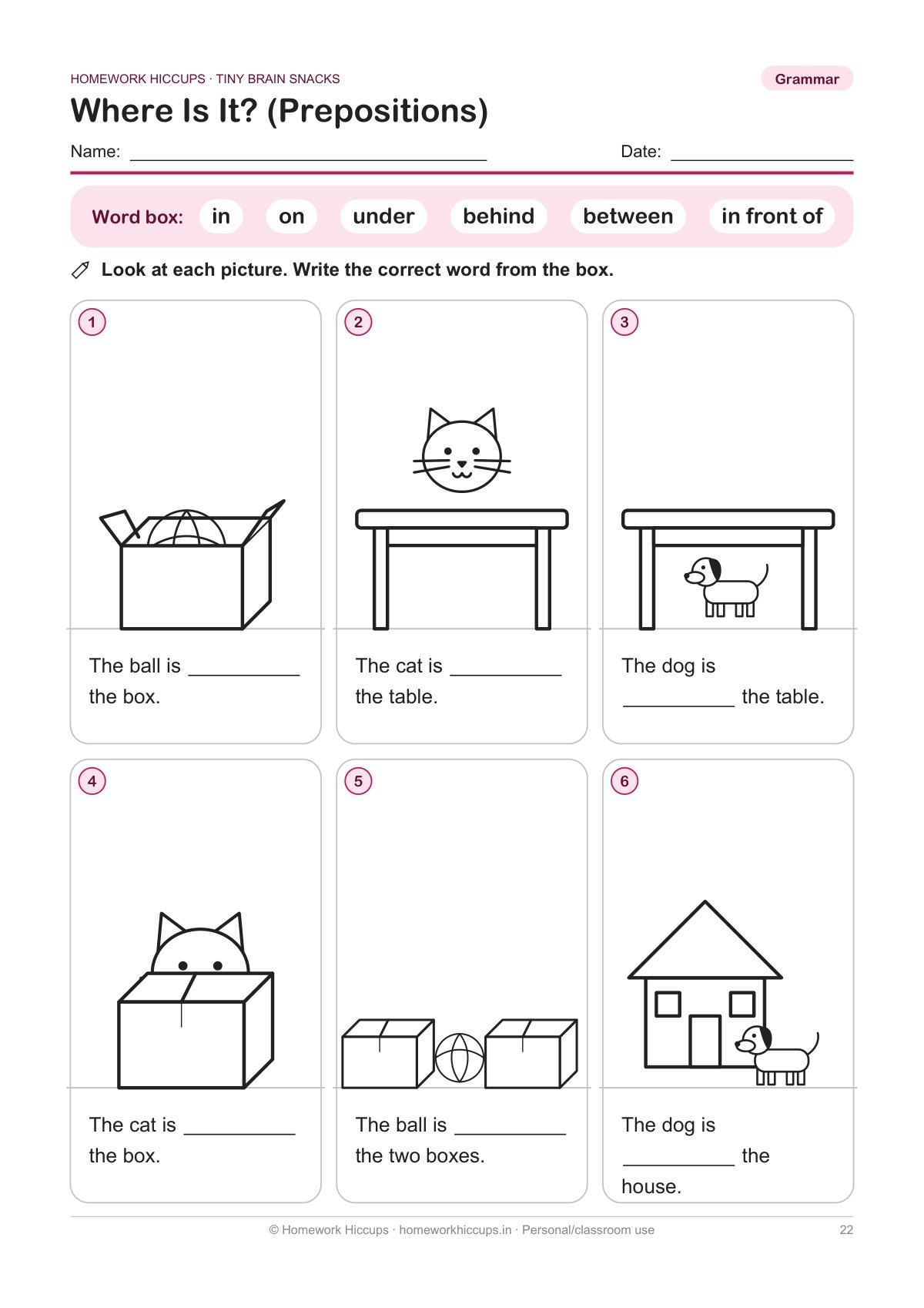
If you would rather not draw pages every evening, our Tiny Brain Snacks: Nursery Starter Pack is a 46-page printable A4 PDF made for ages 3 to 4. It covers maths alongside pre-writing and letters, so one pack takes care of the whole Nursery routine. The maths pages include:
- 5 number pages for 1 to 10, two numbers per page, each with a stroke-order model, count-and-colour pictures, big dotted tracing and a “colour N stars” task.
- 3 shape pages: trace a circle, square, triangle and star, then find and colour the shapes with a colour key.
- Thinking pages: more or less, big and small, odd one out, match the same, and fruits or vegetables sorting.
- 8 pre-writing line pages that build the pencil control needed for numbers.
- An answer key, a 4-week star tracker and a “Nursery Star” certificate.
It also has 13 capital letter pages for A to Z, colour pages, dot art, a My Body page and a parent page with grip tips. All pictures are black line art, so it prints well on any home black-and-white printer. The licence covers personal and single-classroom use.
Get the Nursery Starter Pack – ₹149
Not sure yet? Try a free sample first. The free Nursery worksheets sample has 5 pages: a cover, 3 real pages from the pack and a contents page. Add it to your cart, enter your name and email at checkout, and download it with no payment.
When your child is ready for a bit more, the Dot-to-Dot and Cut-and-Paste pack (₹79, ages 3 to 7) has dot-to-dot pictures starting at 1 to 10, which are a fun way to practise number order. You can also browse all nursery worksheets or our maths worksheets for older classes.
Common mistakes to avoid
- Too much, too soon. A full page of 20 numbers is overwhelming. One small task per page is enough.
- Skipping objects. If a child cannot count real things, a worksheet will not fix it. Go back to spoons and buttons.
- Long sessions. Five happy minutes beat twenty tearful ones. Always end on a success.
Want everything for Nursery to Class 2?
Complete Worksheet Library – All 20 Packs for Ages 3–8 (790+ Pages): all 20 printable packs, 790+ A4 pages of English, maths, Hindi, EVS and festival activities. ₹699 ₹2130
Frequently asked questions
What maths should a nursery child know?
Most nursery children aged 3 to 4 work on counting to 10, counting small groups of objects, recognising numbers 1 to 10, naming basic shapes like circle, square and triangle, and comparing big and small or more and less. Writing numbers neatly usually comes later in LKG.
At what age should a child start maths worksheets?
Many children enjoy simple counting and colouring sheets from around age 3, once they can hold a crayon and count a few real objects. Keep sessions to 3 to 5 minutes and always do a hands-on activity with real objects first.
Which numbers should my child trace first?
Straight-line numbers such as 1, 4 and 7 are easiest to trace. Then move to curved numbers like 0, 6 and 9, followed by 2, 3 and 5, and finally 8 and 10. Keep counting out loud in the normal order every day.
My child counts to 10 but gets the wrong answer when counting objects. Is that normal?
Yes, this is very common. Saying numbers in order is easier than touching one object for each number. Practise slowly with real objects, touching or moving each one as you count, and ask your child to colour each picture as they count it on paper.
Is there a free nursery maths worksheet I can try?
Yes. Our free Nursery worksheets sample has 5 pages, including 3 real pages from the 46-page Nursery Starter Pack. You enter your name and email at checkout and there is no payment. You can also draw the simple DIY worksheets in this guide at home.