Class 2 is the year maths suddenly gets bigger. Numbers jump from 100 to 1000, sums need carrying and borrowing, and children meet multiplication, money and the clock all in one session. Good maths worksheets for Class 2 help a child practise each step in small, clear chunks, so that a tricky topic like borrowing across a zero feels routine by the end of the term.
Print-ready worksheets for this topic
Class 2 Maths Worksheets PDF – Numbers to 1000, Carrying, Borrowing, Tables, Money & Time (50 Pages) – A4 PDF, instant download. ₹149 ₹299
This guide is for parents and primary teachers. It lists the topics commonly taught in Class 2 maths, gives a simple term plan, explains carrying, borrowing and early multiplication in plain words, and includes 20 ready-to-copy Class 2 maths questions with checked answers. At the end you will find a free sample and our print-ready Class 2 Maths pack.
🧰 Make practice more fun at home
As an Amazon Associate, Homework Hiccups earns from qualifying purchases, at no extra cost to you.
Quick answer: Class 2 maths worksheets usually cover:
- Numbers to 1000: hundreds, tens and ones, expanded form, comparing and ordering.
- Addition with carrying and subtraction with borrowing for 2- and 3-digit numbers.
- Multiplication for Class 2: equal groups, repeated addition and tables of 2, 3, 4, 5 and 10.
- Everyday maths: Indian money, time, calendar, length, weight, capacity and simple data.
- Routine: one short page a day, about 5 to 10 minutes, with answers checked straight away.
Topics commonly taught in Class 2 maths
Every board and school orders topics a little differently, and CBSE, ICSE and state board books do not match page for page. Still, most Class 2 maths books cover the same core ideas:
| Topic | What children practise |
|---|---|
| Numbers to 1000 | Counting, reading and writing 3-digit numbers, number names, before, after and between |
| Place value | Hundreds, tens and ones; expanded form such as 476 = 400 + 70 + 6 |
| Comparing and ordering | Using >, < and =; ascending and descending order; 10 more and 100 less |
| Odd, even and skip counting | Counting in 2s, 3s, 5s, 10s and 100s |
| Addition | 2- and 3-digit sums with and without carrying; word problems |
| Subtraction | 2- and 3-digit sums with and without borrowing, including zeros; word problems |
| Multiplication | Equal groups, repeated addition, arrays, tables of 2, 3, 4, 5 and 10 |
| Division | Equal sharing and grouping |
| Money | Indian coins and notes, making amounts, simple bills and change |
| Time and calendar | O’clock, half past, quarter past, quarter to; days, weeks and months |
| Measurement | Centimetres, heavier and lighter, kilograms, litres |
| Shapes and patterns | 2D and 3D shapes, sides and corners, symmetry, number and shape patterns |
| Data handling | Tally marks and pictographs with a key |
A simple Class 2 maths term plan
Many schools split the year into two terms. If yours uses a different order, follow the school book.
| Term | Main topics | Home practice idea |
|---|---|---|
| Term 1 (about April to September) | Numbers to 1000, place value, comparing, odd and even, skip counting, addition and subtraction without and then with carrying and borrowing, shapes | Build 3-digit numbers with bundles of matchsticks (100s, 10s and loose 1s); two sums a day |
| Term 2 (about October to March) | Multiplication, tables 2 to 5 and 10, sharing, money, time and calendar, measurement, patterns, data | Play shop with a price list; read the wall clock at fixed times each day; one table a week |
Addition with carrying for Class 2
Carrying (also called regrouping) happens when the ones add up to 10 or more. The trick is to see that 10 ones make 1 ten. Teach it in this order:
- Show it with objects first. 7 loose matchsticks plus 5 loose matchsticks makes 12. Tie 10 of them into a bundle. Now you have 1 ten and 2 ones.
- Write the sum in columns with T and O at the top, so digits line up.
- Add the ones. If the answer is 10 or more, write the ones digit below and carry the 1 to the top of the tens column.
- Add the tens, including the carried 1.
- For 3-digit sums, repeat the same idea from tens to hundreds.
Worked example: 256 + 178. Ones: 6 + 8 = 14, write 4, carry 1. Tens: 5 + 7 + 1 = 13, write 3, carry 1. Hundreds: 2 + 1 + 1 = 4. Answer: 434.
Subtraction with borrowing
Borrowing (also called regrouping) is needed when the top digit in a column is smaller than the bottom digit. Children break 1 ten into 10 ones. The hardest case is borrowing across a zero, such as 503 minus 268. Here the child must first borrow from the hundreds to make 10 tens, then borrow 1 ten to make the ones column bigger.
Worked example: 503 − 268. Ones: 3 is smaller than 8 and the tens digit is 0, so borrow from the hundreds: 5 hundreds become 4, the tens become 10, then borrow 1 ten, so the tens become 9 and the ones become 13. Now 13 − 8 = 5, 9 − 6 = 3 and 4 − 2 = 2. Answer: 235. Check by adding: 235 + 268 = 503.
Our detailed guide on subtraction with borrowing for Class 2 walks through more examples and the most common slips.
Multiplication for Class 2: groups first, tables second
Children understand multiplication best when they see it as equal groups. Put 4 plates on the table with 5 grapes on each. How many grapes? 5 + 5 + 5 + 5 = 20, which we write as 4 × 5 = 20. Then move to arrays (rows of dots) and tables.
Most Class 2 children learn the tables of 2, 3, 4, 5 and 10. A good order is 2, 10 and 5 first, because they follow easy patterns (even numbers, numbers ending in 0, numbers ending in 0 or 5), and then 3 and 4. Teach turn-around facts too: 3 × 4 and 4 × 3 both make 12, so one fact gives you two answers. For memory tricks and games, read how to learn multiplication tables.
Prefer ready-to-print pages?
Class 2 Maths Worksheets PDF – Numbers to 1000, Carrying, Borrowing, Tables, Money & Time (50 Pages) – A4 PDF, instant download. ₹149 ₹299
Money, time and measurement
These topics feel real to children, so use real life. Let your child count change at the kirana store, pay for vegetables with a ₹50 note, or read the price on a packet of biscuits. For time, ask your child to read the clock at fixed moments: when school starts, at lunch, at bedtime. Remember that at half past 4 the hour hand sits halfway between 4 and 5, not on the 4. For practice ideas from the year before that still help in Class 2, see our posts on money worksheets and clock worksheets.
🧸 Learning toys kids love
As an Amazon Associate, Homework Hiccups earns from qualifying purchases, at no extra cost to you.
20 Class 2 maths questions with answers (free to copy)
Copy these into a notebook. Do four or five a day rather than all twenty at once.
Numbers and place value
- Write 476 in expanded form.
- What is the place value of 8 in 583?
- Write the number name for 92.
- Which number comes just before 300? Which number comes between 509 and 511?
- Put the correct sign (>, < or =): 638 ___ 683.
- Arrange in ascending order: 405, 450, 45, 504.
- What is 10 more than 395? What is 100 less than 720?
- Skip count in 5s and fill the gaps: 35, 40, ___, ___, 55.
Addition and subtraction
- 47 + 38 = ?
- 256 + 178 = ?
- 82 − 47 = ?
- 503 − 268 = ?
- Riya has 145 stickers. Her brother gives her 68 more. How many stickers does she have now?
- A train has 420 passengers. At a station, 175 passengers get off and nobody gets on. How many are left on the train?
Multiplication and division
- Write 5 + 5 + 5 + 5 as a multiplication fact and find the answer.
- 3 × 7 = ?; 5 × 9 = ?; 4 × 8 = ?
- There are 6 boxes with 3 pencils in each box. How many pencils are there in all?
- Amma shares 15 ladoos equally on 3 plates. How many ladoos are on each plate?
Money and time
- Aarav has one ₹50 note, two ₹20 notes and one ₹10 note. How much money does he have? He buys a pencil box for ₹65 and pays with a ₹100 note. How much change does he get?
- Write the time in digits: half past 4, and quarter to 7.
Answers
| Q | Answer |
|---|---|
| 1 | 400 + 70 + 6 |
| 2 | 80 (8 tens) |
| 3 | Ninety-two |
| 4 | 299; 510 |
| 5 | 638 < 683 |
| 6 | 45, 405, 450, 504 |
| 7 | 405; 620 |
| 8 | 45, 50 |
| 9 | 85 |
| 10 | 434 |
| 11 | 35 |
| 12 | 235 |
| 13 | 145 + 68 = 213 stickers |
| 14 | 420 − 175 = 245 passengers |
| 15 | 4 × 5 = 20 |
| 16 | 21; 45; 32 |
| 17 | 6 × 3 = 18 pencils |
| 18 | 15 ÷ 3 = 5 ladoos |
| 19 | ₹50 + ₹20 + ₹20 + ₹10 = ₹100; change ₹100 − ₹65 = ₹35 |
| 20 | 4:30; 6:45 |
Common Class 2 maths mistakes (and quick fixes)
- Forgetting the carried 1. Ask your child to write the carried 1 small at the top of the next column every time, and tick it when it has been added.
- Taking the smaller digit from the bigger one. In 82 − 47, some children do 7 − 2 = 5 and get 45. Teach the rule: always start with the top number, and if it is too small, borrow.
- Getting stuck on zeros. In 503 − 268 there are no tens to borrow. Practise a few zero sums with matchstick bundles until the step makes sense.
- Digits not lined up. Use squared notebook paper or draw H, T and O columns so each digit has its own box.
- Misreading the hour hand. At quarter to 7 the hour hand is nearly at 7, which confuses children into writing 7:45. Remind them that “quarter to 7” means 15 minutes before 7, so it is 6:45.
Class 2 maths worksheets PDF: our print-ready pack
If you want ready pages instead of copying questions by hand, our Tiny Brain Snacks: Class 2 Maths Practice Pack is a 50-page printable A4 PDF for ages 7 to 8. It follows common Class 2 themes and is not an official board or NCERT workbook. Inside you will find:
- Numbers to 1000 with drawn hundreds, tens and ones blocks, place value, expanded form and number names up to 100
- Before, after and between; 10 more or less and 100 more or less; comparing with >, < and =; ascending and descending order
- Odd and even numbers and skip counting in 2s, 3s, 5s, 10s and 100s
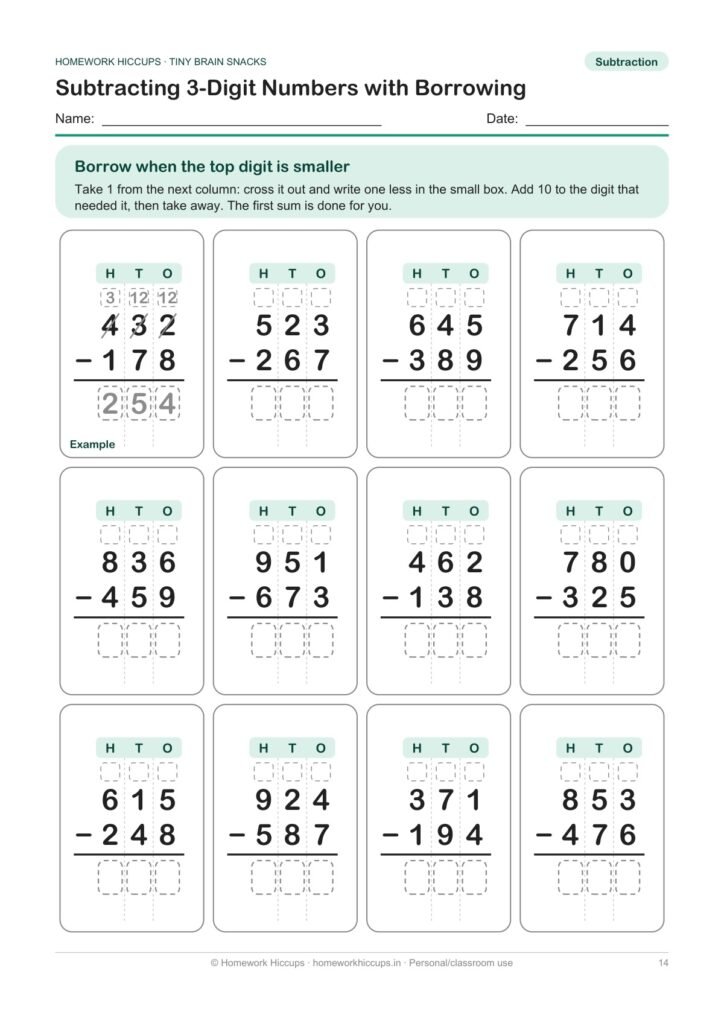
- 2- and 3-digit addition with carrying and subtraction with borrowing in H/T/O columns, where the first sum on each page is fully worked in grey
- A mixed practice page and 10 word problems with Indian context such as mangoes, cricket runs, diyas and a train
- Multiplication with equal groups, arrays, tables of 2, 3, 4 and 5, a tables grid and 5 word problems; division by equal sharing and grouping
- Indian money with ₹10 to ₹500 notes (simple drawings, not real designs), counting notes and a shop bill with change
- Time to the quarter hour, a printed calendar page, measuring in centimetres, kilograms and litres
- 2D and 3D shapes, symmetry, patterns, a pictograph and a tally chart
- 3 mental maths speed sheets of 30 sums each, 5 pages of answer keys, a 4-week tracker and a certificate
It prints well in black and white. Licence: personal or single-classroom use.
Get the Class 2 Maths Worksheets PDF – ₹149
Not sure it suits your child? Try a free sample first. The free Class 2 Maths sample has 5 pages: a cover, 3 real pages from the pack and a contents page. Enter your name and email at checkout and download it with no payment.
For extra tables, clock and money practice, the Times Tables, Time and Money pack (41 pages, ages 6 to 9) has one page for each table from 2 to 10, three speed tests, 5-minute clock times, a calendar page and kirana-store shopping with change.
Get the Tables, Time and Money pack – ₹99
You can also browse all Class 2 worksheets and our full range of maths worksheets.
Frequently asked questions
What topics are covered in Class 2 maths?
Class 2 maths commonly covers numbers to 1000, place value, comparing and ordering numbers, addition with carrying, subtraction with borrowing, multiplication as repeated addition, tables of 2, 3, 4, 5 and 10, simple sharing, Indian money, time, calendar, measurement, shapes, patterns and pictographs. The order varies between boards and schools.
Which multiplication tables should a Class 2 child know?
Most Class 2 children learn the tables of 2, 3, 4, 5 and 10. Start with 2, 10 and 5 because they follow easy patterns, then move to 3 and 4. Many schools teach the tables from 6 to 10 in Class 3.
How do I teach addition with carrying to a Class 2 child?
Start with real objects such as matchsticks, tying every 10 ones into a bundle to show 1 ten. Then write the sum in tens and ones columns, add the ones first, write the ones digit and carry the 1 to the tens column before adding the tens.
How much maths practice does a Class 2 child need each day?
About 5 to 10 minutes a day is enough for most children. One short worksheet with answers checked straight away works better than a long session once a week. Add real-life maths like counting change or reading the clock.
Is there a free Class 2 maths worksheet PDF?
Yes. Our free Class 2 Maths sample has 5 pages, including 3 real pages from the 50-page pack. You enter your name and email at checkout and there is no payment. This post also has 20 free questions with answers that you can copy.