In many schools, drawing and colouring are part of the regular timetable from Nursery onwards, and in some schools they are even graded on the report card. So it is no surprise that parents and teachers search for UKG drawing worksheets PDF files, LKG colouring pages and easy drawing ideas. The good news is that children don’t need talent to draw well at this age. They need simple shapes, a few clear steps and lots of practice.
Print-ready worksheets for this topic
Colouring Pages and Mazes for Kids PDF – Incredible India Colouring & Mazes Fun Pack, Ages 3–7 (37 Pages) – A4 PDF, instant download. ₹79 ₹149
This guide gives you 20 easy step-by-step drawings built from basic shapes (mango, kite, auto-rickshaw, peacock and more), a crayon-skills progression table from Nursery to Class 1, ideas for making your own free colouring pages at home, and tips on how drawing is often assessed. Everything can be used with just paper, a pencil and crayons.
Quick answer: Easy drawings for LKG and UKG start from shapes children already know:
- Circle: sun, balloon, apple, face, ladybird.
- Triangle: kite, hut roof, ice cream cone, boat sail.
- Square and rectangle: house, bus, auto-rickshaw, train engine.
- Oval: mango, fish, egg, peacock body.
- Method: draw the big shape first, add small shapes, then colour inside the lines.
Why drawing matters in LKG and UKG
Drawing is not just a fun extra. Holding a crayon, controlling a line and colouring inside a shape all build the same hand muscles and control that children need for writing letters and numbers. Drawing also builds observation, imagination and the confidence to say, “I made this.”
When schools set drawing as a graded activity, teachers usually look at simple things: Is the picture recognisable? Has the child used suitable colours? Is the colouring neat and mostly inside the lines? Is the page filled thoughtfully? Exact criteria vary between schools, but none of them expect perfect art. They expect effort and steady progress.
Crayon-skills progression from Nursery to Class 1
Use this table to see what is typical at each stage. Every child develops at their own pace, so treat it as a rough guide rather than a checklist.
| Class (age) | Typical drawing skills | Typical colouring skills | Good activities |
|---|---|---|---|
| Nursery (3 to 4) | Scribbles, lines, rough circles; names what they drew | Colours over and around the shape; one colour per picture | Big chunky crayons, finger painting, large simple outlines |
| LKG (4 to 5) | Circle, square and triangle; simple face; sun and house | Mostly inside big shapes; starts choosing colours on purpose | Join-the-dots shapes, colouring big pictures, tearing and sticking |
| UKG (5 to 6) | Combines shapes into objects; people with bodies, arms and legs | Inside the lines most of the time; strokes in one direction | Step-by-step drawings, colour by number, simple scenes |
| Class 1 (6 to 7) | Scenes with a ground line and sky; more detail; beginning to show size | Neat colouring; light and dark shading; background filled | Themed scenes (my family, a rainy day), festival drawings, picture stories |
If your child is still at an early stage, our guide to worksheets for 3-year-olds has gentle pre-drawing and pencil-control activities.
20 easy step-by-step drawings for kids
Draw each step yourself first, slowly, while your child watches. Then let them try on their own sheet. Say the shapes out loud as you draw: “big circle, small circle, two lines.”
Drawings that start with a circle
- Sun: draw a circle. Add short straight lines all around for rays. Add a smiling face if your child likes. Colour yellow and orange.
- Balloon: draw a circle, add a tiny triangle at the bottom for the knot, then a wavy line for the string.
- Apple: draw a circle with a small dip at the top. Add a short line for the stalk and a small oval leaf. Colour red or green.
- Ladybird: draw a big circle for the body and a small half-circle for the head. Draw a line down the middle and add dots on both sides.
- Flower: draw a small circle in the middle and five or six circles around it for petals. Add a long line for the stem and two leaves.
Drawings that start with an oval
- Mango: draw an oval that is a little fatter at one end and slightly curved, like a bean. Add a short stalk and one long leaf at the top. Colour yellow with a touch of green and orange.
- Fish: draw an oval for the body and a triangle at one end for the tail. Add a dot for the eye and curved lines for scales.
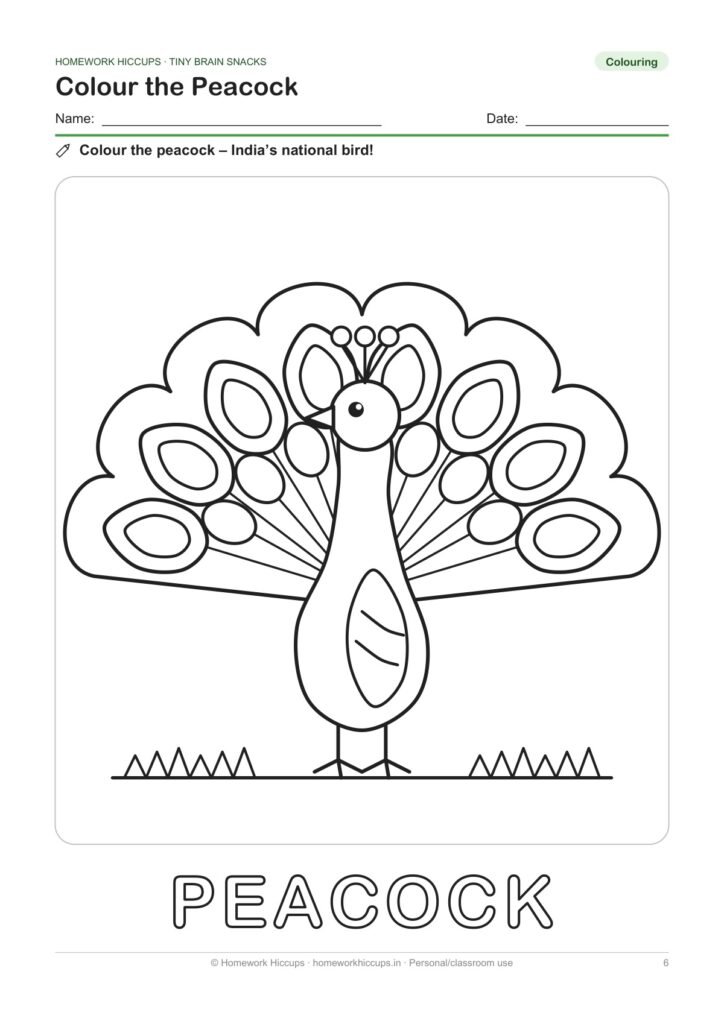
- Peacock: draw a small oval for the body and a small circle on top for the head. Add a little triangle beak and three short lines for the crest on its head. Behind the body, draw a big fan shape for the tail and fill it with small circles inside larger ovals for the feather eyes. Colour blue, green and a little gold or yellow.
- Owl: draw a big oval body, two big circles for eyes with dots inside and a small triangle beak. Add two pointed ears on top.
- Egg in a nest: draw two or three ovals close together and zigzag lines around and under them for the nest.
Drawings that start with a triangle
- Kite (patang): draw a diamond shape (two triangles joined at the base). Draw a cross from corner to corner. Add a wavy tail with small bows. Perfect for Makar Sankranti.
- Ice cream cone: draw an upside-down triangle for the cone and a criss-cross pattern on it. Add one or two circles on top for scoops.
- Boat: draw a wide shape like a bowl for the boat, a straight line up from the middle for the mast, and a triangle for the sail. Add wavy lines for water.
- Christmas or Diwali paper star: draw a triangle, then an upside-down triangle on top of it to make a six-pointed star.
- Village hut: draw a square for the walls and a triangle on top for the thatched roof. Add a small rectangle door and lines on the roof for straw.
Drawings that start with a square or rectangle
- House: draw a big square, a triangle roof, a rectangle door and two small square windows. Add a sun and grass.
- Auto-rickshaw: draw a rectangle for the body with a curved roof on top, like a half-circle stretched sideways. Add a small window, a driver’s seat area at the front, one wheel at the front and one at the back (two circles), and a small headlight. Colour the bottom green or black and the roof yellow, like the autos children see.
- Bus: draw a long rectangle, add a row of small squares for windows, a rectangle door and two circle wheels.
- Train engine: draw a rectangle on its side, a smaller tall rectangle on top for the cabin, a short tube (rectangle) for the chimney, and three circles for wheels. Add puffs of smoke as small circles.
- Diya: draw a wide half-circle like a bowl, then a small flame shape on one side (a tear drop). Colour the diya brown or orange and the flame yellow with an orange centre.
Once children can draw these, ask them to combine two or three into a scene: a house with a sun and a kite, a boat on the river with a fish below, or a village hut beside a mango tree.
Drawing ideas for kids in Class 1
Class 1 children are ready for full scenes and themes. Schools often set topics like these:
- My family
- My school
- A rainy day
- A visit to the mela or the market
- Diwali night with diyas and rangoli
- Kite flying on Makar Sankranti
- A garden with flowers and butterflies
- Animals at the zoo
- My favourite food
- A train journey
Teach one simple rule for scenes: draw a ground line at the bottom and colour a band of sky at the top. Things that are far away are drawn smaller. These small ideas make a big difference to how finished a picture looks.
UKG colouring worksheets PDF or home-made? Make your own free colouring pages
Many parents search for a UKG drawing worksheets PDF free download, or for LKG and nursery drawing worksheets PDF files. Before you hunt online, remember that you can make simple colouring sheets for free at home in a few minutes:
- Take a plain A4 sheet and a thick black sketch pen or marker.
- Draw one big, simple picture from the list above (sun, mango, kite or house) so it fills most of the page.
- Keep the outlines thick and the spaces large. Tiny details are frustrating for LKG hands.
- Write the name of the picture in big outline letters at the bottom, so your child can colour the word too.
- For UKG, add numbers inside each part and a small colour key (1 yellow, 2 green, 3 red) to make a colour-by-number page.
- If you have a photocopier or printer nearby, make a few copies so your child can try again.
For other no-cost practice pages, our free LKG worksheets page explains how to get our free 6-page LKG sample. You can also download it directly as the free LKG worksheets PDF.
Prefer ready-to-print pages?
Colouring Pages and Mazes for Kids PDF – Incredible India Colouring & Mazes Fun Pack, Ages 3–7 (37 Pages) – A4 PDF, instant download. ₹79 ₹149
Colouring tips for LKG and UKG
- Use the right crayons: thick wax crayons for Nursery and LKG; thinner crayons or colour pencils for UKG and Class 1.
- Colour the edges first: trace slowly along the inside of the outline, then fill the middle. This keeps colouring inside the lines.
- One direction: encourage strokes that go the same way (all up and down, or all side to side) for a neat finish.
- Light then dark: press lightly first, then go over again for a stronger colour.
- Talk about colours: “What colour is a real mango? Can a peacock have a purple tail in your picture?” Both real and imaginative colours are fine.
- Keep sessions short: ten to fifteen minutes is plenty for LKG. Stop before your child gets tired.
How parents can help without taking over
- Draw alongside, not on, their page. Make your own drawing on a separate sheet so your child can copy the steps without feeling corrected.
- Praise specific things: “I love how you coloured the sky all the way to the edge,” rather than just “nice”.
- Ask them to tell you about it. Children often add a story to their picture, which builds language too.
- Display their work on the fridge or a wall. It tells your child their effort matters.
For a full view of what UKG children practise across subjects, see our UKG worksheets PDF guide.
Print-ready UKG drawing worksheets PDF: Indian-theme colouring pages
If you would like ready-made LKG and UKG colouring worksheets in PDF form, our Incredible India Colouring & Mazes Fun Pack (₹79, 37 A4 pages, ages 3 to 7) has 14 full-page colouring pictures with bold outlines and big colouring areas: peacock, tiger, elephant, cow, parrot, auto-rickshaw, train, kite festival, mango tree, lotus, India Gate, cricket player, village hut and fruit cart, each with its name in big outline letters to colour. It also includes 3 colour-by-number pages (lotus, kites and village hut), 10 mazes, 3 trace-the-path pages and 2 dot-to-dot pictures, with answer keys. All pages are black line art, so a black-and-white printer is enough, and you can print them again for your own children or one classroom.
Get the Incredible India Colouring & Mazes Pack – ₹79
You can also browse our activity packs, LKG worksheets and UKG worksheets.
Want every pack in one go? The Complete Worksheet Library Bundle includes all 20 of our packs, more than 790 pages in total.
Get the Complete Worksheet Library Bundle – ₹699
Frequently asked questions
What should a UKG child be able to draw?
Many UKG children can combine simple shapes into objects such as a house, a sun, a tree, a fish or a person with a body, arms and legs. Every child develops at their own pace, so focus on steady progress.
How can I teach my child to draw step by step?
Start with shapes your child knows, such as a circle, oval, triangle and square. Draw one step at a time while they watch, then let them copy on their own sheet. Say the shapes aloud as you go, and keep sessions short.
How do I help my child colour inside the lines?
Use thick, bold outlines and large spaces. Teach your child to colour slowly along the inside edge first and then fill the middle with strokes in one direction. Practice and short daily sessions help the most.
Are drawing and colouring graded in LKG and UKG?
Some schools include drawing and colouring on the report card. Teachers usually look at whether the picture is recognisable, the choice of colours, neatness and effort. Criteria vary between schools.
What are easy drawing ideas for Class 1?
Good Class 1 drawing topics include my family, my school, a rainy day, a mela, Diwali night with diyas, kite flying, a garden, animals at the zoo and a train journey. Teach children to add a ground line and sky to finish a scene.