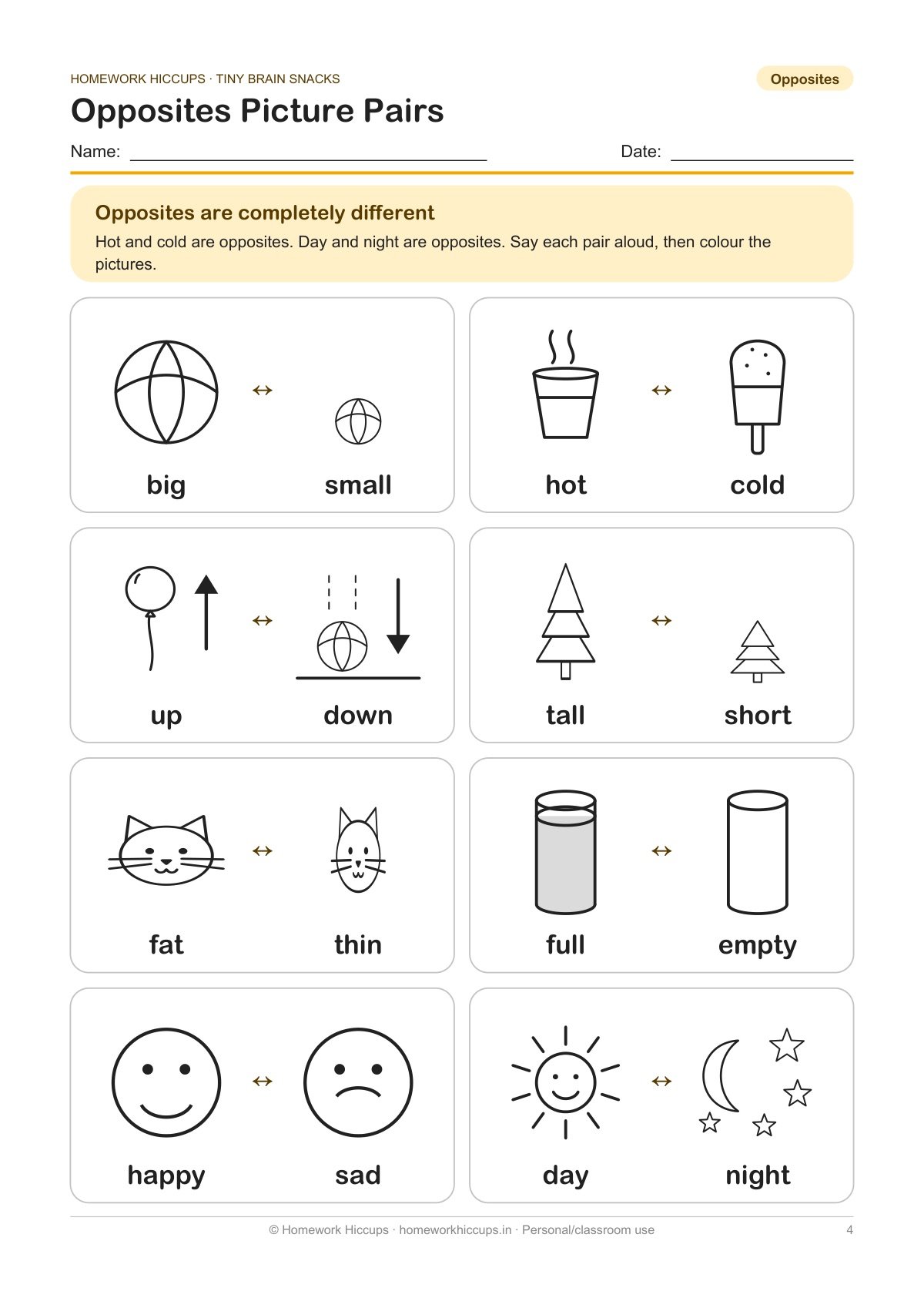
A time worksheet for Class 2 looks very different from one for Class 1. In Class 1, most children learn o’clock times, where the long hand points to 12. In Class 2, many books add half past, quarter past, quarter to and then times to the nearest 5 minutes. That jump is where a lot of children get stuck, usually because of one small detail: where the short hand goes.
Print-ready worksheets for this topic
Times Tables, Time & Money Worksheets PDF – Tables 2–10, Clock, Calendar & Indian Rupees (41 Pages) – A4 PDF, instant download. ₹99 ₹199
This guide explains telling time for Class 2 step by step: counting minutes in 5s, quarter past and quarter to, where the hour hand sits, digital and analogue clocks, and 25 practice questions with answers. If your child is not yet sure about o’clock times, start with our clock worksheets for Class 1 guide.
🧰 Make practice more fun at home
As an Amazon Associate, Homework Hiccups earns from qualifying purchases, at no extra cost to you.
Quick answer: To tell the time in Class 2:
- Short hand = hour, long hand = minutes.
- Count the long hand in 5s: each number on the clock is 5 more minutes (1 = 5, 2 = 10, 3 = 15 and so on).
- Quarter past = long hand on 3 (15 minutes). Half past = long hand on 6 (30 minutes). Quarter to = long hand on 9 (45 minutes).
- The short hand moves too: at quarter to, it is just before the next hour.
Clock reading for kids: what Class 2 adds
| Time type | Long hand points to | Short hand sits | Digital |
|---|---|---|---|
| O’clock | 12 | exactly on the hour | 4:00 |
| Quarter past | 3 | a little past the hour | 4:15 |
| Half past | 6 | halfway between the hour and the next | 4:30 |
| Quarter to | 9 | most of the way to the next hour | 4:45 (quarter to 5) |
| 5-minute times | any number | moves a little further every 5 minutes | 4:20, 4:55 |
Step 1: Counting minutes in 5s
Before quarter past and quarter to make sense, children need to know that the long hand counts in 5s. Ask them to point to each number in turn while counting: 5, 10, 15, 20 up to 60. If they already know the skip counting pattern in 5s, this is quick.
| Long hand on | 1 | 2 | 3 | 4 | 5 | 6 | 7 | 8 | 9 | 10 | 11 | 12 |
|---|---|---|---|---|---|---|---|---|---|---|---|---|
| Minutes | 5 | 10 | 15 | 20 | 25 | 30 | 35 | 40 | 45 | 50 | 55 | 0 (o’clock) |
A useful trick: draw a small 5, 10, 15 and so on outside the numbers on a paper clock with a pencil. Rub them out after a week.
Step 2: Quarter past and quarter to, with a roti
Cut a paper circle and call it a roti. Fold it in half: two halves. Fold again: four quarters. Put it on the clock face. The long hand going from 12 to 3 covers one quarter of the roti. That is quarter past: a quarter of the hour has passed.
When the long hand reaches 9, three quarters have passed and only one quarter is left before the next o’clock. That is quarter to: a quarter of an hour to go. So quarter to 5 means 15 minutes until 5 o’clock, which is 4:45.
Step 3: Where the hour hand sits
This is the most common Class 2 time mistake. The short hand does not jump from one number to the next. It moves slowly all hour long.
- At 4:00 it points right at 4.
- At 4:15 it has moved a little past 4.
- At 4:30 it is halfway between 4 and 5.
- At 4:45 it is most of the way to 5, just before it. The hour is still 4, which is why we write 4:45.
Children often see the short hand near 5 at 4:45 and say 5:45. Teach them: Which number has the short hand just passed? That is the hour. A real wall clock with a second hand is the best teacher here. Watch it together at quarter to the hour and see the short hand creep closer.
Step 4: Digital vs analogue time
An analogue clock has hands. A digital clock shows numbers, like 7:20. In digital time, the number before the two dots is the hour and the number after is the minutes. Children can practise by matching the wall clock to a phone or microwave display.
| Say it | Digital |
|---|---|
| Five past 7 | 7:05 |
| Twenty past 7 | 7:20 |
| Half past 7 | 7:30 |
| Twenty-five to 8 | 7:35 |
| Quarter to 8 | 7:45 |
| Ten to 8 | 7:50 |
Notice the pattern: up to 30 minutes we say past the hour we are in. After 30 minutes we say to the next hour. Some schools teach only the digital way of saying it (seven forty-five) in Class 2, so follow your child’s book.
🧸 Learning toys kids love
As an Amazon Associate, Homework Hiccups earns from qualifying purchases, at no extra cost to you.
Prefer ready-to-print pages?
Times Tables, Time & Money Worksheets PDF – Tables 2–10, Clock, Calendar & Indian Rupees (41 Pages) – A4 PDF, instant download. ₹99 ₹199
Class 2 worksheet on time: 25 questions
Section A: Read the clock (the hands are described)
- The long hand is on 6. The short hand is halfway between 3 and 4.
- The long hand is on 3. The short hand is just past 8.
- The long hand is on 9. The short hand is most of the way from 10 to 11.
- The long hand is on 12. The short hand is on 5.
- The long hand is on 4. The short hand is a little past 7.
- The long hand is on 11. The short hand is almost on 5.
- The long hand is on 2. The short hand is just past 9.
- The long hand is on 7. The short hand is just past halfway between 1 and 2.
Section B: Write the digital time
- Quarter past 6
- Half past 12
- Quarter to 3
- Ten past 4
- Twenty-five to 9
Section C: Write the time in words
- 7:45
- 11:30
- 2:15
- 5:05
- 9:50
Section D: Draw the hands (say where each hand goes)
- 3:15
- 6:45
- 10:25
Section E: Time stories
- Lunch is at 12:30. Play time is 1 hour later. What time is play time?
- Riya starts her homework at 5 o’clock and works for 30 minutes. What time does she finish?
- The train leaves at quarter to 7. Kabir reaches the station at half past 6. How many minutes early is he?
- How many minutes are there from 4:15 to 4:45?
Answer key
| Q | Answer | Q | Answer |
|---|---|---|---|
| 1 | 3:30, half past 3 | 14 | quarter to 8 |
| 2 | 8:15, quarter past 8 | 15 | half past 11 |
| 3 | 10:45, quarter to 11 | 16 | quarter past 2 |
| 4 | 5:00, 5 o’clock | 17 | five past 5 |
| 5 | 7:20, twenty past 7 | 18 | ten to 10 |
| 6 | 4:55, five to 5 | 19 | long hand on 3; short hand a little past 3 |
| 7 | 9:10, ten past 9 | 20 | long hand on 9; short hand most of the way from 6 to 7 |
| 8 | 1:35, twenty-five to 2 | 21 | long hand on 5; short hand a little less than halfway from 10 to 11 |
| 9 | 6:15 | 22 | 1:30 |
| 10 | 12:30 | 23 | 5:30 |
| 11 | 2:45 | 24 | 15 minutes |
| 12 | 4:10 | 25 | 30 minutes |
| 13 | 8:35 |
Daily ways to practise telling time
- Time checks: ask your child the time at breakfast, after school and at bedtime.
- Timetable talk: say the time of favourite TV shows, tuition or the school bus aloud.
- Paper plate clock: make one with a split pin and two paper hands; call out times for your child to show.
- Beat the timer: if tidying up starts at 6:10, can it be done by quarter past 6?
For other Class 2 topics alongside time, see our maths worksheets for Class 2 guide and the money worksheet for Class 2.
Time worksheet for Class 2 with accurate clock faces
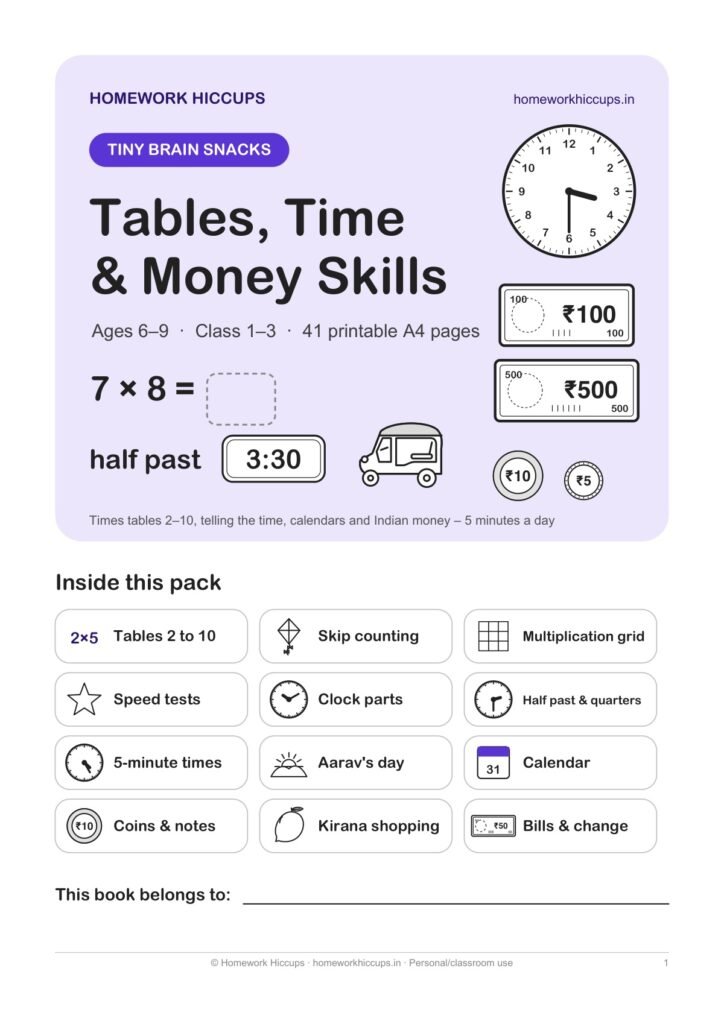
Some clock worksheets draw the short hand pointing straight at a number for every time, which teaches the wrong habit. The Times Tables, Time and Money Worksheets PDF (41 pages, ages 6 to 9) draws every clock face accurately, with the hour hand in the right place for half past, quarter to and 5-minute times. The time section covers parts of a clock and counting minutes in 5s, o’clock, half past, quarter past and quarter to (read and draw), 5-minute times such as 7:20 and 4:55, matching clocks to digital times, a daily routine timeline, simple 1 hour later questions and a calendar page. It also has times tables 2 to 10 with 3 speed tests (see our tables speed test guide) and Indian money from ₹1 to ₹500, plus 4 pages of answer keys.
Get the Tables, Time and Money Worksheets – ₹99
The free sample of this pack lets you check the style first; you get it by entering your name and email at checkout, with no payment. Browse more maths worksheets.
Download the 41-page Tables, Time and Money Pack – ₹99
Frequently asked questions
What time topics are taught in Class 2?
Many Class 2 books cover o’clock, half past, quarter past and quarter to, and some add times to the nearest 5 minutes, digital time and simple calendar questions. The exact topics vary by school.
Where is the hour hand at quarter to?
At quarter to, the hour hand is most of the way to the next hour, just before it. At quarter to 5, it is just before 5, and the time is 4:45.
How do I teach my child to count minutes on a clock?
Teach that each number on the clock stands for 5 minutes. Point to the numbers in order and count in 5s: 5, 10, 15, 20, up to 60.
What is the difference between quarter past and quarter to?
Quarter past means 15 minutes after the hour, with the long hand on 3. Quarter to means 15 minutes before the next hour, with the long hand on 9.
Should Class 2 children learn digital time?
Yes, it helps. Matching a clock with hands to a digital time like 7:30 shows children that both ways mean the same time, and they see digital clocks every day on phones and screens.