Division for Class 2 is less about long sums and more about one big idea: sharing fairly. If 12 laddoos are shared equally on 3 plates, how many go on each plate? Children understand this instantly when they are holding the laddoos, and that is exactly where teaching should begin. The ÷ sign comes later, once the idea is secure.
Print-ready worksheets for this topic
Class 2 Maths Worksheets PDF – Numbers to 1000, Carrying, Borrowing, Tables, Money & Time (50 Pages) – A4 PDF, instant download. ₹149 ₹299
In this guide you will find how to teach equal sharing and equal grouping with things you already have at home, how to introduce the ÷ sign, how division links to the multiplication tables your child is learning, and 25 practice questions with answers (no remainders), including five short word problems.
🧰 Make practice more fun at home
As an Amazon Associate, Homework Hiccups earns from qualifying purchases, at no extra cost to you.
Quick answer: Simple division for kids in Class 2 usually means:
- Equal sharing: 12 laddoos on 3 plates, one at a time, gives 4 on each plate.
- Equal grouping: 12 laddoos in boxes of 4 makes 3 boxes.
- The ÷ sign: 12 ÷ 3 = 4, read as “12 shared into 3 equal groups is 4”.
- Link to tables: 3 × 4 = 12, so 12 ÷ 3 = 4 and 12 ÷ 4 = 3.
Two kinds of division: sharing and grouping
Class 2 children meet division in two forms. They give the same answer, but they feel different to a child, so it helps to practise both.
| Equal sharing | Equal grouping | |
|---|---|---|
| Question | 12 laddoos on 3 plates. How many on each plate? | 12 laddoos, 4 in each box. How many boxes? |
| What we know | The number of groups | The size of each group |
| What we find | How many in each group | How many groups |
| How to do it | Deal out one at a time | Make groups of 4 until none are left |
| Answer | 4 on each plate | 3 boxes |
How to teach division to kids, step by step
Step 1: share real things on plates
Put 3 plates on the table and give your child 12 small things: laddoos, grapes, buttons or toy cars. Ask them to share so every plate has the same. Most children deal them out “one for you, one for you, one for you” until none are left. Count each plate together: 4, 4, 4. That is equal sharing.
Step 2: check it is fair
Ask, “Is it fair? Does every plate have the same?” Equal is the key word in division. Try an unfair share on purpose (5, 4, 3) and let your child fix it.
Step 3: make equal groups
Now give the same 12 things and a different question: “Put 4 in each box. How many boxes do we need?” Your child makes groups of 4 and counts the groups: 3.
Step 4: draw it
Draw circles for plates and dots for laddoos. Children add one dot to each plate in turn. This is the bridge from objects to paper and is what most Class 2 sharing worksheets look like.
Step 5: write the ÷ sign
Write 12 ÷ 3 = 4. Read it as “12 shared equally into 3 groups is 4” or “12 divided by 3 is 4”. Point to each part: 12 is how many we start with, 3 is the number of groups, and 4 is how many in each group.
Division and multiplication: two sides of the same fact
Division is the reverse of multiplication. Once children see this, the tables they already know become division facts for free. Use a fact family triangle with 3, 4 and 12 at the corners and write all four facts:
- 3 × 4 = 12
- 4 × 3 = 12
- 12 ÷ 3 = 4
- 12 ÷ 4 = 3
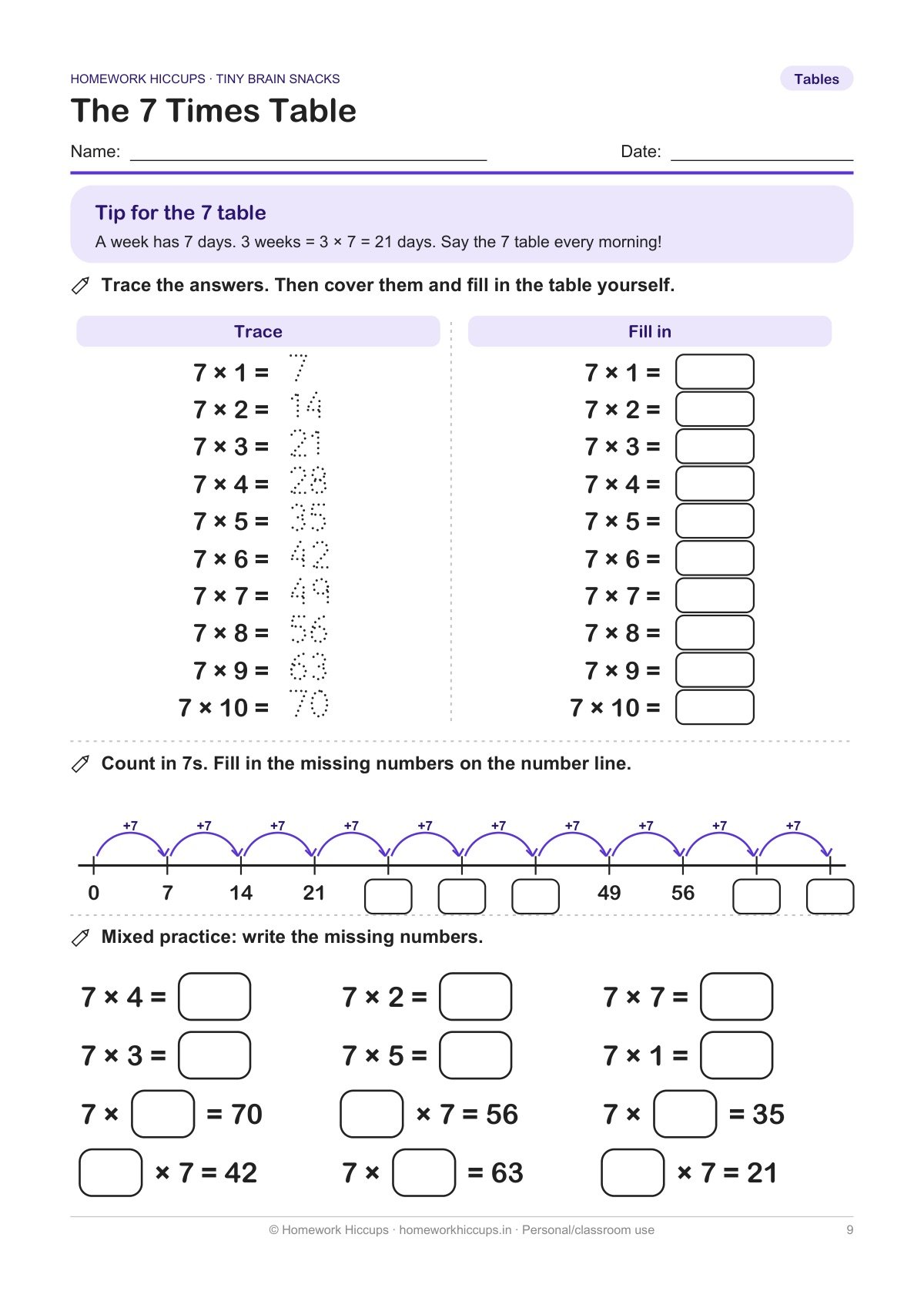
To solve 20 ÷ 5, ask: “5 times what makes 20?” If your child knows the 5 times table, the answer is 4. That is why division is easiest after tables of 2, 3, 4 and 5 are fairly secure. If tables need work, our guide on how to learn multiplication tables has quick daily routines, and a printable multiplication table chart on the wall helps during practice.
🧸 Learning toys kids love
As an Amazon Associate, Homework Hiccups earns from qualifying purchases, at no extra cost to you.
Equal sharing for Class 2: 25 questions with answers
Set A: share on plates (draw it)
Draw the plates and share the dots one at a time.
- 6 laddoos on 2 plates. How many on each plate?
- 8 bananas on 4 plates.
- 10 biscuits on 2 plates.
- 12 grapes on 3 plates.
- 15 sweets on 5 plates.
- 9 jalebis on 3 plates.
- 20 peanuts on 4 plates.
- 16 cherries on 2 plates.
- 12 idlis on 4 plates.
- 18 strawberries on 3 plates.
Answers: 1) 3 2) 2 3) 5 4) 4 5) 3 6) 3 7) 5 8) 8 9) 3 10) 6
Set B: division facts
Think of the matching multiplication fact.
- 14 ÷ 2 = ___
- 20 ÷ 5 = ___
- 24 ÷ 4 = ___
- 21 ÷ 3 = ___
- 30 ÷ 5 = ___
- 18 ÷ 2 = ___
- 27 ÷ 3 = ___
- 32 ÷ 4 = ___
- 25 ÷ 5 = ___
- 40 ÷ 5 = ___
Answers: 11) 7 12) 4 13) 6 14) 7 15) 6 16) 9 17) 9 18) 8 19) 5 20) 8
Set C: word problems
- Ananya has 24 pencils. She puts 4 pencils in each box. How many boxes does she fill?
- Dadi shares ₹35 equally among 5 grandchildren. How much does each child get?
- 16 children play a game in teams of 4. How many teams are there?
- A fruit seller puts 30 bananas into bags of 5. How many bags does he fill?
- Sir arranges 18 chairs in 3 equal rows. How many chairs are in each row?
Answers: 21) 6 boxes (24 ÷ 4 = 6) 22) ₹7 (35 ÷ 5 = 7) 23) 4 teams (16 ÷ 4 = 4) 24) 6 bags (30 ÷ 5 = 6) 25) 6 chairs (18 ÷ 3 = 6)
Questions 21, 23 and 24 are grouping (we know the size of each group). Questions 22 and 25 are sharing (we know the number of groups). Ask your child which kind each one is; it is a good thinking question. For more mixed practice across the year, see our maths worksheets for Class 2 guide.
Common division mistakes and how to fix them
| Mistake | Why it happens | Fix |
|---|---|---|
| Unequal plates | Child shares in handfuls | Deal one at a time, round and round |
| Writes the number of plates as the answer | Mixes up groups and items | Ask “How many on ONE plate?” |
| Reads 12 ÷ 3 as 3 ÷ 12 | Not sure which number comes first | The bigger pile always comes first in Class 2 sums |
| Guesses facts | Tables not yet secure | Count in steps: 5, 10, 15, 20 is four jumps |
| Stuck on word problems | Does not know whether to share or group | Act it out with buttons first |
Prefer ready-to-print pages?
Class 2 Maths Worksheets PDF – Numbers to 1000, Carrying, Borrowing, Tables, Money & Time (50 Pages) – A4 PDF, instant download. ₹149 ₹299
Division games at home and in class
- Party plates: set out paper plates for toys and share a packet of biscuits. Change the number of guests and share again.
- Get into groups: in a class or a big family, the leader calls “Groups of 3!” and everyone rushes into groups. Count the groups and anyone left over (a nice preview of remainders for later).
- Egg box sharing: use an empty egg tray. Share 12 beads between 2, 3, 4 and 6 rows and record each answer.
- Fact family cards: write 3, 5 and 15 on a card and ask your child to say all four facts.
A one-week division plan
- Day 1: share real objects on plates. No writing.
- Day 2: equal groups in boxes or cups.
- Day 3: draw it, then Set A questions 1 to 5.
- Day 4: introduce the ÷ sign, Set A questions 6 to 10.
- Day 5: fact families, Set B.
- Day 6: word problems, Set C, acting out first.
- Day 7: party plates game and a quick quiz of five facts.
Division for Class 2: printable practice pages
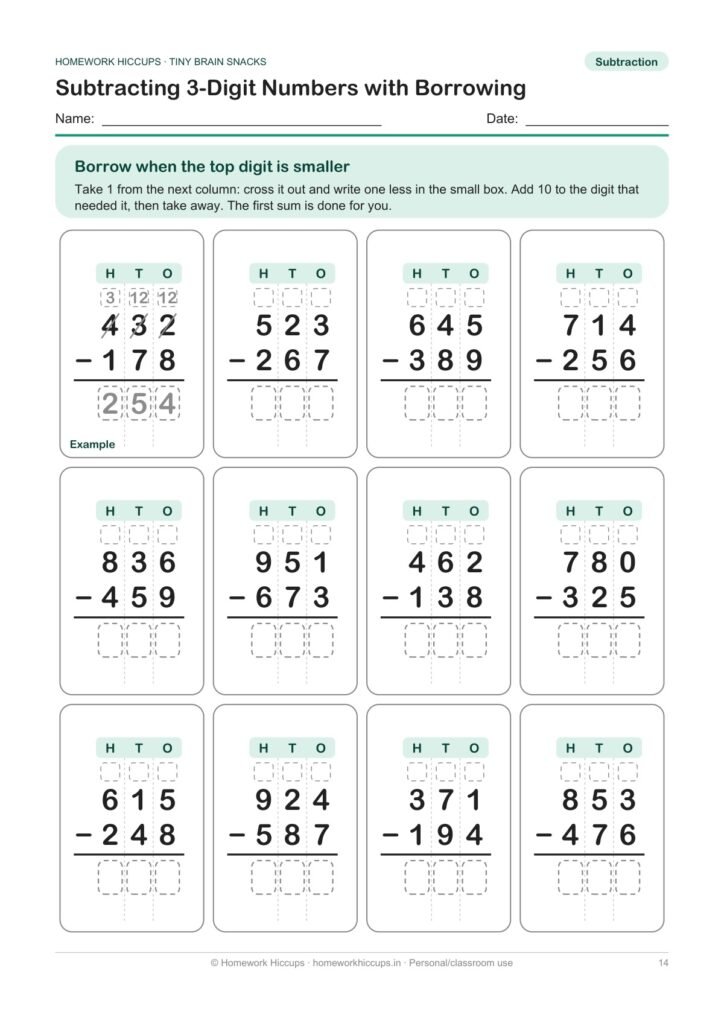
For print-ready practice, our Class 2 Maths Worksheets PDF (50 A4 pages) includes division pages with equal sharing on plates and equal grouping, with simple ÷ facts. The same pack covers multiplication with equal groups, arrays and tables of 2, 3, 4 and 5, plus numbers to 1000, addition with carrying, subtraction with borrowing, Indian money, time, measurement, shapes and data. Five pages of answer keys sit at the back.
Get the Class 2 Maths Worksheets – ₹149
Want to check the pages first? Try the free Class 2 maths sample: 3 real pages plus the cover and contents page, free at checkout with your name and email.
Download the Class 2 Maths Pack – ₹149
Frequently asked questions
What is division for Class 2?
In Class 2, division usually means sharing a number of things equally into groups, or making equal groups of a given size. Children learn to write it with the ÷ sign, for example 12 ÷ 3 = 4.
How do I explain division to my child?
Start with real objects. Share 12 laddoos equally on 3 plates, one at a time, and count how many are on each plate. Once this is easy, draw it on paper and then introduce the ÷ sign.
Should Class 2 children learn division with remainders?
Most Class 2 practice uses numbers that share exactly, with no remainder. Remainders are usually taught in later classes, so check your child’s school book.
How is division related to multiplication?
Division is the reverse of multiplication. If 3 times 4 is 12, then 12 divided by 3 is 4 and 12 divided by 4 is 3. Knowing tables makes division facts much easier.
Does the Class 2 Maths pack have division worksheets?
Yes. The 50-page Class 2 Maths Worksheets PDF includes equal sharing on plates and equal grouping with simple division facts, along with multiplication tables of 2 to 5 and answer keys.