Children’s Day on 14 November is a day for children to simply enjoy themselves, and colouring is one of the easiest ways to make that happen in a classroom or at home. Children’s Day colouring pages give every child, from the shyest to the busiest, a calm and happy activity, and the finished pages make a bright display for the rest of the week.
Print-ready worksheets for this topic
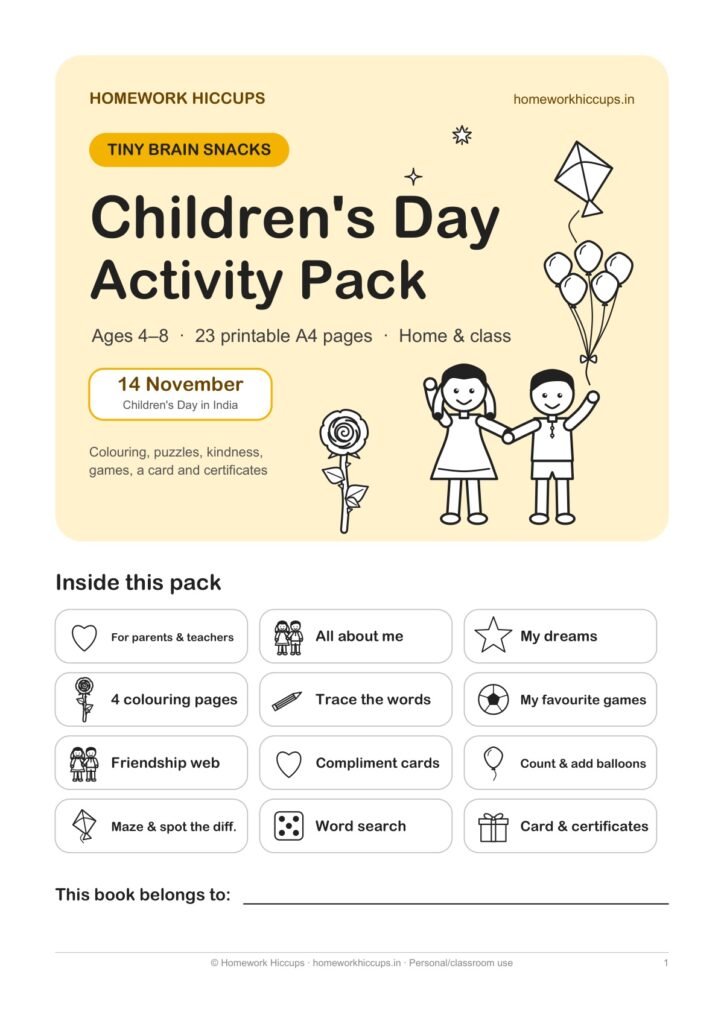
Children's Day Worksheets for Kids PDF – Colouring, Puzzles, Kindness & Certificates, Ages 4–8 (23 Pages) – A4 PDF, instant download. ₹49 ₹99
This guide is about the colouring itself: 10 colouring themes for 14 November, colouring techniques by age, a 30-minute colouring-corner plan for teachers and a simple display idea. If you want things for children to draw from scratch instead, see our Children’s Day drawing ideas.
🧰 Make practice more fun at home
As an Amazon Associate, Homework Hiccups earns from qualifying purchases, at no extra cost to you.
Quick answer: Good Children’s Day colouring pages for kids include:
- Themes: a rose, kites, balloons, friends playing, a school bag, a party.
- Ages 4–5: one big picture with thick lines and crayons.
- Ages 6–8: busier scenes with colour pencils and a line to write on.
- Plan: 30 minutes: talk (5), colour (20), share and display (5).
Why 14 November? A short note for children
In India, Children’s Day (Bal Diwas) is celebrated on 14 November, the birthday of Pandit Jawaharlal Nehru, India’s first Prime Minister. He was born in 1889. He loved children, and many children called him Chacha Nehru. He is often remembered with a rose on his coat, which is why roses appear in so many Children’s Day pictures. In 2026, 14 November falls on a Saturday, so check your school calendar to see which day your class will celebrate.
10 Children’s Day colouring page ideas
| # | Theme | Best for | Talk point |
|---|---|---|---|
| 1 | A big rose with a bud | Ages 4–6 | Chacha Nehru’s rose |
| 2 | Kites in the sky | Ages 4–8 | Colour each kite differently |
| 3 | Balloons and party | Ages 4–6 | Count the balloons |
| 4 | Friends playing together | Ages 5–8 | Who do you like to play with? |
| 5 | A school bag and books | Ages 4–6 | Every child should go to school |
| 6 | Children holding hands in a ring | Ages 5–8 | Different faces, one class |
| 7 | A playground: swing and slide | Ages 4–8 | Favourite games |
| 8 | A star with “I am special” | Ages 4–6 | Something you are good at |
| 9 | A gift box with a bow | Ages 4–5 | Kindness is a gift |
| 10 | Chacha Nehru with a rose | Ages 6–8 | Who was Pandit Nehru? |
For Bal Diwas colouring, themes 1, 2 and 4 are the most popular. They are cheerful, easy to draw and show what the day is about: play, friendship and childhood.
A tip on theme 10: line drawings of real people can be hard to get right. For young children, a rose, a cap and a kind smile are enough. Many teachers prefer themes 1–9 for the colouring corner and use theme 10 for a short talk.
Colouring techniques by age
Colouring is not just fun. It builds the grip, pressure and control children need for writing. Here is what to teach at each stage.
Ages 4–5: pressure and big shapes
- Use thick crayons; they are easier to hold than thin pencils.
- Show “soft” and “hard” pressing. Ask your child to colour one balloon lightly and one darkly.
- Praise the colours they choose, not whether they stayed inside the lines.
Ages 5–6: filling inside the lines
- Teach “edge first”: colour slowly along the inside of the outline, then fill the middle.
- Small strokes in one direction look neater than round scribbles.
- Turn the paper instead of twisting the wrist into awkward angles.
Ages 6–8: shading and detail
- Show two shades of one colour: light pink for the rose, darker pink for the edges of each petal.
- Colour the background last so it doesn’t smudge the picture.
- Add a sentence at the bottom: “On Children’s Day I like to ______.”
How to run a Children’s Day colouring corner (30-minute plan)
A colouring corner works in any classroom, even with 40 children, if you set it up well.
| Time | What happens | Teacher tip |
|---|---|---|
| 0–5 min | Short talk: what is Children’s Day? Show a rose. | Keep it to three sentences |
| 5–8 min | Each child chooses a colouring page from 3–4 themes | Print a few extra of each |
| 8–25 min | Colouring time with soft music | Walk round and praise effort |
| 25–28 min | Write name and one word: play, friend, kite, smile | Write the words on the board |
| 28–30 min | Pin pages up, tidy crayons | Make tidying a race |
Setting up the corner
- Put crayons in shared tubs in the middle of each table, one tub per four children.
- Keep finished pages in a tray, not on the desk, to avoid crumpling.
- Have a few blank sheets for children who finish early and want to draw their own.
- Pair a confident child with a shy one so both enjoy it.
Display idea: our class garden
Cut each coloured rose, balloon or kite out roughly, and pin them on a chart-paper background with a big heading: “Our Class Garden – Happy Children’s Day!” Draw green stems with a marker to join the roses, or a long string to join the kites. Add each child’s name under their picture. Parents love seeing it at pick-up, and children feel proud that their work is part of something bigger.
For a home version, stick your child’s page on the fridge with the date written on the back. Next year you can compare and see how their colouring has grown.
🧸 Learning toys kids love
As an Amazon Associate, Homework Hiccups earns from qualifying purchases, at no extra cost to you.
Prefer ready-to-print pages?
Children's Day Worksheets for Kids PDF – Colouring, Puzzles, Kindness & Certificates, Ages 4–8 (23 Pages) – A4 PDF, instant download. ₹49 ₹99
Questions to ask while children colour
Quiet chat during colouring builds speaking skills. Try these simple prompts:
- Why did you choose that colour for your kite?
- Who is playing with you in your picture?
- What is your favourite game with friends?
- If you could give someone a rose today, who would it be?
- What makes you happy at school?
Accept every answer warmly. On Children’s Day, the aim is for each child to feel heard, not to get an answer right.
Pair colouring with one more activity
Colouring works well as one part of a bigger celebration. Try one of these afterwards:
- A short kindness game, such as giving a compliment to the friend on your left.
- A simple craft from our Children’s Day craft ideas.
- A worksheet or quiz from our Children’s Day worksheets post.
- A full day of fun from our Children’s Day activities for kids.
Ready-to-print Children’s Day colouring pages
Our Children’s Day Activity Pack (23 A4 pages, ages 4–8) includes 4 colouring pages: friends playing together, flying kites, a rose and rosebud, and balloons and a party. It also has an “All About Me” page, a “My Dreams” draw-and-write page, Children’s Day word tracing, a favourite games tick-list, a friendship web, 8 compliment cards, counting and adding balloons, a maze, spot the difference, a word search, a fold-and-colour card, answer keys, a “Superstar Child” certificate and a blank class certificate. There is also a parent and teacher page with simple, accurate facts about Bal Diwas and a one-day plan.
Get the Children’s Day Activity Pack – ₹49
Would you like to see it first? Try the free Children’s Day sample, which has 3 real pages from the pack. The pack is black line art, so it prints well on any school printer, and the licence covers copies for one classroom.
Download the Children’s Day Colouring Pack – ₹49
See more festival packs for the school year.
Frequently asked questions
What should children colour on Children’s Day?
Popular themes are a rose, kites, balloons, friends playing together, a playground, a school bag and children holding hands in a ring. They show play, friendship and childhood.
Why is a rose used in Children’s Day pictures?
Pandit Jawaharlal Nehru, whose birthday is celebrated as Children’s Day on 14 November, is often remembered wearing a rose on his coat, so roses are a common symbol of the day.
How do I help my child colour inside the lines?
Teach edge first: colour slowly along the inside of the outline, then fill the middle with small strokes in one direction. Thick crayons and large shapes help younger children.
How long should a colouring activity last in class?
About 15 to 20 minutes of colouring is right for ages 4 to 8. With a short talk before and a display after, the whole activity fits into 30 minutes.
When was Pandit Jawaharlal Nehru born?
Pandit Jawaharlal Nehru was born on 14 November 1889. His birthday is celebrated as Children’s Day, or Bal Diwas, in India.