The symbols > and < look simple to adults, but for a five- or six-year-old they are two confusing arrows that point the wrong way half the time. If you are hunting for a greater than less than worksheet for Class 1 or UKG, the worksheet itself is only half the job. Children need a picture in their heads that tells them which way the symbol opens.
Print-ready worksheets for this topic
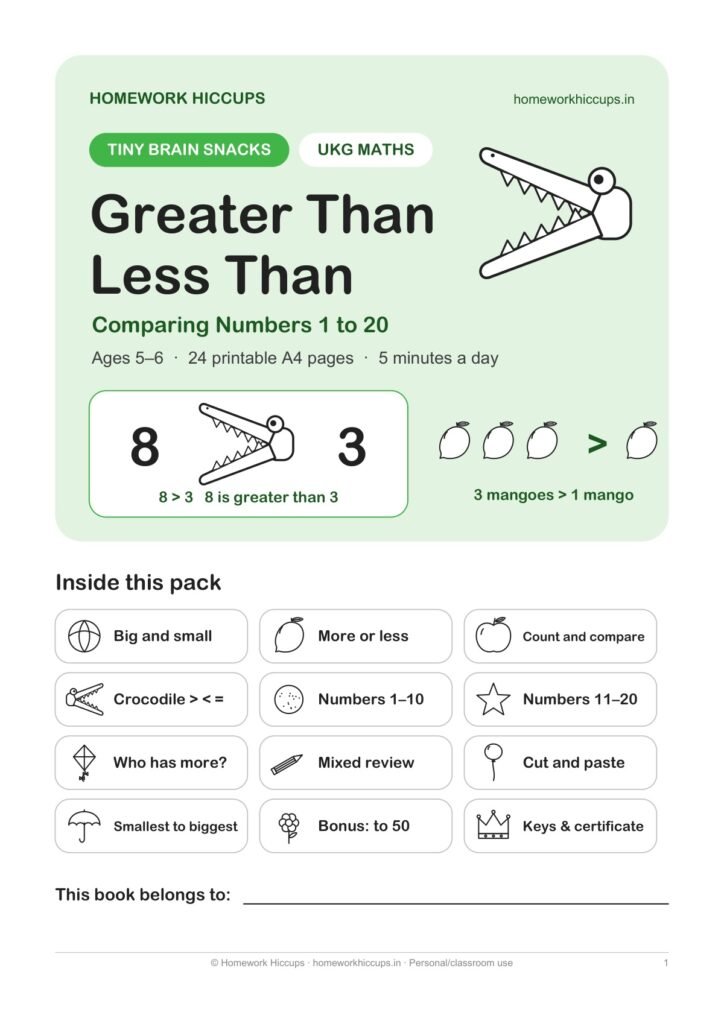
Greater Than Less Than Worksheets for UKG PDF – Comparing Numbers 1 to 20 (24 Pages) – A4 PDF, instant download. ₹49 ₹99
If you are looking for a greater than less than worksheet for UKG, start with the picture worksheet below: UKG children compare groups they can count before they compare written numbers. Class 1 children can go straight to the number worksheet further down.
🧰 Make practice more fun at home
As an Amazon Associate, Homework Hiccups earns from qualifying purchases, at no extra cost to you.
This guide gives you that picture (the hungry crocodile), the Hindi words many Indian families use at home, a step-by-step teaching sequence, five quick games and a 30-question practice table with answers, split into UKG (numbers 1 to 20) and Class 1 (numbers 1 to 100).
Quick answer: How to teach greater than, less than and equal to:
- > means greater than (7 > 3). < means less than (2 < 5). = means equal to (4 = 4).
- Crocodile trick: the open mouth always faces the bigger number.
- In Hindi: से बड़ा (greater than), से छोटा (less than), के बराबर (equal to).
- Order: real objects, then pictures, then numbers to 20 (UKG), then numbers to 100 (Class 1).
The greater than less than symbols explained
There are three comparison symbols children need in UKG and Class 1:
| Symbol | Name | Example | Read it as |
|---|---|---|---|
| > | Greater than | 7 > 3 | 7 is greater than 3 |
| < | Less than | 2 < 5 | 2 is less than 5 |
| = | Equal to | 4 = 4 | 4 is equal to 4 |
We always read from left to right. So 3 < 7 is read as “3 is less than 7”, even though it says the same thing as 7 > 3. Many children find this hard at first, so practise saying both ways out loud.
The hungry crocodile trick
Tell your child that the symbol is a crocodile’s mouth, and the crocodile is very hungry. It always wants to eat the bigger number, so the open mouth faces the bigger number. The pointed end, which is closed, points to the smaller number.
Make it physical: your child puts their arms out like a crocodile’s jaws, opens them towards the bigger pile of toys and snaps them shut. After a week, the arms become a drawn mouth with teeth, and finally just the plain symbol.
A second trick for older children: the small, pointed end of the symbol always points to the smaller number. Some children prefer this because it does not need a story.
Greater than less than in Hindi
Many children hear Hindi at home and English at school, so it helps to use the words they know. These are the terms commonly used in Hindi-medium maths books:
| English | Hindi | Example sentence |
|---|---|---|
| Greater than (>) | से बड़ा (se bada) | 7 > 3: सात, तीन से बड़ा है। (Seven is greater than three.) |
| Less than (<) | से छोटा (se chhota) | 2 < 5: दो, पाँच से छोटा है। (Two is less than five.) |
| Equal to (=) | के बराबर (ke baraabar) | 4 = 4: चार, चार के बराबर है। (Four is equal to four.) |
| More / fewer | ज़्यादा / कम (zyaada / kam) | मेरे पास ज़्यादा टॉफ़ी हैं। (I have more toffees.) |
Switching between languages is fine. What matters is that the idea of “bigger” and “smaller” is secure before the symbols arrive.
Greater than less than: how to teach it step by step
Step 1: More than and less than with objects
Start with no numbers at all. Make two piles of buttons, grapes or blocks and ask, “Which pile has more? Which has less?” Then make two equal piles and introduce the word “equal”. This is the stage most UKG children need longest.
Everyday questions work well too: who has more rotis on the plate, which bowl has fewer grapes, are there more chairs or more people at the table? Asking two or three such questions a day builds the idea without any worksheet at all.
Step 2: Count and compare
Now count each pile and say the numbers: “This pile has 6, this pile has 4. 6 is more than 4.” Write the two numbers on paper with a gap between them.
Step 3: Add the crocodile
Draw a crocodile mouth in the gap, opening towards the bigger number. Read the whole sentence together. After a few days, swap the drawing for the > and < symbols.
Step 4: Use a number line
On a number line, numbers get bigger as you move right. Any number on the right is greater than any number on its left. This helps children who still count objects for every question. If your child is shaky on order, practise with our before and after numbers activities first.
Step 5: Two-digit numbers (Class 1)
Teach one simple rule: compare the tens first. In 45 and 41, both have 4 tens, so compare the ones: 5 is more than 1, so 45 > 41. In 36 and 63, 6 tens is more than 3 tens, so 63 is bigger, even though both use the same digits. Knowing number names from 1 to 100 helps children say these sentences aloud correctly.
Five greater than less than games
- Crocodile hands. Call out two numbers. Children make the crocodile mouth with their arms and open it towards the bigger number. Great for a whole class.
- Card battle (बड़ा कौन?). Use number cards 1 to 20 (or a pack of playing cards for 1 to 10). Each player turns over a card; the bigger number wins both. Say the sentence before collecting: “9 is greater than 6.”
- Dice duel. Each child rolls two dice and makes the biggest two-digit number they can (a 3 and a 5 make 53). Compare, write the sentence with the right symbol, and the bigger number scores a point.
- Number line walk. Tape a number line on the floor. Two children stand on two numbers. The rest of the class says who is on the greater number and why.
- Human number sentence. Two children hold number cards; a third holds a big > or < card and must turn it the right way round. Swap roles every round.
Greater than less than worksheet for UKG (picture comparing)
In UKG, most children first learn “more” and “less” by counting objects. Ask your child to count each group, write the number under it, and then put the crocodile mouth (> or <) or = between the two groups. The crocodile always eats the bigger group. Keep it to five questions a day.
| No. | Group A | >, < or = | Group B | Answer |
|---|---|---|---|---|
| 1 | ★★★★ | ___ | ★★ | 4 > 2 |
| 2 | ●● | ___ | ●●●●● | 2 < 5 |
| 3 | ♥♥♥ | ___ | ♥♥♥ | 3 = 3 |
| 4 | ★★★★★★ | ___ | ★★★ | 6 > 3 |
| 5 | ● | ___ | ●●●● | 1 < 4 |
| 6 | ♥♥♥♥♥ | ___ | ♥♥♥♥♥♥♥ | 5 < 7 |
| 7 | ★★★★★★★★ | ___ | ★★★★★ | 8 > 5 |
| 8 | ●●●●●● | ___ | ●●●●●● | 6 = 6 |
| 9 | ♥♥ | ___ | ♥♥♥♥♥♥♥♥♥ | 2 < 9 |
| 10 | ★★★★★★★★★★ | ___ | ★★★★★★★ | 10 > 7 |
Make it hands-on: before the worksheet, put two small piles of real objects on the table, such as rajma beans, buttons or toy cars. Let your child count both piles and point the open “crocodile mouth” (made with two pencils) towards the bigger pile. Once this feels easy, move on to questions 1 to 15 in the number worksheet below, which use numbers 1 to 20.
Prefer ready-to-print pages?
Greater Than Less Than Worksheets for UKG PDF – Comparing Numbers 1 to 20 (24 Pages) – A4 PDF, instant download. ₹49 ₹99
Greater than less than worksheet for UKG and Class 1 (with answers)
Copy the first two columns into a notebook, or read each pair aloud and let your child write the symbol. Questions 1 to 15 suit UKG (numbers 1 to 20). Questions 16 to 30 suit Class 1 (numbers 1 to 100). Cover the answer column before starting.
| No. | Fill in >, < or = | Answer | No. | Fill in >, < or = | Answer |
|---|---|---|---|---|---|
| 1 | 5 ___ 3 | > | 16 | 23 ___ 32 | < |
| 2 | 2 ___ 7 | < | 17 | 45 ___ 41 | > |
| 3 | 9 ___ 9 | = | 18 | 67 ___ 67 | = |
| 4 | 4 ___ 6 | < | 19 | 89 ___ 98 | < |
| 5 | 10 ___ 8 | > | 20 | 50 ___ 49 | > |
| 6 | 1 ___ 5 | < | 21 | 36 ___ 63 | < |
| 7 | 12 ___ 15 | < | 22 | 72 ___ 27 | > |
| 8 | 18 ___ 11 | > | 23 | 100 ___ 99 | > |
| 9 | 14 ___ 14 | = | 24 | 58 ___ 85 | < |
| 10 | 20 ___ 19 | > | 25 | 40 ___ 14 | > |
| 11 | 6 ___ 16 | < | 26 | 91 ___ 19 | > |
| 12 | 13 ___ 3 | > | 27 | 66 ___ 76 | < |
| 13 | 17 ___ 7 | > | 28 | 30 + 5 ___ 35 | = |
| 14 | 8 ___ 18 | < | 29 | 10 + 10 ___ 19 | > |
| 15 | 11 ___ 12 | < | 30 | 81 ___ 18 | > |
Questions 28 and 29 are a small stretch: work out the sum first (35 and 20), then compare. They prepare children for the number sentences many Class 1 books include later in the year.
Bonus: ascending and descending order
Comparing numbers leads straight into putting them in order, which many schools teach alongside > and <.
| Numbers | Ascending (smallest first) | Descending (biggest first) |
|---|---|---|
| 7, 2, 9, 4 | 2, 4, 7, 9 | 9, 7, 4, 2 |
| 15, 11, 19, 13 | 11, 13, 15, 19 | 19, 15, 13, 11 |
| 34, 12, 56, 9 | 9, 12, 34, 56 | 56, 34, 12, 9 |
| 81, 18, 45, 54 | 18, 45, 54, 81 | 81, 54, 45, 18 |
Common mistakes and quick fixes
| Mistake | Why it happens | Quick fix |
|---|---|---|
| Symbol drawn the wrong way | Child remembers the shape, not the direction | Go back to crocodile arms for a few days |
| Thinks 36 > 63 | Looks at the ones digit first | Circle the tens digit and compare that first |
| Reads 3 < 7 as “3 is greater” | Confuses the names of the symbols | Always read from left to right, starting with the first number |
| Misses equal pairs | Expects one number to always win | Include one or two = questions in every set |
Comparing numbers is usually taught in the second half of UKG; see our UKG syllabus for where it fits alongside counting and number writing.
Printable Class 1 maths worksheets with >, < and =
When your child is ready for printed practice, our Class 1 Maths Worksheets PDF (₹149, 49 A4 pages, ages 6 to 7) includes pages on comparing with >, < and = and on ascending and descending order, alongside numbers 1 to 100, before, after and between, tens and ones, addition and subtraction, Indian money, shapes, measurement, time and data. There are five pages of answer keys, three mental maths speed sheets and a 4-week progress tracker.
Get the UKG Greater Than Less Than Pack – ₹49
For a real-life twist on comparing, the Tables, Time & Money Worksheets PDF (₹99) has children compare rupee amounts with >, < and =, and our guide to money worksheets for Class 1 has free shop games to go with it. Browse all our maths worksheets or Class 1 worksheets for more.
See the Tables, Time & Money Worksheets PDF – ₹99
🧸 Learning toys kids love
As an Amazon Associate, Homework Hiccups earns from qualifying purchases, at no extra cost to you.
Frequently asked questions
What is the easiest way to remember greater than and less than?
Use the hungry crocodile trick. The symbol is a crocodile’s open mouth, and the crocodile always wants to eat the bigger number, so the open side faces the bigger number.
What is greater than and less than called in Hindi?
Greater than is से बड़ा (se bada) and less than is से छोटा (se chhota). Equal to is के बराबर (ke baraabar). For example, 7 > 3 is read as सात, तीन से बड़ा है।
When do children learn greater than and less than?
Many children compare groups of objects in UKG and learn the symbols with numbers up to 20. In Class 1, they usually compare two-digit numbers up to 100.
How do you compare two-digit numbers?
Compare the tens digit first. The number with more tens is greater. If the tens are the same, compare the ones digit. For example, 63 is greater than 36 because 6 tens is more than 3 tens.
Are answers included in this greater than less than worksheet?
Yes. All 30 questions in the practice table have answers in the answer columns, along with answers for the ascending and descending order table.