If you are looking for an addition worksheet for UKG, you probably have a five-year-old who can count well but goes blank when they see 3 + 2 written on paper. That is completely normal. At this age, addition only makes sense once a child has felt it with real things, seen it in pictures, and only then met the + and = signs.
Print-ready worksheets for this topic
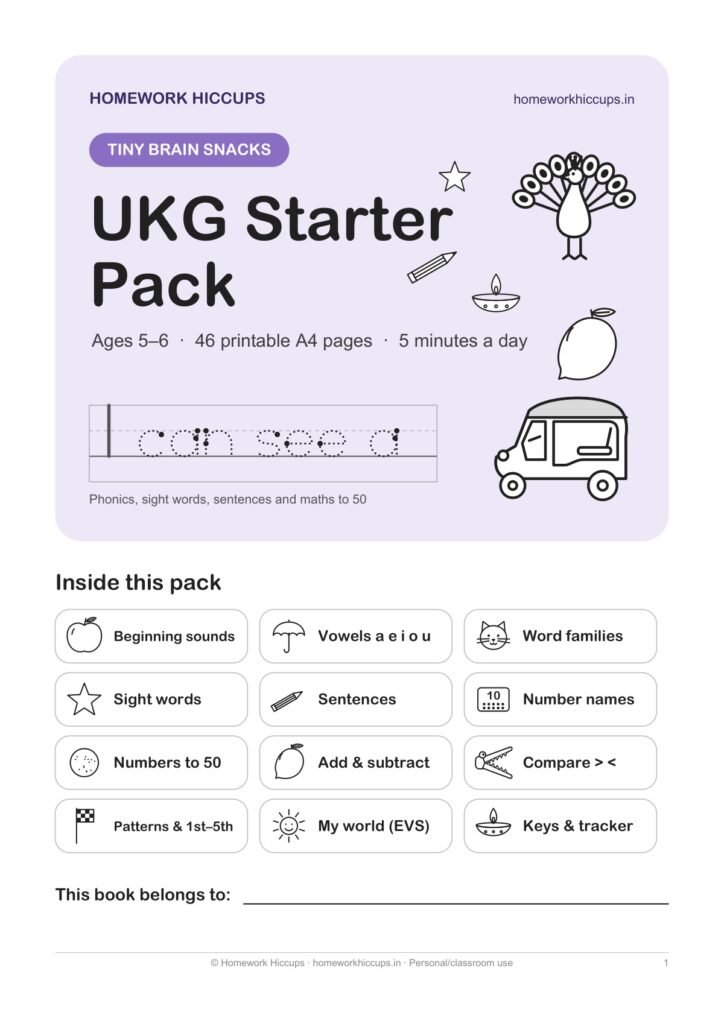
UKG Worksheets PDF – Tiny Brain Snacks Starter Pack (46 Pages) – A4 PDF, instant download. ₹149 ₹299
This guide gives you a simple three-stage method for teaching addition within 10, a way to explain the plus and equals signs, the counting-on trick, 30 practice sums with answers and five easy games. When your child is ready for bigger numbers, our guide to addition worksheets for Class 1 picks up where this one ends.
🧰 Make practice more fun at home
As an Amazon Associate, Homework Hiccups earns from qualifying purchases, at no extra cost to you.
Quick answer: To teach simple addition for UKG:
- Stage 1, objects: join two small groups of real things and count them all.
- Stage 2, pictures: count and add drawn objects, then use a number line.
- Stage 3, symbols: write the sum with + and =, keeping totals within 10.
- Practise 5 minutes a day with games, and move to counting on once counting all is easy.
What UKG children need before addition
Addition builds on counting, so check these three skills first. If one is shaky, spend a week on it before starting sums.
| Skill | Quick check | Ready if… |
|---|---|---|
| Counting objects | Put 7 buttons on the table and ask how many | They touch each one once and say 7 |
| Number recognition | Point to digits 0 to 10 in random order | They name each digit without counting up |
| More and less | Show 4 and 6 blocks; ask which has more | They answer without counting both again |
For counting and number practice that comes before addition, see our guide to maths worksheets for UKG.
How to teach addition to UKG: the 3-stage method
Stage 1: Real objects (about 1 week)
Use anything small and safe: bangles, bottle caps, peanuts, toy cars or rajma beans for older children who will not put them in their mouths. Make two groups on two plates. Say: Here are 3 bangles. Here are 2 bangles. Let us put them together. How many now? Your child pushes them into one group and counts all of them: 1, 2, 3, 4, 5.
Use the words and, put together, altogether and in all again and again. These words are what children later meet in word problems. Do 5 or 6 of these a day, with totals up to 5 first, then up to 10.
Stage 2: Pictures and the number line (about 1 to 2 weeks)
Now draw the objects instead: 4 mangoes and 1 mango. Your child counts the first group, counts the second, then counts all. Next, add a number line from 0 to 10. Start on the first number and hop forward the second number: for 4 + 3, put a finger on 4 and hop 1, 2, 3 to land on 7. A number line also prepares children for the number line work in Class 1.
Stage 3: Symbols (ongoing)
Only now write the sum: 4 + 3 = 7. Keep pictures beside the first few sums so the symbols always connect to something real. Gradually take the pictures away.
Teaching the + and = signs
Many UKG children copy the signs without knowing what they mean. Give each sign a simple job:
- + means put together. Make a plus with two pencils crossing and say: this sign joins the groups.
- = means is the same as. Not just here comes the answer. Show 2 + 1 on one plate and 3 on another plate: the two sides have the same amount, so we can put = between them.
A quick check: write 5 = 3 + 2 now and then. A child who truly understands = will happily say it is right. A child who thinks = means the answer comes next may say it is wrong, which tells you to show the two-plate idea again.
Counting on: the first addition strategy
Counting all works, but it is slow. Once your child is confident, teach counting on: Put the bigger number in your head and count up the smaller number on your fingers. For 6 + 3, say six in a big voice, then count seven, eight, nine on three fingers. The answer is the last number you say.
Two tips make this easier:
- Start with the bigger number. 2 + 7 is easier as 7 + 2. Show that 2 + 7 and 7 + 2 both make 9 using blocks, so children trust the swap.
- Do not count the first number again. The most common mistake is saying six, seven, eight for 6 + 3 and getting 8. Remind them the first number is already in their head.
30 simple addition sums for UKG (with answers)
Copy these into a notebook, a few rows at a time. Set A is for drawing or using objects, Set B for the number line, and Set C for written sums. All totals are 10 or less. Cover the answer column before your child starts.
Set A: Picture addition for kids (draw or use objects)
| No. | Sum | Answer |
|---|---|---|
| 1 | 1 ball + 1 ball | 2 balls |
| 2 | 2 kites + 1 kite | 3 kites |
| 3 | 2 diyas + 2 diyas | 4 diyas |
| 4 | 3 apples + 1 apple | 4 apples |
| 5 | 3 stars + 2 stars | 5 stars |
| 6 | 4 ducks + 1 duck | 5 ducks |
| 7 | 1 cup + 4 cups | 5 cups |
| 8 | 2 cars + 3 cars | 5 cars |
| 9 | 4 ladoos + 2 ladoos | 6 ladoos |
| 10 | 3 flowers + 3 flowers | 6 flowers |
Set B: Number line hops
| No. | Start on, then hop | Sum | Answer |
|---|---|---|---|
| 11 | Start on 5, hop 1 | 5 + 1 | 6 |
| 12 | Start on 5, hop 2 | 5 + 2 | 7 |
| 13 | Start on 4, hop 3 | 4 + 3 | 7 |
| 14 | Start on 6, hop 1 | 6 + 1 | 7 |
| 15 | Start on 5, hop 2 (swap 2 + 5) | 2 + 5 | 7 |
| 16 | Start on 4, hop 4 | 4 + 4 | 8 |
| 17 | Start on 5, hop 3 | 5 + 3 | 8 |
| 18 | Start on 6, hop 2 | 6 + 2 | 8 |
| 19 | Start on 7, hop 1 | 7 + 1 | 8 |
| 20 | Start on 6, hop 3 (swap 3 + 6) | 3 + 6 | 9 |
Set C: Written sums
| No. | Sum | Answer | No. | Sum | Answer |
|---|---|---|---|---|---|
| 21 | 5 + 4 = | 9 | 26 | 7 + 3 = | 10 |
| 22 | 7 + 2 = | 9 | 27 | 8 + 2 = | 10 |
| 23 | 8 + 1 = | 9 | 28 | 9 + 1 = | 10 |
| 24 | 5 + 5 = | 10 | 29 | 0 + 6 = | 6 |
| 25 | 6 + 4 = | 10 | 30 | 3 + 0 = | 3 |
Sums 29 and 30 introduce zero: adding nothing leaves the number the same. Show it with an empty plate.
Prefer ready-to-print pages?
UKG Worksheets PDF – Tiny Brain Snacks Starter Pack (46 Pages) – A4 PDF, instant download. ₹149 ₹299
5 addition games for UKG
- Two-dice add. Use dice with dots. Roll both and count all the dots. Once easy, say the number on the bigger die and count on the other.
- Bus stop. A shoebox is the bus. Put 3 toy people in, then 2 more get on at the next stop. How many on the bus now? Children love making up their own stops.
- Make 10 with bangles. Lay out 10 bangles. Hide some under a cloth. Your child counts the ones they can see and works out how many are hidden. This builds the number bonds to 10 that help in Class 1.
- Hopscotch sums. Chalk a number line from 0 to 10 on the floor. Call out a sum like 3 + 4; your child stands on 3 and hops 4 times.
- Snack shop. Price toys at ₹1 to ₹5 with paper tags. Your child buys two things and adds the prices with ₹1 coins.
When to move on (and when to slow down)
Your child is ready for subtraction and bigger numbers when they can add within 10 using counting on, explain what + and = mean, and solve a simple spoken story like 4 birds sat on a wall and 2 more came. Our guide to subtraction for UKG uses the same objects-pictures-symbols order. If your child still counts every object from 1 for every sum, stay with objects for another week. That is not falling behind; it is building a solid base.
Addition worksheet for UKG: UKG maths worksheets to print
Our UKG Worksheets PDF Starter Pack (46 pages) brings this practice together with the other big UKG skills: phonics, CVC word families, sight words, numbers to 50, and addition and subtraction to 10. It is a simple way to give your child a short page each day without having to draw sums yourself.
Get the UKG Worksheets Starter Pack – ₹149
Want to try a few pages first? The free UKG worksheets sample is a 5-page PDF (cover, 3 real pages and a contents page) that you get by entering your name and email at checkout, with no payment. You can also explore all UKG worksheets and maths worksheets.
Download the 46-page UKG Pack – ₹149
🧸 Learning toys kids love
As an Amazon Associate, Homework Hiccups earns from qualifying purchases, at no extra cost to you.
Frequently asked questions
What addition should a UKG child know?
Most UKG children practise adding two small groups with totals up to 10, first with objects and pictures and then with written sums using the plus and equals signs. Schools vary, so check your child’s school book.
How do I teach addition to a 5-year-old?
Start with real objects, joining two groups and counting them all. Then move to pictures and a number line, and only then to written sums. Keep sessions to about 5 minutes and use games.
What is counting on in addition?
Counting on means keeping the bigger number in your head and counting up the smaller number. For 6 + 3, say six and count seven, eight, nine. The answer is 9.
Should UKG children use fingers for addition?
Yes. Fingers are a natural tool at this age. Over time, children start to remember facts like 5 + 5 = 10 and use their fingers less.
When should I start subtraction in UKG?
Start subtraction once your child can add within 10 confidently with objects and pictures. Use the same order: real objects first, then pictures, then written sums.