Before a child can understand 7 > 4, they have to see that a plate of seven laddoos has more than a plate of four. That simple idea, comparing groups, is what a more or less worksheet teaches. In UKG it is the bridge between counting and the greater-than and less-than symbols that come a little later.
Print-ready worksheets for this topic
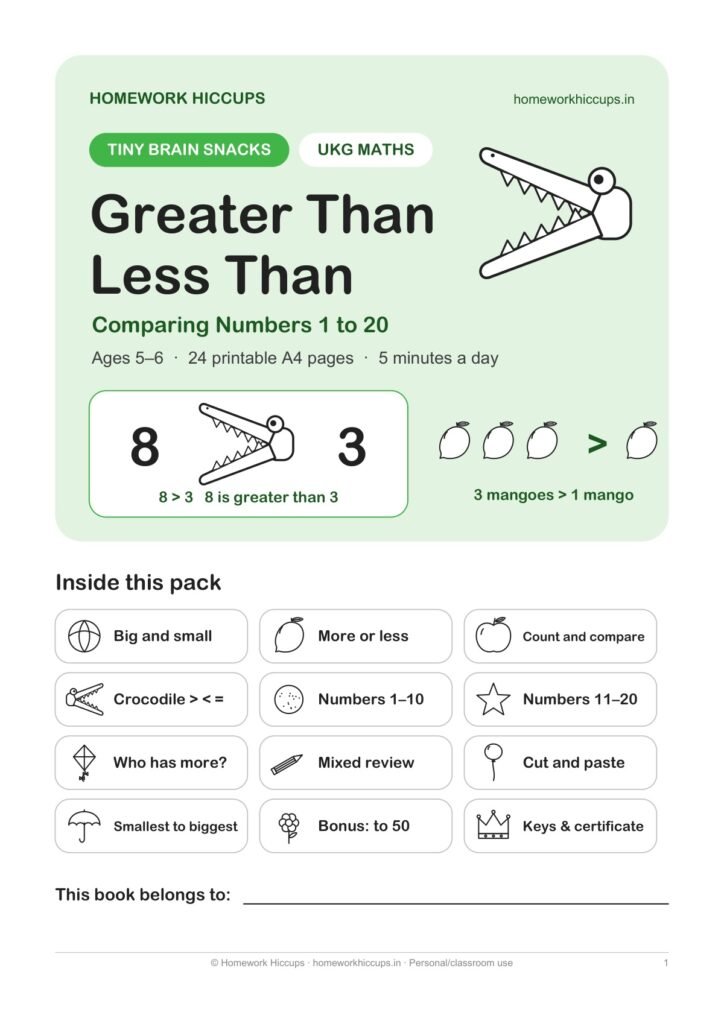
Greater Than Less Than Worksheets for UKG PDF – Comparing Numbers 1 to 20 (24 Pages) – A4 PDF, instant download. ₹49 ₹99
This guide shows you how to teach more, less and same with things children already love (laddoos, bangles, kites), how one-to-one matching works, the words to use, and 15 ready picture questions written as text, with answers, that you can draw or ask aloud today.
🧰 Make practice more fun at home
As an Amazon Associate, Homework Hiccups earns from qualifying purchases, at no extra cost to you.
Quick answer: To teach more or less in UKG:
- Start real: two plates of laddoos; ask which has more.
- Match one-to-one: line items up in pairs; the group with leftovers has more.
- Add “same”: when every item has a partner, the groups are the same.
- Then count: count both groups and compare the numbers.
- Last: introduce the > and < symbols.
Why more and less come before symbols
Children who jump straight to > and < often memorise the shape without understanding it. Comparing groups first gives the symbols meaning. When a child has spent a week deciding which plate has more laddoos, the idea that 7 is greater than 4 is no longer abstract.
Most UKG children are ready when they can count a group of up to 10 objects reliably. If counting is still shaky, practise that first with our ideas on before and after numbers.
The words to use: more, less, fewer and same
| Word | Meaning for a child | Example |
|---|---|---|
| More | The bigger group | 5 kites is more than 2 kites |
| Less | The smaller group | 2 kites is less than 5 kites |
| Fewer | Less, for things you can count | Riya has fewer bangles than Meera |
| Same | Every item has a partner | 3 cups and 3 saucers are the same |
Fewer vs less, in simple terms: grown-ups say fewer for things you can count one by one (fewer bangles) and less for things you can’t (less water, less rice). Most UKG worksheets use “less” for both, and that is fine at this age. If you like, say both: “Riya has fewer bangles – she has less.” Children pick up the difference naturally over time.
How to teach more or less: a 5-day plan
Day 1: laddoos on plates
Put 2 laddoos on one plate and 6 on another. Ask: “Which plate has more?” Most children can see it. Then try 4 and 5, which is harder to see at a glance. That is when they need a strategy.
Day 2: one-to-one matching with bangles
Lay out 6 bangles in a row for you and 4 for your child. Pair them up, one of yours next to one of theirs. Two of yours have no partner. “I have more because I have bangles left over.” This is one-to-one matching, and it works even before a child can count.
Day 3: kites and “same”
Draw 3 kites in one box and 3 in another. Join each kite to a kite in the other box with a line. No kite is left over, so the groups are the same. Then rub one out and ask again.
Day 4: count and compare
Now count both groups and write the numbers. “This box has 7, that box has 5. 7 is more than 5.” Keep using the objects alongside the numbers.
Day 5: the size trap
Draw 3 big elephants and 8 small ants. Ask: “Which group has more?” Many children say the elephants because they look bigger. Matching and counting show that 8 ants are more. Talk about it: more means how many, not how big.
🧸 Learning toys kids love
As an Amazon Associate, Homework Hiccups earns from qualifying purchases, at no extra cost to you.
15 more or less questions with answers
Draw these quickly on paper as dots or simple shapes, or ask them aloud using real objects.
- Plate A has 3 laddoos. Plate B has 5 laddoos. Which plate has more?
- Box A has 6 bangles. Box B has 4 bangles. Which box has less?
- Box A has 2 kites. Box B has 2 kites. More, less or same?
- Basket A has 7 mangoes. Basket B has 9 mangoes. Which has more?
- Row A has 1 diya. Row B has 4 diyas. Which has less?
- Group A has 5 balloons. Group B has 5 balloons. More, less or same?
- Box A has 8 pencils. Box B has 3 pencils. Which has more?
- Riya has 4 flowers. Kabir has 6 flowers. Who has fewer?
- There are 10 ants and 2 elephants. Which group has more?
- Box A has 3 big balls. Box B has 6 small balls. Which box has more balls?
- Aarav has 5 rotis. Diya has 2 rotis. Who has less?
- Plate A has 3 laddoos and Plate B has 4. How many laddoos must you add to Plate A to make them the same?
- Box A has 9 stars. Box B has 9 stars. More, less or same?
- Box A has 0 sweets. Box B has 1 sweet. Which has more?
- There are 6 cups and 4 saucers. Does every cup get a saucer?
| Q | Answer | Q | Answer |
|---|---|---|---|
| 1 | Plate B (5) | 9 | Ants (10 is more than 2) |
| 2 | Box B (4) | 10 | Box B (6 small balls) |
| 3 | Same | 11 | Diya (2) |
| 4 | Basket B (9) | 12 | Add 1 |
| 5 | Row A (1) | 13 | Same |
| 6 | Same | 14 | Box B (1) |
| 7 | Box A (8) | 15 | No, 2 cups have no saucer, so there are more cups |
| 8 | Riya (4) |
More or less activity ideas
- Handful game: you and your child each grab a handful of rajma or buttons. Match them in pairs to see who has more.
- Snack check: at tea time, ask who has more biscuits. Let your child make it the same.
- Dice towers: roll a dice twice and build two block towers. Which is taller? Which has more blocks?
- Clap and stamp: you clap 3 times, your child stamps 5 times. Who made more sounds?
- Toy parking: line up toy cars and parking spots drawn on paper. Are there more cars or more spots?
Short, playful rounds of 5 minutes work far better than a long worksheet session.
Prefer ready-to-print pages?
Greater Than Less Than Worksheets for UKG PDF – Comparing Numbers 1 to 20 (24 Pages) – A4 PDF, instant download. ₹49 ₹99
Common mistakes and how to fix them
| Mistake | Fix |
|---|---|
| Chooses the group that looks bigger or longer | Match items one-to-one so spacing doesn’t matter |
| Counts the same item twice | Touch and push each item aside as you count |
| Mixes up more and less | Always ask “more” first for a few days, then add “less” |
| Forgets “same” is possible | Include one equal pair in every set of questions |
From more and less to greater than and less than
Once your child is confident with groups, it is time for numbers and symbols. Our post on the greater than less than worksheet explains the crocodile method step by step. For more UKG maths, see maths worksheets for UKG, and for size words, try our big and small worksheet ideas.
A printable more or less and comparing pack
Our Greater Than Less Than Worksheets for UKG (24 A4 pages, ages 5–6) follow exactly this order. They begin with big and small (8 picture pairs) and 2 pages of more or less picture groups to count and circle, with mangoes, ladoos, kites and diyas. Then comes Chomp the hungry crocodile to explain >, < and =, count-and-compare pages, comparing numbers 1 to 10 and 11 to 20, picture stories with Aarav, Diya, Kabir, Meera and Riya, mixed reviews, 2 cut-and-paste symbol pages, smallest-to-biggest ordering, a bonus page comparing numbers to 50, answer keys, a tracker and a certificate.
Get the Greater Than Less Than UKG Pack – ₹49
It is black line art, so it prints well at home. Explore more UKG worksheets and maths worksheets.
Download the Comparing Worksheets PDF – ₹49
Frequently asked questions
What is a more or less worksheet?
It is a page with two groups of pictures. The child counts or matches the groups and circles the one with more, the one with less, or marks them as the same.
At what age do children learn more and less?
Many children start comparing groups in LKG and UKG, around ages 4 to 6, once they can count up to 10 objects.
What is one-to-one matching?
One-to-one matching means pairing each item in one group with one item in the other. The group with items left over has more. It works even before a child can count well.
Should I teach fewer or less to UKG children?
Most UKG worksheets use less for everything, which is fine. You can also say fewer for things you can count, such as fewer bangles, and children will learn the difference over time.
When should I introduce the greater than and less than symbols?
Introduce the symbols once your child can confidently say which of two groups has more, less or the same, and can count both groups to compare the numbers.