A times table chart on the wall does quiet work every day. Children glance at it while brushing their teeth, check an answer during homework and slowly start to see the patterns. This page gives you tables for kids printable straight from your browser: a tables 2 to 20 chart written out clearly, plus tips for printing and displaying them, five tricks that make tables easier, a 4-week routine and free practice ideas.

Print-ready worksheets for this topic
Times Tables, Time & Money Worksheets PDF – Tables 2–10, Clock, Calendar & Indian Rupees (41 Pages) – A4 PDF, instant download. ₹99 ₹199
If you want a full step-by-step teaching method, our guide on how to learn multiplication tables covers that. This page is the chart itself, ready to print or copy.
Quick answer:
- Print: use your browser’s print option on this page, or copy the charts below onto chart paper.
- Start with: tables 2, 5 and 10, then 3, 4, 9, then 6, 7, 8.
- Tricks: the 9s finger trick, 5s end in 5 or 0, 10s add a zero, 4s are double the 2s, 8s are double the 4s.
- Routine: one table a week, 5 to 10 minutes a day, with a quick test on Saturday.
- Tables 11 to 20 usually come later, in Class 3 or 4 in many schools.
Tables for kids printable: chart 2 to 10
Read each row across. For example, the row for 7 shows 7 × 1 = 7, 7 × 2 = 14 and so on up to 7 × 10 = 70.
| Table | × 1 | × 2 | × 3 | × 4 | × 5 | × 6 | × 7 | × 8 | × 9 | × 10 |
|---|---|---|---|---|---|---|---|---|---|---|
| 2 | 2 | 4 | 6 | 8 | 10 | 12 | 14 | 16 | 18 | 20 |
| 3 | 3 | 6 | 9 | 12 | 15 | 18 | 21 | 24 | 27 | 30 |
| 4 | 4 | 8 | 12 | 16 | 20 | 24 | 28 | 32 | 36 | 40 |
| 5 | 5 | 10 | 15 | 20 | 25 | 30 | 35 | 40 | 45 | 50 |
| 6 | 6 | 12 | 18 | 24 | 30 | 36 | 42 | 48 | 54 | 60 |
| 7 | 7 | 14 | 21 | 28 | 35 | 42 | 49 | 56 | 63 | 70 |
| 8 | 8 | 16 | 24 | 32 | 40 | 48 | 56 | 64 | 72 | 80 |
| 9 | 9 | 18 | 27 | 36 | 45 | 54 | 63 | 72 | 81 | 90 |
| 10 | 10 | 20 | 30 | 40 | 50 | 60 | 70 | 80 | 90 | 100 |
The table of 1 is simply the number itself (1 × 7 = 7), so most charts start at 2. Tables 1 to 10 for kids are the core set that many schools expect by the end of Class 2 or Class 3.
Tables 11 to 20 chart
These are for older or confident children. Many schools introduce tables 11 to 20 in Class 3 or 4, so there is no rush in Class 1 or 2.
| Table | × 1 | × 2 | × 3 | × 4 | × 5 | × 6 | × 7 | × 8 | × 9 | × 10 |
|---|---|---|---|---|---|---|---|---|---|---|
| 11 | 11 | 22 | 33 | 44 | 55 | 66 | 77 | 88 | 99 | 110 |
| 12 | 12 | 24 | 36 | 48 | 60 | 72 | 84 | 96 | 108 | 120 |
| 13 | 13 | 26 | 39 | 52 | 65 | 78 | 91 | 104 | 117 | 130 |
| 14 | 14 | 28 | 42 | 56 | 70 | 84 | 98 | 112 | 126 | 140 |
| 15 | 15 | 30 | 45 | 60 | 75 | 90 | 105 | 120 | 135 | 150 |
| 16 | 16 | 32 | 48 | 64 | 80 | 96 | 112 | 128 | 144 | 160 |
| 17 | 17 | 34 | 51 | 68 | 85 | 102 | 119 | 136 | 153 | 170 |
| 18 | 18 | 36 | 54 | 72 | 90 | 108 | 126 | 144 | 162 | 180 |
| 19 | 19 | 38 | 57 | 76 | 95 | 114 | 133 | 152 | 171 | 190 |
| 20 | 20 | 40 | 60 | 80 | 100 | 120 | 140 | 160 | 180 | 200 |
How to print and display a multiplication table chart
- Print from this page: use your browser’s print option (Ctrl + P on a computer, or Share and Print on a phone). Choose A4 and portrait.
- Make a chart by hand: copy one table at a time onto chart paper with a thick marker. Children remember tables they helped to write.
- Use colour: write the answers of the 5s in one colour and the 10s in another. Patterns jump out.
- Put it at eye level: near the study table, on the fridge or next to the bathroom mirror.
- Laminate or use a sheet protector: children can circle answers with a dry-erase marker and wipe them clean.
- Show one table at a time: fold or cover the rest. A full chart can overwhelm a seven-year-old.
5 tricks that make times tables easier
1. The 9s finger trick
Hold up all 10 fingers. For 9 × 4, fold down the 4th finger from the left. There are 3 fingers to the left (tens) and 6 to the right (ones), so 9 × 4 = 36. It works for 9 × 1 to 9 × 10.
Another 9s pattern: the digits of each answer add up to 9 (18: 1 + 8 = 9; 27: 2 + 7 = 9), and the tens digit is one less than the number you multiply by (9 × 7 = 63).
2. The 5s and 10s patterns
Every answer in the 10s table ends in 0: just add a zero (10 × 6 = 60). Every answer in the 5s table ends in 5 or 0. And 5 times a number is half of 10 times it: 5 × 8 is half of 80, which is 40.
3. Doubling
The 2s are doubles (2 × 7 = 14). The 4s are double the 2s: 4 × 7 = double 14 = 28. The 8s are double the 4s: 8 × 7 = double 28 = 56. Three tables learned for the price of one.
4. Swap the numbers
3 × 7 is the same as 7 × 3. Once your child knows the 2s, 3s, 4s and 5s, much of the 6s, 7s, 8s and 9s is already known. Shade the facts they know on the chart; the rest looks much smaller.
5. Build big tables from small ones
The 20s are double the 10s: 20 × 7 = 140. The 12s are the 10s plus the 2s: 12 × 7 = 70 + 14 = 84. The 11s up to 11 × 9 repeat the digit: 11 × 6 = 66.
Prefer ready-to-print pages?
Times Tables, Time & Money Worksheets PDF – Tables 2–10, Clock, Calendar & Indian Rupees (41 Pages) – A4 PDF, instant download. ₹99 ₹199
A 4-week chart routine
| Week | Tables | Daily activity (5 to 10 minutes) |
|---|---|---|
| 1 | 2, 5 and 10 | Say the table aloud from the chart, then skip count with claps |
| 2 | 3 and 4 | Cover one answer on the chart and ask for it; use the doubling trick for 4s |
| 3 | 9 and 6 | Practise the 9s finger trick; for 6s, take the 5s answer and add the number once more (6 × 7 = 35 + 7 = 42) |
| 4 | 7 and 8 | Use doubling for 8s; mixed questions from all tables on Saturday |
Slower is fine. Many children take two weeks per table, and that still covers 2 to 10 in a school term. Revise old tables on Saturdays so they stay fresh.
Tables for kids worksheet: free practice ideas
Fill the missing answers
Copy a table onto paper and leave some answers blank.
- 6 × 3 = ___ Answer: 18
- 6 × 7 = ___ Answer: 42
- 6 × 9 = ___ Answer: 54
Missing number
- 4 × ___ = 32 Answer: 8
- ___ × 5 = 35 Answer: 7
- 9 × ___ = 81 Answer: 9
Ten-fact speed test
| Question | Answer | Question | Answer |
|---|---|---|---|
| 3 × 4 | 12 | 9 × 6 | 54 |
| 6 × 7 | 42 | 12 × 3 | 36 |
| 8 × 9 | 72 | 5 × 9 | 45 |
| 7 × 7 | 49 | 6 × 8 | 48 |
| 4 × 8 | 32 | 7 × 9 | 63 |
Time it once a week and write the score on the chart. Beating your own time is more motivating than comparing with others.
Games with no printing at all
- Stair tables: say one fact for every step you climb.
- Dice multiply: roll two dice and multiply the numbers. Whoever answers first keeps the point.
- Shop maths: “Pencils cost ₹5 each. How much for 6?” Answer: ₹30. Our money worksheets for Class 1 guide has more shopping sums.
- Clap and count: clap on every 3rd number while counting to 30.
Tables are a big part of Class 2 maths in many schools; see our maths worksheets for Class 2 guide for where they fit. For more free practice across subjects, our list of free printable worksheets for kids is a good next stop.
Times tables for kids printable pack: tables 2 to 10
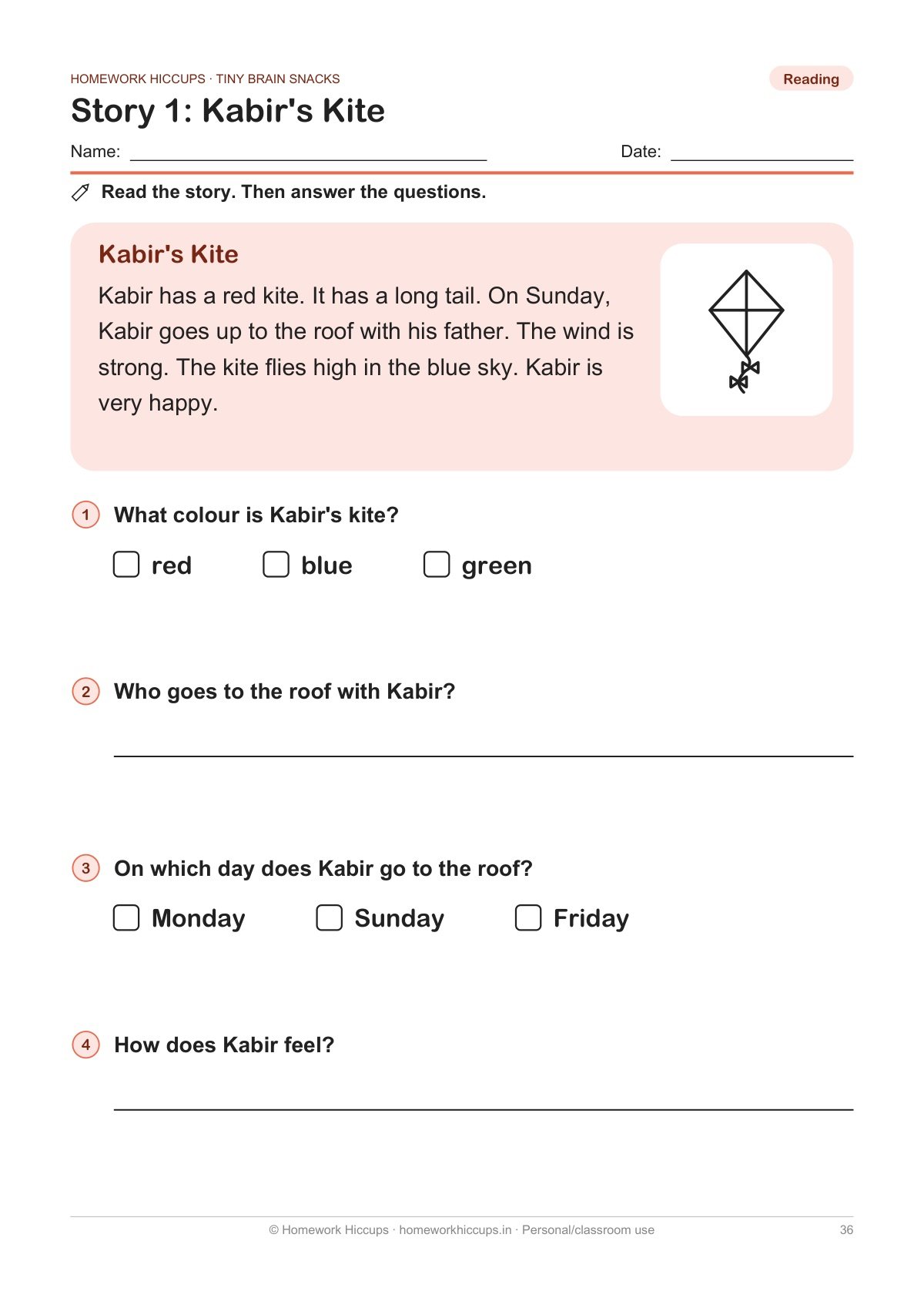
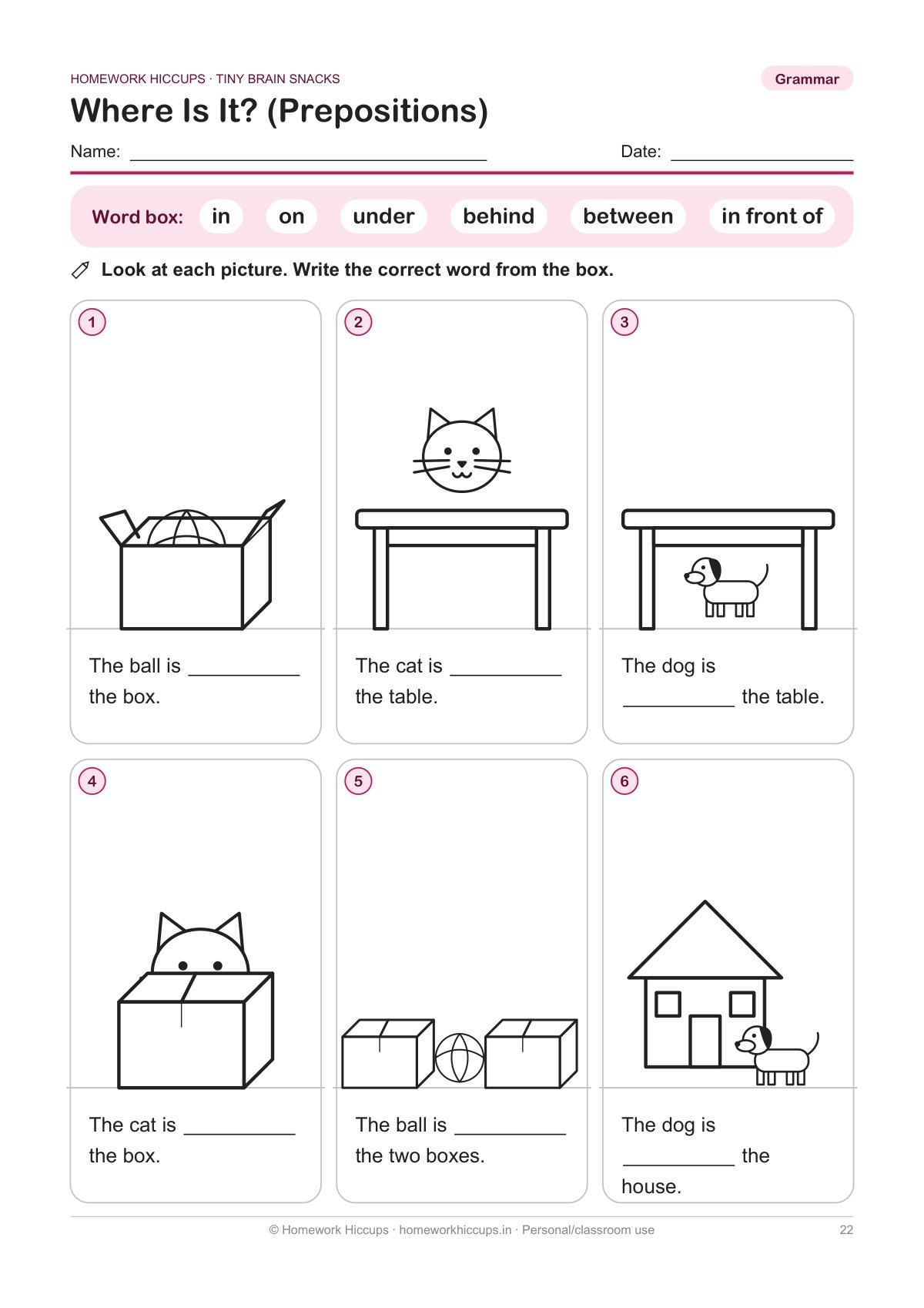
When the chart is up and your child is ready for written practice, or you want tables for kids as a PDF, our Times Tables, Time and Money Worksheets PDF (₹99, ages 6 to 9, 41 A4 pages) has one page per table from 2 to 10: trace the table, fill it in, skip count on a number line and do mixed practice with out-of-order facts and missing numbers. It also has a 1 to 10 multiplication grid to fill in, three speed tests of 30 facts each with time and score boxes, and answer keys. The rest of the pack covers telling the time, the calendar and Indian money.
Get the Times Tables, Time and Money Pack – ₹99
Not sure it suits your child? Try a free sample first: a free 5-page PDF with the cover, 3 real pages from the paid pack and a contents page. Enter your name and email at checkout and download it with no payment. The full pack is paid.
Frequently asked questions
Which tables should a child learn first?
Start with 2, 5 and 10 because they have clear patterns. Then move to 3, 4 and 9, and finish with 6, 7 and 8, which most children find hardest.
At what age should kids learn tables 2 to 10?
Many schools in India start tables in Class 2, around age 7, and expect 2 to 10 by Class 3. Some start the 2s, 5s and 10s in Class 1 through skip counting.
When should children learn tables 11 to 20?
Many schools introduce tables 11 to 20 in Class 3 or 4. Children who know 2 to 10 well can build them using tricks, such as the 20s being double the 10s.
How long does it take to learn tables 2 to 10?
With 5 to 10 minutes a day, most children learn one table a week or every two weeks, so 2 to 10 takes roughly two to four months.
Is a multiplication table chart enough to learn tables?
A chart helps children see patterns and check answers, but they also need to say the tables aloud, play quick games and answer mixed questions until the facts come without counting.