A one and many worksheet for UKG is usually a child’s first meeting with singular and plural. At this age, children are not learning spelling rules yet. They are learning to notice: is there one thing, or more than one? And does the word change when there are many? That noticing is the foundation for every plural rule that comes later in Class 1 and Class 2.
Print-ready worksheets for this topic
Singular and Plural Noun Worksheets PDF – One and Many for Class 1 & 2 (24 Pages) – A4 PDF, instant download. ₹49 ₹99
This guide shows you how to teach one and many with real objects at home, gives you a free 12-picture “circle the right word” mini worksheet in text form, a list of 20 easy add-s pairs, three oral games and a clear picture of what to expect at UKG level compared with Class 1.
🧰 Make practice more fun at home
 A4 printing paperBright 75–80 GSM sheets so worksheets print crisp.See on Amazon →
 Wipe-clean sheet protectorsSlip a page in, write, wipe and reuse.See on Amazon →
 Magnetic lettersBuild words on the fridge while dinner cooks.See on Amazon →
 Word building gameSpell and match words through play.See on Amazon →
As an Amazon Associate, Homework Hiccups earns from qualifying purchases, at no extra cost to you.
Quick answer: To teach one and many in UKG:
- Start with real things: one roti, many rotis; one spoon, many spoons.
- Teach the idea first: one means a single thing, many means more than one.
- Show that we usually add s for many: cat, cats.
- Use picture pages where the child circles “one” or “many”, or the right word.
- Leave es, ies and special plurals for Class 1 and 2.
What “one and many” means for kindergarten children
For UKG children, singular and plural is really a counting and looking skill. You might say: “When there is one, we say one cat. When there are many, we say cats. Can you hear the hiss at the end? That is the s sound.” Children don’t need the words “singular” and “plural” yet, although many schools introduce them. Use “one” and “many” first, and add the grammar words later.
Teach one and many with real objects at home
The kitchen is the best classroom for this topic. Try a five-minute session:
- Put one roti on a plate. Say, “One roti.”
- Put three rotis on another plate. Say, “Many rotis.” Stress the s.
- Ask your child to point: “Show me one roti. Show me many rotis.”
- Repeat with spoons, cups, bangles, blocks, pencils and toy cars.
- Now swap roles. Your child puts things on plates and you say “one” or “many”.
Once your child is confident, make a mistake on purpose: put three spoons and say “one spoon”. Children love catching a grown-up out, and it shows they understand.
Free mini worksheet: one and many pictures (circle the right word)
Draw each picture in a box on a sheet of paper (stick figures are fine), and write the two words beside it. The child looks at the picture and circles the correct word.
| # | Draw this | Circle one word | Answer |
|---|---|---|---|
| 1 | 1 ball | ball / balls | ball |
| 2 | 4 cats | cat / cats | cats |
| 3 | 1 kite | kite / kites | kite |
| 4 | 3 cups | cup / cups | cups |
| 5 | 5 stars | star / stars | stars |
| 6 | 1 tree | tree / trees | tree |
| 7 | 2 hats | hat / hats | hats |
| 8 | 1 pen | pen / pens | pen |
| 9 | 6 eggs | egg / eggs | eggs |
| 10 | 1 duck | duck / ducks | duck |
| 11 | 3 rotis | roti / rotis | rotis |
| 12 | 4 books | book / books | books |
For a non-reader, write “one” and “many” instead of the words and let them circle the idea. For a confident reader, cover the word choices and ask them to write the word.
20 easy add-s pairs for UKG
These words all make their plural by simply adding s, so they are perfect for UKG. Most are CVC or short words children can read.
| One | Many | One | Many |
|---|---|---|---|
| cat | cats | bat | bats |
| dog | dogs | kite | kites |
| pen | pens | star | stars |
| cup | cups | tree | trees |
| bag | bags | egg | eggs |
| hat | hats | ant | ants |
| book | books | doll | dolls |
| car | cars | duck | ducks |
| ball | balls | bed | beds |
| rat | rats | frog | frogs |
Avoid words like box, bus, baby, leaf, man and child for now. They change in other ways (boxes, buses, babies, leaves, men, children), which is Class 1 and Class 2 work. Our plural rules for kids post explains each of those rules when your child is ready.
3 oral games for one and many
1. Show me one, show me many
Give your child a pile of buttons, beads or blocks. Call out “one!” or “many!” and they show you the right amount as fast as they can. Then say a word: “Show me blocks.” (many) “Show me block.” (one). This makes them listen for the s.
2. The s detective
Say pairs of words and ask your child to clap when they hear many: “pen… pens”, “cups… cup”, “tree… trees”. Then say a short sentence: “I see two dogs.” Did they hear the s? This builds listening for word endings, which helps with spelling later.
3. Shopping market
Set up a pretend vegetable stall with toy or real items. Your child is the shopkeeper. You ask, “One onion, please.” “Many tomatoes, please.” The child gives you the right number. Then swap. Keep to easy add-s items first (onions, carrots, apples, bananas). If your child asks why it is tomatoes and not “tomatos”, that is a great question to save for later.
Prefer ready-to-print pages?
Singular and Plural Noun Worksheets PDF – One and Many for Class 1 & 2 (24 Pages) – A4 PDF, instant download. ₹49 ₹99
Common mix-ups and how to help
- Saying “two cat”. Repeat it back correctly with a smile: “Yes, two cats!” Don’t stop the child to correct them.
- Adding s to everything. “Mans” and “foots” are normal at this age. They show the child has found the pattern.
- Counting instead of looking. For “many”, the exact number doesn’t matter. Two, five or ten are all many.
UKG versus Class 1: what to expect
| Skill | UKG | Class 1 |
|---|---|---|
| Idea of one and many | Yes, with pictures and objects | Revised quickly |
| Add s | Hear it, read it, circle it | Write plurals on their own |
| Add es (box, bus) | Not yet | Often introduced |
| y to ies, f to ves | Not yet | Usually Class 2 |
| Special plurals (men, children) | Only by listening | Common ones introduced |
| Words “singular” and “plural” | Optional | Commonly used |
Exact topics vary by school and board, so check your child’s school syllabus. For a broad look at UKG English skills, read our UKG English worksheets guide and the UKG syllabus. When your child moves on to naming words, our nouns worksheet for Class 1 is the natural next step.
One many worksheet PDF: the print-ready option
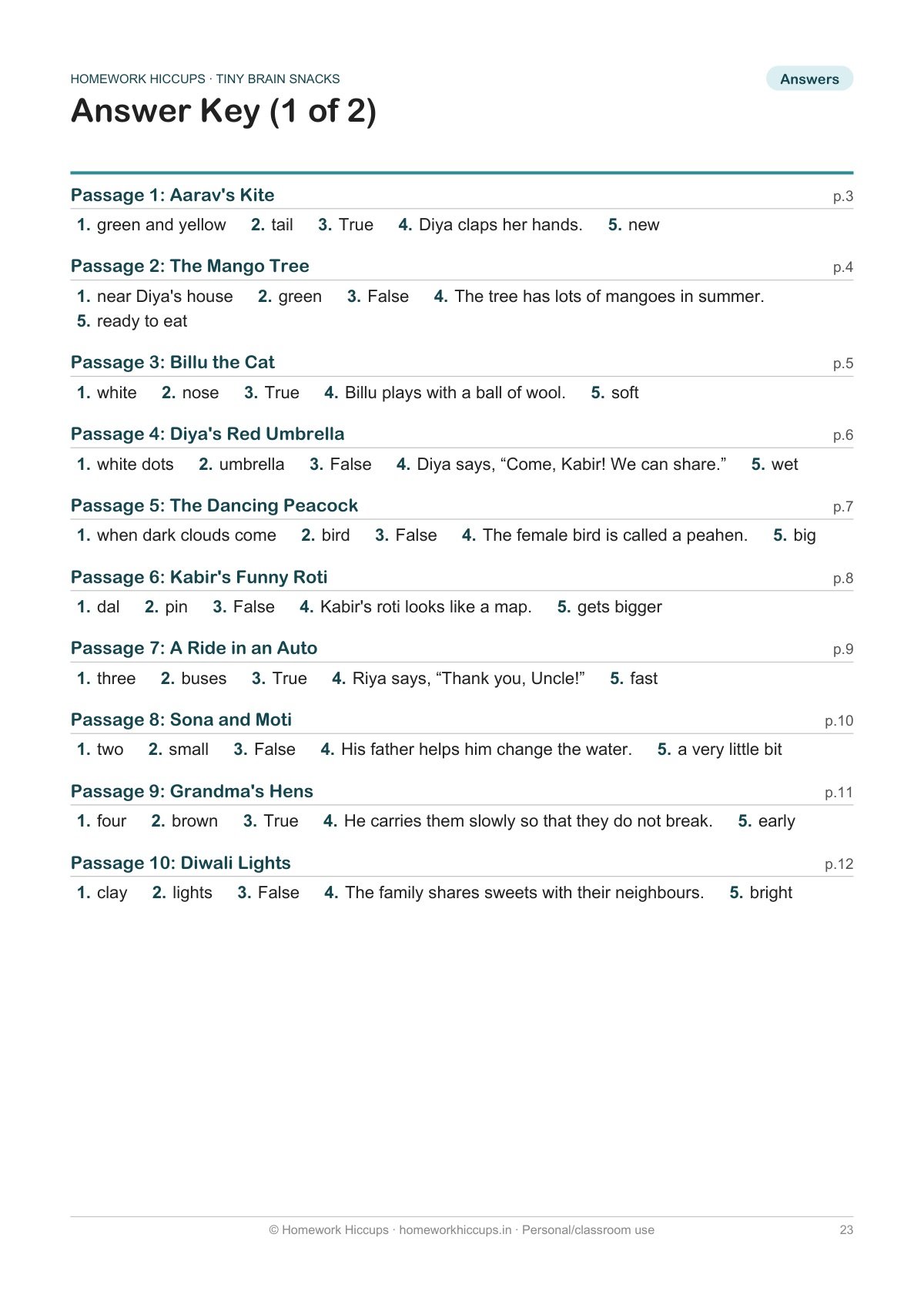
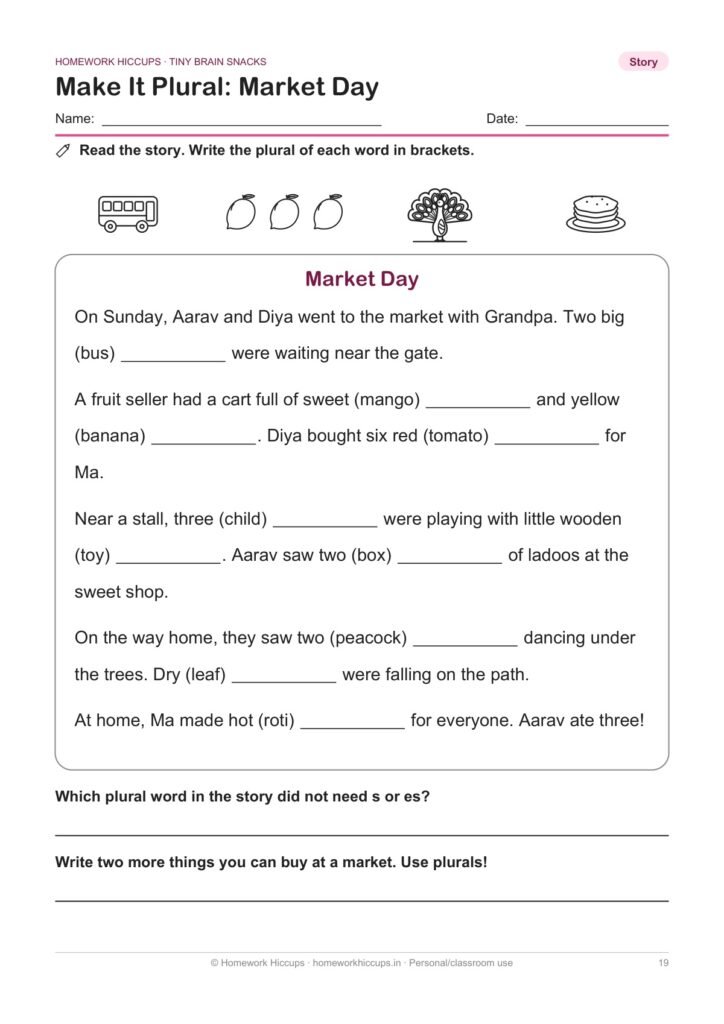
The Singular and Plural Noun Worksheets PDF (₹49, 24 A4 pages) is designed for Class 1 and Class 2, but it begins exactly where UKG children start. The first activity pages are “One or many?”: children circle the right word for 12 picture cards and tick one or many for 8 words. Then it moves to add s with picture cards (one book, two books). When your child is ready, the same pack continues with add es, y to ies, f and fe to ves, special plurals like men, children, teeth and mice, words that stay the same (sheep, deer, fish), a cut-and-sort page, a word search, a “Market Day” story, answer keys, a tracker and a certificate.
So a strong UKG child can use the first few pages now and keep the rest for Class 1.
Get the Singular and Plural Worksheets – ₹49
If you want practice across the whole UKG year (phonics, CVC word families, sight words, numbers to 50, and addition and subtraction to 10), the UKG Worksheets Starter Pack (₹149, 46 pages) covers it. You can also browse all English worksheets.
Download the One and Many Worksheet Pack – ₹49
🧸 Learning toys kids love
 Story cubesRoll the cubes and tell a story together.See on Amazon →
 LCD writing tabletWrite, erase with one button, write again: no paper.See on Amazon →
 Jigsaw puzzles (3–6 yrs)Screen-free focus time for little ones.See on Amazon →
 Educational board gamesFamily game time that sneaks in learning.See on Amazon →
As an Amazon Associate, Homework Hiccups earns from qualifying purchases, at no extra cost to you.
Frequently asked questions
How do I teach one and many to a UKG child?
Use real objects first, such as one roti and many rotis, and say the words clearly. Then move to pictures where the child circles one or many, or the correct word.
Should UKG children learn singular and plural rules?
Not yet. At UKG level, children learn the idea of one and many and the simple add s pattern. Rules such as es, ies and ves are usually taught in Class 1 and Class 2.
What words are best for a one and many worksheet?
Short words that only add s, such as cat, cup, pen, ball, star, tree, egg and book. Avoid box, baby, leaf and child at this stage.
Is there a one and many worksheet PDF for kindergarten?
Yes. The Singular and Plural Noun Worksheets PDF starts with one-or-many picture pages that suit ready UKG children, then moves on to plural rules for Class 1 and Class 2.
How long should one and many practice take?
About five to ten minutes a day is enough. Mix one short worksheet with a quick oral game, and stop while your child is still enjoying it.