Plural rules for kids can feel confusing to explain. Why is it boxes but boys? Babies but toys? Leaves but roofs? Children in Class 1 and Class 2 ask these questions all the time, and many parents only know the answer “because that is how it is spelt”. The good news is that most English plurals follow a small number of rules, and children can learn them one at a time.
Print-ready worksheets for this topic
Singular and Plural Noun Worksheets PDF – One and Many for Class 1 & 2 (24 Pages) – A4 PDF, instant download. ₹49 ₹99
This guide explains 8 plural rules in simple words, with 6 examples for each, the common exceptions, a one-page rules chart you can copy and a 24-word practice test with answers. If you just need a long list of singular and plural words, our singular and plural worksheet post has a 100-word list.
🧰 Make practice more fun at home
As an Amazon Associate, Homework Hiccups earns from qualifying purchases, at no extra cost to you.
Quick answer: The 8 plural rules for kids are:
- Most words: add s (cat → cats).
- Words ending in s, x, sh, ch and many ending in o: add es (box → boxes).
- Consonant + y: change y to ies (baby → babies). Vowel + y: just add s (toy → toys).
- Many words ending in f or fe: change to ves (leaf → leaves).
- Some words change inside (man → men), some stay the same (sheep → sheep), and some are always plural (scissors).
Plural rules chart for Class 1 and Class 2
Copy this chart into the back of your child’s English notebook. Teach one row per week, not all eight at once.
| Rule | When | What to do | Example |
|---|---|---|---|
| 1 | Most words | Add s | pen → pens |
| 2 | Ends in s, x, sh, ch, and many words ending in o | Add es | bus → buses |
| 3 | Ends in consonant + y | Change y to i, add es | city → cities |
| 4 | Ends in vowel + y | Add s | key → keys |
| 5 | Ends in f or fe (many words) | Change to ves | knife → knives |
| 6 | Irregular words | The word changes | child → children |
| 7 | Same for one and many | No change | deer → deer |
| 8 | Always plural | No singular form | scissors |
Rule 1: Most words, just add s
This is the rule children meet first, and it covers most naming words.
Examples: book → books, pen → pens, cat → cats, kite → kites, tree → trees, girl → girls.
Child-friendly tip: “If nothing special is happening at the end of the word, just add s.”
When to add es to make plural (Rule 2)
Words ending in s, x, sh, ch get es. Say “boxs” aloud and it is hard to hear the plural. Adding es adds an extra sound: box-es. That extra beat is the clue.
Examples: bus → buses, box → boxes, dish → dishes, watch → watches, brush → brushes, bench → benches.
Words ending in o: many common ones add es: tomato → tomatoes, potato → potatoes, mango → mangoes, hero → heroes.
Exceptions with o: some just add s: piano → pianos, photo → photos, radio → radios, zoo → zoos, video → videos. Children simply learn these as special words.
S or es? A quick test
Ask your child to say the plural aloud. If it adds an extra beat (bus-es, dish-es, watch-es), write es. If not (cats, pens), write s.
Words ending in y: plural rule (Rules 3 and 4)
Look at the letter just before the y.
Consonant + y → ies: baby → babies, lady → ladies, city → cities, story → stories, puppy → puppies, butterfly → butterflies.
Vowel (a, e, i, o, u) + y → add s: toy → toys, boy → boys, key → keys, day → days, monkey → monkeys, tray → trays.
Child-friendly tip: “If a vowel is holding the y’s hand, the y stays. If a consonant is next to it, the y changes to ies.”
F to ves plural rule (Rule 5)
Many words ending in f or fe change to ves.
Examples: leaf → leaves, knife → knives, wolf → wolves, half → halves, shelf → shelves, wife → wives. Also: calf → calves, loaf → loaves, thief → thieves, life → lives.
Exceptions: roof → roofs, chef → chefs, chief → chiefs, cliff → cliffs, giraffe → giraffes. Say them aloud: we say “roofs”, not “rooves”, so we write roofs.
Rule 6: Irregular plurals
These words change inside, so children need to learn them by heart.
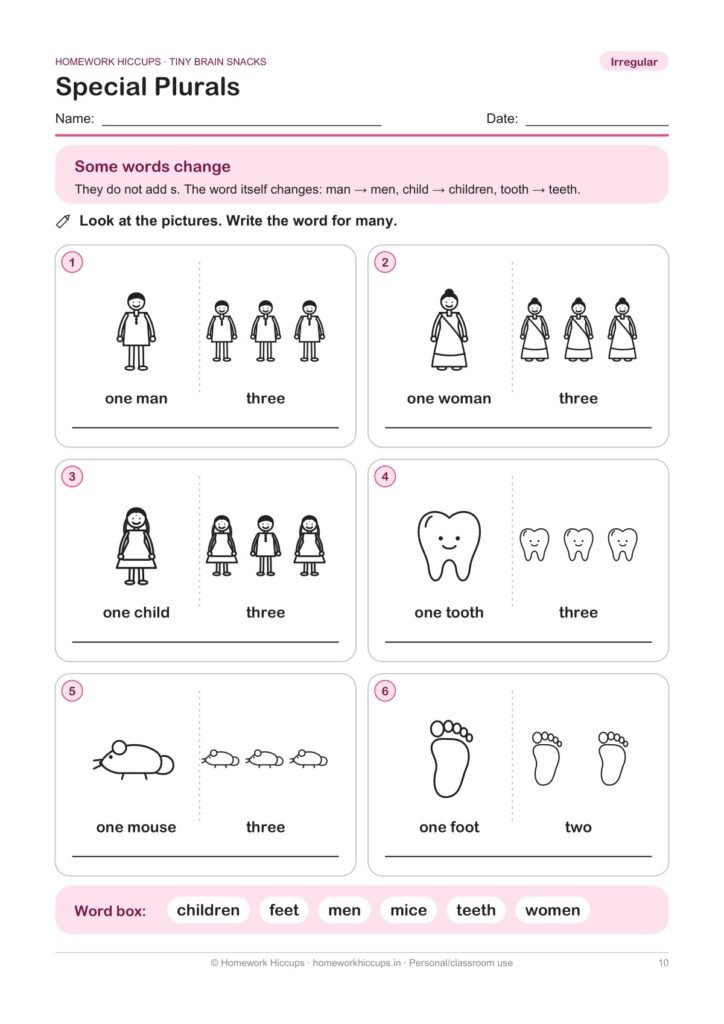
Examples: man → men, woman → women, child → children, tooth → teeth, foot → feet, mouse → mice. Also: goose → geese, ox → oxen, person → people.
For a full list with practice sentences, see our guide to irregular plural nouns for kids.
Prefer ready-to-print pages?
Singular and Plural Noun Worksheets PDF – One and Many for Class 1 & 2 (24 Pages) – A4 PDF, instant download. ₹49 ₹99
Rule 7: Same for one and many
Some words do not change at all. One sheep, ten sheep.
Examples: sheep → sheep, deer → deer, fish → fish, aircraft → aircraft, salmon → salmon, bison → bison.
Note for Class 2: “fishes” is sometimes used when talking about different kinds of fish, but for school worksheets, one fish and many fish is the usual answer.
Rule 8: Words that are always plural
Some things come in two matching parts, so the word is always plural.
Examples: scissors, trousers, spectacles, jeans, pyjamas, shorts.
We say “a pair of scissors” or “my jeans are blue”, never “a scissor” or “my jeans is blue”. This is a common mistake in Indian English, so it is worth practising.
S or es worksheet: 24-word practice test
Write the plural of each word, then write the rule number from the chart. Cover the answers before you start.
| Word | Plural | Rule | Word | Plural | Rule |
|---|---|---|---|---|---|
| 1. fox | foxes | 2 | 13. potato | potatoes | 2 |
| 2. lady | ladies | 3 | 14. roof | roofs | exception |
| 3. key | keys | 4 | 15. deer | deer | 7 |
| 4. leaf | leaves | 5 | 16. glass | glasses | 2 |
| 5. child | children | 6 | 17. city | cities | 3 |
| 6. sheep | sheep | 7 | 18. wolf | wolves | 5 |
| 7. bench | benches | 2 | 19. photo | photos | exception |
| 8. pencil | pencils | 1 | 20. day | days | 4 |
| 9. puppy | puppies | 3 | 21. mouse | mice | 6 |
| 10. knife | knives | 5 | 22. brush | brushes | 2 |
| 11. tooth | teeth | 6 | 23. cow | cows | 1 |
| 12. monkey | monkeys | 4 | 24. story | stories | 3 |
Scoring: 20 or more is excellent. If most mistakes are in one rule, spend the next week on that rule only.
Common mistakes and how to fix them
- “Babys” or “toies”. Go back to the y rule and look at the letter before the y.
- “Mans”, “foots”, “childs”. Make flashcards of irregular words and read them daily for a week.
- “Sheeps” and “fishs”. Say, “Some words are lazy. They do not change at all.”
- Forgetting the plural in sentences. “I have two pencil.” Ask, “How many? Then the word needs to show many.”
- Spelling plural words. Add plural words to weekly spelling lists. Our spelling words for Class 1 post has ready-made lists.
Plural rules for kids, one page at a time
If you want this taught step by step on printed pages, our Singular and Plural Noun Worksheets PDF (24 pages, Class 1 and 2) opens with a “Plural rules at a glance” chart of 8 rules, then practises the rules in turn: one or many picture pages, add s, add es (bus, box, dish, watch, brush, tomato, potato, hero), s or es sorting, y to ies and vowel + y, f and fe to ves (with roof → roofs and chef → chefs), special plurals such as men, children, teeth and mice, and words that stay the same. It finishes with a mixed review, plurals in 12 sentences, a cut-and-sort page, a word search, a “Market Day” story to make plural, and 3 pages of answer keys.
Get the Singular and Plural Worksheets – ₹49
Each rule has a short rule box that grown-ups can read aloud, so you do not need to explain it from memory. Browse more English worksheets for Class 1 and 2.
Download 24 Pages of Plural Practice – ₹49
🧸 Learning toys kids love
As an Amazon Associate, Homework Hiccups earns from qualifying purchases, at no extra cost to you.
Frequently asked questions
When do we add es to make a plural?
Add es to words ending in s, x, sh or ch, such as bus, box, dish and watch, and to many words ending in o, such as tomato and potato.
What is the plural rule for words ending in y?
If a consonant comes before the y, change y to i and add es, so baby becomes babies. If a vowel comes before the y, just add s, so toy becomes toys.
Why is it leaves but roofs?
Many words ending in f change to ves, like leaf to leaves. A few words, such as roof, chef and cliff, are exceptions and just add s.
What are irregular plurals?
Irregular plurals do not follow the usual rules. The word changes instead, such as man to men, child to children, tooth to teeth and mouse to mice.
Which class learns plural rules?
Many schools introduce one and many with s and es in Class 1, and add the y, f and irregular rules in Class 2. The order varies between schools.