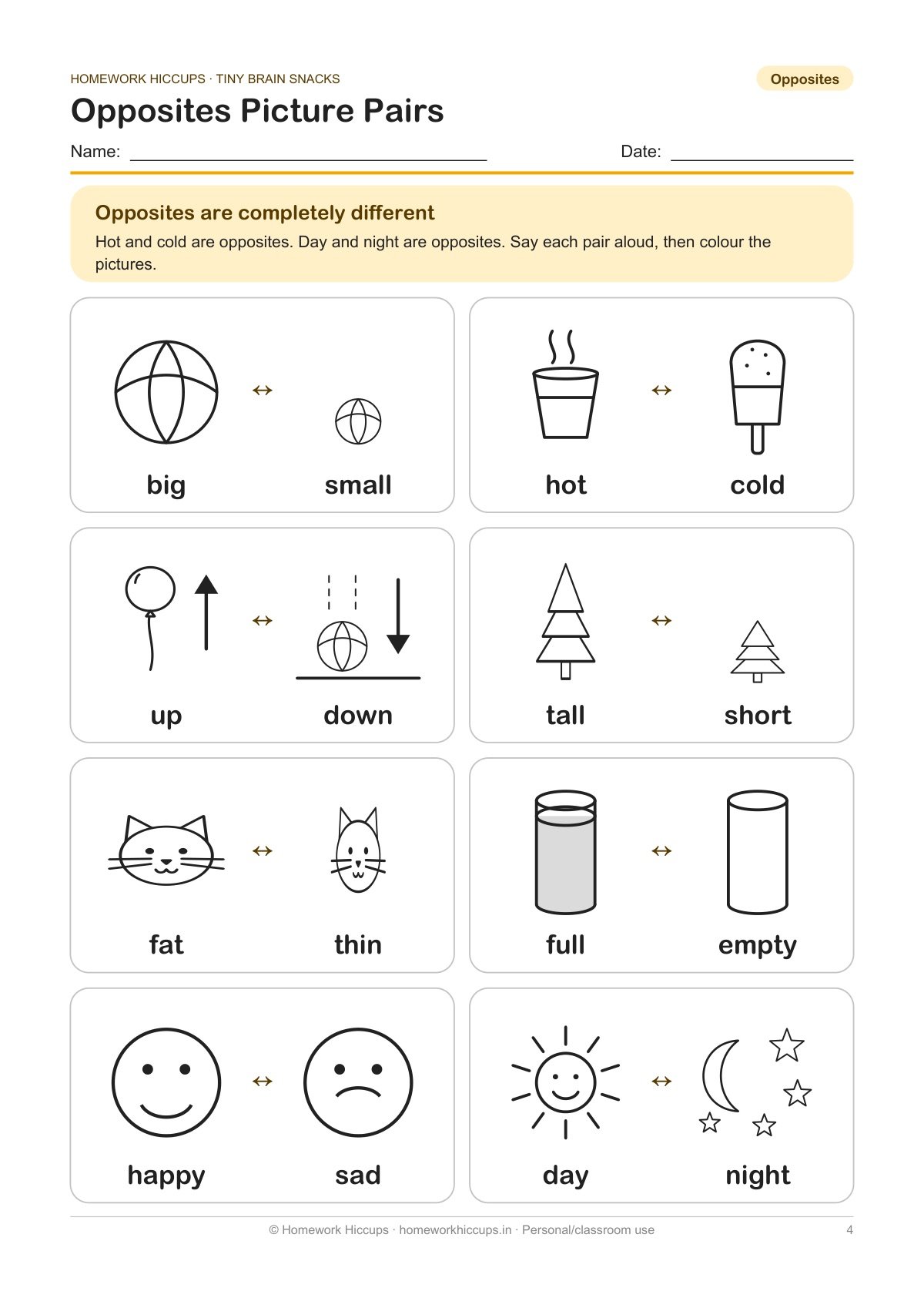
Shapes are one of the first maths ideas a three-year-old meets, and they are everywhere: the round roti on the plate, the square window, the triangle of a samosa. A shapes worksheet for nursery works best when children have already seen, touched and talked about these shapes in real life. Then the page becomes a fun way to trace and spot something they already know.

Print-ready worksheets for this topic
Nursery Worksheets PDF for Ages 3–4 – Pre-Writing, Colours, Shapes, A–Z & 1–10 (46 Pages) – A4 PDF, instant download. ₹149 ₹299
This guide covers the four shapes most nursery classes start with (circle, square, triangle and star), a shape-hunt list of everyday Indian household objects, how to trace each shape with the right grip and stroke order, five shape games, and what comes later in UKG and Class 1, so you do not rush ahead.
🧰 Make practice more fun at home
As an Amazon Associate, Homework Hiccups earns from qualifying purchases, at no extra cost to you.
Quick answer: Basic shapes for kids in nursery are usually:
- Circle: round, no corners (roti, bindi, coin).
- Square: 4 equal sides, 4 corners (carrom board, ludo board).
- Triangle: 3 sides, 3 corners (samosa, a slice of sandwich cut corner to corner).
- Star: points all around (a star cut-out or lantern).
- Order: see it, touch it, say it, find it, then trace it.
Why these four shapes first?
Circles, squares and triangles are very different from one another, so young children can tell them apart easily. A star is not a basic geometric shape in the way the others are, but children love it, recognise it quickly and enjoy tracing its points. Rectangles and ovals are usually added later because they look a lot like squares and circles, and that can confuse a three-year-old.
At this age the aim is recognition and naming, not definitions. If your child can point to the circle and say “circle” when asked, that is a real success.
How to teach shapes to toddlers and preschoolers
- See it: show one real object, for example a steel plate. “This is a circle.”
- Touch it: run your child’s finger around the edge. “Round and round, no corners.”
- Say it: ask your child to repeat the name. Use the same word every time.
- Find it: go on a hunt for more circles around the house.
- Make it: form it with play dough, a rope on the floor, or matchsticks for a square and triangle.
- Trace it: only now move to a dotted shape on paper.
Spend a few days on one shape before adding the next. Children learn shapes faster when they meet them one at a time.
Shape hunt: Indian household objects
Use this list for a shape hunt at home or a “show and tell” in class. Some objects are only roughly the shape, which is fine; say “It looks like a triangle.”
| Circle | Square | Triangle | Star |
|---|---|---|---|
| roti or chapati | carrom board | samosa | star-shaped lantern |
| bindi | ludo board | triangle paratha | star biscuit or cookie cutter |
| coin | square tile on the floor | sandwich cut corner to corner | a star in a storybook |
| steel plate (thali) | square biscuit | slice of watermelon | a starfish picture |
| clock face | chessboard | a kite (some kites) | a sliced star fruit (kamrakh) |
| bangle | a square napkin | a tent shape | a star drawn on a rangoli |
| wheel of a cycle | a dice (each face) | a hanger | a star sticker |
Ask your child to collect three objects of one shape and line them up. Talk about what is the same: “All of them are round.” Colour words fit naturally here too; our post on colours worksheets for nursery has ideas you can combine with shapes, such as “find a red circle”.
Shape tracing for nursery: grip and stroke tips
Tracing shapes is excellent pre-writing practice, because circles, standing lines and slanting lines are the same strokes children later use for letters and numbers.
Grip
- Use thick crayons or chunky pencils. They are easier to hold than thin pencils.
- Break crayons into short pieces. A short crayon encourages a natural pinch grip with the thumb and two fingers.
- Tracing on a slightly slanted surface, like a clipboard on a cushion, helps small wrists.
- Do not worry about a perfect grip at three. Keep sessions short and positive.
Stroke order
| Shape | Where to start | What to say |
|---|---|---|
| Circle | At the top, move round to the left | “Start at the top, go round and round, back to the top.” |
| Square | Top left corner | “Across, down, across, up. Four sides.” |
| Triangle | The top point | “Slide down, go across, slide back up.” |
| Star | The top point | “Slide down to the left foot, up to the right arm, straight across, down to the right foot, back to the top.” |
Starting a circle at the top and going round to the left (anticlockwise) is the same movement as writing a, c, d, g and o later, which is why many teachers teach it this way. If your child is still working on basic lines, try our nursery lines worksheets first.
Before tracing on paper
- Trace shapes in a tray of sand, rice or atta with one finger.
- Draw big shapes in the air with the whole arm.
- Draw with chalk on the floor, then walk around the shape.
- Trace over a shape drawn on a whiteboard, then wipe and try again.
5 shapes activities for preschoolers
1. Shape sorting basket
Cut circles, squares, triangles and stars from old cardboard boxes. Mix them up in a basket and let your child sort them into four bowls.
2. Feely bag
Put a few cardboard shapes in a cloth bag. Your child feels one without looking and guesses the shape. Corners are the big clue.
3. Shape stamping
Dip the end of a bangle (circle), a square block and a triangle cut from a potato into paint and stamp patterns on old newspaper.
4. Hop on the shape
Draw big chalk shapes on the floor. Call out a shape and your child hops onto it. This works brilliantly with a whole nursery class.
5. Shape pictures
Give paper cut-outs and let your child make a picture: a triangle on a square becomes a house, circles become a caterpillar. Ask them to name each shape they used.
Prefer ready-to-print pages?
Nursery Worksheets PDF for Ages 3–4 – Pre-Writing, Colours, Shapes, A–Z & 1–10 (46 Pages) – A4 PDF, instant download. ₹149 ₹299
How shapes grow from nursery to Class 1
| Class | Shapes children usually meet |
|---|---|
| Nursery | Circle, square, triangle, star: recognise, name, trace |
| LKG and UKG | Add rectangle, oval, heart, diamond; count sides and corners |
| Class 1 | 2D shapes with sides and corners, plus 3D shapes such as cube, sphere, cylinder and cone |
You do not need to teach the later shapes now. When the time comes, our guide to shapes worksheets for Class 1 picks up from here.
Signs your child is ready for the next step
- Points to the right shape when you name it, most of the time.
- Names a shape when you point to it.
- Finds shapes around the house without help.
- Traces a shape staying roughly on the dotted line.
Once these feel easy, add one new shape, or combine shapes with counting (“How many triangles?”). Our nursery maths worksheets guide shows how shapes fit with numbers 1 to 10, and worksheets for 3-year-olds has tips on keeping pages short and fun.
Printable shapes worksheet for nursery
Our Nursery Worksheets PDF for Ages 3–4 (46 A4 pages) has three shape pages: trace a circle, square, triangle and star, then find and colour the shapes using a colour key. The same pack includes eight pre-writing line pages, colour pages, dot art, capital letters A to Z, numbers 1 to 10, thinking pages such as big and small and odd one out, a parent tips page and a star tracker. Everything is black line art, so it prints well in black and white.
Get the Nursery Worksheets Pack – ₹149
Want to see the pages first? Get the free nursery worksheets sample: 3 real pages plus the cover and contents page, free at checkout with your name and email.
Download the Nursery Starter Pack – ₹149
🧸 Learning toys kids love
As an Amazon Associate, Homework Hiccups earns from qualifying purchases, at no extra cost to you.
Frequently asked questions
Which shapes should a nursery child learn first?
Most nursery classes start with the circle, square and triangle, and many add a star because children enjoy it. Rectangles and ovals usually come later.
At what age can a child recognise shapes?
Many children start recognising a circle and square around the age of 2 to 3, and name a few basic shapes by 3 to 4. Every child is different, so follow your child’s pace.
How do I teach a child to trace a circle?
Start at the top and move round to the left, back to the top. Practise first in the air and in a tray of sand or atta, then on paper with a thick crayon.
What are easy shape activities for preschoolers?
Try a shape hunt around the house, a feely bag, shape sorting with cardboard cut-outs, stamping with bangles and blocks, and hopping onto chalk shapes on the floor.
Does the nursery pack include shape worksheets?
Yes. The 46-page Nursery Worksheets PDF has three shape pages where children trace a circle, square, triangle and star, then find and colour the shapes with a colour key.