Once a UKG child can read simple CVC words like cat, bus and red, a lovely next step opens up: reading a few sentences and answering questions about them. Reading comprehension for UKG is not about tests. It is about helping a child notice that the words on the page tell a little story, and that they can look back to find answers.
Print-ready worksheets for this topic
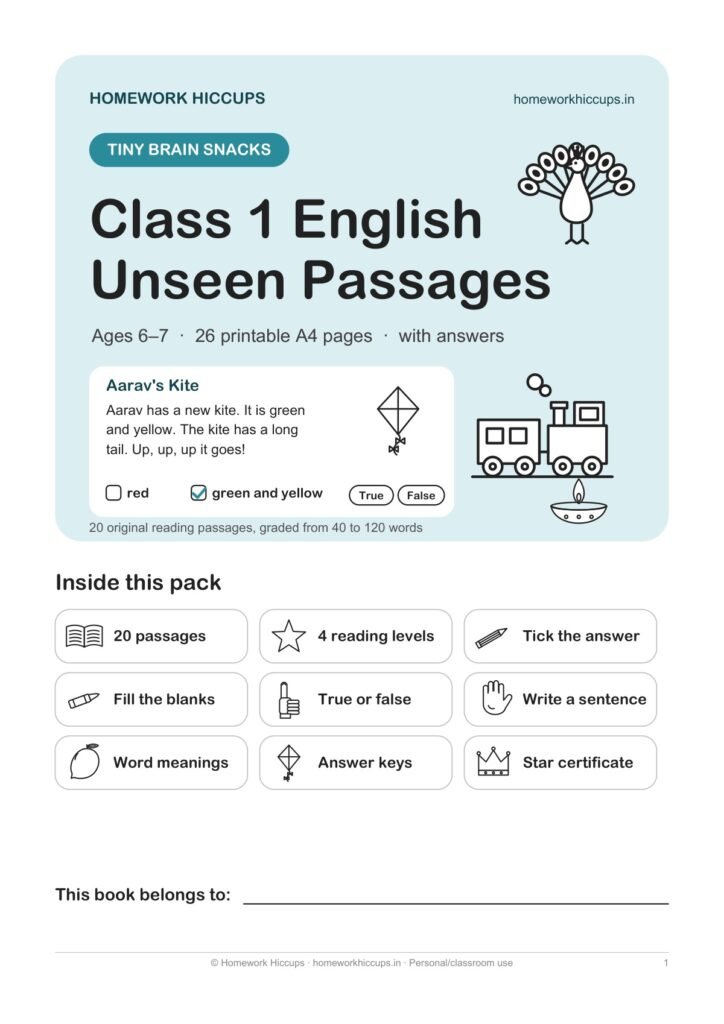
Class 1 English Unseen Passage Worksheets PDF – 20 Reading Passages with Answers (26 Pages) – A4 PDF, instant download. ₹49 ₹99
This guide gives you 5 original tiny passages (32–37 words each) built from CVC and sight words, 3 questions for each with answers, a simple way to read together first, and the signs that your child is ready for longer Class 1 passages.
🧰 Make practice more fun at home
As an Amazon Associate, Homework Hiccups earns from qualifying purchases, at no extra cost to you.
Quick answer: How to start reading comprehension in UKG:
- Use passages of 3–6 short sentences with CVC words and common sight words.
- Read together first, then let your child read alone.
- Ask 3 questions: one “what”, one “who” or “where”, one yes/no.
- Teach your child to point to the answer in the passage.
- Do one passage a day, 5–10 minutes.
Is my UKG child ready for comprehension?
Your child is ready if they can:
- read most CVC words by sounding out (see our CVC words list);
- recognise sight words like the, is, a, has, and, she, he, it;
- read a short sentence without losing their place;
- answer simple questions about a story you read aloud.
If reading single words is still hard, spend a few more weeks on phonics first. Our guide on how to teach reading to kids walks through the steps.
How to read a passage together (the 4-step routine)
- Look: read the title together and guess what the story might be about.
- Listen: you read the passage aloud slowly while your child follows with a finger.
- Read: your child reads it aloud. Help with tricky words, but let them try first.
- Find: ask each question and have your child point to the sentence with the answer before saying it.
Step 4 is the real skill. Children who learn to look back now will find Class 1 unseen passages much easier.
🧸 Learning toys kids love
As an Amazon Associate, Homework Hiccups earns from qualifying purchases, at no extra cost to you.
5 short passages for UKG with questions
Passage 1: The Red Hat
Raj has a red hat. The hat is big. Raj puts the hat on the bed. His cat jumps up and sits in the hat. Raj and the cat nap in the sun. The cat is happy.
- What colour is the hat?
- Where does the cat sit?
- Is the cat sad?
Answers: 1. Red. 2. In the hat. 3. No, the cat is happy.
Passage 2: Meena and the Bus
Meena gets up at six. She has a bath and eats an egg. Then she runs to the bus. The bus is yellow. Meena sits next to her friend Tina. They go to school.
- What does Meena eat?
- What colour is the bus?
- Who is Meena’s friend?
Answers: 1. An egg. 2. Yellow. 3. Tina.
Passage 3: The Big Box
Dad has a big box. In the box is a pup! The pup is tan and has a wet nose. Ravi hugs the pup. He calls it Bolt. Bolt can run fast.
- What is in the box?
- Who hugs the pup?
- What is the pup’s name?
Answers: 1. A pup. 2. Ravi. 3. Bolt.
Passage 4: Mud and the Tub
It is a wet day. Pinky jumps in a big mud puddle. Her legs get wet and brown. Mum is not mad. She says, “Get in the tub!” Pinky sits in the tub and sings a song.
- Where does Pinky jump?
- Is Mum mad?
- What does Pinky do in the tub?
Answers: 1. In a big mud puddle. 2. No, Mum is not mad. 3. She sings a song.
Passage 5: A Fish (a tiny fact passage)
A fish can swim. It lives in water. It has fins and a tail. A fish has no legs. Some fish are big and some are small. Anu has a pet fish. It is red and gold.
- Where does a fish live?
- Does a fish have legs?
- What colour is Anu’s fish?
Answers: 1. In water. 2. No. 3. Red and gold.
Passage guide at a glance
| Passage | Words | Type | Sight words to pre-teach |
|---|---|---|---|
| The Red Hat | 37 | Story | the, has, his, is |
| Meena and the Bus | 34 | Story | she, then, they, go |
| The Big Box | 32 | Story | in, he, it, can |
| Mud and the Tub | 37 | Story | says, her, not |
| A Fish | 37 | Fact | some, are, no |
Before each passage, write the sight words on a card and read them together twice. That way the passage feels easy and your child can focus on meaning.
UKG English comprehension: question types to use
| Type | Example | Why it helps |
|---|---|---|
| What | What is in the box? | Finds a fact in the text |
| Who | Who hugs the pup? | Tracks characters |
| Where | Where does the cat sit? | Notices place words |
| Yes / No | Is Mum mad? | Checks careful reading |
| Picture | Draw Bolt the pup | Shows understanding without writing |
For UKG, answers can be spoken, circled or a single word. Full-sentence answers come in Class 1.
Prefer ready-to-print pages?
Class 1 English Unseen Passage Worksheets PDF – 20 Reading Passages with Answers (26 Pages) – A4 PDF, instant download. ₹49 ₹99
Make your own picture questions
Many UKG children are still slow writers. Picture questions let them show understanding without struggling with spelling:
- Draw three hats: red, blue, green. “Colour the hat Raj has.”
- Draw a bus and a car. “Circle what Meena goes to school in.”
- Draw a cat, a pup and a fish. “Tick the pet in the box.”
- “Draw Pinky in the tub.”
Three common mistakes to avoid
- Too long, too soon: a 60-word passage can overwhelm a UKG reader. Stay with 25–40 words until reading feels smooth.
- Too many questions: three is enough. Ten questions turn a happy story into a test.
- Correcting every word: let small slips go if the meaning is right. Fix one word at the end instead.
Signs your child is ready for Class 1 passages
- Reads a 35-word passage in about two minutes without much help.
- Answers 3 out of 3 questions on most days.
- Looks back at the passage to find answers without being told.
- Can tell you what happened in their own words.
- Reads simple sight words like said, was and they without sounding out.
When you see most of these signs, it is time for longer passages with five questions, including fill in the blank and true or false. Our unseen passage for Class 1 post explains what comes next, and UKG English worksheets has more practice for this stage.
The next step for strong UKG readers
Our Class 1 English Unseen Passage Worksheets (26 A4 pages) are made for Class 1, but Level 1 is a natural step up for confident UKG readers. Passages 1–5 are 42–60 words: Aarav’s Kite, The Mango Tree, Billu the Cat, Diya’s Red Umbrella and The Dancing Peacock. The pack has 20 original passages in 4 levels (up to 120 words), each on its own page with a picture to colour and 5 or 6 questions: tick the right answer, fill in the blank, true or false, one full-sentence answer and one opposite-word or word-meaning question. There are 2 answer-key pages, a reading tracker and a Super Reader certificate.
Get the Unseen Passage Worksheets – ₹49
Start with one Level 1 passage a week alongside the tiny passages above, then move to one a day as your child grows confident. See all English worksheets.
Download the 20 Reading Passages PDF – ₹49
Frequently asked questions
What is reading comprehension for UKG?
It means reading a short passage of 3 to 6 simple sentences and answering easy questions about it, such as what, who or where. It teaches children that words carry meaning.
How long should a UKG reading passage be?
About 25 to 40 words is right for most UKG children. Use CVC words and common sight words so they can read it with little help.
Should UKG children write full-sentence answers?
Not yet. For UKG, a spoken answer, one word, a circle or a tick is enough. Full-sentence answers usually start in Class 1.
How often should my child practise comprehension?
One short passage a day, taking 5 to 10 minutes, is plenty. Regular short practice works better than long sessions.
What if my child guesses instead of reading?
Ask your child to point to the sentence with the answer before saying it. This habit of looking back slows down guessing and builds careful reading.