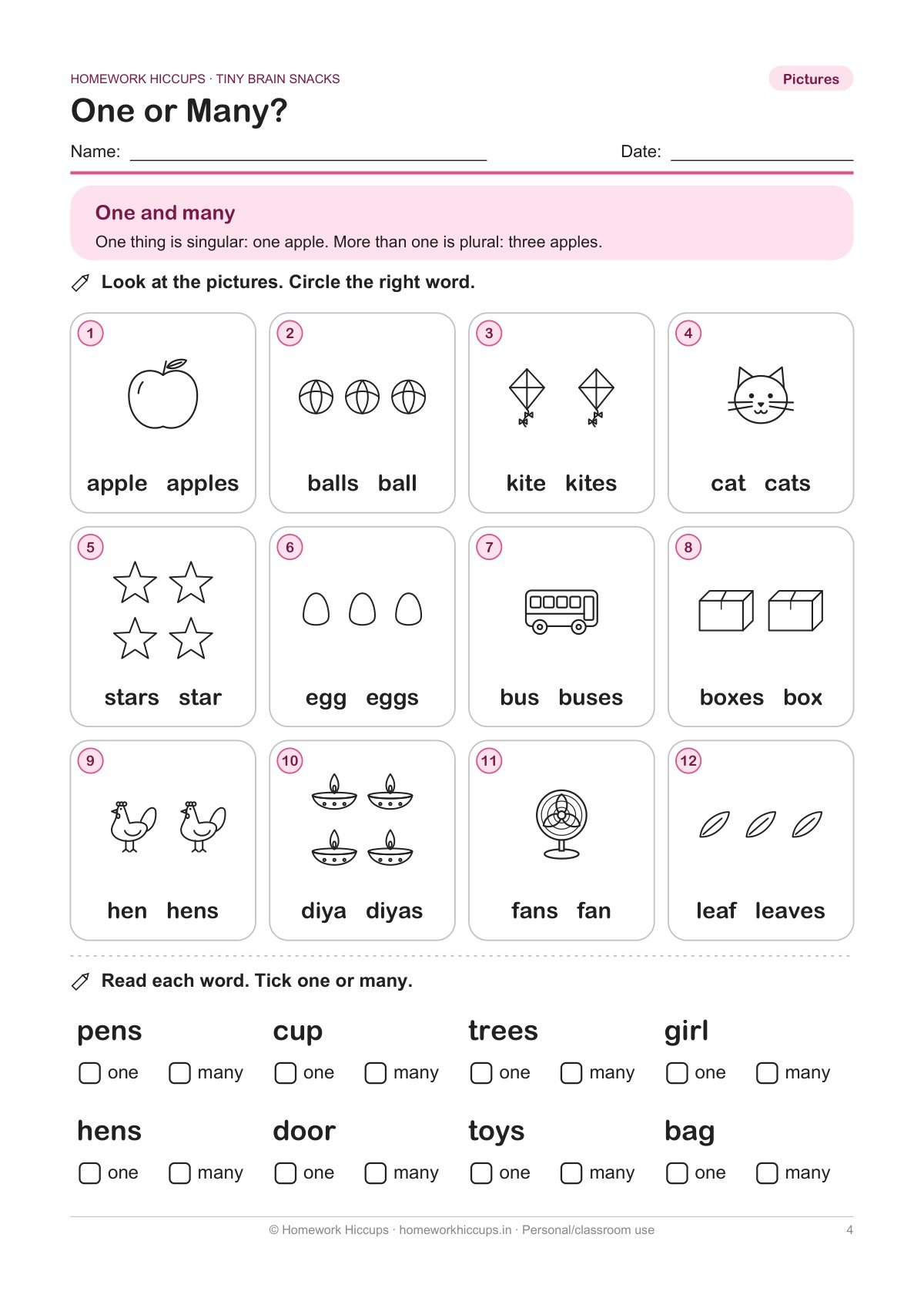
Vachan (वचन) is the Hindi word for number: is there one thing, or more than one? “Vachan badlo” exercises ask children to turn एक कमरा into दो कमरे, or एक लड़की into दो लड़कियाँ. It looks like the English singular and plural, but Hindi has its own rules, and those rules depend on how the word ends and whether it is masculine or feminine. This guide to vachan badlo in Hindi explains each rule simply, with examples children can read.
Print-ready worksheets for this topic
Hindi Matra Worksheets PDF – Barakhadi, Matra Words & Sentences (मात्रा अभ्यास), Ages 5–7 (44 Pages) – A4 PDF, instant download. ₹99 ₹199
You will find 100 एकवचन–बहुवचन pairs with transliteration and meaning, how whole sentences change, exercises with answers for Class 1 and Class 2, and the spelling mistakes children make most often. Every form below is standard school Hindi.
🧰 Make practice more fun at home
As an Amazon Associate, Homework Hiccups earns from qualifying purchases, at no extra cost to you.
Quick answer: Hindi has two vachan: एकवचन (ekvachan, one) and बहुवचन (bahuvachan, many). The main rules:
- Masculine -आ to -ए: कमरा – कमरे, केला – केले.
- Feminine -ई to -इयाँ: लड़की – लड़कियाँ, रोटी – रोटियाँ.
- Feminine ending in a consonant, add -एँ: बात – बातें, किताब – किताबें.
- Feminine -आ, add -एँ: माता – माताएँ.
- Most other masculine words do not change: एक घर – दो घर, एक राजा – दो राजा.
What is vachan? Ekvachan and bahuvachan explained
Tell children: “When there is one thing, the word is एकवचन. When there are many, it is बहुवचन.” Show one banana: एक केला. Show three: तीन केले. Ask what changed. Children quickly hear that the end of the word changes, and so does the verb: केला मीठा है, but केले मीठे हैं.
| Hindi term | Transliteration | Meaning | Example |
|---|---|---|---|
| वचन | vachan | number | – |
| एकवचन | ekvachan | singular (one) | कमरा, लड़की, किताब |
| बहुवचन | bahuvachan | plural (many) | कमरे, लड़कियाँ, किताबें |
Because the rules depend on gender, it helps if children already know पुल्लिंग and स्त्रीलिंग; see our guide to ling badlo in Hindi. English plurals work differently, and our singular and plural worksheet covers those.
Vachan badlo in Hindi: the rules with 100 words
Format: एकवचन – बहुवचन (transliteration, meaning). These are vachan ke udaharan you can copy straight into a notebook.
Rule 1: masculine words ending in -आ change to -ए (25)
कमरा – कमरे (kamra – kamre, room); लड़का – लड़के (ladka – ladke, boy); केला – केले (kela – kele, banana); बच्चा – बच्चे (bachcha – bachche, child); घोड़ा – घोड़े (ghoda – ghode, horse); कपड़ा – कपड़े (kapda – kapde, cloth); पत्ता – पत्ते (patta – patte, leaf); बेटा – बेटे (beta – bete, son); जूता – जूते (joota – joote, shoe); तारा – तारे (tara – tare, star); पंखा – पंखे (pankha – pankhe, fan); रास्ता – रास्ते (raasta – raaste, road); गमला – गमले (gamla – gamle, flowerpot); संतरा – संतरे (santra – santre, orange); कुत्ता – कुत्ते (kutta – kutte, dog); मुर्गा – मुर्गे (murga – murge, rooster); अंडा – अंडे (anda – ande, egg); बकरा – बकरे (bakra – bakre, goat); तोता – तोते (tota – tote, parrot); कौआ – कौए (kaua – kaue, crow); झंडा – झंडे (jhanda – jhande, flag); ताला – ताले (taala – taale, lock); बस्ता – बस्ते (basta – baste, school bag); गुब्बारा – गुब्बारे (gubbara – gubbare, balloon); चूहा – चूहे (chooha – choohe, mouse).
Rule 2: feminine words ending in -ई or -इ change to -इयाँ (20)
लड़की – लड़कियाँ (ladki – ladkiyaan, girl); नदी – नदियाँ (nadi – nadiyaan, river); रोटी – रोटियाँ (roti – rotiyaan, roti); टोपी – टोपियाँ (topi – topiyaan, cap); कुर्सी – कुर्सियाँ (kursi – kursiyaan, chair); थाली – थालियाँ (thaali – thaaliyaan, plate); खिड़की – खिड़कियाँ (khidki – khidkiyaan, window); घड़ी – घड़ियाँ (ghadi – ghadiyaan, clock); तितली – तितलियाँ (titli – titliyaan, butterfly); सहेली – सहेलियाँ (saheli – saheliyaan, girl’s friend); मछली – मछलियाँ (machhli – machhliyaan, fish); बकरी – बकरियाँ (bakri – bakriyaan, she-goat); लकड़ी – लकड़ियाँ (lakdi – lakdiyaan, stick of wood); कहानी – कहानियाँ (kahani – kahaniyaan, story); चाबी – चाबियाँ (chaabi – chaabiyaan, key); सीढ़ी – सीढ़ियाँ (seedhi – seedhiyaan, step, ladder); गाड़ी – गाड़ियाँ (gaadi – gaadiyaan, vehicle); बिल्ली – बिल्लियाँ (billi – billiyaan, cat); तिथि – तिथियाँ (tithi – tithiyaan, date); पंक्ति – पंक्तियाँ (pankti – panktiyaan, line).
Notice that the long ी becomes a short ि before याँ.
Rule 3: feminine words ending in -इया add only ँ (4)
चिड़िया – चिड़ियाँ (chidiya – chidiyaan, bird); गुड़िया – गुड़ियाँ (gudiya – gudiyaan, doll); डिबिया – डिबियाँ (dibiya – dibiyaan, small box); बुढ़िया – बुढ़ियाँ (budhiya – budhiyaan, old woman).
Rule 4: feminine words ending in a consonant add -एँ (20)
बात – बातें (baat – baatein, talk); किताब – किताबें (kitaab – kitaabein, book); रात – रातें (raat – raatein, night); आँख – आँखें (aankh – aankhein, eye); बहन – बहनें (bahan – bahanein, sister); भैंस – भैंसें (bhains – bhainsein, buffalo); मेज़ – मेज़ें (mez – mezein, table); सड़क – सड़कें (sadak – sadakein, road); दीवार – दीवारें (deewar – deewarein, wall); कलम – कलमें (kalam – kalamein, pen); चप्पल – चप्पलें (chappal – chappalein, slipper); पेंसिल – पेंसिलें (pencil – pencilein, pencil); झील – झीलें (jheel – jheelein, lake); पुस्तक – पुस्तकें (pustak – pustakein, book); आदत – आदतें (aadat – aadatein, habit); बोतल – बोतलें (botal – botalein, bottle); तस्वीर – तस्वीरें (tasveer – tasveerein, picture); चीज़ – चीज़ें (cheez – cheezein, thing); ईंट – ईंटें (eent – eentein, brick); लहर – लहरें (lahar – laharein, wave).
Rule 5: feminine words ending in -आ add -एँ (12)
माता – माताएँ (mata – mataaein, mother); कथा – कथाएँ (katha – kathaaein, story); कविता – कविताएँ (kavita – kavitaaein, poem); लता – लताएँ (lata – lataaein, creeper); शाखा – शाखाएँ (shakha – shakhaaein, branch); सभा – सभाएँ (sabha – sabhaaein, meeting); भाषा – भाषाएँ (bhasha – bhashaaein, language); कक्षा – कक्षाएँ (kaksha – kakshaaein, class); दिशा – दिशाएँ (disha – dishaaein, direction); परीक्षा – परीक्षाएँ (pariksha – parikshaaein, exam); बालिका – बालिकाएँ (balika – balikaaein, girl); छात्रा – छात्राएँ (chhatra – chhatraaein, girl student).
Rule 6: feminine words ending in -उ or -ऊ add -एँ (5)
वस्तु – वस्तुएँ (vastu – vastuein, object); धातु – धातुएँ (dhatu – dhatuein, metal); ऋतु – ऋतुएँ (ritu – rituein, season); बहू – बहुएँ (bahoo – bahuein, daughter-in-law); वधू – वधुएँ (vadhoo – vadhuein, bride). Notice that ू becomes ु.
Rule 7: words that do not change (14)
Most masculine words that do not end in -आ stay the same. So do respect and relationship words ending in -आ. Only the verb and the number word show that there are many.
घर (ghar, house); फल (phal, fruit); फूल (phool, flower); पेड़ (ped, tree); बालक (balak, boy); हाथी (haathi, elephant); आदमी (aadmi, man); भाई (bhai, brother); मोर (mor, peacock); साधु (sadhu, holy man); राजा (raja, king); पिता (pita, father); चाचा (chacha, uncle); दादा (dada, grandfather).
Example: एक घर – चार घर; एक राजा – दो राजा. Writing “घरें” or “राजे” is a common mistake.
That makes 100 words: 25 + 20 + 4 + 20 + 12 + 5 + 14.
How sentences change from ekvachan to bahuvachan
When the noun becomes plural, the verb changes too. है becomes हैं (with a dot on top), and masculine verbs ending in -ता or -आ change to -ते or -ए.
| एकवचन | बहुवचन |
|---|---|
| लड़का खेलता है। | लड़के खेलते हैं। |
| लड़की गाती है। | लड़कियाँ गाती हैं। |
| किताब मेज़ पर है। | किताबें मेज़ पर हैं। |
| कमरा साफ़ है। | कमरे साफ़ हैं। |
| पेड़ बड़ा है। | पेड़ बड़े हैं। |
In the last example the noun पेड़ does not change, but बड़ा becomes बड़े and है becomes हैं.
For Class 2: when a word like में, से, को or ने follows a plural noun, the ending changes to -ओं: बच्चों को, किताबों में, घरों से, लड़कियों ने. Most Class 1 worksheets do not test this yet.
Ekvachan bahuvachan worksheet in Hindi: exercises with answers
Class 1 vachan worksheet: Set A
1. केला 2. लड़की 3. किताब 4. घोड़ा 5. रोटी 6. बात 7. तितली 8. जूता 9. आँख 10. गुड़िया
Answers: 1. केले 2. लड़कियाँ 3. किताबें 4. घोड़े 5. रोटियाँ 6. बातें 7. तितलियाँ 8. जूते 9. आँखें 10. गुड़ियाँ
Class 2 vachan worksheet with answers: Set B
1. कविता 2. नदी 3. घर 4. ऋतु 5. पत्ता 6. सड़क 7. राजा 8. कक्षा 9. चिड़िया 10. बहू
Answers: 1. कविताएँ 2. नदियाँ 3. घर 4. ऋतुएँ 5. पत्ते 6. सड़कें 7. राजा 8. कक्षाएँ 9. चिड़ियाँ 10. बहुएँ
Set C: change the sentence to bahuvachan
1. बच्चा पढ़ता है। 2. मछली पानी में है। 3. तारा चमकता है। 4. मेरी किताब नई है। 5. फूल सुंदर है।
Answers: 1. बच्चे पढ़ते हैं। 2. मछलियाँ पानी में हैं। 3. तारे चमकते हैं। 4. मेरी किताबें नई हैं। 5. फूल सुंदर हैं।
Set D: एकवचन or बहुवचन?
कुर्सियाँ, कमरा, रातें, अंडे, बोतल, कहानियाँ
Answers: बहुवचन: कुर्सियाँ, रातें, अंडे, कहानियाँ. एकवचन: कमरा, बोतल.
Prefer ready-to-print pages?
Hindi Matra Worksheets PDF – Barakhadi, Matra Words & Sentences (मात्रा अभ्यास), Ages 5–7 (44 Pages) – A4 PDF, instant download. ₹99 ₹199
Common errors in vachan
- लड़कीयाँ instead of लड़कियाँ: the long ी must become short ि.
- किताबे instead of किताबें: the dot on top (anusvara) is missing.
- घरें, फलें: masculine words like घर and फल do not change.
- राजे, पिते: respect words like राजा and पिता do not change.
- Forgetting the verb: “लड़के खेलता है” should be लड़के खेलते हैं.
- ँ or ं? Standard Hindi writes माताएँ and लड़कियाँ with chandrabindu (ँ). Some books print माताएं with a dot instead. Follow your child’s textbook for spelling tests.
Hindi worksheet vachan: teaching tips
- Use real objects. One spoon, then three spoons: एक चम्मच, तीन चम्मच. Spoons, bananas and rotis make vachan concrete.
- One rule a week. Start with Rule 1 (-आ to -ए) and Rule 2 (-ई to -इयाँ), which cover the words children use most.
- Link to matras. Most changes are matra changes: ा to े, ी to ि. Children who read matras well spot the pattern quickly.
- Dictate pairs. Say the एकवचन and let your child write the बहुवचन. Our Hindi dictation for Class 1 post has more word lists.
For the bigger picture of what Class 1 Hindi covers, see our Hindi worksheets for Class 1 guide.
Build the reading first: Hindi Matra Worksheets
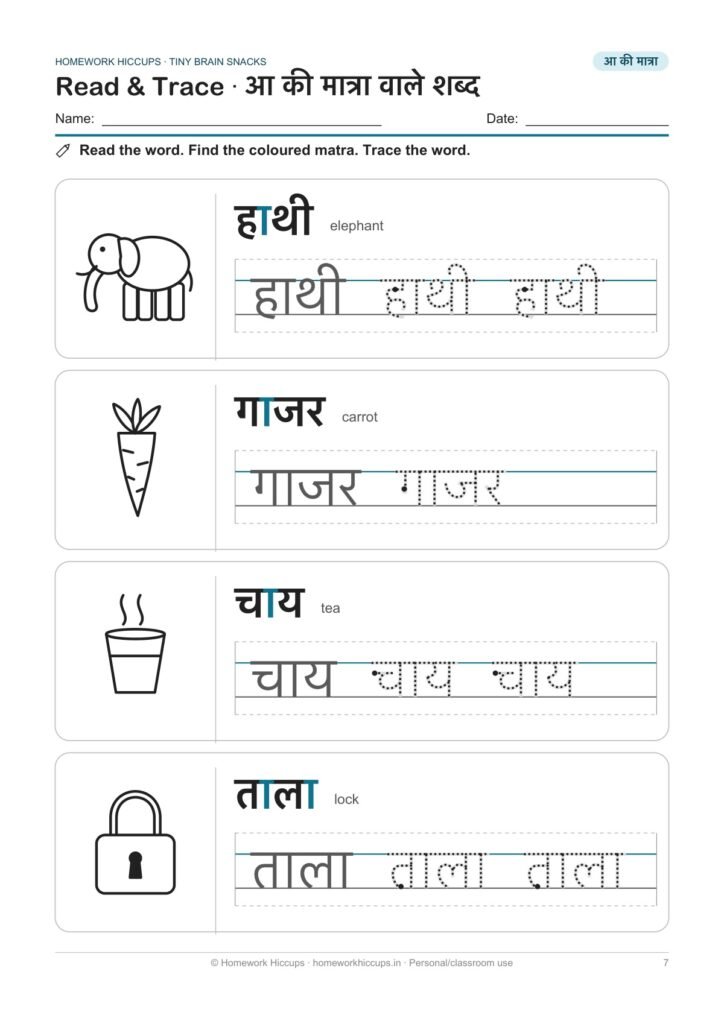
Vachan changes are mostly matra changes, so confident matra reading makes this topic far easier. Our Hindi Matra Worksheets PDF (₹99, 44 A4 pages, ages 5–7) has a बारहखड़ी chart, no-matra words, all 10 matras (ा to ं) with syllable tracing and colour-coded picture words, read-aloud sentences and answer keys. It does not teach vachan itself, but it builds the reading these words need.
Get the Hindi Matra Worksheets – ₹99
Not sure yet? Try a free sample first: 3 real pages from the pack, plus the cover and contents page.
🧸 Learning toys kids love
As an Amazon Associate, Homework Hiccups earns from qualifying purchases, at no extra cost to you.
Frequently asked questions
What is vachan in Hindi?
Vachan (वचन) tells us whether a word means one thing or many. Hindi has two: एकवचन (ekvachan, one) and बहुवचन (bahuvachan, many), for example कमरा and कमरे.
What is the bahuvachan of लड़की?
The bahuvachan of लड़की (ladki, girl) is लड़कियाँ (ladkiyaan). The long ी becomes a short ि and याँ is added.
Why does घर not change in the plural?
Most masculine words that do not end in -आ, such as घर, फल and पेड़, stay the same in the plural. We show that there are many with a number word and the verb: दो घर बड़े हैं.
What is the plural of किताब in Hindi?
The plural of किताब (kitaab, book) is किताबें (kitaabein). Feminine words ending in a consonant add -एँ.
In which class is vachan taught?
Many schools introduce simple vachan pairs in Class 1 and practise the rules and sentence changes in Class 2. The order depends on the school and textbook.