If you have searched for class 1 evs worksheets and felt confused about what your child is actually meant to learn, you are not alone. Some schools have a thick EVS book in Class 1, some call it Science or General Awareness, and some seem to have no EVS book at all. The topics, though, are remarkably similar everywhere: my body, food, plants, animals, family, water, transport and safety.
Print-ready worksheets for this topic
EVS & GK Worksheets PDF for UKG & Class 1 – My Body, Plants, Animals, India & GK Quiz, Ages 5–7 (42 Pages) – A4 PDF, instant download. ₹99 ₹199
This page explains why EVS looks different from school to school, then gives you free chapter-wise questions with answers for eight common Class 1 EVS topics. Each chapter has fill in the blanks, a match the following and true or false questions, so you can use it for daily revision, Term 2 exam practice or a quick check at the end of a chapter.
Quick answer:
- Common Class 1 EVS chapters: my body, food we eat, plants, animals, my family, water, transport, safety.
- Question types: fill in the blanks, match the following, true or false, one-word answers and picture-based tasks.
- CBSE note: in the NCERT books many CBSE schools use, there is no separate EVS textbook in Class 1; schools teach EVS ideas through other books or their own EVS book.
- Practice tip: one chapter a day, 10 minutes, with answers checked together.
Is there EVS in Class 1? A quick explanation
In the NCERT books that many CBSE schools follow, Classes 1 and 2 have no separate EVS or science textbook. EVS ideas such as family, food, animals and the world around us are woven into the language and maths books, and a separate EVS book usually starts from Class 3. Many CBSE, ICSE and state board schools still choose to teach EVS in Class 1 using their own EVS, science or GK book, which is why grade 1 EVS worksheets in CBSE schools can look so different from one school to another.
The good news is that the topics hardly change. The table below shows what most Class 1 EVS books cover. Pick the chapters that match your child’s book and term.
| Chapter | Key ideas for Class 1 | Often taught in |
|---|---|---|
| My body | Body parts, sense organs, keeping clean | Term 1 |
| Food we eat | Food from plants and animals, healthy food, meals | Term 1 |
| Plants around us | Parts of a plant, what plants need, uses of plants | Term 1 or 2 |
| Animals around us | Pet, farm, wild and water animals; homes; what they eat | Term 1 or 2 |
| My family | Family members, small and joint families, helping at home | Term 1 |
| Water | Sources and uses of water, saving water | Term 2 |
| Transport | Land, water and air transport | Term 2 |
| Safety | Road safety, safety at home, safety from strangers | Term 2 |
Class 1 EVS worksheets: chapter-wise questions with answers
Answers are given in brackets or at the end of each section. Read the questions aloud for children who are still building reading speed.
Chapter 1: My body
Fill in the blanks.
- We see with our ______. (eyes)
- We hear with our ______. (ears)
- We have ______ fingers on each hand. (five)
- We should brush our teeth ______ a day. (twice)
- We should wash our hands before we ______. (eat)
Match the following. Nose – a. taste · Tongue – b. touch · Skin – c. smell.
Answers: Nose – smell (c), Tongue – taste (a), Skin – touch (b).
True or false.
- We have two eyes. (True)
- It is fine to share a toothbrush with a friend. (False)
- We should cut our nails regularly. (True)
Chapter 2: Food we eat (food worksheet for Class 1)
Fill in the blanks.
- We get milk from a ______. (cow; buffalo and goat are also correct)
- Bees give us ______. (honey)
- Rice, wheat and dal come from ______. (plants)
- Our first meal of the day is ______. (breakfast)
- Chips and cold drinks are ______ food. (junk)
Sort into plant food and animal food: apple, egg, carrot, curd, rice, honey.
Answers: Plant food – apple, carrot, rice. Animal food – egg, curd (made from milk), honey (from bees).
True or false.
- Fruits and vegetables keep us healthy. (True)
- We should eat junk food every day. (False)
- We should drink plenty of clean water. (True)
Chapter 3: Plants around us
Fill in the blanks.
- The ______ hold the plant in the soil. (roots)
- Most leaves are ______ in colour. (green)
- A new plant grows from a ______. (seed)
- Plants need water, air and ______ to grow. (sunlight)
- A very big, strong plant with a thick trunk is called a ______. (tree)
Match what we get from plants. Mango tree – a. wood · Cotton plant – b. fruit · Teak tree – c. cloth.
Answers: Mango tree – fruit (b), Cotton plant – cloth (c), Teak tree – wood (a).
True or false.
- Plants are living things. (True)
- Plants do not need water. (False)
- We should not pluck flowers and leaves without a reason. (True)
Chapter 4: Animals around us (animals worksheet for Class 1)
Fill in the blanks.
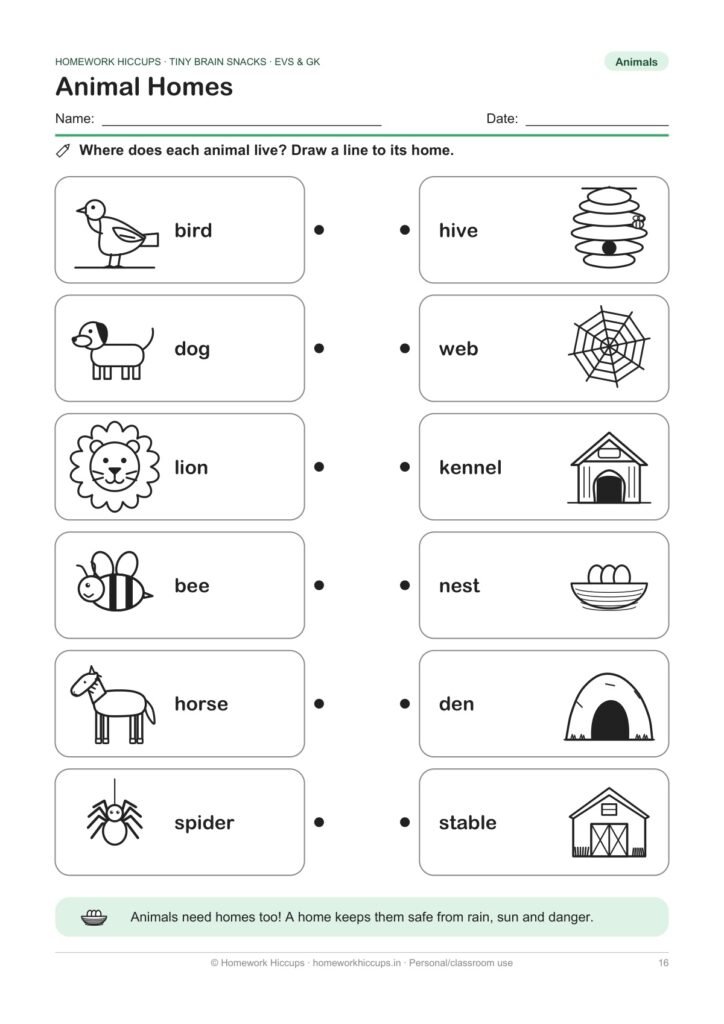
- A dog lives in a ______. (kennel)
- A bird lives in a ______. (nest)
- Animals that live in the forest are called ______ animals. (wild)
- A cow eats ______. (grass)
- Fish live in ______. (water)
Match the animal to its group. Cat – a. wild animal · Tiger – b. water animal · Goat – c. pet animal · Fish – d. farm animal.
Answers: Cat – pet (c), Tiger – wild (a), Goat – farm (d), Fish – water (b).
True or false.
- A frog can live on land and in water. (True)
- A lion eats grass. (False; a lion eats other animals)
- Birds have feathers. (True)
Chapter 5: My family
Fill in the blanks.
- My father’s mother is my ______. (grandmother, dadi)
- My mother’s father is my ______. (grandfather, nana)
- A family with grandparents, parents, uncles, aunts and cousins living together is a ______ family. (joint)
- A family with parents and their children is a ______ family. (small, or nuclear)
True or false.
- We should help our family with small jobs at home. (True)
- Only mothers should do housework. (False; everyone can help)
- Family members love and care for each other. (True)
This chapter pairs well with drawing and writing a few lines about “My family”. For ideas on describing a picture in simple sentences, see our guide to picture composition for Class 1.
Chapter 6: Water
Fill in the blanks.
- We get water from rain, rivers, lakes, wells and ______. (taps)
- We should ______ the tap while brushing our teeth. (close, or turn off)
- All living things need ______ to live. (water)
Match the use of water. Bathing – a. plants · Watering – b. cooking dal · Boiling – c. keeping clean.
Answers: Bathing – keeping clean (c), Watering – plants (a), Boiling – cooking dal (b).
True or false.
- We should drink clean water. (True)
- Wasting water is a good habit. (False)
- Rain water can be collected and saved. (True)
Chapter 7: Transport
Sort into land, water and air: bus, ship, aeroplane, train, boat, helicopter, auto-rickshaw.
Answers: Land – bus, train, auto-rickshaw. Water – ship, boat. Air – aeroplane, helicopter.
Fill in the blanks.
- A train runs on ______. (tracks, or rails)
- A ______ flies in the sky and carries many passengers. (aeroplane)
- A bicycle has ______ wheels. (two)
Chapter 8: Safety
Fill in the blanks.
- We should cross the road at the ______ crossing. (zebra)
- A red traffic light means ______. (stop)
- A green traffic light means ______. (go)
- Before crossing, look right, then left, then ______ again. (right)
True or false.
- We should play with matchsticks. (False)
- We should walk on the footpath. (True)
- We should not touch electric switches with wet hands. (True)
- It is safe to go anywhere with a stranger. (False)
Class 1 science worksheets with answers: quick mixed revision
Use these ten one-word questions as a 5-minute oral quiz before a test.
| Question | Answer |
|---|---|
| Which sense organ helps us taste? | Tongue |
| Which part of a plant is under the soil? | Roots |
| Which animal gives us wool? | Sheep |
| Where does a lion live? | Den |
| Which insect gives us honey? | Bee |
| Name one means of water transport. | Ship or boat |
| What colour light means stop? | Red |
| What do plants need from the sky to grow? | Sunlight and rain |
| Name one healthy food. | Any fruit, vegetable, dal, milk |
| What should we do before eating? | Wash our hands |
For more quick questions, our Class 1 GK questions cover India, animals, the body and general awareness. If your child finds the habit questions fun, try our page on good habits for kids.
Prefer ready-to-print pages?
EVS & GK Worksheets PDF for UKG & Class 1 – My Body, Plants, Animals, India & GK Quiz, Ages 5–7 (42 Pages) – A4 PDF, instant download. ₹99 ₹199
Tips for Class 1 EVS worksheets with answers for Term 2
- Check the school syllabus first. Ask the teacher which chapters come in Term 2 and practise only those.
- Read answers aloud. Many children know the answer but cannot spell it yet. Accept oral answers first, then practise writing key words such as roots, kennel and zebra.
- Use real life. Spot transport on the way to school; look at leaves and roots in a pot at home.
- Revise in short bursts. One chapter a day for eight days covers everything on this page.
- Coming from UKG? Our UKG EVS worksheets page has easier picture-based versions of the same topics.
Printable EVS worksheets for Class 1
For print-ready pages, our EVS & GK Worksheets PDF for UKG and Class 1 (42 A4 pages, ages 5 to 7) covers many of these chapters with picture-based tasks. It includes my body and the five senses, good habits vs bad habits, a “My Family” draw-and-label page, types of houses, food from plants or animals, healthy and junk food, parts of a plant and what a plant needs, animal groups, homes and young ones, means of transport, traffic lights and road safety rules, community helpers, seasons in India, uses of water and saving water, plus India’s national symbols, festivals and a picture GK quiz. Answer keys cover every page with a fixed answer, and children answer by circling, ticking, matching, counting and writing single words.
Get the EVS & GK Worksheets – ₹99
For a complete set of Class 1 practice across subjects, the Complete Worksheet Library Bundle includes all 20 packs, 790+ pages, including Class 1 maths and English.
See the Complete Worksheet Library – ₹699
Browse more EVS and GK worksheets and Class 1 worksheets. All packs are for personal or single-classroom use.
Frequently asked questions
Is there an EVS subject in CBSE Class 1?
In the NCERT books many CBSE schools use, there is no separate EVS textbook in Class 1. EVS ideas are taught through language and maths books, and many schools add their own EVS or GK book. A separate EVS book usually starts from Class 3.
What chapters are in Class 1 EVS?
Common Class 1 EVS chapters are my body, food we eat, plants, animals, my family, water, transport and safety. Some books also include houses, community helpers, seasons and festivals.
What types of questions come in a Class 1 EVS worksheet?
Class 1 EVS worksheets usually have fill in the blanks, match the following, true or false, one-word answers, sorting and picture-based tasks like circling or colouring. Questions are short and based on everyday life.
How can I help my child prepare for the Class 1 EVS exam?
Find out which chapters are in the exam, revise one chapter a day for about 10 minutes, ask questions aloud and practise writing key words. Linking each topic to real life makes answers easier to remember.
Is EVS the same as science in Class 1?
In Class 1, EVS and science cover much the same ground: the body, plants, animals, food, water and safety. Some schools call the book science, others call it EVS or general awareness.