Your child knows the Hindi letters. They can point to क, say “kamal wala ka” and trace घ on the शिरोरेखा. Now the teacher’s diary says “do akshar ke shabd” and you wonder what comes next. Two letter words in Hindi are the bridge between knowing letters and actually reading.
Print-ready worksheets for this topic
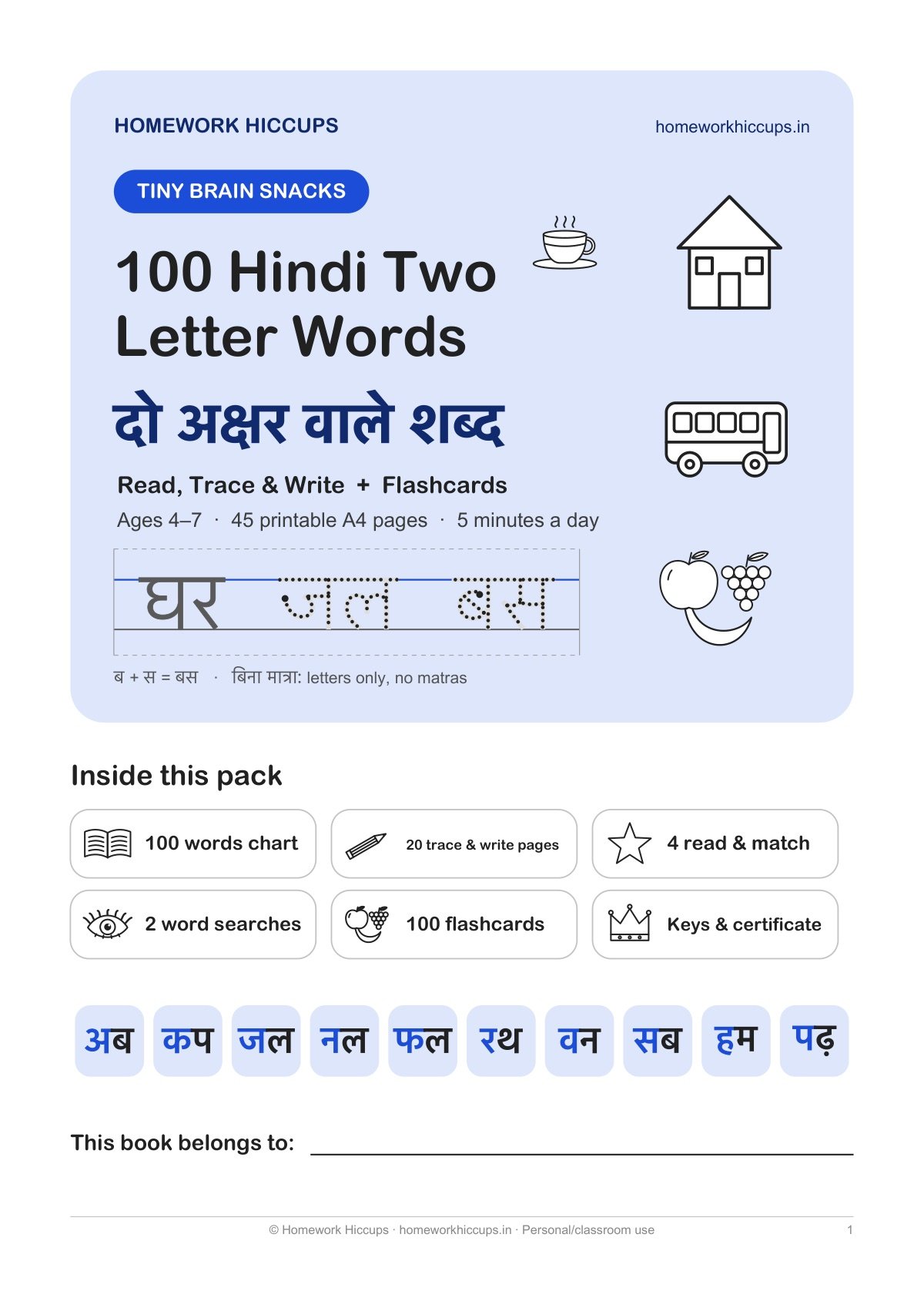
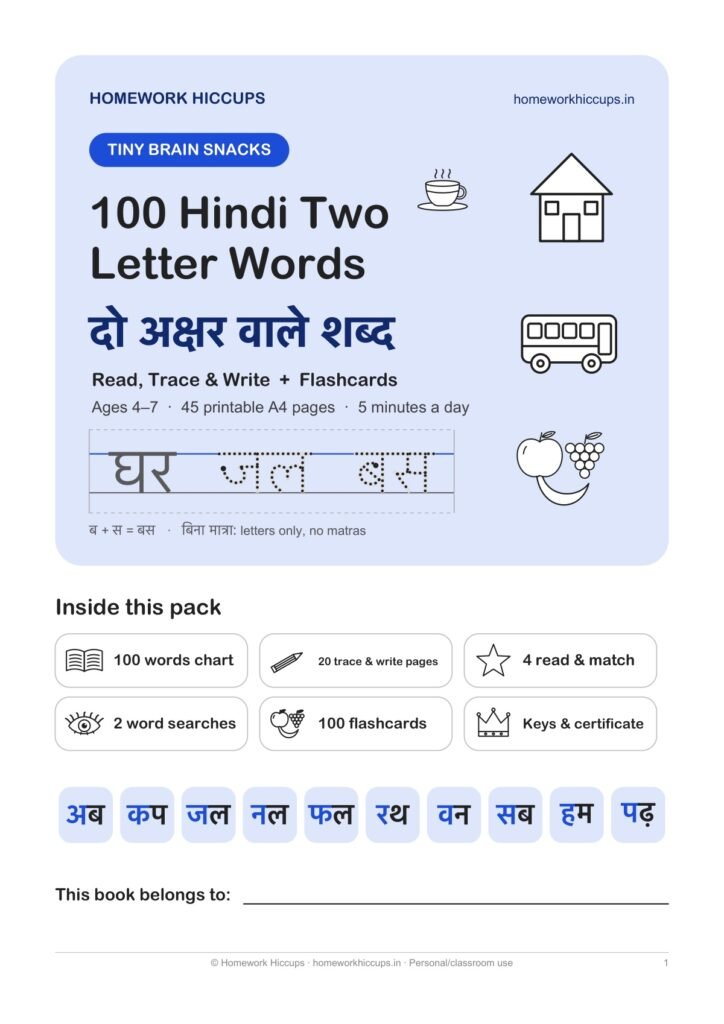
100 Hindi Two Letter Words Worksheets PDF – Read, Trace & Write (Bina Matra), Flashcards (45 Pages) – A4 PDF, instant download. ₹49 ₹99
This guide gives you 100 two letter words in Hindi without matra (बिना मात्रा के शब्द), each with its English transliteration and meaning, 20 picture words for UKG and Class 1, a simple way to teach blending, and practice ideas you can do at home in about five minutes a day.
🧰 Make practice more fun at home
As an Amazon Associate, Homework Hiccups earns from qualifying purchases, at no extra cost to you.
Quick answer: Two letter words in Hindi (दो अक्षर वाले शब्द) are words made of just two letters with no matra, where every letter keeps its natural अ sound. Common examples:
- घर (ghar) – house, जल (jal) – water, फल (phal) – fruit, नल (nal) – tap
- कब (kab) – when, अब (ab) – now, सब (sab) – all, तब (tab) – then
- हम (ham) – we, बस (bas) – bus / enough, रस (ras) – juice
- मन (man) – mind, वन (van) – forest, धन (dhan) – wealth
Children usually start reading them in UKG or early Class 1, once they recognise most of the varnamala.
What are two letter words in Hindi (do akshar ke shabd)?
In Hindi, every consonant (व्यंजन) carries a hidden अ sound. क is really “k + a”, म is “m + a”. When two such letters sit side by side with no matra, they make a word like कम (kam) or घर (ghar). Teachers call these बिना मात्रा वाले शब्द or दो अक्षर वाले शब्द.
One small detail is worth knowing before you start. When we read घर aloud, we say “ghar”, not “ghara”. The अ sound at the end of the word is usually dropped in spoken Hindi. Children pick this up naturally if you model it, so there is no need to explain the rule — just read the word the normal way and let them copy you.
When should children start reading two letter words?
The right time is not a fixed age. It is when your child can:
- Recognise most स्वर and व्यंजन without help, in and out of order.
- Say the sound of each consonant (not just its name in a rhyme).
- Write most letters with the शिरोरेखा (the top line), even if a little wobbly.
For many children this happens in UKG; for others it comes in Class 1. If letters are still shaky, spend a few more weeks on the varnamala. Our Hindi Varnamala tracing worksheets (48 pages, ₹99) cover all स्वर and व्यंजन on शिरोरेखा guides with picture words, which is exactly the foundation two letter words need.
Hindi two letter words: 100 words without matra (with meaning)
Here are 100 Hindi two letter words for everyday reading, grouped by their first letter so you can practise one letter family at a time. A few words have more than one meaning; we have given the meaning a young child is most likely to meet. Words with ड़ and ढ़ (like जड़ and पढ़) are included because they are common, but some teachers save these letters for slightly later.
| First letter | Words (transliteration – meaning) |
|---|---|
| अ | अब (ab) – now |
| क | कब (kab) – when; कल (kal) – tomorrow / yesterday; कम (kam) – less; कर (kar) – do; कप (kap) – cup; कस (kas) – tighten; कह (kah) – say |
| ख | खग (khag) – bird |
| ग | गज (gaj) – elephant; गप (gap) – chit-chat; गढ़ (garh) – fort |
| घ | घर (ghar) – house; घट (ghat) – pot; घन (ghan) – cloud |
| च | चल (chal) – walk / come on; चख (chakh) – taste; चढ़ (charh) – climb |
| छ | छत (chhat) – roof; छल (chhal) – trick |
| ज | जल (jal) – water; जब (jab) – when; जग (jag) – world / jug; जन (jan) – people; जप (jap) – chant; जय (jay) – victory; जड़ (jar) – root |
| झ | झट (jhat) – quickly |
| ठ | ठग (thag) – cheat |
| ड | डर (dar) – fear; डग (dag) – step |
| ढ | ढल (dhal) – slope / set (like the sun) |
| त | तब (tab) – then; तन (tan) – body; तट (tat) – shore; तल (tal) – bottom; तप (tap) – penance; तर (tar) – wet |
| थ | थल (thal) – land; थक (thak) – get tired |
| द | दस (das) – ten; दम (dam) – breath; दल (dal) – team / group; दर (dar) – rate |
| ध | धन (dhan) – wealth; धड़ (dhar) – body / torso |
| न | नल (nal) – tap; नभ (nabh) – sky; नट (nat) – acrobat; नस (nas) – vein; नर (nar) – male; नग (nag) – gem |
| प | पर (par) – feather / on; पल (pal) – moment; पथ (path) – path; पद (pad) – post / foot; पग (pag) – step; पढ़ (parh) – read |
| फ | फल (phal) – fruit; फन (phan) – hood of a snake; फट (phat) – burst |
| ब | बस (bas) – bus / enough; बल (bal) – strength; बन (ban) – become; बच (bach) – be saved; बह (bah) – flow; बढ़ (barh) – grow |
| भ | भर (bhar) – fill; भय (bhay) – fear |
| म | मन (man) – mind; मत (mat) – don’t / vote; मग (mag) – mug; मठ (math) – monastery |
| य | यह (yah) – this; यश (yash) – fame |
| र | रस (ras) – juice; रथ (rath) – chariot; रख (rakh) – keep; रट (rat) – learn by heart; रह (rah) – stay |
| ल | लत (lat) – bad habit; लय (lay) – rhythm; लड़ (lar) – fight |
| व | वन (van) – forest; वह (vah) – he / she / that; वर (var) – groom; वट (vat) – banyan tree |
| श | शक (shak) – doubt |
| स | सब (sab) – all; सच (sach) – truth; सर (sar) – head; सज (saj) – dress up; सह (sah) – bear / put up with; सन (san) – year (as in सन 2026) |
| ह | हम (ham) – we; हल (hal) – plough / answer; हर (har) – every; हट (hat) – move away; हद (had) – limit; हठ (hath) – stubbornness |
A note on transliteration: we use simple English spellings, so “th” in रथ is the soft Hindi थ and “r” in पढ़ stands for the ढ़ sound. Read the Devanagari aloud whenever you can.
20 picture words for UKG and Class 1
Young children read best when a word connects to something they can see. These 20 two letter words are easy to draw or find around the house, which makes them perfect for flashcards and picture-matching.
| Word | Meaning | Picture idea |
|---|---|---|
| घर (ghar) | house | A simple house with a door |
| नल (nal) | tap | The kitchen or bathroom tap |
| फल (phal) | fruit | A bowl of fruit |
| जल (jal) | water | A glass of water |
| बस (bas) | bus | The school bus |
| कप (kap) | cup | A chai cup |
| मग (mag) | mug | A bathroom mug |
| जग (jag) | jug | A water jug |
| रथ (rath) | chariot | A chariot with horses |
| छत (chhat) | roof | The roof of a house |
| वन (van) | forest | A group of trees |
| पर (par) | feather | A peacock feather |
| हल (hal) | plough | A farmer with a plough |
| गज (gaj) | elephant | An elephant |
| दस (das) | ten | Ten dots or ten fingers |
| सर (sar) | head | A child pointing to their head |
| नभ (nabh) | sky | Blue sky with a cloud |
| तट (tat) | shore | Sand and waves |
| वट (vat) | banyan tree | A big tree with hanging roots |
| फन (phan) | snake’s hood | A cobra with its hood open |
How to teach two letter words: blending sounds
The real skill behind reading Hindi is blending — joining two sounds smoothly into one word. Once your child can blend क + म into कम, they can read any word on this list.
Step 1: Say the sounds, then join them
Point to each letter and say its sound slowly: “क… म”. Then say them faster and faster until they join: “क-म… कम!” Let your child try. If they get stuck, say the first sound and let them add the second.
Step 2: Change one letter at a time
Keep the second letter the same and change the first. This builds confidence quickly because the pattern is predictable:
- नल → जल → फल → कल → बल → दल
- सब → कब → तब → जब → अब
- मन → वन → धन → तन → जन
- बस → रस → दस → नस
Step 3: Read, then say what it means
After reading a word, ask, “What is नल? Where is the नल in our house?” Connecting the word to its meaning turns decoding into real reading.
Prefer ready-to-print pages?
100 Hindi Two Letter Words Worksheets PDF – Read, Trace & Write (Bina Matra), Flashcards (45 Pages) – A4 PDF, instant download. ₹49 ₹99
Practice activities: read, trace, match and write
Five minutes a day is plenty. Rotate between these activities so practice stays fresh:
- Read aloud: five words from one letter family each day. Tick the ones your child reads without help.
- Trace and write: trace the word once on a शिरोरेखा guide, then write it once independently. Remind your child to draw the top line after writing both letters.
- Picture match: draw lines from words (घर, नल, बस) to small pictures.
- Make the word: write letters on small paper squares and ask your child to build a word you say aloud — “Make फल.”
- Dictation: once reading is steady, say a word and let your child write it. Start with words that use letters they write confidently.
Keep corrections light. If your child writes नल as लन, read back what they wrote and let them fix it themselves.
Printable practice for bina matra ke shabd
You can print this page and use the tables above as a reading list straight away. If you would like structured worksheets, our Hindi Matras worksheet pack begins with words that have no matra — such as घर, नल and कमल — before moving on to all 10 matras with picture words, a बारहखड़ी chart and simple sentences. It is 44 A4 pages for ₹99, paid quickly by UPI, and you can reprint pages for your own child as often as you need.
Get the 100 Hindi Two Letter Words Pack – ₹49
If your child still needs letter practice first, start with the varnamala pack and come back to this list in a few weeks.
Next step: three letter words and matras
Once two letter words feel easy, the natural progression is:
- Three letter words without matra such as कमल (lotus), नमक (salt), मटर (peas) and शहद (honey). The blending skill is the same — just one more sound.
- Matras, one at a time, starting with आ की मात्रा (ा). Our guide on how to teach Hindi matras walks through every matra with example words and the common छोटी इ / बड़ी ई mix-up.
- The full बारहखड़ी, chanted and read. See our Hindi barakhadi chart from क to ज्ञ with English transliteration.
If your child is in UKG, you may also find our UKG syllabus guide useful — it shows where Hindi reading fits alongside English and Maths in a typical year.
🧸 Learning toys kids love
As an Amazon Associate, Homework Hiccups earns from qualifying purchases, at no extra cost to you.
Frequently asked questions about two letter words in Hindi
What are two letter words in Hindi called?
They are usually called दो अक्षर वाले शब्द (do akshar wale shabd) or बिना मात्रा के शब्द (bina matra ke shabd). Examples include घर, जल, फल, नल, कब and हम.
At what age should a child read two letter Hindi words?
Most children start in UKG or early Class 1, roughly between five and six years old. The better guide is readiness: if your child recognises most letters of the varnamala and knows their sounds, they are ready to try blending two letters.
Should my child learn two letter words before matras?
Yes. Words without matra teach blending in its simplest form, because every letter keeps its natural अ sound. Once blending is secure, matras are much easier to understand.
Why do we say ghar and not ghara?
In everyday spoken Hindi, the अ sound at the end of a word is usually dropped, so घर is read as ghar. Children learn this naturally by hearing you read, so simply model the normal pronunciation.
How many two letter words should a UKG child know?
There is no fixed number. Rather than memorising a list, aim for your child to read any new two letter word by blending the sounds. Practising a few letter families, such as नल, जल, फल, usually builds this skill quickly.