
Homeschool · Nursery to Class 2 · Ages 3–8
Homeschooling in India: A Simple Guide and Kits for Ages 3–8
Homeschooling a young child in India does not need a classroom, a costly curriculum or hours at a table. From Nursery to Class 2, children learn best in short, calm sessions: 15 to 25 minutes of focused practice, plenty of talk, play and reading, and a parent who knows what to do next. This page shows you exactly that, age by age, and gives you ready-made Homeschool Kits so you never have to plan from scratch.
Quick answer: For ages 3 to 8, keep homeschool lessons short (15–25 minutes a day, Monday to Friday), cover English, maths, Hindi and the world around us (EVS), and follow a simple weekly rhythm with a review day. A Homework Hiccups Homeschool Kit gives you the printable worksheets plus a 36-week day-by-day plan, trackers, report cards and certificates.
Choose your Homeschool Kit
Each kit bundles the right worksheet packs for one age with a printed 36-week planner that tells you which page to do each day. Everything is a PDF: pay once, download instantly and print on A4 at home.
| Kit | Ages | What is inside | Price |
|---|---|---|---|
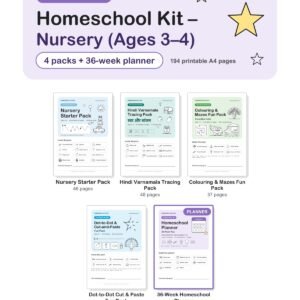
| Nursery Homeschool Kit | 3–4 | Nursery Starter, Hindi Varnamala Tracing, Colouring & Mazes, Dot-to-Dot Cut & Paste + 36-week planner | ₹299 |
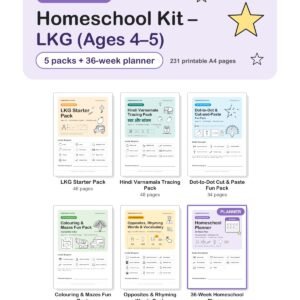
| LKG Homeschool Kit | 4–5 | LKG Starter, Hindi Varnamala Tracing, Dot-to-Dot Cut & Paste, Colouring & Mazes, Opposites & Rhyming Words + 36-week planner | ₹299 |
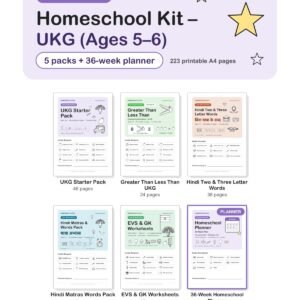
| UKG Homeschool Kit | 5–6 | UKG Starter, Greater Than Less Than, Hindi Two & Three Letter Words, Hindi Matras, EVS & GK + 36-week planner | ₹349 |
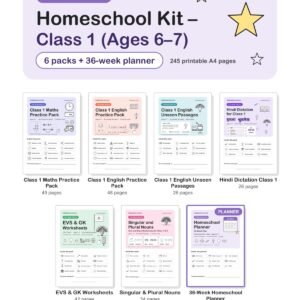
| Class 1 Homeschool Kit | 6–7 | Class 1 Maths, Class 1 English, Unseen Passages, Hindi Dictation, EVS & GK, Singular & Plural + 36-week planner | ₹399 |
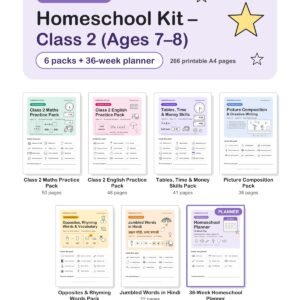
| Class 2 Homeschool Kit | 7–8 | Class 2 Maths, Class 2 English, Tables Time & Money, Picture Composition, Opposites & Rhyming, Jumbled Words in Hindi + 36-week planner | ₹399 |
Plan your day: Homeschool Timetable Pack
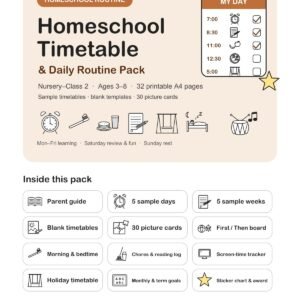
Need a routine before you need worksheets? The Homeschool Timetable & Daily Routine Pack (₹79) has sample daily and weekly timetables for Nursery to Class 2, blank timetables, 30 picture schedule cards for children who cannot read yet, morning and bedtime checklists, a chore chart, a reading log and a screen-time tracker.
-
Activity Packs
Homeschool Timetable for Kids PDF – Daily Routine Chart, Weekly Timetable & Picture Schedule Cards (32 Pages)
Original price was: ₹149.₹79Current price is: ₹79. Buy Now – ₹79 -
Bundles
Homeschool Kit for Nursery (Ages 3–4) – Worksheets PDF + 36-Week Plan
Original price was: ₹406.₹299Current price is: ₹299. Buy Now – ₹299 -
Bundles
Homeschool Kit for LKG (Ages 4–5) – Worksheets PDF + 36-Week Plan
Original price was: ₹485.₹299Current price is: ₹299. Buy Now – ₹299 -
Bundles
Homeschool Kit for UKG (Ages 5–6) – Worksheets PDF + 36-Week Plan
Original price was: ₹495.₹349Current price is: ₹349. Buy Now – ₹349 -
Bundles
Homeschool Kit for Class 1 (Ages 6–7) – Worksheets PDF + 36-Week Plan
Original price was: ₹544.₹399Current price is: ₹399. Buy Now – ₹399 -
Bundles
Homeschool Kit for Class 2 (Ages 7–8) – Worksheets PDF + 36-Week Plan
Original price was: ₹604.₹399Current price is: ₹399. Buy Now – ₹399
What a homeschool day looks like (ages 3–8)
Young children do not need school hours at home. What they need is a predictable rhythm. Here is a simple day that works for most families:
- Morning warm-up (5 minutes): say the day and date, sing a rhyme, count something in the house.
- Worksheet time (10–20 minutes): one or two pages from the plan. Sit together, read the instructions aloud and let the child do the writing.
- Talk and play (10 minutes): the screen-free activity from the planner, such as sorting spoons by size, finding things that start with a sound, or a shop game with real coins.
- Story time (10–15 minutes): read aloud every day, in English and in Hindi or your home language.
- Outdoor time: walks, the park, helping in the kitchen. This is learning too: measuring, naming, noticing.
Keep Saturday for review: redo a favourite page, finish anything pending and do one fun page. Keep Sunday free.
What to teach at each age
| Age | English | Maths | Hindi | World around us |
|---|---|---|---|---|
| Nursery (3–4) | Pencil grip, lines and curves, letter sounds, capital letters | Counting 1–10, big and small, shapes, colours | Listening, rhymes, first swar tracing | Body parts, family, animals, fruits |
| LKG (4–5) | A–Z and a–z tracing, beginning sounds | Numbers 1–20, patterns, more and less | Swar and vyanjan tracing with pictures | Seasons, transport, helpers, opposites |
| UKG (5–6) | Phonics, CVC words, sight words, short sentences | Numbers to 50, greater than and less than, addition and subtraction to 10 | Two and three letter words, first matras | Plants, animals and their homes, good habits |
| Class 1 (6–7) | Reading passages, nouns, singular and plural, a/an, is/are | Numbers to 100, addition and subtraction, shapes, time | All matras, dictation (imla), simple sentences | Family, food, water, safety, festivals |
| Class 2 (7–8) | Grammar, picture composition, paragraph writing | Carrying and borrowing, tables, time, money | Reading, word order and sentences | Our country, community, environment |
Children differ. If your child is ahead, move on; if a skill is not clicking, slow down and repeat. The kit planners say what to do in both cases.
How the 36-week planner works
Every Homeschool Kit includes a printable planner made for that age. It turns the worksheet packs into a full year you can simply follow:
- Year at a glance: three terms of 12 weeks with the skills for each term.
- Day-by-day plan: for every week, which page of which pack to do each day, plus a quick screen-free activity.
- Weekly tracker: a sticker chart for all 36 weeks, so your child sees progress.
- Report cards: a simple skills checklist at the end of each term (Not yet, Getting there, Got it).
- Certificates: for finishing each term and the whole year.
Start any week of the year. Print one week at a time so you only use paper you need.
Get the UKG Homeschool Kit – ₹349
Try before you buy: free samples
Not sure about the level? Download a free sample first. Each sample has real pages from the pack, and you get it by entering your name and email at checkout, with no payment.
- Free Nursery sample
- Free LKG sample
- Free UKG sample
- Free Class 1 Maths sample and Class 1 English sample
- Free Class 2 Maths sample and Class 2 English sample
- Free Hindi Varnamala sample
Homeschooling with more than one child
If you teach siblings of different ages, the Complete Worksheet Library (₹699) has all 20 original packs from Nursery to Class 2 in one download. Use the planner from the kit for each child’s age and pull pages from the library as they grow.
Tips from families who homeschool young children
- Short beats long. Stop while your child still wants more. Ten happy minutes teach more than forty tired ones.
- Same time, same place. A fixed slot after breakfast makes the habit easy.
- Talk in your home language. Explaining a maths idea in Hindi or your mother tongue is not cheating; it builds understanding.
- Keep a portfolio. Save a few finished pages each month with the date. It shows progress and is useful if your child joins a school later.
- Mix in real life. Shopping, cooking, travel and festivals are full of counting, reading and new words.
- Connect with others. Local homeschool groups and library story times give children friends and you support.
If you plan for your child to join or return to school later, check the current admission rules of the schools you are considering, and keep your portfolio and report cards ready.
Homeschool guides on our blog
- How to plan home practice for kids
- Activities for LKG kids at home
- How to teach Hindi to English-medium kids
- How to help your child with homework
- All blog posts
Homeschool FAQs
How many hours a day should I homeschool a 5 year old?
For ages 3 to 6, 15 to 25 minutes of focused worksheet time a day is plenty, with reading aloud, play and outdoor time making up the rest of the learning. Class 1 and 2 children can do 25 to 40 minutes, split into two short sessions.
What is included in a Homeschool Kit?
Each kit includes 4 to 6 worksheet packs chosen for that age, delivered as separate PDFs, plus a 36-week homeschool planner with a day-by-day plan, weekly sticker tracker, term report cards and certificates.
Can I use the kits if my child also goes to school?
Yes. Many parents use the kits for 15 minutes of after-school or holiday practice. Simply follow the plan at a slower pace, for example three days a week.
Do I need a printer?
The files are A4 PDFs designed for home printing in black and white. You can also print a week at a time at a local print shop.
Which kit should I choose if my child is between two levels?
Start with the lower kit if writing or counting is still shaky, and the higher kit if your child finds most pages easy. You can check with the free samples first.