Looking for short stories for Class 1 with questions that your child can actually read? Most stories online are either too long, too hard, or set in places Indian children have never seen. Class 1 readers do best with stories of about 80 to 120 words, simple sentences, familiar names and five questions that check whether they really understood.
Print-ready worksheets for this topic
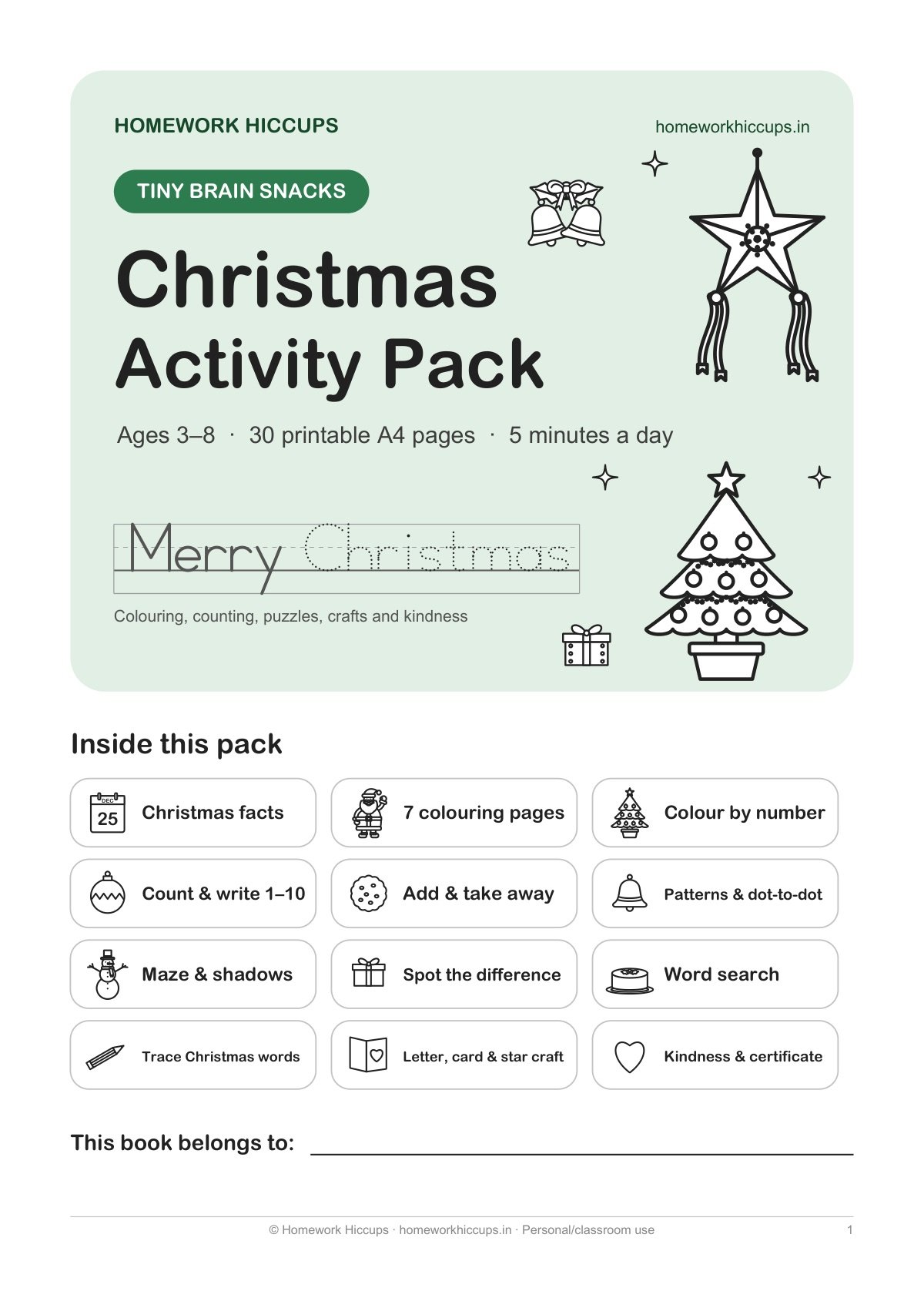
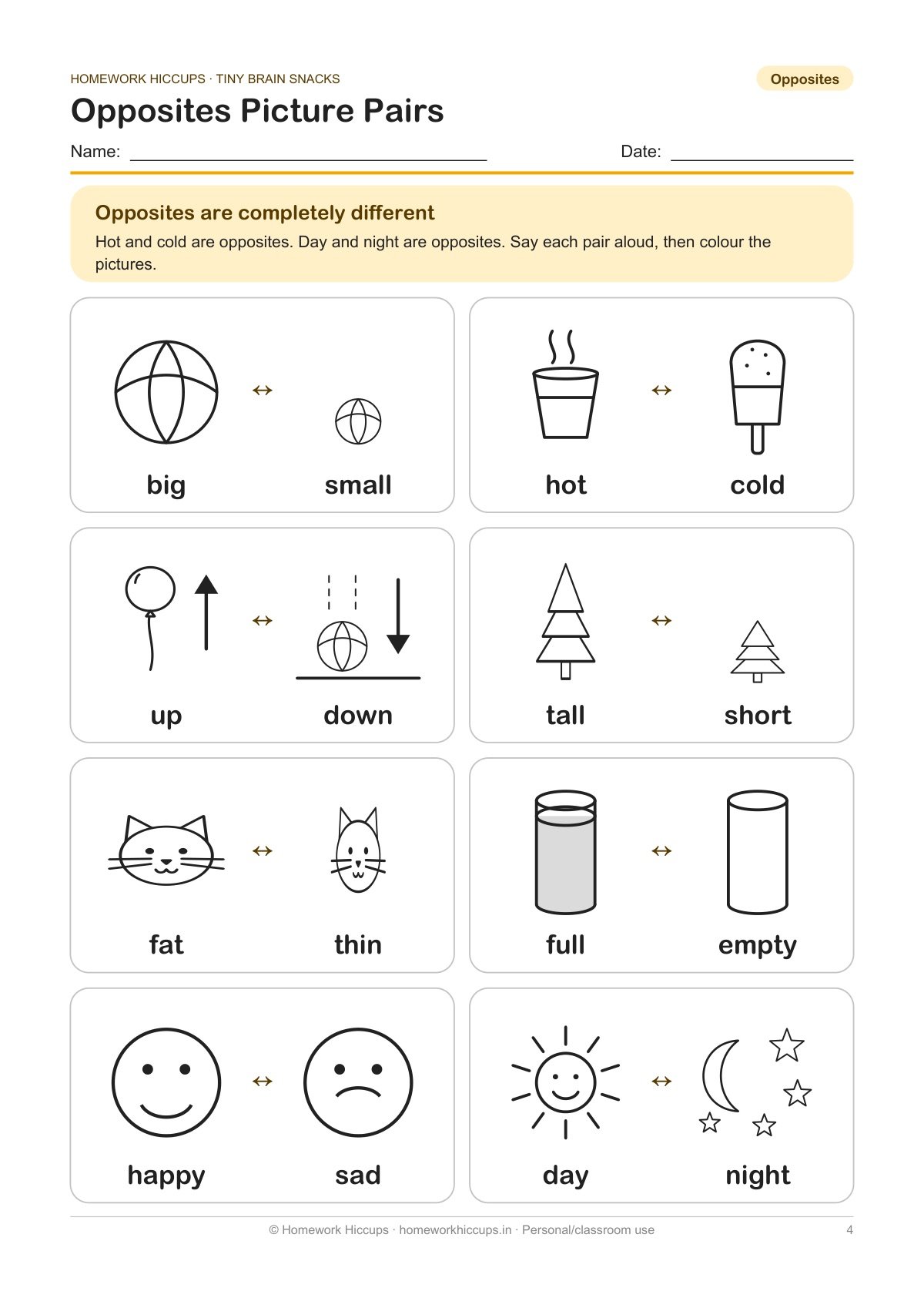
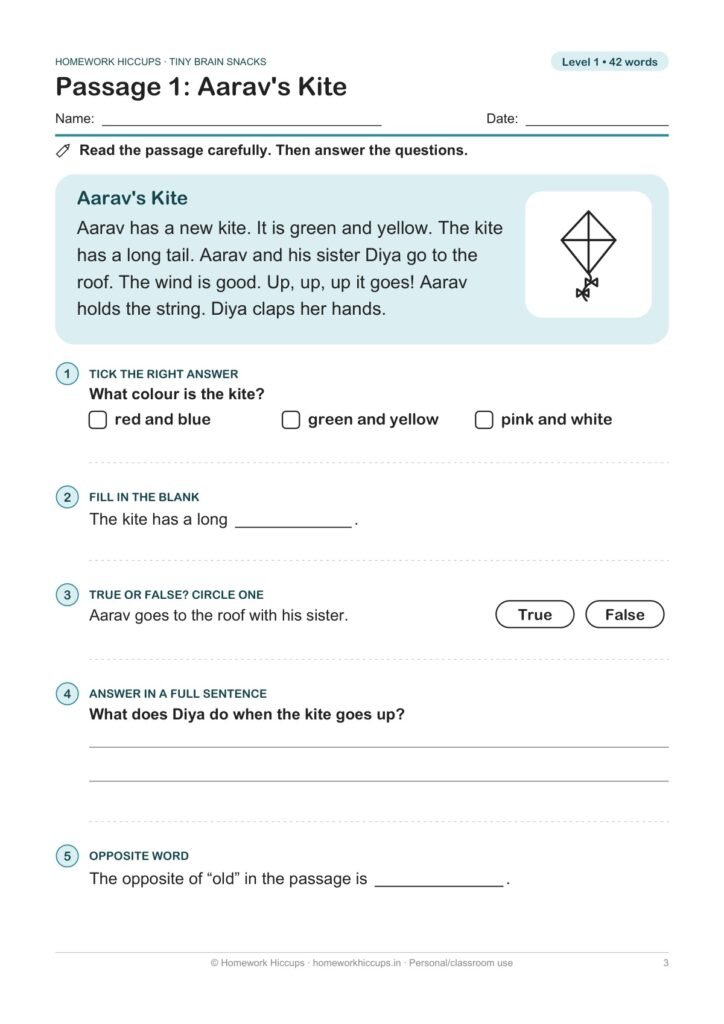
Class 1 English Unseen Passage Worksheets PDF – 20 Reading Passages with Answers (26 Pages) – A4 PDF, instant download. ₹49 ₹99
Below are six original short stories written for Class 1, set in everyday Indian homes, roofs and schools. Each one has new words with meanings, five questions and answers. There is also a simple read-aloud routine at the end, so each story becomes a 10-minute reading lesson.
🧰 Make practice more fun at home
As an Amazon Associate, Homework Hiccups earns from qualifying purchases, at no extra cost to you.
Quick answer: A good Class 1 story with questions should have:
- 80–120 words in short sentences.
- Familiar settings: home, school, market, roof, park.
- 5 questions: who, what, where, why and one about feelings or a word meaning.
- Answers found in the story, so children learn to look back.
🧸 Learning toys kids love
As an Amazon Associate, Homework Hiccups earns from qualifying purchases, at no extra cost to you.
How to use these short stories for Class 1 with questions
- Look at the title. Ask, “What do you think this story is about?”
- Read the new words together before the story.
- Read the story twice. First you read aloud while your child follows with a finger. Then your child reads it aloud.
- Answer the questions. Younger readers can answer aloud. Confident readers can write the answers.
- Look back. If an answer is wrong, ask your child to find the line in the story.
Story 1: The Kite on the Roof
New words: roof (top of a house), string (thin rope), stuck (cannot move)
It was a windy Sunday. Ishaan and his sister Tara went up to the roof with a red kite. Tara held the string and Ishaan ran. The kite went up, up, up into the sky. Then the wind became very strong. The kite flew into the neem tree and got stuck. Ishaan felt sad. Tara had an idea. She called their grandfather. Dadaji brought a long stick and gently pulled the kite down. “It is not torn!” said Ishaan. They flew the red kite again until the sun went down. That night, Ishaan drew a picture of the kite for Dadaji.
Questions
- What colour was the kite? Answer: red
- Where did the kite get stuck? Answer: in the neem tree
- Who helped get the kite down? Answer: Dadaji, their grandfather
- What did Dadaji use? Answer: a long stick
- What did Ishaan draw that night? Answer: a picture of the kite
Story 2: The Lost Chappal
New words: chappal (open shoe), search (look for), puppy (baby dog)
Meher was ready for the park, but she had only one blue chappal. “Where is my other chappal?” she asked. Mumma looked under the bed. Papa looked behind the door. Meher looked in the toy box. It was not there. Then they heard a small sound from the balcony. Their puppy, Golu, was sitting in his basket. He had the blue chappal in his mouth! Everyone laughed. Papa gave Golu a ball to play with instead. Meher put on both chappals and ran to the park. Golu came too, holding his new ball.
Questions
- What colour was Meher’s chappal? Answer: blue
- Where did Mumma look? Answer: under the bed
- Who had the chappal? Answer: Golu, the puppy
- What did Papa give Golu? Answer: a ball
- True or false: Meher went to school. Answer: false, she went to the park
Story 3: A Rainy School Day
New words: puddle (small pool of water), raincoat (coat for rain), dry (not wet)
Dark clouds filled the sky on Monday morning. Kabir wore his yellow raincoat and took his green umbrella. On the way to school, he saw a big puddle. He wanted to jump in it, but he remembered his clean shoes. He walked around it carefully. At school, many children were wet. Kabir was dry. In class, the teacher said, “Let us write about the rain.” Kabir wrote, “Rain makes the trees green and the air cool.” The teacher put a star on his page. On the way home, the sun came out and Kabir saw a rainbow.
Questions
- What colour was Kabir’s raincoat? Answer: yellow
- Why did Kabir not jump in the puddle? Answer: he remembered his clean shoes
- What did the teacher ask the children to write about? Answer: the rain
- What did the teacher put on his page? Answer: a star
- What did Kabir see on the way home? Answer: a rainbow
Story 4: Nani’s Mango Tree
New words: ripe (ready to eat), village (small place in the countryside), share (give some to others)
In the summer holidays, Anaya went to Nani’s village. Behind Nani’s house there was a big mango tree. Its mangoes were green and hard. “When will they be ripe?” Anaya asked every day. Nani smiled. “Be patient.” After one week, some mangoes turned yellow. Nani and Anaya picked six mangoes and put them in a basket. Nani cut one, and it was sweet and juicy. Anaya wanted to eat them all. Then she saw the children next door. She gave them two mangoes. “Sharing makes the mango sweeter,” said Nani.
Questions
- Where did Anaya go in the holidays? Answer: to Nani’s village
- What colour were the mangoes at first? Answer: green
- How many mangoes did they pick? Answer: six
- How many mangoes did Anaya give to the children next door? Answer: two
- What is the opposite of sweet? Answer: sour (or bitter)
Story 5: Arjun’s Tiffin
New words: tiffin (lunch box), forgot (did not remember), lunch (the midday meal)
Arjun was in a hurry. He put on his shoes, picked up his bag and ran to the school bus. At lunch time, he opened his bag. There was no tiffin! He had forgotten it on the dining table. Arjun’s tummy made a loud noise. His friend Zoya heard it. She opened her tiffin and gave him half of her aloo paratha. Their friend Sam gave him an apple. “Thank you,” said Arjun. The next day, Arjun brought extra laddoos in his tiffin for Zoya and Sam. Now he checks his bag every morning.
Questions
- Where did Arjun forget his tiffin? Answer: on the dining table
- What did Zoya share with him? Answer: half of her aloo paratha
- What did Sam give him? Answer: an apple
- What did Arjun bring the next day? Answer: extra laddoos
- What does Arjun do every morning now? Answer: he checks his bag
Prefer ready-to-print pages?
Class 1 English Unseen Passage Worksheets PDF – 20 Reading Passages with Answers (26 Pages) – A4 PDF, instant download. ₹49 ₹99
Story 6: The Sparrow at the Window
New words: sparrow (small brown bird), grains (small seeds), nest (bird’s home)
Every morning, a little brown sparrow sat at Riya’s window. “Chirp, chirp!” it said. Riya wanted to give it food. She asked her mother for some rice grains. Riya put the grains in a small plate and a bowl of water next to it. The sparrow looked at her. Then it hopped to the plate and ate. The next day, the sparrow brought a friend. Soon there were four sparrows at the window. One day Riya saw some dry grass on the window ledge. The sparrows were making a nest! Riya smiled and kept the window quiet.
Questions
- What colour was the sparrow? Answer: brown
- What did Riya give the sparrow to eat? Answer: rice grains
- What did she put next to the plate? Answer: a bowl of water
- How many sparrows came in the end? Answer: four
- What were the sparrows making? Answer: a nest
Small stories for Class 1: a 10-minute read-aloud routine
| Minutes | Step | What you say or do |
|---|---|---|
| 0–1 | Predict | “Look at the title. What will happen?” |
| 1–2 | New words | Read the three new words and their meanings |
| 2–4 | You read | Read slowly with expression; your child follows with a finger |
| 4–7 | Child reads | Help only with hard words; praise smooth reading |
| 7–10 | Questions | Ask the 5 questions; look back in the story for any wrong answer |
Read one story a day for six days, then go back to story 1 and see how much more smoothly your child reads it. Re-reading is one of the best ways to build fluency. For more ideas, see our guide on how to teach reading to kids.
Class 1 story with questions: tips for better answers
- Answer in a full sentence when writing: “The kite was red.” This is what many schools expect.
- Use the question words. Who asks about a person, where asks about a place, what asks about a thing. Our wh questions for kids post explains each one.
- Find the line. Every answer in these stories is in the text. Teaching children to look back is the key skill for unseen passages in tests.
- Talk about feelings. Ask, “How did Ishaan feel when the kite got stuck?” This builds deeper understanding.
English story for Class 1 with question answer: 20 more passages
If your child enjoys these, our Class 1 English Unseen Passage Worksheets PDF (26 pages) has 20 more original reading passages, one per A4 page, graded in four levels from 42 to 120 words. Stories and simple facts use Indian names and settings, such as Aarav’s Kite, Diya’s Red Umbrella, A Ride in an Auto and The Train to Nani’s House. Every passage has 5 or 6 mixed questions (tick the answer, fill in the blank, true or false, a full-sentence answer and a word-meaning or opposite question), a picture to colour and full answer keys, plus a reading tracker and certificate.
Get 20 Class 1 Unseen Passages – ₹49
For more on comprehension practice, read our unseen passage for Class 1 guide, or browse Class 1 worksheets.
Download the Unseen Passage Pack – ₹49
Frequently asked questions
How long should a Class 1 story be?
Most Class 1 children read comfortably with stories of about 80 to 120 words. Start shorter if your child is a new reader and build up slowly.
How many questions should I ask after a story?
Five questions is a good number for Class 1: a mix of who, what, where, why and one about feelings or a word meaning.
Should my child answer in full sentences?
For written answers, many schools expect full sentences, such as The kite was red. For spoken answers, short answers are fine at first.
What if my child cannot read the story alone?
Read it aloud first while your child follows with a finger, then read it together. After a few readings, most children can try it alone.
Are these stories original?
Yes. All six stories on this page were written for Homework Hiccups, with Indian names and everyday settings for Class 1 readers.