A five senses worksheet is a favourite in UKG and Class 1 EVS, and for good reason: children already use their senses all day long. They just have not stopped to notice. When you help them name what their eyes, ears, nose, tongue and skin are doing, a simple lesson becomes an adventure in their own kitchen.
Print-ready worksheets for this topic
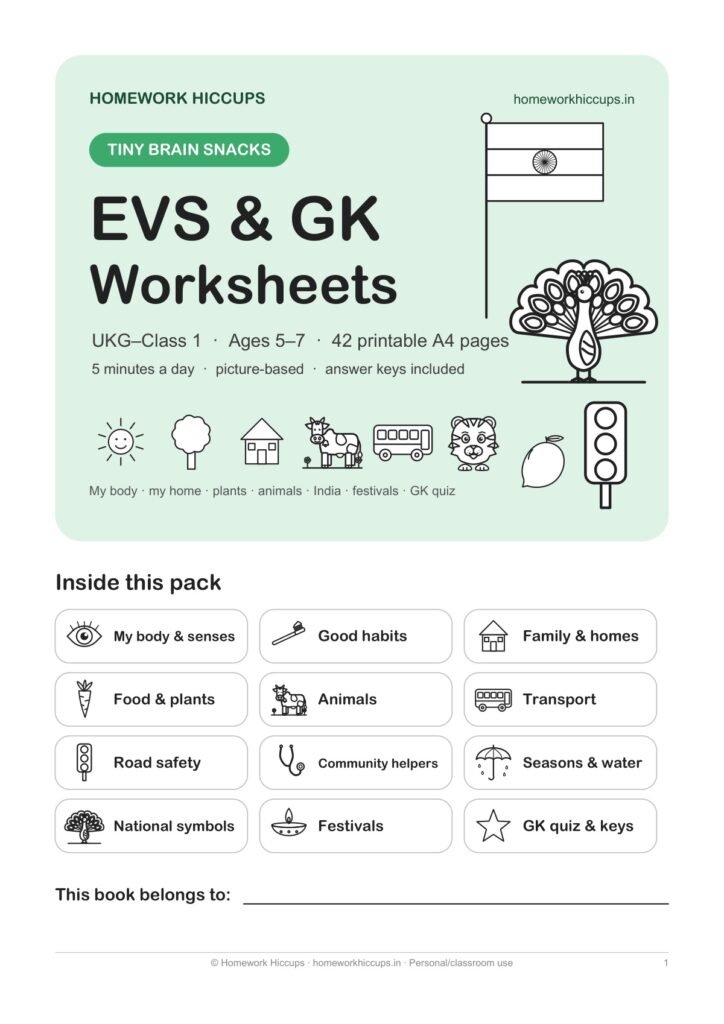
EVS & GK Worksheets PDF for UKG & Class 1 – My Body, Plants, Animals, India & GK Quiz, Ages 5–7 (42 Pages) – A4 PDF, instant download. ₹99 ₹199
This guide explains the five senses for kids one by one, gives you a five-station home activity, 15 questions with answers and easy care tips for each sense organ. Everything can be done with things you already have at home or in class.
🧰 Make practice more fun at home
As an Amazon Associate, Homework Hiccups earns from qualifying purchases, at no extra cost to you.
Quick answer: The five senses and their sense organs are:
- Sight: eyes help us see.
- Hearing: ears help us hear.
- Smell: the nose helps us smell.
- Taste: the tongue helps us taste.
- Touch: the skin helps us feel.
Sense organs for Class 1: a simple table
| Sense | Sense organ | Hindi | We use it to… |
|---|---|---|---|
| Sight | Eyes | आँख (aankh) | see colours, shapes, people and the world around us |
| Hearing | Ears | कान (kaan) | hear voices, music, the school bell and the pressure cooker whistle |
| Smell | Nose | नाक (naak) | smell flowers, food and smoke |
| Taste | Tongue | जीभ (jeebh) | taste sweet, salty, sour and bitter food |
| Touch | Skin | त्वचा (tvacha) | feel hot, cold, soft, hard, rough and smooth things |
A fun point for children: the skin is the biggest sense organ, because it covers the whole body. For naming other body parts, see our body parts worksheet guide.
The five senses for kids, one by one
Sight: our eyes
Our eyes tell us what things look like: their colour, size and shape, and whether they are near or far. We need light to see. Ask your child to close their eyes and describe the room from memory, then open them and check. What did they miss?
Hearing: our ears
Our ears pick up sounds, loud and soft, near and far. Sounds can warn us of danger, like a car horn, or make us happy, like a song. Ask: Which sounds can you hear right now? Fans, birds, traffic and voices are all good answers.
Smell: our nose
Our nose tells us about smells, pleasant and unpleasant. Smell helps us enjoy food and warns us of things like smoke or spoilt milk. Smell and taste work together: food tastes less strong when your nose is blocked with a cold.
Taste: our tongue
Our tongue tells us how food tastes. Four tastes are easy for children to name: sweet (sugar, jaggery, mango), salty (salt, chips), sour (lemon, tamarind, curd) and bitter (karela, bitter gourd). The tongue also helps us chew, swallow and talk.
Touch: our skin
Our skin tells us if something is hot or cold, soft or hard, rough or smooth, wet or dry. It also tells us when something hurts, which keeps us safe. Fingertips are especially good at feeling.
5 senses activities: a five-station home or class activity
Set up five stations on a table or in five corners of the room. Children visit each one for 3 to 5 minutes. In class, groups of four or five rotate. At home, one child can do all five in about 20 minutes.
| Station | Sense | What you need | What children do |
|---|---|---|---|
| 1. Mystery bag | Touch | A cloth bag with a spoon, cotton wool, a key, a stone and a leaf | Feel without looking and guess each object; say if it is soft, hard, rough or smooth |
| 2. Smell jars | Smell | Small covered cups with cardamom, lemon peel, coffee, a rose petal and onion | Smell with eyes closed and guess; say which smell they like best |
| 3. Taste test | Taste | Tiny pieces of jaggery, a pinch of salt, lemon and a sliver of karela | Taste each and sort into sweet, salty, sour and bitter |
| 4. Sound walk | Hearing | A quiet corner, a balcony or a garden | Sit still for 1 minute and list or draw every sound they hear |
| 5. Colour spotting | Sight | A list of colours on a card | Find one thing of each colour in the room and tick it off |
Safety notes: check for food allergies before the taste test, use only food-safe items, and never use anything sharp, hot or harmful in the mystery bag or smell jars. Avoid strong chillies and pepper, which can sting eyes and noses.
Turn it into a worksheet
After the stations, give each child a sheet with five boxes, one per sense. They draw or write one thing they found at each station, for example: I felt a rough stone. I smelt a lemon. I tasted sweet jaggery.
🧸 Learning toys kids love
As an Amazon Associate, Homework Hiccups earns from qualifying purchases, at no extra cost to you.
Five senses worksheet: 15 sense organs questions for UKG
Read these aloud for UKG children and let Class 1 children read them themselves. Answers are in the table below.
- Which sense organ helps us see?
- Which sense organ helps us hear?
- Which sense organ helps us smell?
- Which sense organ helps us taste?
- Which sense organ helps us feel hot and cold?
- How many senses do we have?
- You hear the school bell. Which sense are you using?
- You smell a rose. Which sense organ are you using?
- Name one sour food.
- Name one sweet food.
- Is a lemon sweet or sour?
- Which sense tells you that ice is cold?
- Which is the biggest sense organ?
- Which sense organ do we use to read a book?
- Which two senses help us enjoy a plate of hot jalebi?
| Q | Answer | Q | Answer |
|---|---|---|---|
| 1 | Eyes | 9 | Lemon, tamarind or curd (any one) |
| 2 | Ears | 10 | Jaggery, mango, sugar or ladoo (any one) |
| 3 | Nose | 11 | Sour |
| 4 | Tongue | 12 | Touch (skin) |
| 5 | Skin | 13 | Skin |
| 6 | Five | 14 | Eyes |
| 7 | Hearing (ears) | 15 | Taste and smell (sight and touch are also fair answers) |
| 8 | Nose |
Prefer ready-to-print pages?
EVS & GK Worksheets PDF for UKG & Class 1 – My Body, Plants, Animals, India & GK Quiz, Ages 5–7 (42 Pages) – A4 PDF, instant download. ₹99 ₹199
How to take care of our sense organs
Care tips are a natural part of the five senses topic in EVS, and they fit well with lessons on good habits for kids.
| Sense organ | Care tips for children |
|---|---|
| Eyes | Read in good light. Do not rub your eyes with dirty hands. Never look straight at the sun. Take breaks from screens. |
| Ears | Never put pencils, sticks or other objects in your ears. Keep loud music low. Tell a grown-up if your ear hurts. |
| Nose | Use a clean hanky or tissue. Do not put anything inside your nose. Cover your nose and mouth when you sneeze. |
| Tongue | Brush your teeth and gently clean your tongue. Do not eat food that is too hot. Rinse your mouth after meals. |
| Skin | Bathe every day and wash your hands with soap. Keep cuts clean and covered. Stay in the shade in strong sun. |
Five senses EVS: ideas for teachers
- Senses song or chant: touch each organ while saying eyes to see, ears to hear, nose to smell, tongue to taste, skin to feel.
- Sense walk: take the class around the school garden with a five-column chart and fill it in.
- Odd one out: show four pictures (eye, ear, nose, hand holding a pencil) and ask which is not a sense organ; then discuss that hands feel because of skin.
- Kindness link: talk gently about people who cannot see or hear, and how they use their other senses, such as Braille and sign language.
For other EVS topics in the same year, see our guides to EVS worksheets for Class 1 and UKG EVS worksheets.
EVS and GK worksheets with a five senses match
The EVS and GK Worksheets PDF (42 A4 pages, ages 5 to 7) includes a five senses match (eyes, ears, nose, tongue, skin) in its My Body section, alongside labelling body parts, a How many do I have? counting page, good and bad habits and a My Family page. The rest of the pack covers houses, food and plants, animals, transport, road safety, community helpers, seasons, water, national symbols of India, festivals and two picture GK quiz pages, with answer keys and a GK Star certificate.
Get the EVS and GK Worksheets PDF – ₹99
Try the free EVS and GK sample first if you like: you get it by entering your name and email at checkout, with no payment. Browse all EVS and GK worksheets.
Download the 42-page EVS and GK Pack – ₹99
Frequently asked questions
What are the five senses for kids?
The five senses are sight, hearing, smell, taste and touch. We use our eyes to see, ears to hear, nose to smell, tongue to taste and skin to feel.
What are the five sense organs called in Hindi?
Eye is आँख (aankh), ear is कान (kaan), nose is नाक (naak), tongue is जीभ (jeebh) and skin is त्वचा (tvacha).
Which is the largest sense organ?
The skin is the largest sense organ because it covers the whole body. It helps us feel touch, heat, cold and pain.
How do I teach the five senses to UKG children?
Use hands-on activities such as a mystery bag for touch, smell jars, a small taste test, a sound walk and colour spotting, then follow up with a simple matching worksheet.
How can children take care of their eyes?
Children should read in good light, avoid rubbing their eyes with dirty hands, take breaks from screens and never look straight at the sun.