Picture composition for Class 2 asks a little more than it did in Class 1. Instead of three short lines, most children are now expected to write five or six sentences, use a few describing words and keep their ideas in a sensible order. The good news is that this is a skill with a clear method, and it improves quickly with regular practice.
Print-ready worksheets for this topic
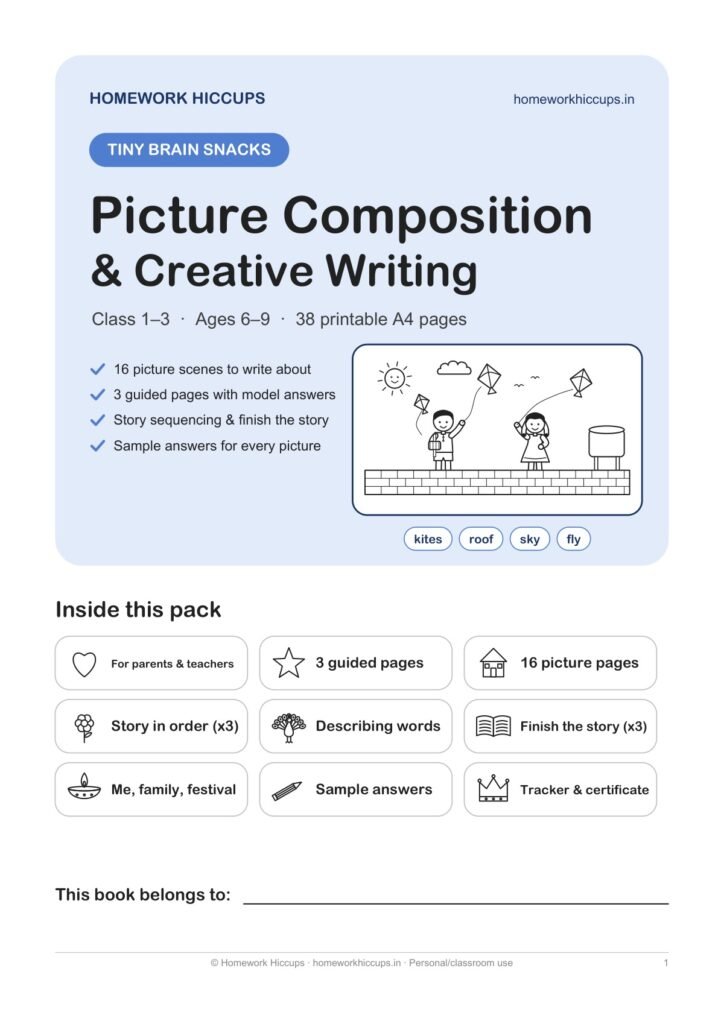
Picture Composition Worksheets PDF for Class 1–3 – 16 Scenes, Story Sequencing & Creative Writing (38 Pages) – A4 PDF, instant download. ₹79 ₹149
Below you will find a 5-sentence writing frame, six everyday Indian scenes described in words (so you can sketch them or find a similar picture), a word bank and four guiding questions for each, original model answers, and a simple checklist for marking at home or in class.
🧰 Make practice more fun at home
As an Amazon Associate, Homework Hiccups earns from qualifying purchases, at no extra cost to you.
Quick answer: For a good Class 2 picture composition, a child should:
- Look at the whole picture first, then the people, the place and the action.
- Answer four questions: Where is it? Who is there? What are they doing? How do they feel?
- Write 5–6 sentences: one about the place, three about actions, one about feelings or weather, and a closing line.
- Add 2–3 describing words such as tall, crowded, colourful or happy.
The 5-sentence writing frame for picture composition for Class 2
Children freeze when they do not know where to begin. A frame gives them a starting point without writing the piece for them. Copy this into the back of a notebook:
| Sentence | What it tells | Sentence starter |
|---|---|---|
| 1 | The place and time | This is a picture of… / It is a sunny morning at… |
| 2 | Who is there | I can see… / There are many… |
| 3 | An action | A boy is… / Two girls are… |
| 4 | Another action | Near the…, a man is… |
| 5 | Weather, sound or feeling | Everyone looks… / The sky is… |
| 6 (bonus) | A closing thought | I would like to… / It is a lovely day. |
Once your child is confident, let them drop the starters and write freely. The frame is a ladder, not a cage. If your child is still finding three sentences hard, go back to our simpler picture composition for Class 1 first.
Picture composition for Class 2 with answers: 6 scenes
Each scene below is described so you can draw a quick sketch, show a similar photo, or simply describe it aloud. Talk about the picture before writing. The model answers are examples; any true, clear sentence about the picture is correct.
Scene 1: A busy railway station
The picture: A long blue train stands at a platform. A family with a big suitcase is walking towards it. A tea seller holds a kettle, and a big clock hangs above.
Word bank: platform, train, porter, suitcase, ticket, crowded, clock, tea seller
Guiding questions: Where is this? Who is travelling? What is the tea seller doing? What can you hear?
Model answer: This is a picture of a busy railway station. A long blue train is standing at the platform. A family is pulling a heavy suitcase towards the train. A tea seller is calling out, “Chai, chai!” A big round clock shows that it is nine o’clock. The station is crowded and noisy.
Scene 2: The vegetable stall
The picture: A smiling vegetable seller sits behind baskets of tomatoes, potatoes and green chillies. A mother and her son are buying vegetables. A weighing scale is on the cart.
Word bank: vegetable seller, cart, basket, fresh, red tomatoes, weighing scale, cloth bag, buy
Guiding questions: What is the seller selling? Who is buying? What is the boy holding? How do the vegetables look?
Model answer: This is a vegetable stall in our market. The seller has baskets full of fresh vegetables. There are red tomatoes, brown potatoes and green chillies. A mother is buying vegetables for dinner. Her son is holding a cloth bag. The seller is weighing the tomatoes on his scale.
Scene 3: A rainy day
The picture: Dark clouds and rain. Two children in raincoats are walking to school. One child jumps in a puddle. A paper boat floats in the water near the road.
Word bank: dark clouds, raincoat, umbrella, puddle, paper boat, wet, splash, gumboots
Guiding questions: What is the weather like? What are the children wearing? What is floating? How do the children feel?
Model answer: It is a rainy morning. Dark clouds cover the sky. Two children are walking to school in yellow raincoats. One boy is jumping in a big puddle. A small paper boat is floating in the water. The children are wet but very happy.
Scene 4: A birthday party
The picture: A girl stands behind a round cake with seven candles. Friends wear party hats. Balloons hang on the wall and gifts lie on a table.
Word bank: birthday, cake, candles, balloons, party hats, gifts, clap, cheerful
Guiding questions: Whose birthday is it? How old is she? What are the friends doing? What is on the table?
Model answer: Today is Riya’s birthday party. There is a big chocolate cake with seven candles. Riya is going to blow out the candles. Her friends are wearing colourful party hats. They are clapping and singing for her. Balloons and gifts make the room look cheerful.
Scene 5: The school library
The picture: Tall shelves full of books. A teacher sits at a desk stamping a book. Three children read at a table, and one boy chooses a book from a shelf.
Word bank: library, shelves, storybook, quiet, librarian, table, choose, read
Guiding questions: Where are the children? What is the librarian doing? What is the boy doing? Why is the room quiet?
Model answer: This is our school library. Tall shelves are full of books. The librarian is stamping a book at her desk. Three children are reading quietly at a table. A boy is choosing a storybook about animals. Everyone is silent so that others can read.
Scene 6: Kite flying on the roof
The picture: A clear blue sky with many kites. A father and daughter stand on a flat roof. The girl holds the spool while her father flies a red kite.
Word bank: roof, kite, string, spool, windy, blue sky, high, cheer
Guiding questions: Where are they? Who is flying the kite? What is the girl holding? What is the weather like?
Model answer: It is a windy afternoon. Many colourful kites are flying in the blue sky. Aarav’s father is flying a red kite on the roof. Aarav is holding the spool of string. The red kite is going higher and higher. They are shouting and cheering with joy.
Picture description for Class 2: adding describing words
The quickest way to lift a Class 2 answer from “fine” to “very good” is two or three describing words (adjectives). Teach your child to ask “What kind?” about each naming word.
| Plain sentence | Better sentence |
|---|---|
| There is a train. | There is a long blue train. |
| The boy has a bag. | The boy has a heavy school bag. |
| There are clouds. | There are dark grey clouds. |
| She has a cake. | She has a big chocolate cake. |
For more practice, see our adjectives worksheet for Class 2. When your child can write about one picture, try three pictures in order with our picture sequencing worksheets, and then move on to paragraph writing for Class 2 without a picture.
Prefer ready-to-print pages?
Picture Composition Worksheets PDF for Class 1–3 – 16 Scenes, Story Sequencing & Creative Writing (38 Pages) – A4 PDF, instant download. ₹79 ₹149
Marking checklist for parents and teachers
Mark gently and look for one thing to praise and one thing to improve.
| Check | Yes / Not yet |
|---|---|
| 5 or more sentences | |
| Each sentence is about the picture | |
| Starts with the place or a “This is” sentence | |
| At least 2 describing words | |
| Capital letter at the start, full stop at the end | |
| Sentences do not all start with “There is” | |
| Word bank words spelled correctly |
Common problems and quick fixes
- Writing a list. “Train. Clock. Bag.” Ask: what is the train doing? Turn each naming word into a sentence.
- Making up things not in the picture. Praise the imagination, then ask, “Can I see that in the picture?”
- Every sentence starts the same way. Give three different starters to choose from.
- Mixing past and present. In picture composition, the present continuous (is flying, are reading) usually works best.
Picture writing for Class 2: ready-to-print scenes
If you want clear pictures to write about instead of sketching your own, our Picture Composition Worksheets PDF (38 pages, Class 1–3) has 16 picture composition pages from everyday Indian life, including a railway station, vegetable stall, rainy day, birthday party, library and kite flying on the roof. Each one has a word bank of 8 words, 4 guiding questions and five four-line writing rows, and there is a sample paragraph for every picture. It also includes 3 guided pages, 3 picture-sequence stories, a describing words page, 3 finish-the-story pages and a writing tracker. All pages are black line art that prints well on any printer.
Get the Picture Composition Worksheets – ₹79
You can also try the free picture composition sample first, or browse our Class 2 worksheets.
Download 16 Picture Composition Scenes – ₹79
🧸 Learning toys kids love
As an Amazon Associate, Homework Hiccups earns from qualifying purchases, at no extra cost to you.
Frequently asked questions
How many sentences should a Class 2 picture composition have?
Most Class 2 picture compositions ask for 5 or 6 sentences. Check your school’s worksheet, as some teachers ask for a fixed number.
How do I start a picture composition?
Start with the place, for example: This is a picture of a busy railway station. Then write about who is there and what they are doing.
Which tense should be used in picture composition?
The present continuous tense usually works best, such as is flying, are reading or is walking, because the picture shows what is happening now.
Can my child write things that are not in the picture?
Most sentences should describe what can be seen. One closing sentence about a feeling or a wish is fine, but the rest should match the picture.
How can I help my child write better picture compositions?
Talk about the picture first, give a small word bank, use the 5-sentence frame and ask what kind questions to add describing words. Practise one picture two or three times a week.