Hindi alphabet tracing worksheets help children learn something English letters never teach them: how letters hang from a line at the top. In Hindi, almost every letter sits under the शिरोरेखा (shirorekha), the headline that joins letters into words. A child who learns to place letters correctly under that line from the start writes neater Hindi for years.
Print-ready worksheets for this topic
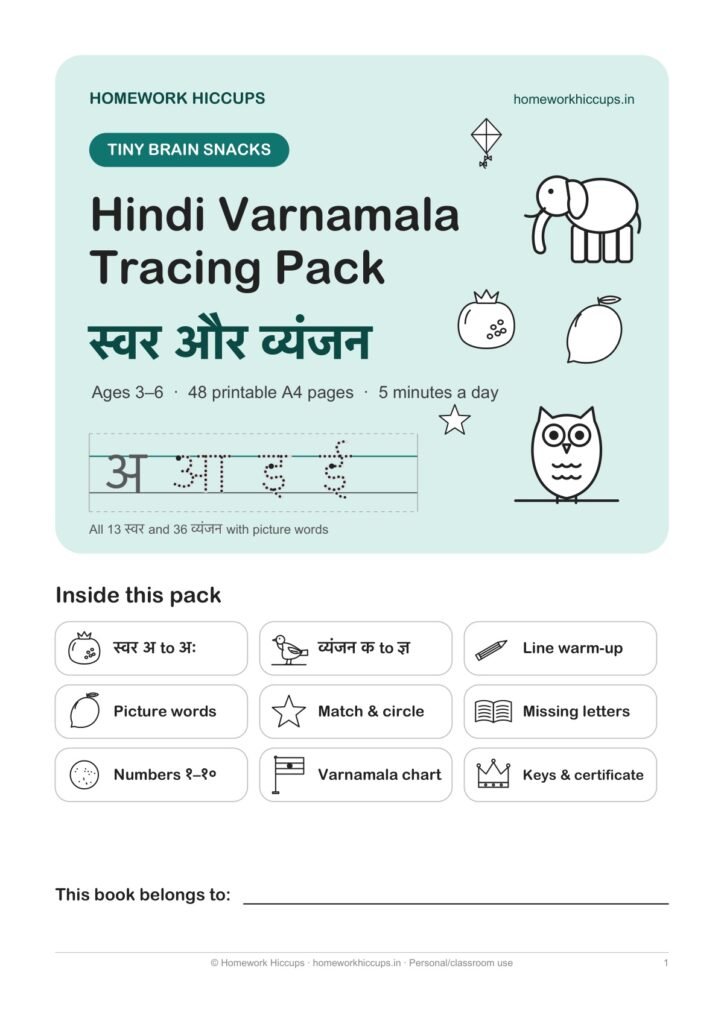
Hindi Varnamala Tracing Worksheets PDF – Swar & Vyanjan (स्वर और व्यंजन) with Picture Words, Ages 3–6 (48 Pages) – A4 PDF, instant download. ₹99 ₹199
This guide explains how Hindi letters sit on the lines, the order to write each part, stroke tips for the trickiest letters (अ, झ, ण and क्ष) and a 6-week plan that groups all the letters by shape. For the full list of letters with pictures, see our Hindi varnamala chart with pictures; this page focuses on writing them.
🧰 Make practice more fun at home
As an Amazon Associate, Homework Hiccups earns from qualifying purchases, at no extra cost to you.
Quick answer: To teach Hindi letter tracing:
- Write the letter body first, then the शिरोरेखा (headline) across the top.
- Start every letter at the start dot, usually at the top left of the body.
- Group letters by shape, not by varnamala order, so each new letter builds on one already learnt.
- Practise 5 to 10 minutes a day: trace, copy, then write alone.
How Hindi letters sit on the lines
Hindi writing practice books usually show a headline at the top and a body space below it. Most letters fill the body space and hang from the headline. A few parts go above it (like the curl of some matras later on) or below it, but for the basic letters, think of it this way:
- The शिरोरेखा is a washing line. Letters are clothes hanging from it. Each letter touches the line at the top.
- Many letters have a खड़ी पाई (standing line) on the right, such as ग, त, न, प, म and स. The standing line runs from the headline down to the bottom of the body space.
- Some letters have no standing line, such as ट, ठ, ड, ढ, द, र and ह. They hang from the headline on their own.
- A few letters, such as ध and भ, do not take a full headline in many fonts and handwriting styles. Follow the model on the sheet.
Write the letter, then the line
Most children find it easier to write the shape of the letter first and add the शिरोरेखा at the end. That way the letter is the right size, and the line is drawn just as long as the letter needs. When children later write whole words, one long headline joins all the letters together, which looks neat and is quick to draw. Some teachers prefer drawing the headline first; either is fine if your child is consistent, but follow the school’s method if it has one.
Hindi letter tracing for kids: 6 tips before you start
- Warm up with lines: standing lines, sleeping lines, curves and small circles. These are the building blocks of every Hindi letter.
- Big first, small later. Trace letters with a finger in a tray of rice or atta, then with a crayon on large dotted letters, then with a pencil.
- Say the sound while writing. It links the shape to the sound.
- One or two letters a day is plenty for ages 3 to 6.
- Stop before your child is tired. Five neat letters are better than a full page of wobbly ones.
- Praise the right start. Starting at the dot is the habit that matters most.
Stroke order for tricky letters: अ, झ, ण and क्ष
Handwriting styles vary a little between schools and books, so treat these as guides. The numbered stroke hints on a tracing sheet are always the best model.
अ (a)
अ is often the first letter children learn, and one of the hardest to write well. Break it into steps:
- Start below the headline on the left and draw a small curve that bulges to the right and comes back, then a second, slightly bigger curve below it. Together they look a little like the number 3.
- From the middle of this shape, draw a short line across to the right.
- Draw a standing line from the top of the body space down to the bottom, touching the end of the short line.
- Finally, draw the शिरोरेखा over the whole letter.
Once अ is secure, आ is easy: it is अ with an extra standing line (the ा) on the right.
झ (jha)
झ is a letter children rarely see in words, so it needs extra practice. Its left part hangs from the headline with a curve, joins the standing line on the right in the middle, and ends with a tail that curls down and back to the left at the bottom. Trace it slowly, stopping at each corner. Words to practise: झंडा (jhanda, flag), झरना (jharna, waterfall).
ण (na)
ण is a nasal letter that never starts a Hindi word, so children only meet it inside words such as बाण (baan, arrow), गणेश (Ganesh) and कारण (kaaran, reason). Its curved left part joins a standing line on the right. Children often leave a gap at the join, so check that the pencil touches the standing line before lifting.
क्ष (ksha)
क्ष is not a single sound letter but a joined letter (संयुक्ताक्षर) made from क and ष: क् + ष = क्ष. It is written as one shape, then given its headline. Explain the sound first: ksh, as in कक्षा (kaksha, class) and क्षमा (kshama, forgiveness). The same idea applies to त्र (त् + र) and ज्ञ (ज् + ञ), the other joined letters at the end of the varnamala.
Hindi varnamala tracing: a 6-week writing plan
This plan groups all 13 स्वर and 33 consonants plus the three joined letters by shape, so each week builds on the last. Many schools start with स्वर (vowels). If yours does, simply do Weeks 5 and 6 first.
| Week | Letters | Why this group |
|---|---|---|
| 1 | ट ठ ड ढ द र ह | No standing line; simple hanging curves |
| 2 | प म न त ग ल स | A left shape plus a standing line, the most common Hindi letter build |
| 3 | ब व भ घ ध य थ ष ख श | Look-alike pairs: ब and व, घ and ध, य and थ, प and ष; ख looks like र and व joined |
| 4 | क फ च छ ज झ ञ ङ ण | Tricky shapes and rare nasal letters |
| 5 | अ आ इ ई उ ऊ ऋ | First स्वर; आ, ई and ऊ build on अ, इ and उ |
| 6 | ए ऐ ओ औ अं अः, then क्ष त्र ज्ञ | The rest of the स्वर, the joined letters and full revision |
A simple daily routine for each letter:
- Say the letter and a word that starts with it.
- Air-write it with a big arm movement.
- Trace the big dotted letter 3 times, starting at the dot.
- Copy it 3 times on lines with a शिरोरेखा.
- Write it once alone, then tick the best one.
At the end of each week, play a quick game: say a letter and ask your child to write it without looking. For playful ideas beyond tracing, see our Hindi varnamala activity ideas, and for practice with vowels and consonants separately, our swar and vyanjan worksheets guide.
Prefer ready-to-print pages?
Hindi Varnamala Tracing Worksheets PDF – Swar & Vyanjan (स्वर और व्यंजन) with Picture Words, Ages 3–6 (48 Pages) – A4 PDF, instant download. ₹99 ₹199
Look-alike letters to watch
| Pair | How to tell them apart |
|---|---|
| ब and व | ब has a short slanting line inside the loop; व does not |
| घ and ध | Look at how the left part joins the headline and the standing line; trace both side by side |
| म and भ | भ has a little curl on the left and a shorter headline |
| प and ष | ष has an extra slanting line across the middle of प |
| ख and रव | ख is one letter with a join at the bottom; in रव the two letters stand apart |
| य and थ | थ has a small loop on the left; य does not |
Hindi akshar likhna: common problems and fixes
- Letters floating below the headline. Remind your child that every letter must touch the washing line.
- Letters of very different sizes. Use lines with a clear body space and practise one letter size at a time.
- Headline drawn first and too long. Switch to writing the letter first, then the line.
- Starting from the bottom. Mark a green start dot at the top on every practice letter.
- Mixing up look-alike letters. Teach them in different weeks and compare them side by side only after both are learnt.
Once letters are confident, children move on to joining them into words and building neat, even handwriting; our guide to Hindi handwriting practice for kids covers that stage.
Hindi alphabet tracing worksheets: varnamala worksheet PDF with start dots
The Hindi Varnamala Tracing Worksheets PDF (48 A4 pages, ages 3 to 6) prints every letter as a big dotted letter on Hindi writing lines with the शिरोरेखा, a start dot and numbered stroke hints, followed by tracing rows, a word to trace and empty rows to write alone. It covers all 13 स्वर (one per page) and 36 व्यंजन from क to ज्ञ, shows ङ, ञ and ण inside real words, and explains क्ष, त्र and ज्ञ as joined letters. There is a line warm-up page, revision activities such as look-alike letters and missing letters, Hindi numbers १ to १०, a revision chart, an answer key and a शाबाश! certificate.
Get the Hindi Varnamala Tracing Worksheets – ₹99
To try a few pages first, get the free Hindi varnamala sample by entering your name and email at checkout, with no payment. Browse all Hindi worksheets.
Download the 48-page Varnamala Tracing Pack – ₹99
🧸 Learning toys kids love
As an Amazon Associate, Homework Hiccups earns from qualifying purchases, at no extra cost to you.
Frequently asked questions
Should the शिरोरेखा be written before or after the letter?
Most children find it easier to write the letter body first and then draw the शिरोरेखा across the top. Some schools teach the line first. Either works if your child is consistent.
At what age should children start Hindi letter tracing?
Many children start tracing Hindi letters between ages 3 and 5, after some practice with standing lines, sleeping lines and curves. Short daily sessions work best.
How many letters are in the Hindi varnamala?
Most school charts show 13 स्वर (vowels, including अं and अः) and 36 व्यंजन (consonants), counting क्ष, त्र and ज्ञ as joined letters at the end. Some books count them slightly differently.
Which Hindi letters are hardest to write?
Letters such as अ, झ, ण, ङ and ञ and look-alike pairs like ब and व or घ and ध are usually the hardest. Teaching them in shape groups with clear start dots helps.
How long does it take to learn to write all Hindi letters?
With 5 to 10 minutes of daily practice, many children can form all the letters in about six weeks, though neat handwriting keeps improving for much longer.