Where does a lion sleep? Where does a horse rest at night? Homes of animals is a favourite topic in UKG and Class 1, partly because children love animals and partly because the names are fun to say: den, stable, kennel, burrow, hive. It is also a great vocabulary builder, since many of these words are not used every day at home.
Print-ready worksheets for this topic
Opposites and Rhyming Words Worksheets PDF – Word Families & Vocabulary for Ages 5–8 (37 Pages) – A4 PDF, instant download. ₹79 ₹149
Below you will find a table of 35 animals and their homes, a simple way to explain the difference between a home and a habitat, a 20-question quiz with answers, and a draw-the-home activity you can use in class or at the dining table. Our animals worksheet for Class 1 has a short section on animal homes; this page goes much deeper.
🧰 Make practice more fun at home
As an Amazon Associate, Homework Hiccups earns from qualifying purchases, at no extra cost to you.
Quick answer: Common names of animal homes for kids:
- lion – den · horse – stable · dog – kennel · cow – shed
- bird – nest · bee – hive · spider – web · rabbit – burrow
- hen – coop · pig – sty · ant – anthill · squirrel – drey
Home or habitat? A simple explanation
A home is the particular place an animal sleeps, rests, stays safe or raises its babies: a nest, a den, a hive. A habitat is the wider area where it lives and finds food: a forest, a desert, a pond, the sea. A bird’s home is its nest; its habitat might be a garden or a forest.
Many school books mix these a little (for example “fish – water”), and that is fine for young children. Here we give the special home name where there is one, and the place where there is not.
Animals and their homes: 35 examples
| No. | Animal | Home | No. | Animal | Home |
|---|---|---|---|---|---|
| 1 | lion | den | 19 | ant | anthill |
| 2 | tiger | den | 20 | termite | mound |
| 3 | fox | den | 21 | spider | web |
| 4 | wolf | den | 22 | rabbit | burrow |
| 5 | bear | den or cave | 23 | rat | hole or burrow |
| 6 | horse | stable | 24 | snake | hole or burrow |
| 7 | donkey | stable | 25 | squirrel | drey |
| 8 | cow | shed (cowshed) | 26 | owl | hollow of a tree |
| 9 | buffalo | shed | 27 | eagle | eyrie |
| 10 | dog | kennel | 28 | bat | cave or hollow tree |
| 11 | hen | coop | 29 | beaver | lodge |
| 12 | pig | sty | 30 | silkworm | cocoon |
| 13 | sheep | pen or fold | 31 | fish | water (an aquarium for pet fish) |
| 14 | goat | shed or pen | 32 | frog | pond |
| 15 | pigeon | loft or dovecote | 33 | crocodile | river |
| 16 | bird | nest | 34 | monkey | tree |
| 17 | bee | hive | 35 | human | house |
| 18 | wasp | nest |
Which homes to teach first
For UKG, start with ten easy ones children can picture: den, stable, kennel, nest, hive, web, burrow, coop, shed and pond. Class 1 children can add sty, anthill, hollow and pen. Words like drey, eyrie and lodge are lovely “did you know?” extras for curious Class 2 children.
Fun facts about animal homes
- A group of rabbit burrows joined underground is called a warren.
- Bees build their hive from wax that they make in their own bodies. The six-sided cells are called a honeycomb.
- A spider spins its web from silk that comes from its own body.
- Some animals carry their homes with them. A snail lives in its shell and pulls itself inside to stay safe.
- A weaver bird weaves a hanging nest from strips of grass. You can sometimes see these nests hanging from trees in India.
- Many animals, like cows, horses and hens, have homes that people build for them.
🧸 Learning toys kids love
As an Amazon Associate, Homework Hiccups earns from qualifying purchases, at no extra cost to you.
Homes of animals quiz: 20 questions with answers
Part A: name the home
- A lion lives in a ___.
- A horse lives in a ___.
- A dog lives in a ___.
- A bird lives in a ___.
- A bee lives in a ___.
- A spider lives in a ___.
- A rabbit lives in a ___.
- A hen lives in a ___.
- A pig lives in a ___.
- A cow lives in a ___.
Part B: who lives here?
- Who lives in an anthill?
- Who lives in a pond and says croak?
- Who lives in a drey?
- Who lives in a hollow of a tree and hoots at night?
- Who lives in an aquarium at home?
Part C: true or false
- A tiger lives in a stable.
- A sheep can live in a pen.
- A snail carries its home with it.
- A kennel is a home for a cat.
- Bees make their hive from wax.
| Q | Answer | Q | Answer |
|---|---|---|---|
| 1 | den | 11 | ant |
| 2 | stable | 12 | frog |
| 3 | kennel | 13 | squirrel |
| 4 | nest | 14 | owl |
| 5 | hive | 15 | fish |
| 6 | web | 16 | false (a den) |
| 7 | burrow | 17 | true |
| 8 | coop | 18 | true |
| 9 | sty | 19 | false (a dog’s home) |
| 10 | shed | 20 | true |
Prefer ready-to-print pages?
Opposites and Rhyming Words Worksheets PDF – Word Families & Vocabulary for Ages 5–8 (37 Pages) – A4 PDF, instant download. ₹79 ₹149
Draw-the-home activity
This works for a single child or a whole class, and needs only paper and crayons.
- Fold an A4 sheet into four boxes.
- In each box, write the name of one animal: for example bird, bee, rabbit and dog.
- Your child draws the animal in its home: a bird sitting in a nest, a bee near a hive, a rabbit peeping out of a burrow, a dog in a kennel.
- Below each drawing, they write the home word.
- For Class 1 and 2, add one sentence: “A rabbit lives in a burrow under the ground.”
For a matching game, write animal names on one set of cards and home names on another. Children turn them face down and play memory, keeping each pair they match.
Ways to teach animal homes for kids
- Story walk: on a walk, look for real animal homes: a nest in a tree, an anthill, a spider web, a cowshed.
- Sound and home: make the animal’s sound and ask for its home. Moo? Shed. Woof? Kennel. Our post on animal sounds for kids has the full list.
- Family links: teach homes together with young ones: a hen, its chick and its coop. See young ones of animals for the baby names.
- Build a home: make a nest from twigs and leaves, or a burrow from a cardboard tube in a tray of soil.
Animal homes sit alongside pet, farm and wild animals in most EVS books. Our EVS worksheets for Class 1 guide shows where they fit in the year.
Printable homes of animals worksheets
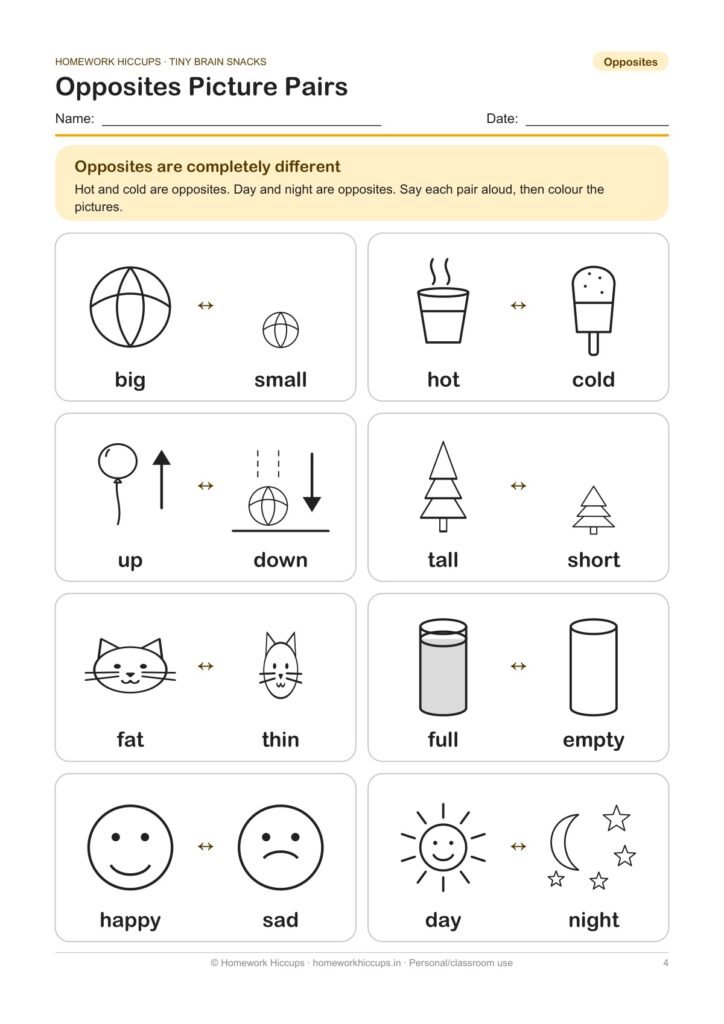
Our Opposites and Rhyming Words Worksheets PDF (37 A4 pages, ages 5 to 8) includes a homes of animals page in its vocabulary section, together with young ones of animals, sounds animals make and one and many. The rest of the pack covers opposites with picture pairs, matching, a crossword, rhyming word families, a rhyming word search, action words, describing words and word webs, with three pages of answer keys.
Get the Opposites and Rhyming Words Pack – ₹79
Want to see it first? The free opposites and rhyming words sample has 3 real pages plus the cover and contents page, free at checkout with your name and email. If your child loves scissors, our Dot-to-Dot and Cut-and-Paste Fun Pack (₹79) includes a cut-and-paste page to match animals to their homes.
Download the Opposites and Rhyming Words Worksheets – ₹79
Frequently asked questions
What are the homes of animals called?
Many animal homes have special names: a lion lives in a den, a horse in a stable, a dog in a kennel, a bird in a nest, a bee in a hive, a rabbit in a burrow and a hen in a coop.
What is the home of a squirrel called?
A squirrel’s nest in a tree is called a drey. It is made of twigs and leaves.
What is the difference between a home and a habitat?
A home is the particular place where an animal sleeps and stays safe, such as a nest or a den. A habitat is the wider area where it lives and finds food, such as a forest or a pond.
Which animals carry their homes with them?
Snails carry their shells with them and can pull themselves inside to stay safe. Tortoises also have shells that are part of their bodies.
Does the opposites and rhyming words pack include animal homes?
Yes. The 37-page Opposites and Rhyming Words Worksheets PDF has a homes of animals page in its vocabulary section, along with young ones and sounds of animals.