Homophones for Class 2 are the words that make spelling tests tricky: sun and son, see and sea, write and right. They sound exactly the same but have different spellings and different meanings. Once children understand that idea, they start noticing homophones everywhere, and their spelling improves quickly.
Print-ready worksheets for this topic
Class 2 English Worksheets PDF – Grammar, Phonics, Reading Comprehension & Writing (48 Pages) – A4 PDF, instant download. ₹149 ₹299
This page gives you a homophones list for kids with 50 pairs, each with a meaning hint and a sentence, a picture-drawing trick to remember them, and a 20-blank practice test with answers. It suits Class 2 and works well as revision for Class 3 too.
🧰 Make practice more fun at home
As an Amazon Associate, Homework Hiccups earns from qualifying purchases, at no extra cost to you.
Quick answer: Homophones are sound-alike words with different spellings and meanings.
- Common pairs for Class 2: sun/son, see/sea, write/right, ate/eight, flour/flower, meet/meat, hear/here, blue/blew, one/won, for/four.
- Teach 5 pairs a week, each with a picture and a sentence.
- Test in sentences, never as single words, because the meaning decides the spelling.
What are homophones? Homophones for Class 2 explained
Try saying this to a seven-year-old: Some words are twins when you hear them but not when you see them. They sound the same, but they are spelt differently and mean different things. We call them homophones. Homo means same and phone means sound.
Then show one pair with pictures: draw a sun in the sky and a boy holding his father’s hand. Say both words aloud. Ask: Did they sound different? No. Do they look different? Yes. That is a homophone.
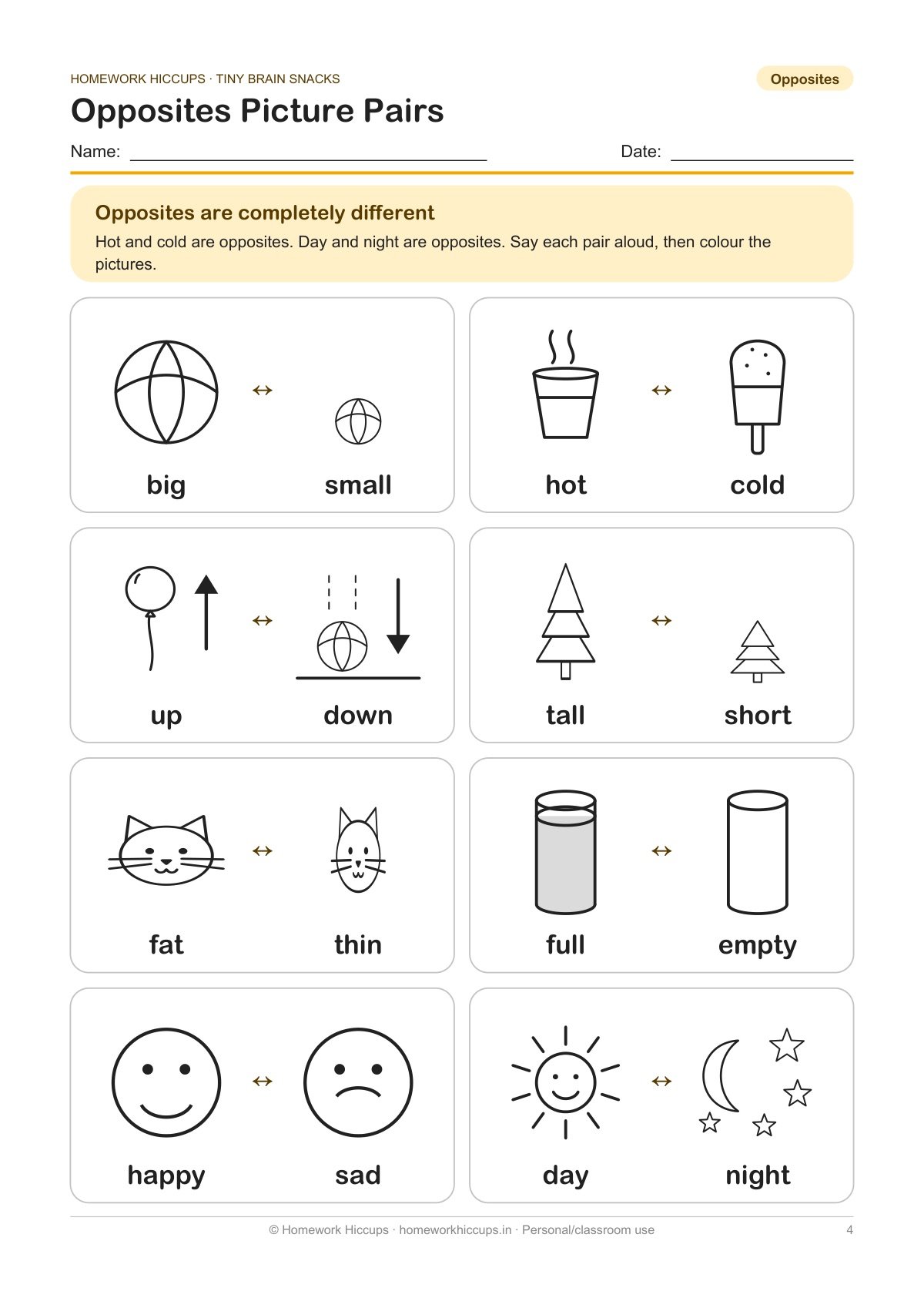
Homophones are different from opposites and from synonyms. Opposites have opposite meanings (hot and cold); see our opposite words for kids. Synonyms have similar meanings but different sounds (big and large); see synonyms for Class 2.
Homophones list for kids: 50 pairs with sentences
The 50 rows give each pair, a short meaning hint and one sentence that uses both words. Reading the sentence aloud is the fastest way to fix the difference in a child’s memory.
| Pair | Meaning hint | Sentence |
|---|---|---|
| sun / son | star in the sky / a boy child | Her son is playing in the sun. |
| see / sea | use your eyes / big salty water | I can see the sea from the train. |
| write / right | use a pencil / correct, or not left | Write with your right hand. |
| ate / eight | had food / the number 8 | Ravi ate eight grapes. |
| flour / flower | atta for rotis / grows on a plant | Mum put a flower next to the flour tin. |
| meet / meat | see someone / food from animals | Meet me at the shop that sells meat. |
| hear / here | use your ears / this place | Come here so you can hear the song. |
| blue / blew | a colour / did blow | The wind blew my blue cap away. |
| one / won | the number 1 / came first | Our team won one prize. |
| two / too / to | the number 2 / also / towards | I want to buy two ladoos too. |
| for / four | meant for someone / the number 4 | These four pens are for you. |
| no / know | not yes / have learnt | No, I do not know the answer. |
| new / knew | not old / did know | I knew you had a new bag. |
| night / knight | time to sleep / a soldier in armour | The knight rode at night. |
| hole / whole | a gap / all of it | The whole sock has a hole. |
| tail / tale | part of an animal / a story | Nani told a tale about a cat with a long tail. |
| mail / male | letters / a boy or man | The male postman brought the mail. |
| pair / pear | two together / a fruit | I bought a pair of socks and a pear. |
| bear / bare | a big animal / with nothing on | The bear walked on bare feet. |
| deer / dear | a forest animal / loved | My dear friend saw a deer. |
| road / rode | a street / did ride | We rode our cycles on the road. |
| week / weak | seven days / not strong | I felt weak for a week after the fever. |
| sail / sale | cloth on a boat / selling cheaply | The shop has a sale on toy boats with a sail. |
| plane / plain | flies in the sky / simple, or flat land | The plane flew over the plain. |
| read / red | did read (past) / a colour | Yesterday I read a red book. |
| by / buy | next to / pay for | Buy the fruit by the gate. |
| hour / our | 60 minutes / belongs to us | Our class lasts one hour. |
| not / knot | no / a tie in rope | This knot will not open. |
| peace / piece | calm / a part of something | Eat your piece of cake in peace. |
| steal / steel | take without asking / a metal | Do not steal the steel spoon. |
| be / bee | to exist / a buzzing insect | Be careful of the bee. |
| wood / would | from trees / a helping word | Would you like a box made of wood? |
| made / maid | did make / a helper at home | We made a card for the maid. |
| wait / weight | stay till later / how heavy | Wait while I check the weight. |
| way / weigh | a path / find how heavy | The way to weigh rice is on a scale. |
| there / their | that place / belongs to them | Their house is over there. |
| nose / knows | you smell with it / has learnt | She knows how to touch her nose. |
| roll / role | turn over / a part in a play | My role is to roll the ball. |
| sell / cell | give for money / a tiny room or a battery | They sell cells for torches. |
| board / bored | a flat piece / not interested | He was bored, so he drew on the board. |
| fair / fare | a mela, or honest / ticket money | We paid the bus fare to the fair. |
| hair / hare | grows on your head / a kind of rabbit | The hare has soft hair. |
| stair / stare | a step / look for a long time | Do not stare; watch the stair. |
| rose / rows | a flower / lines | The garden has rows of roses. |
| so / sew | very / stitch | Dadi can sew so fast. |
| flu / flew | an illness / did fly | The bird flew away; the boy had flu. |
| heel / heal | back of the foot / get better | The cut on my heel will heal. |
| pain / pane | hurt / glass in a window | The window pane broke, but nobody felt any pain. |
| break / brake | crack / makes a cycle stop | Do not break the brake. |
| I / eye | me / you see with it | I have something in my eye. |
The first 20 pairs are the most common in Class 2 books. The last 30 are good stretch words and suit homophones for Class 3 as well. A few pairs, such as hour/our, can sound slightly different in some accents; if your child hears a difference, that is fine.
The picture trick for remembering homophones
Children remember a homophone much better when they draw it. Fold an A4 sheet into four boxes. In each box, write one pair at the top and draw a tiny picture under each word:
- flower / flour: a daisy and a bag of atta.
- ate / eight: a child eating and the number 8 made of two circles.
- pear / pair: one fruit and two shoes side by side.
- knight / night: a soldier with a shield and a moon with stars.
Two extra spelling hooks help: hear has ear inside it, and here is part of there and where, which are all place words. Meat has eat inside it.
Homophones worksheet: 20-blank practice test
Read each sentence and choose the right word from the brackets. Copy them into a notebook, or read them aloud and let your child point to the correct spelling.
- I can (see / sea) a rainbow.
- Please (write / right) your name.
- The cat has a long (tail / tale).
- We (ate / eight) idli for breakfast.
- A bee sat on the (flour / flower).
- The (son / sun) is very hot today.
- Come (hear / here) and sit with me.
- The sky is (blue / blew) today.
- Our team (one / won) the match.
- I have (two / too) hands.
- This gift is (for / four) you.
- Do you (no / know) my name?
- I got a (new / knew) pencil box.
- There is a (hole / whole) in my pocket.
- Can I have a (peace / piece) of mango?
- The (bear / bare) lives in the forest.
- Let us (meet / meat) after school.
- We go to school five days a (week / weak).
- Please (by / buy) some milk.
- The (plane / plain) landed at the airport.
Answers
| Q | Answer | Q | Answer | Q | Answer | Q | Answer |
|---|---|---|---|---|---|---|---|
| 1 | see | 6 | sun | 11 | for | 16 | bear |
| 2 | write | 7 | here | 12 | know | 17 | meet |
| 3 | tail | 8 | blue | 13 | new | 18 | week |
| 4 | ate | 9 | won | 14 | hole | 19 | buy |
| 5 | flower | 10 | two | 15 | piece | 20 | plane |
Prefer ready-to-print pages?
Class 2 English Worksheets PDF – Grammar, Phonics, Reading Comprehension & Writing (48 Pages) – A4 PDF, instant download. ₹149 ₹299
A simple 4-week plan for teaching homophones
- Week 1: the first 5 pairs. Draw them with the picture trick.
- Week 2: the next 5 pairs. Play homophone snap: write each word on a card; children snap when two cards sound the same, then say both meanings.
- Week 3: 5 more pairs. Use them in two sentences each at dinner time.
- Week 4: the 20-blank test above, then revise any wrong ones.
For weekly spelling lists that sit alongside this, see our spelling words guide, and for the rest of the grammar year, our Class 2 English grammar worksheets guide.
Class 2 English worksheets with homophones
The Class 2 English Worksheets PDF is a 48-page A4 pack with a homophones page (sun/son, see/sea, write/right and more) alongside synonyms and contractions. It also covers long vowel phonics, nouns, plurals, pronouns, verbs, is/am/are, adjectives, prepositions, punctuation, 5 reading passages with 5 questions each, picture composition and paragraph writing, with 5 pages of answer keys and a 4-week tracker.
Get the Class 2 English Worksheets PDF – ₹149
You can try the free Class 2 English sample first: a few real pages, yours by entering your name and email at checkout, with no payment. Browse more English worksheets or Class 2 worksheets.
Download the 48-page Class 2 English Pack – ₹149
🧸 Learning toys kids love
As an Amazon Associate, Homework Hiccups earns from qualifying purchases, at no extra cost to you.
Frequently asked questions
What are homophones for Class 2?
Homophones are words that sound the same but have different spellings and meanings, such as sun and son, see and sea, write and right, and ate and eight.
What is the difference between homophones and synonyms?
Homophones sound the same but mean different things, like flour and flower. Synonyms sound different but mean nearly the same thing, like big and large.
How many homophones should a Class 2 child learn?
Around 15 to 20 common pairs is a good target for Class 2. Teach about 5 pairs a week and always practise them inside sentences.
How can I help my child remember homophones?
Ask your child to draw a tiny picture for each word in a pair and use both words in one sentence. Spelling hooks, such as hear having ear inside it, also help.
Are to, too and two homophones?
Yes. To, too and two all sound the same. Two is the number 2, too means also or very, and to shows direction, as in going to school.