Akshar jodo shabd banao (अक्षर जोड़ो, शब्द बनाओ: join the letters, make a word) is one of the most common exercises in Class 1 Hindi. Children get a few letters, sometimes in the wrong order, and have to put them together to make a real word. It sounds simple, but it pulls together everything a young Hindi reader is learning: letter sounds, matras, blending and word meaning.
Print-ready worksheets for this topic
Jumbled Words in Hindi Worksheets PDF – 120 Puzzles with Answers (Class 1–2) – A4 PDF, instant download. ₹49 ₹99
This page explains what an akshar is (and why it is never split), then gives 40 ready-to-use word-building puzzles in three levels, each with the answer, transliteration and meaning. At the end you will find a make-your-own tiles game that turns this into a five-minute daily habit.
🧰 Make practice more fun at home
As an Amazon Associate, Homework Hiccups earns from qualifying purchases, at no extra cost to you.
Quick answer: To solve akshar jodo shabd banao puzzles:
- Read each akshar (a letter with its matra) aloud.
- Try different orders until the sounds make a real word.
- Check the meaning: does the word make sense?
- Write the word with the शिरोरेखा (shirorekha, top line) joined across.
What is an akshar?
In Hindi, an akshar (अक्षर) is one sound unit you say in one go. It can be:
- a letter on its own, like क (ka) or म (ma)
- a letter with its matra, like का (kaa), कि (ki) or कु (ku)
- a vowel on its own, like आ (aa)
The important rule: a matra always stays with its letter. In किताब (kitaab, book), the akshar are कि + ता + ब. We never split कि into क and ि, because they are one sound. This is the same way children clap syllables in English: ki-taab.
Try it: clap each akshar as you say it. मछली = म-छ-ली = three claps. गुलाब = गु-ला-ब = three claps.
If your child is still learning to blend letters, start with our guide on how to join letters in Hindi.
Akshar jodo shabd banao: Level 1 (two akshar, no matra)
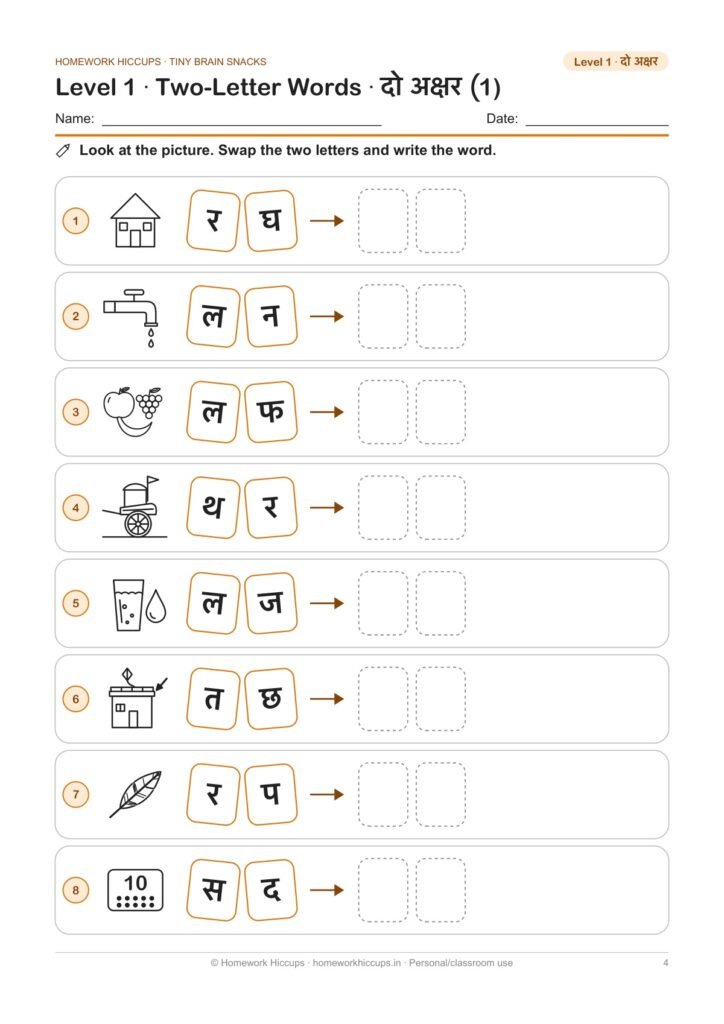
The tiles are mixed up. Your child puts them in the right order to make a word. Each puzzle has only one correct answer.
| No. | Tiles | Word | Sound | Meaning |
|---|---|---|---|---|
| 1 | ल + फ | फल | phal | fruit |
| 2 | र + घ | घर | ghar | house |
| 3 | ल + न | नल | nal | tap |
| 4 | थ + र | रथ | rath | chariot |
| 5 | त + छ | छत | chhat | roof |
| 6 | म + क | कम | kam | less |
| 7 | म + ह | हम | ham | we |
| 8 | प + क | कप | kap | cup |
| 9 | ल + ह | हल | hal | plough |
| 10 | च + स | सच | sach | truth |
Akshar jodkar shabd banao: Level 2 (three akshar, no matra)
| No. | Tiles | Word | Sound | Meaning |
|---|---|---|---|---|
| 11 | र + म + ट | मटर | matar | peas |
| 12 | क + न + म | नमक | namak | salt |
| 13 | ल + म + ह | महल | mahal | palace |
| 14 | र + श + ह | शहर | shahar | city |
| 15 | र + न + ह | नहर | nahar | canal |
| 16 | क + च + म | चमक | chamak | shine |
| 17 | ल + फ + स | फसल | phasal | crop |
| 18 | न + भ + ज | भजन | bhajan | devotional song |
| 19 | क + प + ल | पलक | palak | eyelid |
| 20 | र + न + ग | नगर | nagar | town |
A fun challenge: the tiles क, म, ल can make two real words: कमल (kamal, lotus) and कलम (kalam, pen). Ask your child to find both. That is why the puzzles above avoid these letters: each one has only one answer.
Hindi word building for kids: Level 3 (words with matras)
Now each tile can carry a matra. Remind your child to keep the matra with its letter.
| No. | Tiles | Word | Sound | Meaning |
|---|---|---|---|---|
| 21 | म + आ | आम | aam | mango |
| 22 | क + ना | नाक | naak | nose |
| 23 | जा + रा | राजा | raajaa | king |
| 24 | नी + पा | पानी | paani | water |
| 25 | ब + कि + ता | किताब | kitaab | book |
| 26 | ली + म + छ | मछली | machhli | fish |
| 27 | र + गा + ज | गाजर | gaajar | carrot |
| 28 | ली + ति + त | तितली | titli | butterfly |
| 29 | ब + गु + ला | गुलाब | gulaab | rose |
| 30 | लू + भा | भालू | bhaaloo | bear |
| 31 | ज + सू + र | सूरज | sooraj | sun |
| 32 | ला + के | केला | kelaa | banana |
| 33 | री + ब + क | बकरी | bakri | goat |
| 34 | ता + तो | तोता | totaa | parrot |
| 35 | र + मो | मोर | mor | peacock |
| 36 | र + ट + मा + ट | टमाटर | tamaatar | tomato |
| 37 | सा + पै | पैसा | paisaa | money |
| 38 | का + नौ | नौका | naukaa | boat |
| 39 | द + चाँ | चाँद | chaand | moon |
| 40 | ग + तं + प | पतंग | patang | kite |
Shabd banao worksheet: how to use these puzzles
- Do 5 a day. Ten puzzles at once can tire a six-year-old. Five takes about five minutes.
- Cover the answers. Fold the page or cover the last three columns with a strip of paper.
- Say before writing. Your child says the word aloud first, then writes it.
- Join the top line. In the written word, the शिरोरेखा runs across the whole word, not over each letter separately.
- Use it in a sentence. For Class 2, ask for a short sentence: मोर नाच रहा है। (mor naach raha hai: the peacock is dancing).
Common mistakes
- Splitting the matra. Writing क + ि separately. Keep each akshar as one tile.
- Putting ि after the letter. In कि, the ि line is written before क even though the sound comes after.
- Accepting a non-word. “लफ” is not a word. Ask, “What does it mean?” If there is no meaning, try another order.
- Forgetting the chandrabindu. In चाँद, the dot and moon shape (ँ) must stay on चा.
Prefer ready-to-print pages?
Jumbled Words in Hindi Worksheets PDF – 120 Puzzles with Answers (Class 1–2) – A4 PDF, instant download. ₹49 ₹99
Hindi word making activity: make your own tiles
This homemade game takes 10 minutes to make and can be used for weeks.
- Cut 30 small squares from card or an old box.
- Write one akshar on each square: क, म, ल, न, र, घ, फ, ज, स, ब, आ, ना, पा, नी, कि, ता, ला, गु, मो, के and so on.
- Pick out the tiles for one word, mix them up and hand them to your child.
- Your child arranges the tiles, reads the word aloud and writes it in a notebook.
- Swap roles: your child builds a word and you guess it.
Extra idea for two players: lay out 10 tiles face up. Take turns making any real word from the tiles. Each word scores one point per akshar used.
Join letters to make words in Hindi: what next?
When your child is confident with all 40 puzzles, try longer words with four akshar and short jumbled sentences. For more word lists by length, see our posts on two-letter words in Hindi and three-letter words in Hindi. For jumbled-word practice at different levels, see our guide to jumbled words in Hindi.
120 more puzzles, ready to print
Our Jumbled Words in Hindi Worksheets PDF (22 pages, Class 1–2) builds 120 puzzles exactly this way: every word is cut into its akshar, a matra is never cut off its letter, and each puzzle has only one real answer. It starts with a parent page on what an akshar is and a clap-and-split warm-up, then moves through 16 two-letter words, 16 three-letter words, 30 words with आ, इ and ई matras, 30 words with the other matras, अं and chandrabindu, and 16 jumbled sentences for Class 2. There are 2 cut-and-arrange tile pages, a make-your-own-jumble page and 2 pages of answer keys.
Get the Jumbled Words in Hindi Pack – ₹49
Every page has a picture clue or a meaning hint, so children are never left guessing. Browse more Hindi worksheets.
Download 120 Hindi Word Puzzles – ₹49
🧸 Learning toys kids love
As an Amazon Associate, Homework Hiccups earns from qualifying purchases, at no extra cost to you.
Frequently asked questions
What does akshar jodo shabd banao mean?
It means join the letters and make a word. Children are given letters or akshar, often mixed up, and must put them in order to make a real Hindi word.
What is an akshar in Hindi?
An akshar is one sound unit said in one go. It can be a letter alone like क, a letter with its matra like कि, or a vowel like आ.
Should a matra be split from its letter?
No. A matra always stays with its letter as one akshar. In किताब, the akshar are कि, ता and ब.
Which class does akshar jodo shabd banao?
It is commonly practised in Class 1, starting with two-letter words without matras. Class 2 children often move on to longer words and jumbled sentences.
How can I make Hindi word building fun?
Make akshar tiles from card, mix them up and let your child build words. Swap roles, add a timer or play a two-player game where each akshar used scores a point.