A big and small worksheet is often one of the very first maths pages a child does in Nursery or LKG. It looks simple, circle the big elephant, circle the small mouse, but it is the start of a whole chain of comparing skills: bigger and smaller, more and less, and later greater than and less than with numbers. Children who are confident comparing sizes find number comparison much easier in UKG.
Print-ready worksheets for this topic
Greater Than Less Than Worksheets for UKG PDF – Comparing Numbers 1 to 20 (24 Pages) – A4 PDF, instant download. ₹49 ₹99
In this guide you will find hands-on big and small activities with things you already have at home, a free practice page you can draw in two minutes, other size words like tall and short or heavy and light, a 3-step home lesson and a clear sign of when your child is ready to move on to numbers.
🧰 Make practice more fun at home
As an Amazon Associate, Homework Hiccups earns from qualifying purchases, at no extra cost to you.
Quick answer: To teach big and small to young children:
- Start real: compare two objects your child can hold, such as a big spoon and a small spoon.
- Then pictures: circle the big one and the small one in picture pairs.
- Add size words: tall and short, long and short, heavy and light.
- Then numbers: once size is easy, move to more and less, then comparing numbers in UKG.
Big and small for nursery: why it matters
Comparing is a thinking skill. When a three-year-old decides which ball is bigger, they are looking carefully, holding two things in mind and making a judgement. Those are the same steps they will use later to compare numbers, lengths, weights and amounts of money.
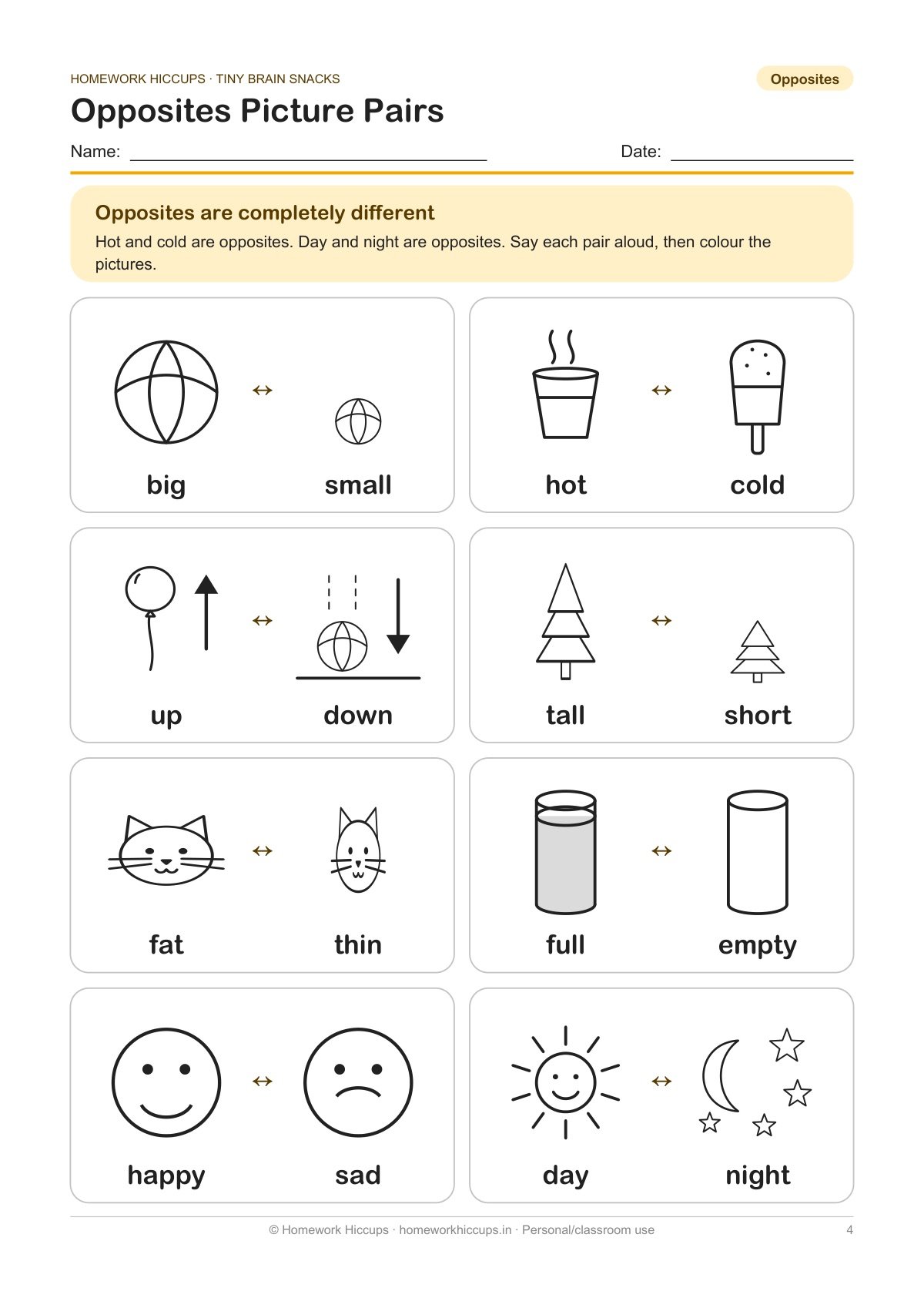
Many Nursery and LKG classes cover big and small early in the year, often alongside colours and shapes. It also links to English, because big and small are a pair of opposite words. Our guide to opposite words for kids has more pairs to try.
Big small activity for kids: 8 ideas with household things
- Spoon sort. Put a serving spoon and a teaspoon on the table. Ask, “Which is big? Which is small?” Then add more spoons and sort them into two groups.
- Shoe line-up. Line up Papa’s, Mumma’s and your child’s chappals. Talk about big, bigger and biggest, small, smaller and smallest.
- Katori stacking. Steel bowls of different sizes are perfect. Children stack them from biggest at the bottom to smallest at the top.
- Roti and puri. At mealtimes, compare a roti and a puri. Food comparisons stick in memory.
- Toy family. Find a big teddy and a small teddy. Give the big teddy the big plate and the small teddy the small plate.
- Fruit basket. A watermelon and a lemon, a mango and a grape. Hold one in each hand and feel the difference.
- Clap game. Say an animal. Your child stretches arms wide for big (elephant) and puts hands close together for small (ant).
- Shadow fun. In the evening, use a torch to make shadows grow big and small on the wall.
Big and small pictures: a free practice page
You can make this page in two minutes on any plain paper. Draw each pair in a row, one big and one small. Ask your child to circle the big one in rows 1–4 and circle the small one in rows 5–8.
| Row | Picture pair | Task | Answer |
|---|---|---|---|
| 1 | Elephant and mouse | Circle the big one | Elephant |
| 2 | Mango and grape | Circle the big one | Mango |
| 3 | Bus and bicycle | Circle the big one | Bus |
| 4 | Tree and flower | Circle the big one | Tree |
| 5 | Watermelon and lemon | Circle the small one | Lemon |
| 6 | Ship and paper boat | Circle the small one | Paper boat |
| 7 | Hen and chick | Circle the small one | Chick |
| 8 | Big ladle and teaspoon | Circle the small one | Teaspoon |
Make it harder for older children: draw the same object in two sizes, for example two stars, one big and one small. Now your child must compare size alone, not what the object is. This is the real skill.
Try this: big, bigger, biggest
Draw three circles of different sizes. Ask your child to colour the biggest one red, the smallest one yellow and the middle one blue. Then ask them to say the order aloud: “small, bigger, biggest” while pointing from the smallest circle to the biggest.
Tall, short, big, small worksheet words
Once big and small are clear, introduce other size words. Use real objects first, then pictures.
| Size words | Use for | Home example |
|---|---|---|
| Big / small | Overall size | Big pillow, small pillow |
| Tall / short | Height of standing things | Papa is tall, the baby is short |
| Long / short | Length of lying-down things | Long dupatta, short ribbon |
| Heavy / light | Weight | Heavy school bag, light feather |
| Thick / thin | Width | Thick book, thin notebook |
| Full / empty | Amount inside | Full glass, empty glass |
Tip: children often mix up tall and long. Stand a pencil up: it is tall. Lay it down: it is long. Seeing the same object both ways makes the difference clear.
Prefer ready-to-print pages?
Greater Than Less Than Worksheets for UKG PDF – Comparing Numbers 1 to 20 (24 Pages) – A4 PDF, instant download. ₹49 ₹99
Size comparison for kids: a 3-step home lesson
Use this simple plan across three days, about 5 to 10 minutes each time.
- Day 1: Feel it. Compare 4 or 5 pairs of real objects. Your child holds each pair and says, “This is big. This is small.”
- Day 2: See it. Do the free practice page above. Ask your child to explain one answer: “Why is the bus big?”
- Day 3: Use it. Go on a big-and-small hunt around the house. Your child finds one big thing and one small thing in each room.
If your child is three, keep each session to a few minutes and lots of play. Our ideas for worksheets for 3 year olds show how to keep early pages short and happy.
When to move from big and small to numbers
Your child is ready to move on when they can:
- Pick the big and the small one quickly, even when both pictures are the same object.
- Order three things from smallest to biggest.
- Use at least two other size words, like tall and short.
The next step is more and less: comparing groups of things, such as 5 mangoes and 2 mangoes. See our more or less worksheet for kids. After that comes comparing numbers with the greater than, less than and equal to signs, usually in UKG. For more early number work, see our nursery maths worksheets.
From big and small to greater than and less than
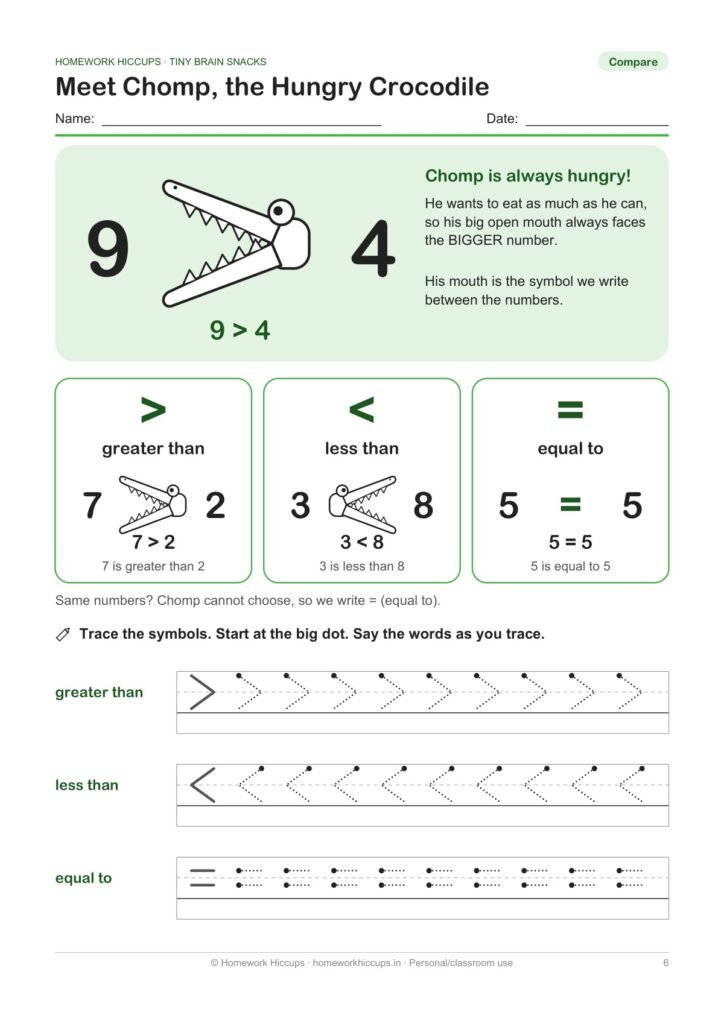
Our Greater Than Less Than Worksheets for UKG (24 pages, ages 5–6) follows exactly this path. It opens with a big and small page (circle the big one, then the small one, with 8 picture pairs), then moves to more and less with picture groups of mangoes, ladoos, kites and diyas. Next, Chomp the hungry crocodile explains the greater than, less than and equal to signs, before children compare numbers 1 to 10 and 11 to 20, solve short picture stories, cut and paste the symbols and put pictures and numbers in order from smallest to biggest. There is a grown-ups’ page with a 2-week plan, and 2 pages of answer keys.
Get the Greater Than Less Than UKG Pack – ₹49
For younger children aged 3–4, our Nursery Worksheets PDF (₹149) includes big and small and more or less thinking pages alongside pre-writing, colours, shapes, A–Z and numbers 1–10. Browse more maths worksheets.
Download 24 Comparing Worksheets – ₹49
🧸 Learning toys kids love
As an Amazon Associate, Homework Hiccups earns from qualifying purchases, at no extra cost to you.
Frequently asked questions
At what age do children learn big and small?
Many children start understanding big and small at around 2 to 3 years, and it is commonly practised in Nursery and LKG with real objects and simple pictures.
How do I teach big and small to a toddler?
Use real objects first, such as a big spoon and a small spoon. Say the words clearly, let your child hold both, then play sorting games before moving to pictures.
What comes after big and small in maths?
After big and small, children usually learn more and less with groups of objects, then compare numbers using greater than, less than and equal to.
What is the difference between tall and long?
Tall is used for things standing up, like a person or a tree. Long is used for things lying down, like a rope or a train. A pencil can be tall when standing and long when lying.
How many big and small worksheets should my child do?
One short page a day for a week or two is usually enough, along with hands-on comparing at home. Move on once your child finds it easy.