The little dot on top of a Hindi letter is one of the first things children notice, and one of the first they forget to write. This guide collects anusvar wale shabd (words with ं, the bindu) and explains them simply, so a child in UKG or Class 1 can hear the sound, see the dot and write it in the right place.
Print-ready worksheets for this topic
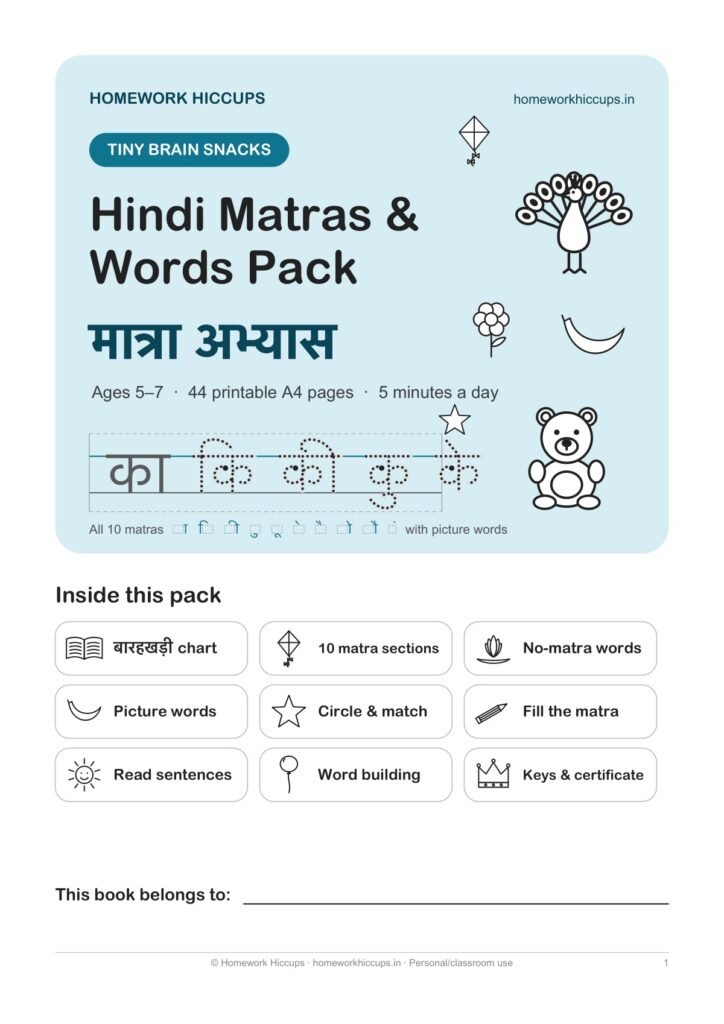
Hindi Matra Worksheets PDF – Barakhadi, Matra Words & Sentences (मात्रा अभ्यास), Ages 5–7 (44 Pages) – A4 PDF, instant download. ₹99 ₹199
You will also learn how anusvar differs from chandrabindu (ँ, the moon with a dot), with 60 anusvar words and 20 chandrabindu words, each with transliteration and meaning. After the lists come 10 sentences, a sorting activity with answers, a dictation list and the most common mistakes. Everything is ready to copy into a notebook or onto the board.
🧰 Make practice more fun at home
As an Amazon Associate, Homework Hiccups earns from qualifying purchases, at no extra cost to you.
Quick answer:
- Anusvar (ं): a dot on top of a letter. It adds a nasal sound like n, m or ng, usually before the next consonant: पतंग (patang), बंदर (bandar), ठंड (thand).
- Chandrabindu (ँ): a half-moon with a dot. The vowel is said through the nose, softly: चाँद (chaand), आँख (aankh), माँ (maan).
- Easy test: if you can hear a clear n, m or ng, it is usually anusvar. If the sound is a soft hum through the nose, it is usually chandrabindu.
- Best pair to remember: हंस (swan) and हँस (laugh).
What are anusvar wale shabd?
Anusvar is the dot (बिंदु) written on the top line of a letter. Children often call it bindu ki matra or ang ki matra, because it is the sign in अं, the second-last box of the barakhadi row (क, का, कि … कं, कः). When we read a word with anusvar, we add a nasal sound after that letter.
Listen to how the sound changes with the letter that follows:
| Word | Say it | What you hear |
|---|---|---|
| पतंग | patang | ng before ग |
| बंदर | bandar | n before द |
| ठंड | thand | n before ड |
| कंबल | kambal | m before ब |
| पंखा | pankha | ng before ख |
Children do not need the grammar rule. Just say the word slowly, stretch the nasal sound and point to the dot: “This dot makes the n sound in बंदर.”
60 anusvar words (bindu wale shabd)
Start with the first 20 for UKG; the rest suit Class 1 and Class 2.
- अंगूर (angoor) grapes
- पतंग (patang) kite
- बंदर (bandar) monkey
- ठंड (thand) cold weather
- पंखा (pankha) fan
- रंग (rang) colour
- संतरा (santra) orange
- कंघी (kanghi) comb
- अंडा (anda) egg
- मंदिर (mandir) temple
- पंख (pankh) feather, wing
- डंडा (danda) stick
- झंडा (jhanda) flag
- घंटी (ghanti) bell
- शंख (shankh) conch shell
- कंबल (kambal) blanket
- हंस (hans) swan
- जंगल (jangal) forest
- सुंदर (sundar) beautiful
- बंद (band) closed
- गंगा (ganga) the river Ganga
- अंक (ank) number, marks
- खंभा (khambha) pillar
- लंबा (lamba) long, tall
- चंपा (champa) champa flower
- पंजा (panja) paw
- मंच (manch) stage
- संगीत (sangeet) music
- अंधेरा (andhera) darkness
- मंगलवार (mangalvaar) Tuesday
- रंगोली (rangoli) rangoli
- कंगन (kangan) bangle
- संदूक (sandook) trunk, box
- तंबू (tambu) tent
- पंडित (pandit) priest, scholar
- ठंडा (thanda) cold
- गंदा (ganda) dirty
- संदेश (sandesh) message
- अंदर (andar) inside
- चिंता (chinta) worry
- सिंह (sinh) lion
- हिंदी (hindi) Hindi
- कुंजी (kunji) key
- बिंदु (bindu) dot
- अंगूठी (angoothi) ring
- कंधा (kandha) shoulder
- गंध (gandh) smell
- दंगल (dangal) wrestling match
- पंप (pamp) pump
- रंगीन (rangeen) colourful
- संसार (sansaar) world
- अंत (ant) end
- चंदन (chandan) sandalwood
- पलंग (palang) bed
- सुरंग (surang) tunnel
- तरंग (tarang) wave
- ढंग (dhang) way, manner
- बसंत (basant) spring season
- गुंबद (gumbad) dome
- मंजन (manjan) tooth powder
20 chandrabindu wale shabd
In these words the vowel itself is said through the nose. There is no separate n or m sound.
- चाँद (chaand) moon
- आँख (aankh) eye
- माँ (maan) mother
- दाँत (daant) tooth
- साँप (saanp) snake
- ऊँट (oont) camel
- गाँव (gaanv) village
- पाँच (paanch) five
- हँसना (hansna) to laugh
- पूँछ (poonchh) tail
- आँगन (aangan) courtyard
- काँच (kaanch) glass
- बाँसुरी (baansuri) flute
- मुँह (munh) mouth
- कुआँ (kuaan) well
- धुआँ (dhuaan) smoke
- चाँदी (chaandi) silver
- आँसू (aansoo) tear
- बूँद (boond) drop
- हाँ (haan) yes
Anusvar and chandrabindu difference
| Anusvar (ं) | Chandrabindu (ँ) | |
|---|---|---|
| Looks like | a dot | a half-moon with a dot |
| Sound | a clear n, m or ng | a soft nasal vowel |
| Examples | बंदर, पतंग, कंबल | चाँद, आँख, साँप |
| Pair | हंस (hans) swan | हँस (hans) laugh |
One rule that confuses parents: when a letter already has a matra above the top line (ि, ी, े, ै, ो, ौ), there is no room for the half-moon, so chandrabindu is written as just a dot. That is why मैं, में, हैं and नहीं have a dot, even though the sound is a soft nasal vowel. For young children, simply teach these as sight words and do not worry about the label.
You may also see older spellings with a half letter, such as बन्दर or हिन्दी. These are not wrong, but most schools now teach the dot form, बंदर and हिंदी, so follow your child’s textbook.
10 sentences with bindu ki matra
- बंदर पेड़ पर है। (The monkey is on the tree.)
- मेरी पतंग लाल है। (My kite is red.)
- अंगूर मीठे हैं। (The grapes are sweet.)
- पंखा चल रहा है। (The fan is running.)
- हंस पानी में तैर रहा है। (The swan is swimming in the water.)
- आज बहुत ठंड है। (It is very cold today.)
- मंदिर में घंटी बजी। (The bell rang in the temple.)
- चाँद आसमान में है। (The moon is in the sky.)
- माँ ने संतरा दिया। (Mother gave an orange.)
- ऊँट रेत पर चलता है। (The camel walks on sand.)
Ask your child to circle every ं in one colour and every ँ in another. Sentences 3 and 5 have a dot on हैं and में; talk about the rule above if your child asks.
Anusvar worksheet for Class 1: sort the words
Write these 12 words on a page and draw two baskets, one labelled ं and one labelled ँ. Your child reads each word and writes it in the right basket.
Words: पतंग, चाँद, जंगल, आँख, झंडा, साँप, कंघी, दाँत, रंग, गाँव, अंडा, पाँच
| Anusvar basket (ं) | Chandrabindu basket (ँ) |
|---|---|
| पतंग, जंगल, झंडा, कंघी, रंग, अंडा | चाँद, आँख, साँप, दाँत, गाँव, पाँच |
Fill in the dot
Write these without the dot and ask your child to add it: पतग, बदर, अगूर, घटी, झडा. Answers: पतंग, बंदर, अंगूर, घंटी, झंडा. Point out that the dot always goes on the letter before the nasal sound, not on the next letter.
Prefer ready-to-print pages?
Hindi Matra Worksheets PDF – Barakhadi, Matra Words & Sentences (मात्रा अभ्यास), Ages 5–7 (44 Pages) – A4 PDF, instant download. ₹99 ₹199
Dictation list
Say each word twice and use it in a short sentence. For more ideas on running calm, short dictation, see our guide to Hindi dictation for Class 1.
| Easy | Medium | Harder |
|---|---|---|
| रंग, बंद, अंक, पंख | बंदर, पतंग, पंखा, अंडा | मंगलवार, संगीत, अंगूठी, सुंदर |
| माँ, हाँ, चाँद, साँप | आँख, ऊँट, गाँव, दाँत | बाँसुरी, चाँदी, आँगन, हँसना |
Common mistakes with anusvar
- Forgetting the dot. पतंग becomes पतग. Ask your child to read back what they wrote, slowly, and listen for the ng.
- Dot on the wrong letter. Children write पतगं instead of पतंग. The dot sits on the letter before the nasal sound.
- Using a dot for every nasal sound. चाँद and दाँत need the half-moon. Practise the pair हंस and हँस.
- Mixing up ं with the visarga (ः). The visarga is two dots after the letter, not on top. It is rare in early reading.
- Dot too far from the top line. The dot should sit just above the शिरोरेखा, not floating high.
A 5-day plan
| Day | Activity |
|---|---|
| 1 | Read the barakhadi row to कं, then 10 easy anusvar words |
| 2 | Read 10 more words and 5 sentences; circle every dot |
| 3 | Meet chandrabindu: चाँद, माँ, आँख, साँप, ऊँट |
| 4 | Two-basket sort and the fill-in-the-dot task |
| 5 | 10-word dictation mixing both signs |
Once these are steady, give your child short passages from our Hindi reading worksheets for Class 1, where anusvar words appear naturally. If ो and ौ still need work, the o and au ki matra words list is the natural step just before this one.
Printable bindu ki matra worksheets
Our Hindi Matra Worksheets PDF (44 A4 pages, ages 5 to 7) covers all 10 matras from ा to ं, and anusvar is the tenth section. Like every section, it has three pages: meet the matra and trace rows of syllables, read and trace picture words with the matra shown in colour (such as पतंग), then circle the matra and match words to pictures or build the missing letter. The pack also has a बारहखड़ी chart, revision pages, read-aloud sentences and answer keys. Please note it does not have a separate chandrabindu section, so use the chandrabindu list above alongside it. Our Hindi matra worksheets guide explains how to use all 10 sections.
Get the Hindi Matra Worksheets PDF – ₹99
Try a free sample first: the free Hindi matra sample has 5 pages (cover, 3 real pages from the pack and a contents page). Enter your name and email at checkout; no payment is needed. See all Hindi worksheets.
🧸 Learning toys kids love
As an Amazon Associate, Homework Hiccups earns from qualifying purchases, at no extra cost to you.
Want everything for Nursery to Class 2?
Complete Worksheet Library – All 20 Packs for Ages 3–8 (790+ Pages): all 20 printable packs, 790+ A4 pages of English, maths, Hindi, EVS and festival activities. ₹699 ₹2130
Frequently asked questions
What is anusvar in Hindi?
Anusvar is the dot (ं) written on top of a letter. It adds a nasal sound such as n, m or ng, as in पतंग, बंदर and कंबल.
What is the difference between anusvar and chandrabindu?
Anusvar is a dot and gives a clear n, m or ng sound, as in हंस (swan). Chandrabindu is a half-moon with a dot and makes the vowel nasal, as in हँस (laugh) and चाँद.
What are 5 easy bindu wale shabd?
Five easy words are पतंग (kite), बंदर (monkey), अंगूर (grapes), पंखा (fan) and झंडा (flag).
Why does मैं have a dot and not a chandrabindu?
When a letter already has a matra above the top line, such as ै, there is no room for the half-moon, so chandrabindu is written as a dot. The sound is still a soft nasal vowel.
Is बन्दर or बंदर correct?
Both spellings are found, but most schools now teach the dot form बंदर. Follow the spelling used in your child’s textbook.