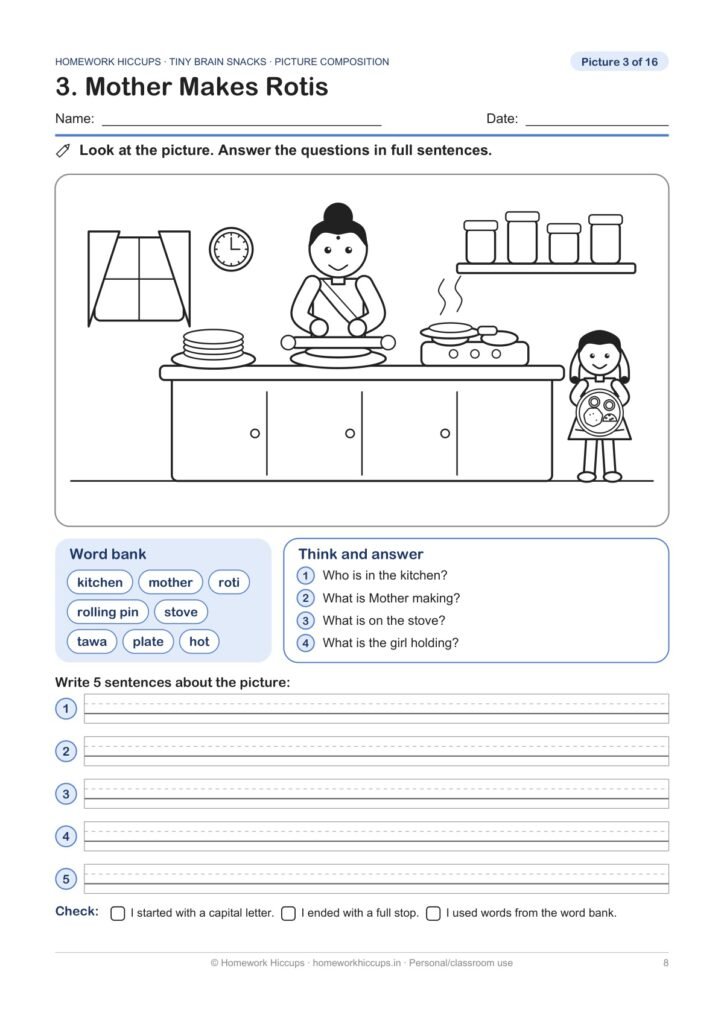
Picture composition is one of those Class 1 English questions that looks easy on paper but can leave children staring at the page. There is a colourful picture, a few lines to write on, and the instruction: “Look at the picture and write five sentences.” Where should a six-year-old even begin?
Print-ready worksheets for this topic
Picture Composition Worksheets PDF for Class 1–3 – 16 Scenes, Story Sequencing & Creative Writing (38 Pages) – A4 PDF, instant download. ₹79 ₹149
This guide explains what picture composition is, gives you a simple four-step method your child can use every time, and shares five solved examples with model answers on familiar Indian scenes: a park, a vegetable market, Diwali, a rainy day and a classroom. You will also find useful words, sentence starters and the common mistakes that cost marks in exams.
🧰 Make practice more fun at home
As an Amazon Associate, Homework Hiccups earns from qualifying purchases, at no extra cost to you.
Quick answer: Picture composition means looking at a picture and writing a few simple sentences about it. In Class 1, children usually write 4 to 6 short sentences.
- Step 1 – Look: what is the place? Who is there?
- Step 2 – Name: list the things you can see.
- Step 3 – Describe: add colours, sizes and actions.
- Step 4 – Sentence: write each idea as a full sentence with a capital letter and a full stop.
- Easy starters: This is a… / I can see… / There is… / There are… / The boy is…
What is picture composition?
In picture composition (sometimes called picture description or picture reading), a child looks at a picture and describes it in their own sentences. It checks several skills at once:
- Observation: noticing people, objects and actions.
- Vocabulary: naming things correctly.
- Grammar: using is/are, a/an, describing words and action words.
- Writing: capital letters, full stops and neat spacing.
In Class 1, nobody expects a story. A few clear, correct sentences are exactly what teachers are looking for. In Class 2 and 3, children add more detail and sometimes write a short paragraph.
A 4-step method: look, name, describe, sentence
Step 1: Look
Before writing anything, spend a minute just looking. Ask: Where is this? Is it a park, a kitchen, a school? Is it day or night? Who is in the picture? The answer often becomes the first sentence: “This is a park.”
Step 2: Name
Point and name everything you can see: tree, swing, slide, boy, girl, dog, ball, sun. Many worksheets give a word bank to help with spelling. If yours doesn’t, write the words lightly on rough paper first.
Step 3: Describe
Now add a describing word or an action to each thing: a tall tree, a red ball, the boy is running, two birds are flying. This is what turns a list into sentences.
Step 4: Sentence
Write each idea as a complete sentence. Check three things every time: a capital letter at the start, a full stop at the end and a finger space between words.
A handy tip: start with the place, then the people, then the things, and end with a feeling sentence (“The children are happy.”).
Useful words and sentence starters
| Type | Examples |
|---|---|
| Sentence starters | This is a… / I can see… / There is a… / There are… / The girl is… / It is a… |
| Describing words | big, small, tall, red, green, happy, sunny, beautiful, old, new |
| Action words | playing, running, sitting, eating, reading, flying, selling, buying, jumping |
| Number words | one, two, three, many, some |
| Ending lines | They are happy. / It is a nice day. / I like this picture. |
Remember: There is goes with one thing (“There is a dog”). There are goes with more than one (“There are two dogs”). This one rule fixes a lot of exam mistakes.
5 solved examples with model answers
Describe each scene to your child (or find a similar picture in a book), then read the model answer together. Encourage your child to change at least one sentence to make it their own.
Example 1: A park
Picture: children on swings and a slide, a big tree, a dog with a ball, the sun in the sky.
- This is a park.
- I can see a big green tree.
- Two children are playing on the swings.
- A girl is going down the slide.
- A dog is running after a red ball.
- It is a sunny day and the children are happy.
Example 2: A vegetable market
Picture: a vegetable seller with a cart, tomatoes, potatoes and onions, a mother and child with a cloth bag.
- This is a vegetable market.
- A man is selling vegetables from his cart.
- There are red tomatoes, potatoes and onions.
- A mother is buying vegetables.
- Her son is holding a cloth bag.
- The market is busy.
Example 3: Diwali
Picture: a family lighting diyas, a rangoli at the door, a lit lantern, a plate of sweets.
- This picture shows Diwali.
- The family is lighting diyas.
- There is a colourful rangoli at the door.
- A lantern is hanging near the window.
- There is a plate of sweets on the table.
- Everyone is happy.
For more festive ideas, see our Diwali activities for kids.
Example 4: A rainy day
Picture: dark clouds, rain, a boy with a yellow umbrella, puddles, a paper boat.
- It is a rainy day.
- There are dark clouds in the sky.
- A boy is holding a yellow umbrella.
- He is wearing a raincoat and boots.
- A paper boat is floating in the water.
- The boy is enjoying the rain.
Example 5: A classroom
Picture: a teacher at the blackboard, children at desks, books, a globe, a clock on the wall.
- This is a classroom.
- The teacher is writing on the blackboard.
- The children are sitting at their desks.
- There is a globe on the table.
- I can see a clock on the wall.
- The children are listening carefully.
Notice how each answer follows the same pattern: place first, then people and actions, then objects, and a feeling or weather line to finish. Once your child knows the pattern, almost any picture becomes manageable.
Prefer ready-to-print pages?
Picture Composition Worksheets PDF for Class 1–3 – 16 Scenes, Story Sequencing & Creative Writing (38 Pages) – A4 PDF, instant download. ₹79 ₹149
Common mistakes in exams
- Writing a list instead of sentences. “Tree. Dog. Ball.” earns few marks. Each line needs a full sentence.
- Mixing up is and are. “The children is playing” should be “The children are playing”.
- Wrong a/an. “a umbrella” should be “an umbrella”. Our guide to a and an for Class 1 explains the simple sound rule.
- Missing capital letters and full stops. These are easy marks to lose. Make checking them the final step every time.
- Writing about things not in the picture. In Class 1, stick to what you can see.
- Repeating the same starter. Six sentences that all begin with “I can see” feel flat. Mix in “There is”, “This is” and “The boy is”.
How to practise at home
- Talk first, write later. Look at a picture in a storybook and ask your child to tell you five things. Writing is easier once the ideas are already spoken.
- Use real life. At the park or market, play “say a sentence”: “There are three cows on the road.”
- Build vocabulary. Describing words and opposites make sentences richer. Our list of opposite words for kids and the rhyming words list are good warm-ups.
- Keep it short. One picture, four to six sentences, two or three times a week is plenty.
Picture composition practice sheets PDF
Children improve fastest with fresh pictures to describe and a little support at the start. Our Picture Composition Worksheets PDF (₹79, Class 1 to 3) includes guided model pages, around 16 picture scenes, each with a word bank, four guiding questions and writing lines, plus picture-sequence stories, finish-the-story prompts and model answers. Print on A4 and use one scene at a time.
Get the Picture Composition Worksheets – ₹79
If you want picture composition as part of a full Class 1 English plan, the Class 1 English Worksheets PDF covers it along with phonics, sight words, nouns, a/an, describing and action words, is/are, in/on/under, jumbled sentences, four short stories and handwriting, all with answer keys.
See the Class 1 English Worksheets – ₹149
Moving up a class? The Class 2 English Worksheets PDF also includes picture composition alongside grammar and comprehension. Browse more in our Class 1 worksheets and English worksheets collections.
🧸 Learning toys kids love
As an Amazon Associate, Homework Hiccups earns from qualifying purchases, at no extra cost to you.
Frequently asked questions
What is picture composition for Class 1?
Picture composition is a writing task where a child looks at a picture and writes a few simple sentences about it. In Class 1, children usually write 4 to 6 short sentences describing the place, people, things and actions they can see.
How many sentences should a Class 1 child write in picture composition?
Most Class 1 exams ask for 4 to 6 sentences. Check your school’s question paper pattern, but short, correct sentences matter more than writing a lot.
How do I start a picture composition?
Start by naming the place, for example This is a park or It is a rainy day. Then describe the people and their actions, then the objects, and finish with a feeling or weather sentence.
What are good sentence starters for picture composition?
Useful starters are This is a, I can see, There is a, There are, The boy is and It is a. Mixing different starters makes the answer more interesting.
How can I help my child get better at picture composition?
Talk about pictures before writing, build vocabulary with describing and action words, and practise one picture two or three times a week. Always end by checking capital letters, full stops and is or are.