Cat, hat, bat, mat. Children seem to rhyme without even trying, and that is wonderful news, because hearing rhymes is one of the building blocks of reading. When a child notices that cat and hat sound alike at the end, they are learning to listen to the sounds inside words, a skill teachers call phonological awareness.
Print-ready worksheets for this topic
Opposites and Rhyming Words Worksheets PDF – Word Families & Vocabulary for Ages 5–8 (37 Pages) – A4 PDF, instant download. ₹79 ₹149
Rhyming words usually appear in UKG English as picture pairs, and in Class 1 as lists, “write a rhyming word” questions and short poems. This guide gives you clear rhyme families for Class 1, picture pairs for UKG, a list of Hindi तुकांत शब्द, simple games and ideas for worksheet practice.
🧰 Make practice more fun at home
As an Amazon Associate, Homework Hiccups earns from qualifying purchases, at no extra cost to you.
Quick answer: Rhyming words are words that end with the same sound, like cat – hat, sun – fun and bee – tree.
- Easy rhyming words for Class 1: cat – bat – hat, pen – hen – ten, pig – wig – dig, top – mop – hop, bug – mug – jug, cake – lake – snake.
- Key idea: rhyming is about the sound, not always the spelling. Bee, tree, key and sea all rhyme.
- Best way to teach: listen and say first, then read word families, then write.
What are rhyming words?
Two words rhyme when the ending sound is the same, starting from the vowel. In cat and hat, the ending -at is the same; only the first sound changes. That shared ending is called a word family or rime.
A simple explanation for children: “Rhyming words sound the same at the end, like a song. Listen: cat, hat, bat. They all end with -at.”
Two quick checks you can teach:
- Same ending sound? Sun and run – yes. Sun and sit – no, they only start the same.
- Sound, not spelling: blue and shoe rhyme even though they are spelt differently. Cow and low look similar but do not rhyme.
25 rhyming word families for Class 1
Word families are the easiest way to practise rhymes, because children can change the first letter and read a whole set of words. Many of the short-vowel families also double as CVC words, so they support early reading too.
| Word family | Rhyming words |
|---|---|
| -at | cat, bat, hat, mat, rat, sat, fat |
| -an | can, fan, man, pan, ran, van |
| -ap | cap, map, tap, lap, nap, clap |
| -en | hen, pen, ten, men, den |
| -et | net, pet, wet, jet, vet, get |
| -ed | bed, red, fed, shed, sled |
| -ig | big, dig, pig, wig, fig |
| -in | pin, tin, bin, win, fin, chin |
| -ill | hill, mill, fill, pill, will |
| -op | hop, mop, top, pop, stop, shop |
| -ot | hot, pot, dot, cot, not |
| -ock | clock, sock, lock, rock, block |
| -ug | bug, hug, jug, mug, rug |
| -un | sun, fun, run, bun |
| -ake | cake, lake, make, bake, rake, snake |
| -ing | ring, king, sing, wing, swing |
| -ell | bell, well, tell, shell, smell |
| -all | ball, tall, wall, call, fall, small |
| -ay | day, play, say, way, tray |
| -ee | bee, see, tree, three, free |
| -oat | boat, coat, goat, float |
| -ain | rain, train, chain, brain |
| -ar | car, star, jar, far |
| -ook | book, cook, look, hook |
| -ish | fish, dish, wish |
That is well over 100 words. Start with the short-vowel families at the top of the table (-at, -en, -ig, -op, -ug), then move on to longer families like -ake, -ing and -ain.
Rhymes that are spelt differently
Once your child is confident with families, show a few rhymes that don’t share spellings. This teaches them to trust their ears:
- bee – tree – key – sea
- blue – shoe – two – zoo
- night – kite – white
- bear – chair – pear
- go – snow – toe
Rhyming words for UKG (picture pairs)
In UKG, most children can’t yet read all these words, so rhyming practice is done with pictures and listening. Say both words clearly, stretch the ending a little, and ask, “Do they rhyme?”
| Picture pair | Shared ending |
|---|---|
| cat – hat | -at |
| fan – van | -an |
| hen – pen | -en |
| pig – wig | -ig |
| sun – bun | -un |
| mug – jug | -ug |
| cake – snake | -ake |
| king – ring | -ing |
| bell – shell | -ell |
| sock – clock | -ock |
| goat – boat | -oat |
| car – star | -ar |
For UKG, the goal is simply to hear a rhyme. Writing rhyming words can wait until Class 1.
Rhyming words in Hindi (तुकांत शब्द)
If your child learns Hindi as well, rhyming in both languages is great fun, and many Hindi बाल कविताएँ are full of rhymes. Here are some easy तुकांत शब्द sets:
| Ending | Hindi rhyming words |
|---|---|
| -अल | कल, जल, फल, नल, पल |
| -ओर | मोर, चोर, शोर, ओर |
| -आम | आम, काम, नाम, दाम, शाम |
| -आनी | रानी, पानी, नानी, कहानी |
| -आना | गाना, खाना, जाना, दाना |
| -आल | दाल, लाल, बाल, गाल, साल |
| -अर | घर, पर, डर, हर |
| -एला | मेला, केला, ठेला |
| -आय | चाय, गाय |
| -आथी | हाथी, साथी |
Try making a silly two-line Hindi rhyme together, such as “लाल रंग की दाल, खाकर फूले गाल”. Children remember what makes them giggle.
Prefer ready-to-print pages?
Opposites and Rhyming Words Worksheets PDF – Word Families & Vocabulary for Ages 5–8 (37 Pages) – A4 PDF, instant download. ₹79 ₹149
Rhyme games and poems
- Rhyme or not? Say two words. Your child gives a thumbs up if they rhyme and a thumbs down if they don’t. Mix in tricky ones like sun – sit.
- Odd one out. Say three words: cat, hat, dog. Which one doesn’t rhyme?
- Rhyme chain. You say pen, your child says hen, you say ten… keep going until someone gets stuck. Nonsense words are allowed for younger children; it still trains the ear.
- I spy a rhyme. “I spy something that rhymes with log.” (A frog toy? The dog?)
- Finish the line. Say a familiar nursery rhyme and pause before the rhyming word: “Twinkle, twinkle, little star, how I wonder what you…”
- Word family slider. Write -at on a strip of paper and change the first letter on a sliding card: c, b, h, m, r. Read each new word.
Nursery rhymes you already know, such as Humpty Dumpty, Jack and Jill and Hickory Dickory Dock, are full of rhyming pairs. Read them aloud and ask your child to spot the words that sound alike.
Rhyming words worksheets PDF
When oral rhyming is going well, short worksheets help children read and write rhymes, which is what Class 1 tests usually ask for. Useful worksheet types include:
- Match the rhyming pictures.
- Odd one out: circle the word that doesn’t rhyme.
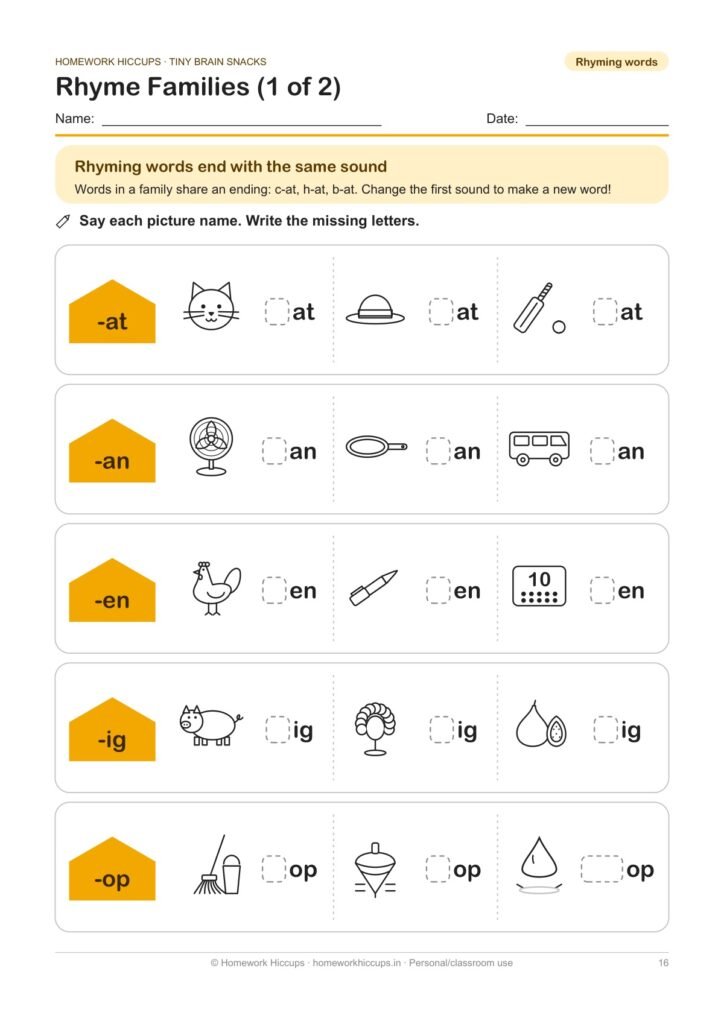
- Complete the rhyme: fill in the missing first letter, such as _at, _at, _at.
- Write a rhyming word: the classic Class 1 exercise.
- Word search: find words from the same family.
Our Opposites & Rhyming Words Worksheets PDF (₹79, UKG to Class 2) covers ten rhyme families (-at, -an, -en, -ig, -op, -ug, -ake, -ing, -ell, -ock), odd one out, complete the rhyme, a word search and vocabulary pages, plus opposite-word practice and answer keys. It prints on A4.
Get the Opposites & Rhyming Words Pack – ₹79
For a full year of Class 1 English, the Class 1 English Worksheets PDF includes rhyming words alongside phonics, blends, digraphs, magic e, sight words, opposites, a/an, picture composition and four short stories, all with answer keys. If your child is still in UKG, the UKG Worksheets Starter Pack is the gentler option.
See the Class 1 English Worksheets – ₹149
Rhyming fits naturally with other word work. Try our list of opposite words for kids, or the simple guide to using a and an in Class 1. You can also browse our English worksheets or the full Class 1 worksheets range.
Common rhyming mix-ups (and how to help)
- Choosing words that start the same. Many children say cat – cap rhyme. Stretch the endings slowly (“c-at, c-ap“) so they hear the difference.
- Relying on spelling. Show pairs like bee – key to prove that ears matter more than letters.
- Getting stuck. Offer a starting sound as a hint: “What rhymes with pig? Try starting with w…”
Keep practice short and playful. A few rhymes in the car or at bathtime often does more than a long sit-down session.
🧸 Learning toys kids love
As an Amazon Associate, Homework Hiccups earns from qualifying purchases, at no extra cost to you.
Frequently asked questions
What are rhyming words for Class 1?
Rhyming words are words that end with the same sound. Easy examples for Class 1 are cat – bat – hat, pen – hen – ten, pig – wig – dig, top – mop – hop and cake – lake – snake.
How do I teach rhyming words to my child?
Start by listening: read nursery rhymes aloud and play rhyme-or-not games. Then show word families like -at or -ig, where only the first letter changes. Ask your child to write rhyming words only once they can hear rhymes easily.
Do rhyming words need the same spelling?
No. Rhyming is about the ending sound, not the spelling. Bee, tree, key and sea all rhyme even though they are spelt differently, while cow and low look alike but do not rhyme.
What are rhyming words called in Hindi?
In Hindi, rhyming words are called तुकांत शब्द. Examples include कल – जल – फल, मोर – चोर – शोर and रानी – पानी – नानी.
Should UKG children write rhyming words?
Most UKG children practise rhyming by listening and matching pictures. Writing rhyming words is usually introduced in Class 1, once children can read simple three-letter words.