Rangoli looks like art, but it is secretly maths. Every rangoli uses symmetry, repeating patterns, shapes and counting. That makes a rangoli worksheet for kids one of the most useful things you can do in the Diwali holidays: children feel they are decorating, while they practise skills that turn up again in Class 1 and Class 2 maths.
Print-ready worksheets for this topic
Diwali Worksheets for Kids PDF – Colouring, Maths, Puzzles & Crafts, Ages 3–8 (30 Pages) – A4 PDF, instant download. ₹99 ₹199
This guide explains symmetry with a mirror, shows three easy dot-grid rangolis step by step in words, gives pattern ideas with petals and coloured rice, and includes a “finish the other half” exercise you can copy straight onto paper.
🧰 Make practice more fun at home
As an Amazon Associate, Homework Hiccups earns from qualifying purchases, at no extra cost to you.
Quick answer: A good rangoli worksheet for kids includes:
- Symmetry: half a design to complete, checked with a small mirror.
- Dot grids: 3 × 3, 4 × 4 or 1-3-5-3-1 dots to join into shapes.
- Patterns: repeating colours or petals (red, yellow, red, yellow).
- Colour-by-number: for number recognition and following a key.
What is symmetry? Explain it with a mirror
Draw half a heart on paper, right up to a straight dotted line. Stand a small mirror on the line. Your child will see a full heart: one half in the paper, the other in the mirror. That is symmetry: both sides match exactly, like a reflection.
Now try it with a rangoli. Draw half a flower and place the mirror along the middle. Ask: “Does it look whole? If we drew the other side, what would it look like?” The line where the mirror stands is called the line of symmetry.
| Shape in a rangoli | Lines of symmetry | Good for |
|---|---|---|
| Heart | 1 | UKG first mirror task |
| Square | 4 | Class 1 |
| Flower with 4 equal petals | 4 | Class 1 |
| Flower with 8 equal petals | 8 | Class 2 |
| Circle | Endless | A fun talking point |
Children in UKG only need the idea that both sides match. In Class 1 and 2, they can start finding and counting lines of symmetry.
Easy rangoli for kids: 3 dot-grid designs, step by step
Dot rangoli, also called kolam in many South Indian homes, starts with a grid of dots. Children join them with lines and curves. Use chalk on the floor, or a pencil on paper first.
Design 1: the 3 × 3 flower (UKG)
- Make 3 rows of 3 dots, evenly spaced. That is 9 dots.
- Join the 4 middle-edge dots (top middle, right middle, bottom middle, left middle) to make a diamond.
- Draw a small circle around the centre dot.
- Around each corner dot, draw a curved petal that points outwards.
- Colour the diamond one colour and the 4 petals another.
Ask: how many dots? (9) How many petals? (4)
Design 2: the 4 × 4 square star (Class 1)
- Make 4 rows of 4 dots. That is 16 dots.
- Join the 4 corner dots to make a big square.
- Draw two straight lines from corner to corner to make an X.
- Join the 4 inner dots (the small 2 × 2 square in the middle) to make a small square at the centre.
- Draw a small loop outside each corner, like a leaf.
- Colour opposite triangles the same colour.
Ask: how many lines of symmetry does the big square have? (4)
Design 3: the 1-3-5-3-1 diamond (Class 1 and 2)
- Make rows of 1, 3, 5, 3 and 1 dots, each row centred. That is 13 dots in a diamond.
- Join the 4 outer tips (top, bottom, left and right) to make a large diamond.
- From the centre dot, draw a petal towards each tip. You now have 4 petals.
- Draw a smaller petal between each pair of big petals, so there are 8 petals in all.
- Draw a circle around the centre dot.
- Colour the big petals one colour and the small petals another.
Check the count with your child: 1 + 3 + 5 + 3 + 1 = 13 dots.
Rangoli design for kids drawing: pattern ideas
Patterns are a big part of early maths. Rangoli lets children make patterns with real materials.
- Flower petals: marigold, rose and leaves in a ring: orange, red, green, orange, red, green.
- Coloured rice: mix rice with a little food colour and let it dry. Fill alternate shapes with two colours.
- Diya ring: place small diyas or round stickers around a circle with equal gaps.
- Grow pattern: 1 dot, 2 dots, 3 dots in each ring outwards.
- Shape pattern: circle, triangle, circle, triangle around the edge.
Ask children to say the pattern aloud and predict what comes next. For more on this skill, see our patterns worksheet for Class 1 and shapes worksheets for Class 1.
Rangoli symmetry worksheet: finish the other half
Copy this grid onto squared paper. The dotted line is down the middle. Children fill the right side so it mirrors the left side. ● is a coloured square and ○ is an empty square.
| Row | Left half | Mirror line | Right half (child fills) |
|---|---|---|---|
| 1 | ● ○ ○ | | | _ _ _ |
| 2 | ○ ● ○ | | | _ _ _ |
| 3 | ○ ○ ● | | | _ _ _ |
| 4 | ● ● ○ | | | _ _ _ |
| 5 | ● ○ ● | | | _ _ _ |
Answers (right half): Row 1: ○ ○ ● · Row 2: ○ ● ○ · Row 3: ● ○ ○ · Row 4: ○ ● ● · Row 5: ● ○ ●
The trick: the square closest to the mirror line on the left matches the square closest to the line on the right. Children often copy the pattern instead of flipping it. If they do, hold a mirror on the line and let them see the difference.
Prefer ready-to-print pages?
Diwali Worksheets for Kids PDF – Colouring, Maths, Puzzles & Crafts, Ages 3–8 (30 Pages) – A4 PDF, instant download. ₹99 ₹199
Rangoli activity for Class 1: a 30-minute lesson
| Time | What happens |
|---|---|
| 0–5 min | Show a rangoli photo or drawing. Ask: what shapes can you see? |
| 5–10 min | Mirror demo with half a heart and half a flower |
| 10–20 min | Children draw Design 1 or 2 on a dot grid |
| 20–27 min | Finish-the-other-half grid in pairs |
| 27–30 min | Share: each pair shows one line of symmetry |
Teachers can make dot grids quickly by drawing one on the board and asking children to copy it, or by printing ready grids.
Tips for an easy, mess-free rangoli at home
- Practise on paper before chalk or colour on the floor.
- Use a bottle cap or bangle to trace neat circles.
- Give little ones only 2 colours; more colours can come later.
- Photograph the finished rangoli so the child can keep it after it is swept away.
- Keep diyas and flames away from rangoli powder and small hands.
Printable rangoli worksheets in our Diwali pack
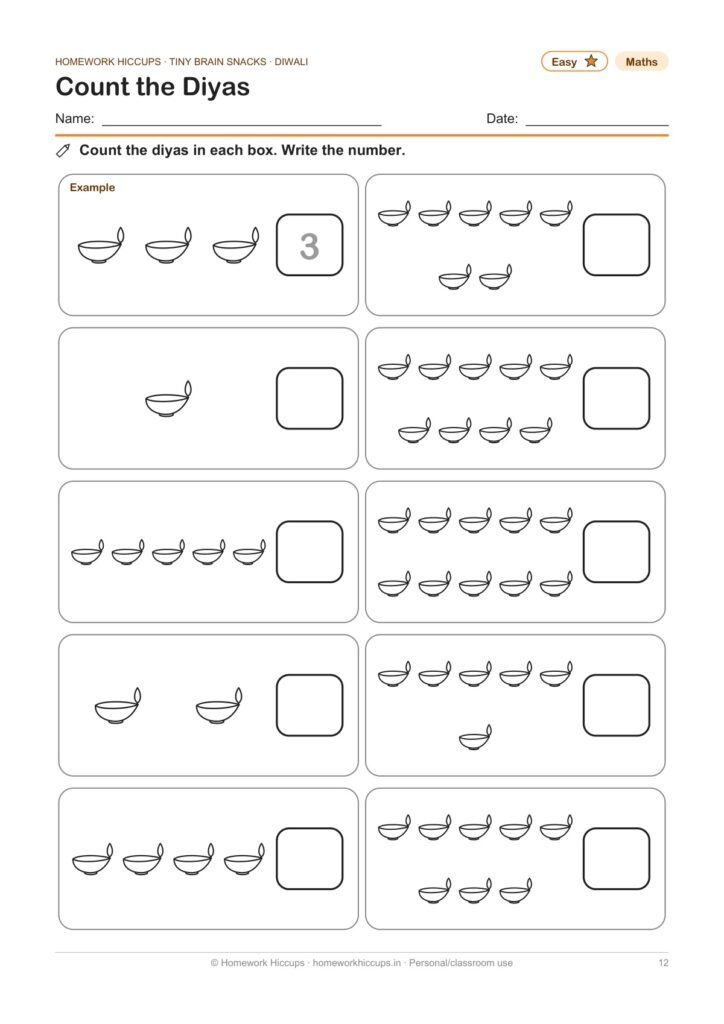
The Diwali Worksheets for Kids pack (30 A4 pages, ages 3–8) includes a colour-by-number rangoli and a rangoli symmetry page where children finish the other half on a dot grid, plus a Diwali patterns page, a rangoli colouring page and 5 more colouring pages. You also get counting diyas, sums to 10, sharing-sweets subtraction stories, a dot-to-dot diya, a maze, spot the difference, a word search, tracing, a greeting card, a paper lantern craft, a kindness checklist and answer keys.
Get the Diwali Rangoli and Activity Pack – ₹99
Prefer to look first? Get the free Diwali sample with 3 real pages from the pack. For more festival ideas, read our Diwali activities for kids and Diwali colouring pages for kids.
Download the Diwali Worksheets PDF – ₹99
🧸 Learning toys kids love
As an Amazon Associate, Homework Hiccups earns from qualifying purchases, at no extra cost to you.
Frequently asked questions
How do I explain symmetry to a 5-year-old?
Draw half a heart up to a straight line and stand a small mirror on the line. The child sees a whole heart. Explain that both sides match, like a reflection.
What is an easy rangoli for kids to draw?
A 3 by 3 dot flower is easiest. Make 9 dots, join the middle-edge dots into a diamond, circle the centre dot and add a petal at each corner.
What is a dot rangoli?
A dot rangoli starts with a grid of evenly spaced dots. Children join the dots with straight lines and curves to make a design, which is a lovely way to practise shapes and counting.
How many lines of symmetry does a square rangoli have?
A square has 4 lines of symmetry: one up and down, one side to side and two along the diagonals.
Is rangoli good for maths learning?
Yes. Rangoli practises symmetry, shapes, repeating patterns and counting, and children enjoy it because it feels like art rather than a worksheet.