Your child knows the Hindi letters, can say क, ख, ग in a sing-song voice, and maybe even trace a few words. Then you point to a short sentence and they freeze. That gap between knowing letters and actually reading is completely normal, and it is exactly what good hindi reading worksheets for class 1 are meant to bridge: tiny steps, real words, and lots of success along the way.
Print-ready worksheets for this topic
Hindi Two & Three Letter Words Worksheets PDF – बिना मात्रा के शब्द, Blending & Sentences, Ages 5–7 (38 Pages) – A4 PDF, instant download. ₹99 ₹199
This guide gives you a graded reading ladder you can use at home today: no-matra phrases, no-matra sentences, sentences with matras, four short unseen passages with questions and answers, a “vakya banao” sentence-making activity, a 5-minute daily routine and a simple fluency checklist. Everything is printed below with transliteration and English meaning, so even parents who are less confident in Hindi can help.
🧰 Make practice more fun at home
As an Amazon Associate, Homework Hiccups earns from qualifying purchases, at no extra cost to you.
Quick answer: The easiest way to build Hindi reading in Class 1 is to climb a ladder:
- Step 1: two- and three-letter words with no matra (घर, कमल).
- Step 2: little no-matra phrases (घर चल, जल भर).
- Step 3: short no-matra sentences (अमन, घर चल।).
- Step 4: sentences with matras (मोर नाच रहा है।).
- Step 5: tiny passages (apathit gadyansh) with 3 easy questions.
- Daily: 5 minutes of reading aloud, every day, beats one long session a week.
Why Hindi reading needs a ladder
Hindi is a very regular script. Once a child knows that क + म + ल makes कमल, they can read thousands of words. But matras add a second layer: the same letter can carry ा, ि, ी, ु and more. If children meet matras before they can blend plain letters smoothly, they guess instead of reading.
That is why many schools and teachers start with बिना मात्रा के शब्द (words without matras). If your child is not yet blending letters, begin with our lists of two-letter words in Hindi and three-letter words in Hindi, then come back to the steps below.
| Level | Usually suits | Example | Ready to move on when |
|---|---|---|---|
| Words, no matra | UKG | घर, जल, कमल | Reads 20 words without sounding out every letter |
| Phrases, no matra | UKG to early Class 1 | घर चल | Reads 2 words together smoothly |
| Sentences, no matra | Class 1 | कमल, जल भर। | Pauses at the comma and stops at । |
| Sentences with matras | Class 1 | मोर नाच रहा है। | Knows most of the 10 matras |
| Short passages | Class 1 to Class 2 | 5 sentences + 3 questions | Answers questions without looking back every time |
Level 1: 10 no-matra phrases
For UKG Hindi reading worksheets and the first weeks of Class 1, phrases are perfect: just two or three words, each made only of letters. Read each phrase slowly, then fast, then ask your child to act it out.
| Phrase | Say it | Meaning |
|---|---|---|
| घर चल | ghar chal | go home |
| जल भर | jal bhar | fill the water |
| कलम रख | kalam rakh | put the pen down |
| फल चख | phal chakh | taste the fruit |
| नमक रख | namak rakh | put the salt |
| अब चल | ab chal | let us go now |
| कप भर | kap bhar | fill the cup |
| मटर रख | matar rakh | put the peas |
| छत पर चढ़ | chhat par chadh | climb onto the roof |
| सड़क पर चल | sadak par chal | walk on the road |
Level 2: 10 no-matra sentences
Now add a name and a full stop. In Hindi the full stop is the पूर्ण विराम (।), a straight standing line. Teach your child to pause at the comma and stop at the line.
| Sentence | Say it | Meaning |
|---|---|---|
| अमन, घर चल। | Aman, ghar chal. | Aman, go home. |
| कमल, जल भर। | Kamal, jal bhar. | Kamal, fill the water. |
| रमन, कलम रख। | Raman, kalam rakh. | Raman, put the pen down. |
| चमन, फल चख। | Chaman, phal chakh. | Chaman, taste the fruit. |
| सरल, बस पकड़। | Saral, bas pakad. | Saral, catch the bus. |
| अजय, छत पर मत चढ़। | Ajay, chhat par mat chadh. | Ajay, do not climb on the roof. |
| अमर, अब सच कह। | Amar, ab sach kah. | Amar, now tell the truth. |
| रजत, शहद चख। | Rajat, shahad chakh. | Rajat, taste the honey. |
| पवन, जग भर। | Pavan, jag bhar. | Pavan, fill the jug. |
| मगन, घर पर रह। | Magan, ghar par rah. | Magan, stay at home. |
Make it a game: write each sentence on a strip of paper, fold them into a bowl and let your child pick one, read it and do the action (carefully, in the case of the roof).
Level 3: 20 Hindi matra vakya (sentences with matras)
Once your child knows most matras, move to these sentences. They use everyday words and only a few joined letters. If a sentence feels hard, check which matra is causing trouble and practise it on its own; our guide to Hindi matra worksheets takes one matra at a time.
| Sentence | Say it | Meaning |
|---|---|---|
| राम आम खाता है। | Raam aam khaata hai. | Ram eats a mango. |
| मीना पानी पीती है। | Meena paani peeti hai. | Meena drinks water. |
| मेरा नाम रिया है। | Mera naam Riya hai. | My name is Riya. |
| आज रविवार है। | Aaj ravivaar hai. | Today is Sunday. |
| फूल लाल है। | Phool laal hai. | The flower is red. |
| केला पीला है। | Kela peela hai. | The banana is yellow. |
| गाय घास खाती है। | Gaay ghaas khaati hai. | The cow eats grass. |
| मोर नाच रहा है। | Mor naach raha hai. | The peacock is dancing. |
| सूरज निकला। | Sooraj nikla. | The sun has come out. |
| बिल्ली दूध पीती है। | Billi doodh peeti hai. | The cat drinks milk. |
| गुड़िया सुंदर है। | Gudiya sundar hai. | The doll is pretty. |
| माँ खाना बनाती है। | Maa khaana banaati hai. | Mother cooks food. |
| दादी कहानी सुनाती है। | Daadi kahaani sunaati hai. | Grandmother tells a story. |
| पापा बाज़ार जाते हैं। | Papa baazaar jaate hain. | Papa goes to the market. |
| चिड़िया पेड़ पर बैठी है। | Chidiya ped par baithi hai. | The bird is sitting on the tree. |
| मैं रोज़ पढ़ता हूँ। | Main roz padhta hoon. | I study every day. |
| बालक मैदान में खेलते हैं। | Baalak maidaan mein khelte hain. | The boys play in the ground. |
| मोहन की कमीज़ नीली है। | Mohan ki kameez neeli hai. | Mohan’s shirt is blue. |
| आसमान में तारे चमकते हैं। | Aasmaan mein taare chamakte hain. | Stars shine in the sky. |
| हम सुबह सात बजे उठते हैं। | Hum subah saat baje uthte hain. | We get up at seven in the morning. |
That makes 40 short phrases and sentences in total. Read five a day and you will have gone through the whole list in eight school days.
Hindi worksheet unseen passage: 4 tiny passages with answers
An unseen passage (अपठित गद्यांश, apathit gadyansh) is simply a short piece your child has not read before, followed by questions. For Class 1, keep it to four or five sentences and three questions whose answers are written in the passage. Read it together first, then let your child read alone.
Passage 1: मेरी बिल्ली (My cat)
मेरा नाम अमन है। मैं सात साल का हूँ। मेरे घर में एक बिल्ली है। उसका नाम मिनी है। मिनी दूध पीती है।
Meaning: My name is Aman. I am seven years old. There is a cat in my house. Her name is Mini. Mini drinks milk.
- बच्चे का नाम क्या है? उत्तर: अमन।
- अमन कितने साल का है? उत्तर: सात साल का।
- मिनी क्या पीती है? उत्तर: दूध।
Passage 2: बाग़ में (In the garden)
आज रविवार है। रिया अपनी दादी के साथ बाग़ में गई। बाग़ में लाल और पीले फूल थे। एक तितली फूल पर बैठी थी। रिया बहुत ख़ुश हुई।
Meaning: Today is Sunday. Riya went to the garden with her grandmother. There were red and yellow flowers in the garden. A butterfly was sitting on a flower. Riya was very happy.
- आज कौन-सा दिन है? उत्तर: रविवार।
- रिया किसके साथ बाग़ में गई? उत्तर: दादी के साथ।
- तितली कहाँ बैठी थी? उत्तर: फूल पर।
Passage 3: हमारी गाय (Our cow)
मोहन के खेत में एक गाय है। गाय का रंग सफ़ेद है। गाय हरी घास खाती है। गाय हमें दूध देती है। मोहन रोज़ गाय को पानी पिलाता है।
Meaning: There is a cow in Mohan’s field. The cow is white. The cow eats green grass. The cow gives us milk. Mohan gives the cow water every day.
- गाय का रंग कैसा है? उत्तर: सफ़ेद।
- गाय क्या खाती है? उत्तर: हरी घास।
- गाय हमें क्या देती है? उत्तर: दूध।
Passage 4: बारिश (Rain)
बारिश का मौसम आया। आसमान में काले बादल छा गए। मीना ने छाता लिया। रास्ते में पानी भरा था। मीना ने काग़ज़ की नाव चलाई।
Meaning: The rainy season came. Dark clouds covered the sky. Meena took an umbrella. There was water on the road. Meena sailed a paper boat.
- आसमान में कैसे बादल थे? उत्तर: काले बादल।
- मीना ने क्या लिया? उत्तर: छाता।
- मीना ने कौन-सी नाव चलाई? उत्तर: काग़ज़ की नाव।
For Hindi reading worksheets for grade 2, use the same passages but add one “why” question, such as “रिया ख़ुश क्यों हुई?” (Why was Riya happy?), and ask your child to write the answer in a full sentence.
Prefer ready-to-print pages?
Hindi Two & Three Letter Words Worksheets PDF – बिना मात्रा के शब्द, Blending & Sentences, Ages 5–7 (38 Pages) – A4 PDF, instant download. ₹99 ₹199
Hindi worksheet vakya banao: make your own sentences
Reading and writing grow together. In a “vakya banao” (make a sentence) activity, children get one word and make a short sentence with it. Start orally, then let them write. Here are sample answers you can show:
| Word | Sample sentence | Meaning |
|---|---|---|
| कलम (pen) | यह मेरी कलम है। | This is my pen. |
| आम (mango) | आम मीठा है। | The mango is sweet. |
| पानी (water) | मुझे पानी दो। | Give me water. |
| बस (bus) | बस आ गई। | The bus has come. |
| गाय (cow) | गाय दूध देती है। | The cow gives milk. |
| पतंग (kite) | पतंग उड़ रही है। | The kite is flying. |
Any correct sentence counts. If your child writes “आम पीला है।” instead of “आम मीठा है।”, that is a perfectly good answer. Praise the attempt first, then fix one thing at most.
A 5-minute daily reading routine
- Warm up (1 minute): read five known words fast, like a race.
- New phrase or sentence (2 minutes): you read it once, your child points and reads it twice.
- Echo reading (1 minute): you read a line with expression, your child copies your voice.
- One question (1 minute): ask who, what or where about what they just read.
Stop while it is still fun. A child who wants “one more” tomorrow is learning far more than a child who was made to do ten more today.
Fluency checklist
Every two weeks, listen to your child read one passage and tick what you notice:
- Reads two-letter and three-letter words without sounding out each letter.
- Reads matra words correctly, especially ि and ी, ु and ू.
- Pauses at commas and stops at the पूर्ण विराम (।).
- Keeps a finger under the words without losing the line.
- Can answer a simple question about what was read.
- Sounds like talking, not like a list of separate words.
If ि and ी are the stumbling block, try our page on chhoti i and badi ee ki matra words, and for the long aa sound see aa ki matra words.
Printable Hindi reading worksheets for Class 1
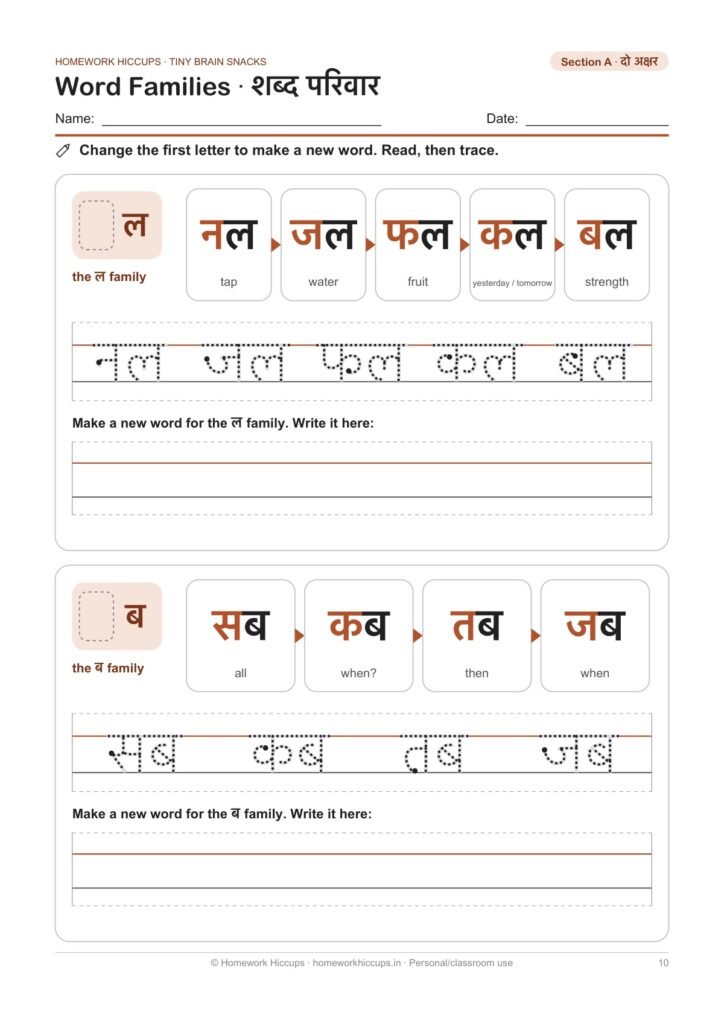
If you would like this ladder ready to print, our Hindi Two & Three Letter Words Worksheets PDF (38 A4 pages, ages 5 to 7) takes children from letters to real reading. It has a warm-up blending page, 16 two-letter picture words and 12 three-letter picture words to read and trace, blending boxes, word families, a 24-word reading grid, little phrases to read (घर चल, जल भर, कलम रख) and phrase tracing. Section C has 12 short no-matra sentences to read, read-and-circle and sentence tracing, which gives many children their first real Hindi reading. Every word has been checked to contain no matra and no joined letter, and answer keys are included.
Get the Hindi Two & Three Letter Words Pack – ₹99
When your child is ready for matras, the Hindi Matra Worksheets PDF (44 pages) continues the journey: a बारहखड़ी chart, all 10 matras with syllable tracing and picture words, revision pages and read-aloud sentences such as सूरज निकला। and मोर नाच रहा है।
See the Hindi Matra Worksheets – ₹99
Browse all Hindi worksheets. Both packs are for personal or single-classroom use and print well in black and white.
🧸 Learning toys kids love
As an Amazon Associate, Homework Hiccups earns from qualifying purchases, at no extra cost to you.
Frequently asked questions
When should a child start reading Hindi sentences?
Most children are ready for short no-matra sentences once they can blend two- and three-letter words smoothly, often in late UKG or early Class 1. Sentences with matras usually follow in Class 1 once most matras are known.
What is an unseen passage in Hindi for Class 1?
An unseen passage, or apathit gadyansh, is a short piece of four or five simple sentences that the child has not read before, followed by two or three questions. The answers are found directly in the passage.
My child reads letter by letter. How can I help?
Go back to two-letter words and practise sliding the sounds together, like ब and स becoming बस. Read the same short list daily until it is quick, then move to phrases. Speed comes from repetition, not from harder text.
Should my child read Hindi aloud or silently?
In Class 1, reading aloud is best because you can hear mistakes with matras and help straight away. Silent reading can come later, once your child reads smoothly and understands what they read.
How long should Hindi reading practice be each day?
Five minutes a day is enough for most children in UKG and Class 1. Short daily practice builds fluency faster than one long session at the weekend and keeps reading enjoyable.